conclave
Health Warn
- License — License: MIT
- Description — Repository has a description
- Active repo — Last push 0 days ago
- Low visibility — Only 5 GitHub stars
Code Pass
- Code scan — Scanned 3 files during light audit, no dangerous patterns found
Permissions Pass
- Permissions — No dangerous permissions requested
No AI report is available for this listing yet.
Stop juggling six AI CLIs. Conclave is your universal remote for LLMs - query any model with one syntax, or unleash them all in parallel and let a judge synthesize the chaos into a verdict. Why trust one robot when you can have a whole council argue about your code?
Conclave



Stop juggling six AI CLIs. Query any model with one syntax, or convene the whole council and let a judge synthesize the verdict.
Tired of memorizing whether it's --file or -f or piping to stdin? Sick of context-switching between gemini, claude, codex, and whatever CLI Grok ships this week? Conclave is your universal remote for LLMs - one command, one syntax, any provider. Six direct providers, plus any model on OpenRouter by its vendor/model slug. Learn it once, query everything.
But here's where it gets interesting: why trust a single AI's opinion when you can convene an entire council? Conclave queries multiple models in parallel, then hands their responses to a judge who synthesizes a verdict with confidence levels, agreements, disagreements, and actionable recommendations. It's like having a room full of very expensive consultants who actually have to reach consensus before billing you.
Built with Charm's Bubble Tea for a terminal UI that doesn't look like it crawled out of 1985. Animated spinners, real-time progress, token counts - because if you're going to burn API credits, you should at least enjoy watching the meter spin.
Why Conclave?
- One interface - Same syntax for Gemini, Claude, GPT, Grok, Perplexity, GLM, and any
vendor/modelon OpenRouter - Reduce bias - No single model's quirks dominate the response
- Catch blind spots - Disagreements are surfaced, not averaged away; different models notice different issues
- Faster iteration - Parallel queries, one synthesized answer, and an opt-in cache so re-runs are free
- Know what it cost - API-mode runs print the real dollar figure per response, from a daily-refreshed price catalog
- Never run a dead model - Conclave warns when a configured model id has vanished from the catalog
- Beautiful TUI - Animated progress with Charm (Bubble Tea)
Recent Updates
v1.3.0 — 2026-09-08
🚀 Claude Opus 5 and GPT-5.6 Sol by default
Defaults moved to the current flagships: claude claude-opus-5, openai gpt-5.6-sol, grok grok-4.6, glm glm-5.3, with grok-build-0.1 and glm-5.3-flash in cheap mode. Every id was verified live on both the CLI and API routes before it shipped. Override any of them with -m provider:model.
🌐 Any model via OpenRouter
In API mode, write a provider as its OpenRouter slug and it just works: conclave -g deepseek/deepseek-v4-pro,anthropic/claude-opus-5 "..." --judge openai/gpt-5.6-sol. Slugs can sit beside direct providers on one panel or act as judge. Needs OPENROUTER_API_KEY; details in docs/OPENROUTER.md.
💸 Costs you can see
API-mode runs now print the dollar figure per response and in total, from a cached OpenRouter price catalog that refreshes once a day in the background. --json gains cost_usd and meta.total_cost_usd. conclave models prints current ids and prices; conclave models --check tells you if a compiled default has been retired.
🗂 Opt-in response cache and a batch budget
--cache reuses an identical provider response instead of paying for it twice; --budget 5.00 stops a batch run once estimated spend hits the cap and leaves it resumable. Judge synthesis is never cached.
🛠 gemini, codex and the hang that wasn't
Google retired gemini-cli's free OAuth tier, so CLI-mode gemini now needs GEMINI_API_KEY and falls back to the direct API when the CLI's auth fails. codex is checked with codex login status instead of demanding an API key. And Conclave no longer opens an interactive setup prompt when stdin is not a terminal, which used to look like a 110-second hang from a script.
v1.2.0 — 2026-06-18
🚀 GPT-5.5 and GLM-5.2 support
Conclave now defaults to the latest flagship models out of the box — OpenAI GPT-5.5 and Z.ai GLM-5.2. Other defaults were refreshed too: gemini gemini-3-pro-preview (shut down) → gemini-3.1-pro-preview, claude → claude-opus-4-8, and grok's CLI default grok-code-fast-1 (retiring 2026-08-15) → grok-4-1-fast-reasoning. Override any of them with -m provider:model.
🔑 OS keyring for API keys
Keys can now live in the OS keyring (Windows Credential Manager / macOS Keychain / Linux Secret Service) instead of a plaintext env var or .env. When a provider's *_API_KEY is unset, Conclave reads it from the keyring automatically — resolution order is env → ~/.config/conclave/.env → ./.env → keyring. Manage entries with the new conclave keyring set|list|rm <ENV_VAR> command.
conclave keyring set GLM_API_KEY # hidden prompt; loads automatically thereafter
🔌 GLM drops the opencode dependency
CLI-mode glm no longer shells out to the opencode binary — it calls the Z.ai GLM Coding Plan directly over OpenAI-compatible HTTP (api.z.ai/api/coding/paas/v4), using your flat Coding Plan subscription. GLM now needs only an API key, like every other provider.
📐 Architecture Decision Records
Added docs/adr/ — eight ADRs capturing the foundational design (dual provider modes, LLM-as-judge, parallel/per-provider timeouts, the shared HTTP client, credential precedence) plus this release's decisions.
v1.1.0 — 2026-05-22
🐛 Production bug fixes
Six fixes for pain points hit running Conclave heavily against gpt-5.x reasoning models. Most importantly: conclave -g openai -m openai:gpt-5.5 now works — previously the call would silently fail or return empty responses because OpenAI rejects max_tokens for the reasoning model family and needs max_completion_tokens instead. Error visibility is dramatically improved across the board: HTTP status codes, provider error codes and params, and full diagnostic bodies are surfaced instead of truncated. When all providers fail, you now see each provider's full error in the styled output instead of just a clipped spinner line.
✨ --raw output mode
New flag emits sentinel-separated provider blocks for clean piping into downstream parsers. Implies --no-judge, mutually exclusive with --json.
conclave -g gemini,claude "classify" --raw -f items.txt | my-extractor
🎨 Styled output with Lipgloss
New header panel with metadata, adaptive colors for light/dark terminals, and a refreshed cool-tones palette. The output now actually looks like the tagline promises.
🛡 Preflight auth checks
Catches missing or invalid credentials before burning the parallel-query timeout. Bypass with --skip-preflight.
👀 --list-providers shows both modes
The CLI and API columns now print side-by-side by default. The surprising divergences (glm is CLI-only, grok uses different defaults per mode) are visible at a glance. Use -g to get the single-column format for scripts that parse this output.
v1.0.0 — 2026-01-08
🎉 Initial release
Multi-provider parallel querying across Gemini, OpenAI, Claude, Grok, Perplexity, and GLM — in CLI mode (wrapping each provider's CLI) or API mode (-g). A judge model synthesizes the responses into a single verdict, with --blind for unbiased judging. Plus cheap mode (-c), batch mode (--batch) with parallel workers and resume, and a Charm Bubble Tea TUI with live progress.
Terminal UI
Conclave features a rich terminal interface powered by Bubble Tea:
▸ Querying 3 providers...
  ├── ⠹ Google Gemini 3.1 Pro [02.34s]
  ├── ✓ OpenAI GPT-5.6 Sol [01.91s / 000168 tokens]
  └── ⠼ Anthropic Claude Opus 5 [03.12s]

▸ Crystallizing... ⠋ [02.45s]
- Animated spinners - Braille animation for active providers
- Real-time progress - Token counts and timing as providers complete
- Synthesis verbs - 25 rotating verbs during verdict synthesis
- Non-TTY fallback - Clean output for CI/CD and piped commands
- Cost on the line - In API mode each provider block and the footer carry the real spend
One CLI, Every LLM
Beyond consensus, Conclave serves as a unified interface for any LLM. Instead of learning six different CLI tools with different syntaxes, flags, and quirks - use one:
# Same syntax, any provider
conclave gemini "Explain this error" -f error.log
conclave claude "Review this PR" -f diff.txt
conclave openai "Generate test cases" -f api.go
conclave grok "What does this regex do?" -f patterns.txt
Why use Conclave for single-provider queries?
| Benefit | Without Conclave | With Conclave |
|---|---|---|
| Syntax | Learn each CLI's flags | One consistent syntax |
| Files | Different -f/--file/stdin handling |
Always -f |
| Setup | Configure each tool separately | conclave init once |
| Switching | Remember which tool for which task | Just change the provider name |
| Models | Different --model formats |
Always -m provider:model |
# Quick single-provider queries (no judge needed)
conclave gemini "What's the time complexity of this?" -f algo.py
conclave perplexity "Latest news on Rust 2.0"
conclave -g claude "Summarize this paper" -f paper.pdf

# Switch models on the fly
conclave gemini "Explain" -m gemini:gemini-3.8-flash      # Fast
conclave gemini "Explain" -m gemini:gemini-3.1-pro-preview # Thorough
When you query a single provider, Conclave skips the judge phase and returns the response directly - it's just a cleaner interface to the underlying LLM.
Installation
git clone https://github.com/0xDarkMatter/conclave
cd conclave
make install  # installs to ~/.local/bin
Requirements
Conclave operates in two modes with different requirements:
API Mode (-g) - Recommended for Most Users
Only requires API keys - no additional CLI tools needed.
conclave init                    # Set up API keys
conclave -g gemini,claude "..."  # Works immediately
CLI Mode (Default)
Uses provider-specific CLI tools optimized for coding tasks. Each provider requires its CLI installed:
| Provider | CLI Tool | Installation |
|---|---|---|
| gemini | gemini |
npm install -g @google/gemini-cli, plus GEMINI_API_KEY (Google retired the CLI's free OAuth tier; Conclave falls back to the API if the CLI's auth fails) |
| claude | claude |
npm install -g @anthropic-ai/claude-code, then claude auth login (Max subscription, no API key) |
| openai | codex |
npm install -g @openai/codex, then codex login (ChatGPT subscription, no API key) |
| grok | grok |
See xAI Grok CLI |
| perplexity | perplexity |
See Perplexity CLI |
| glm | (none — direct API) | Set GLM_API_KEY (GLM Coding Plan key from z.ai) |
Check what's available:
conclave --list-providers      # CLI mode - shows installed CLIs
conclave --list-providers -g   # API mode - shows configured API keys
Tip: Start with API mode (-g) to get running quickly. Add CLI tools later if you want their coding-specific optimizations, or to run on subscriptions instead of metered keys.
Quick Start
# First run - interactive setup for API keys
conclave init

# Query multiple providers
conclave gemini,openai,claude "Is this code secure?" -f auth.go --judge claude

# Use all available providers
conclave --all "Review this architecture" -f design.md --judge claude
Modes
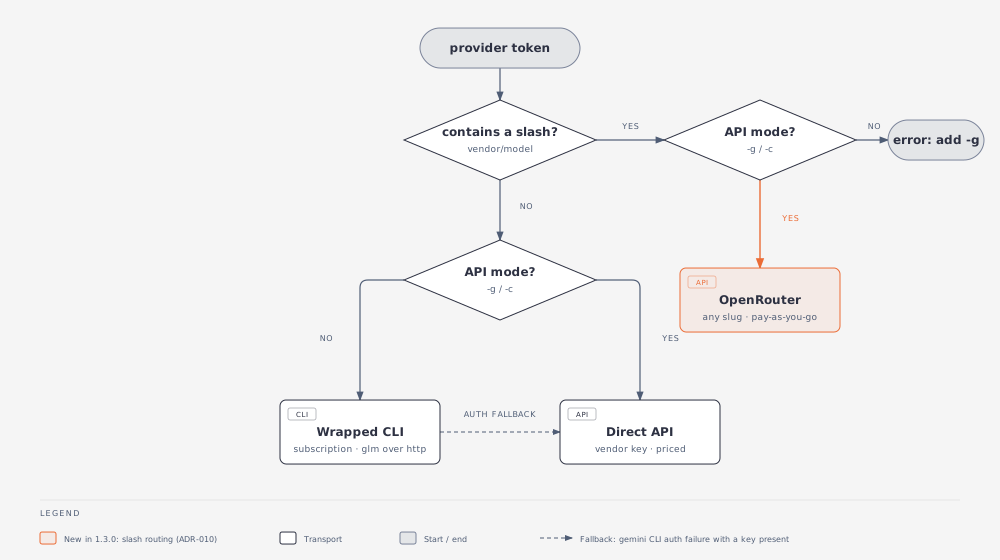
Each provider token is routed by two questions: does it carry a vendor/model slug, and is -g set?
CLI Mode (Default)
Uses coding-focused CLI tools (gemini, claude, codex, etc.). Best for code review and technical queries.
conclave gemini,claude "Explain this function" -f utils.go
General Mode (-g)
Uses raw APIs without coding restrictions. Best for general-purpose queries, research, and non-technical topics.
conclave -g gemini,openai,claude "What are the implications of quantum computing for cryptography?" --judge claude
Cheap Mode (-c)
Uses smaller, faster models for cost-effective batch processing and pipelines. Implies -g (API mode).
# ~10x cheaper per query
conclave -c gemini,claude "Classify as spam/ham" -f message.txt --json

# Batch processing with all providers
conclave -c --all "Summarize" -f doc.md --brief
Cheap mode models:
| Provider | Default Model | Cheap Model |
|---|---|---|
| gemini | gemini-3.1-pro-preview | gemini-3-flash-preview |
| openai | gpt-5.6-sol | gpt-5-nano |
| claude | claude-opus-5 | claude-haiku-4-5 |
| perplexity | sonar-pro | sonar |
| grok | grok-4.6 | grok-build-0.1 |
| glm | glm-5.3 | glm-5.3-flash |
Batch Mode (--batch)
Process thousands of items with parallel workers, rate limiting, and resume capability. Built in Go for performant concurrent execution - scales to 200 parallel workers with minimal overhead. Uses cheap mode by default.
# Process a JSONL file with a single provider
conclave -c grok "Classify this account" --batch items.jsonl -o results.jsonl

# Parallel workers for faster throughput
conclave -c gemini "Analyze" --batch items.jsonl --workers 50 -o results.jsonl

# Cap the spend; the run exits non-zero and --resume continues it
conclave --all --batch items.jsonl -o out.jsonl --budget 5.00 --resume

# Resume an interrupted job
conclave -c claude "Analyze" --batch items.jsonl -o results.jsonl --resume
Input format (JSONL):
{"id": "1", "context": "Username: @acme_corp\nBio: Enterprise solutions...\nFollowers: 50K\n\nRecent posts:\n..."}
{"id": "2", "context": "Username: @jane_dev\nBio: Software engineer, coffee lover\nFollowers: 2K\n\nRecent posts:\n..."}
Performance (99 items, 50 workers, measured December 2025 on the cheap models of the time; costs have moved since, see the caveat in docs/BATCH_BENCHMARKS.md):
| Provider | Time | Cost | Best For |
|---|---|---|---|
| Grok | 23s | $0.05 | Speed & cost efficiency |
| Gemini | 33s | $0.28 | Budget with decent quality |
| Claude | 39s | $0.65 | Accuracy, depth, nuanced analysis |
| OpenAI | 88s | $0.18 | Reliable fallback |
Note: Complex prompts slow throughput by 1.4-2.3x. Claude produces the most comprehensive analysis but at higher cost.
See docs/BATCH_MODE.md for full documentation and docs/BATCH_BENCHMARKS.md for detailed performance benchmarks.
Providers
| Provider | CLI Mode | API Mode (-g) |
Env Variable |
|---|---|---|---|
| gemini | gemini CLI |
Gemini API | GEMINI_API_KEY |
| openai | codex CLI |
OpenAI API | OPENAI_API_KEY |
| claude | claude CLI |
Anthropic API | ANTHROPIC_API_KEY |
| perplexity | perplexity CLI |
Perplexity API | PERPLEXITY_API_KEY |
| grok | grok CLI |
xAI API | XAI_API_KEY |
| glm | Coding Plan API (direct HTTP) | Zhipu API | GLM_API_KEY / ZAI_API_KEY |
vendor/model |
— | OpenRouter (any model) | OPENROUTER_API_KEY |
Default Models
| Provider | CLI Mode | API Mode |
|---|---|---|
| gemini | gemini-3.1-pro-preview | gemini-3.1-pro-preview |
| openai | gpt-5.6-sol | gpt-5.6-sol |
| claude | claude-opus-5 | claude-opus-5 |
| perplexity | sonar-pro | sonar-pro |
| grok | grok-4.6 | grok-4.6 |
Override with -m provider:model:
conclave gemini,claude "Review this" -m gemini:gemini-2.5-flash -m claude:sonnet
OpenRouter (any model)
In API mode, any provider token written as an OpenRouter slug (vendor/model) is sent
through OpenRouter. The slug is both the provider name and
the model id, so several OpenRouter models can sit on one panel or act as judge:
conclave -g deepseek/deepseek-v4-pro,anthropic/claude-opus-5 "Compare these" --judge openai/gpt-5.6-sol
conclave -g google/gemini-3.8-flash,claude "Summarise" --judge claude   # mix with direct providers
Set OPENROUTER_API_KEY (env, .env, or conclave keyring set OPENROUTER_API_KEY).conclave models prints current slugs and prices; --list-providers -g shows whether the key
is configured. --all never auto-includes OpenRouter models. A slug the catalog does not list
still runs (with a warning) as a panel member, but is refused as the judge so a typo cannot cost
you the whole panel; --skip-preflight overrides that.
- API mode only, pay-as-you-go. OpenRouter cannot use subscriptions (Claude Max, Codex,
GLM Coding Plan), and it adds a platform fee of about 5% over the vendor's list price. In CLI
mode a slash token is rejected with a hint to add-g. - Direct providers remain better for gemini, openai and claude: no fee, provider-specific
request fields, and subscription billing in CLI mode. Use OpenRouter for models conclave has
no direct provider for. Full guide (setup, finding slugs, costs, the judge rule, error decoder):
docs/OPENROUTER.md; rationale in ADR-010.
Setup
Interactive Setup
conclave init
Walks you through configuring API keys, validates each one, and saves to ~/.config/conclave/.env. Keys load automatically on subsequent runs.
Manual Setup
Set environment variables directly:
export GEMINI_API_KEY=your-key
export OPENAI_API_KEY=your-key
export ANTHROPIC_API_KEY=your-key
Or create ~/.config/conclave/.env:
GEMINI_API_KEY=your-key
OPENAI_API_KEY=your-key
ANTHROPIC_API_KEY=your-key
OS Keyring (no plaintext)
Store keys in the OS keyring (Windows Credential Manager / macOS Keychain / Linux
Secret Service) instead of a file. When the matching env var is unset, conclave
reads the key from the keyring automatically:
conclave keyring set GLM_API_KEY      # hidden prompt, or: echo "$KEY" | conclave keyring set GLM_API_KEY
conclave keyring list                 # show which provider keys are stored
conclave keyring rm  GLM_API_KEY
Resolution order is environment variable → ~/.config/conclave/.env → ./.env →
OS keyring. See ADR-008.
Check Available Providers
# CLI mode
conclave --list-providers

# API mode
conclave --list-providers -g
Model Catalog and Prices
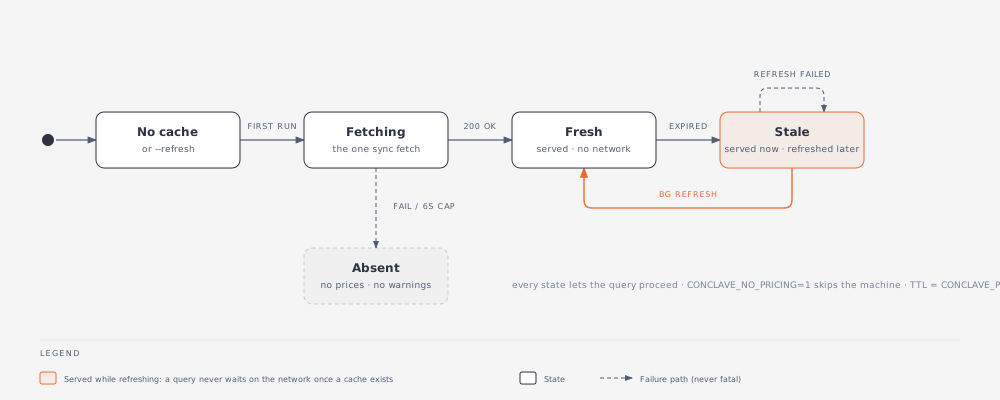
Conclave keeps a cached copy of the OpenRouter model feed
(refreshed in the background once a day) and uses it to warn you when a configured model
id has disappeared, to price batch-mode cost estimates, and to answer "what exists and
what does it cost" without leaving the terminal:
conclave models                 # every provider, newest models first
conclave models claude          # one provider
conclave models --check         # do the compiled defaults still exist? exit 2 on drift
conclave models --refresh       # fetch now instead of waiting for the daily refresh
Prices shown are pay-as-you-go API prices and apply to API mode (-g, -c, --batch).
CLI mode runs on each provider's subscription and costs nothing per token. SetCONCLAVE_NO_PRICING=1 to disable the catalog entirely, or CONCLAVE_PRICING_TTL=<hours>
to change how often it refreshes. --check exits 2 on drift and 3 when the catalog is
unreachable, so a release script can tell the two apart. See
docs/MODEL_REGISTRY.md for the annotated reference.
The catalog never blocks a query: once a cache exists it is served immediately, stale or
not, and refreshed in the background.
Usage Examples
Code Review
# Review a file
conclave gemini,claude,openai "Review for bugs and security issues" -f api.go --judge claude

# Compare implementations
conclave gemini,claude "Which approach is better?" -f impl_a.go -f impl_b.go --judge claude

# Pipe from stdin
git diff HEAD~1 | conclave gemini,claude "Review these changes" --judge claude
Research & Analysis
# General knowledge (API mode)
conclave -g --all "Explain the trolley problem and its variations" --judge claude

# Fact-checking
conclave -g gemini,perplexity,claude "Is it true that..." --judge claude
Architecture Decisions
conclave --all "Should we use microservices or monolith for this use case?" \
  -f requirements.md --judge claude --verbose
Output Formats
Human-Readable (Default)
Shows verdict, confidence, reasoning, agreements, disagreements, and recommendations in a formatted display.
JSON (--json)
conclave gemini,claude "Analyze" --judge claude --json | jq '.verdict'
Structured output for scripting and CI/CD integration.
Cost Fields (API mode only)
In API mode (-g / -c) conclave prices each response from the cached
OpenRouter catalog and shows the dollar figure on the provider block, in the
header panel, and in the Completed in footer. --json carries the same
numbers as responses.<provider>.cost_usd and meta.total_cost_usd (providers
plus judge).
Three rules govern the numbers:
- CLI mode shows nothing about dollars. Those providers ride subscriptions
(Claude Max, Codex, the GLM Coding Plan), so a per-token price would be fiction. - An unknown price is omitted, never printed as
$0.00. If the catalog is
offline, disabled withCONCLAVE_NO_PRICING=1, or simply does not list the
model, the field is absent. A displayed zero always means a real zero. - A total ending in
+is a floor. At least one response could not be
priced, so the true spend is higher than shown.
--raw and --brief are unchanged: both are fixed-shape contracts.
Response cache (--cache)
Off by default. --cache reuses an identical provider response instead of
paying for it twice, which makes iterating on a prompt, a judge choice, or an
output format free.
conclave -g gemini,openai "Review this" -f auth.go --cache        # 24h TTL
conclave -g gemini,openai "Review this" -f auth.go --cache=6h     # explicit TTL
CONCLAVE_CACHE_TTL=6 conclave -g gemini,openai "Review this"      # via env, in hours
conclave -g gemini,openai "Review this" --no-cache                # override the env
An explicit TTL must use --cache=6h, not --cache 6h.
An entry is addressed by the mode, provider, model and the full prompt
including any file or stdin context, so changing one byte of an attached file
is a miss. A hit is marked (cached) on the progress line and the provider
block, carries cached: true in --json, and costs nothing. Failures are never
cached, and judge synthesis is never cached because a verdict depends on the
whole set of responses it saw. See ADR-011.
Works in both CLI and API mode, and batch mode honours it per item.
conclave cache stats   # directory, entry count, size, age range
conclave cache clear   # delete every cached response
Entries are plain JSON under $XDG_CACHE_HOME/conclave/responses/. Leave the
cache off for anything sensitive.
Brief (--brief)
One-line summary: verdict, confidence, and key recommendation.
Quiet (-q)
Verdict only - for scripts that just need the answer.
Raw (--raw)
Sentinel-separated provider blocks only - no header art, no judge, no styling. For piping into downstream parsers.
conclave -g gemini,openai "Classify" --raw -f items.txt | my-extractor
Format:
===PROVIDER:openai MODEL:gpt-5.6-sol STATUS:success===
<response body>
===PROVIDER:claude MODEL:claude-opus-5 STATUS:error===
<error message>
===END===
Implies --no-judge.
Flags Reference
Query Flags:
  -f, --file <path>      Include file content (repeatable)
  -j, --judge <provider> LLM that synthesizes verdict (default: claude)
      --no-judge         Skip synthesis, return raw responses
  -t, --timeout <secs>   Per-provider timeout (default: 60)
  -m, --model <p:model>  Override model for provider

Mode Flags:
  -g, --general          Use API mode (no coding restrictions)
  -c, --cheap            Cheap mode: smaller/faster models, implies -g
  -a, --all              Query all available providers
      --blind            Anonymize providers for unbiased judging

Batch Mode:
      --batch <file>     JSONL input file for batch processing
      --workers <n>      Number of parallel workers (default: 5)
  -o, --output <file>    Output file (default: stdout)
      --resume           Resume from checkpoint, skip processed items
      --retries <n>      Retry failed batch items N times with exponential backoff (batch mode only)
      --no-rate-limit    Disable rate limiting (high-tier API accounts)
      --budget <usd>     Stop dispatching once estimated spend hits this cap (also CONCLAVE_BATCH_BUDGET)

Cache Flags:
      --cache[=TTL]      Reuse identical provider responses (default 24h; also CONCLAVE_CACHE_TTL=<hours>)
      --no-cache         Never read or write the response cache

Output Flags:
      --json             Structured JSON output
      --verbose          Include full provider responses
      --brief            Short verdict only
  -q, --quiet            Minimal output (verdict only)
      --raw              Sentinel-separated provider blocks only (implies --no-judge)

Subcommands:
      conclave models    Inspect the model/price catalog
      conclave keyring   Manage API keys in the OS keyring
      conclave cache     Inspect or empty the response cache

Other:
      --list-providers   List available providers and exit
      --version          Show version
Features
Parallel Execution
All providers are queried simultaneously. Total time ≈ slowest provider, not sum of all.
Automatic Retry
Transient failures (429 rate limits, 5xx errors) automatically retry with exponential backoff:
- Up to 3 retries
- 1s → 2s → 4s delays with jitter
- Respects
Retry-Afterheaders
This is built-in for all single-call queries via API mode. The --retries flag is separate and applies only to batch mode (--batch) — it retries failed items in the JSONL pipeline. 400-class errors (auth, bad params) never retry in either path since they won't fix themselves.
Blind Mode
Anonymize provider names so the judge evaluates responses without brand bias:
conclave --all "Which solution is best?" -f options.md --judge claude --blind
The judge sees "Provider A", "Provider B", etc. instead of "OpenAI", "Claude".
Context Handling
- Automatic stdin detection for piped content
- Multiple
-fflags for comparing files - Configurable context size limits
Configuration
Config File
~/.config/conclave/config.yaml:
default_judge: claude
timeout_seconds: 60

models:
  gemini: gemini-3.1-pro-preview
  openai: gpt-5.6-sol
  claude: claude-opus-5

# Override cheap mode models (optional)
cheap_models:
  gemini: gemini-3.1-flash-lite # Cheaper than the default cheap model
  claude: claude-sonnet-5       # Balance speed/quality
Environment Variables
CONCLAVE_TIMEOUT=30               # Override timeout
CONCLAVE_GEMINI_MODEL=...         # Override default model
CONCLAVE_CHEAP_CLAUDE_MODEL=...   # Override cheap mode model
CONCLAVE_EXCLUDE=glm,grok         # Exclude providers from --all
CONCLAVE_PRICING_TTL=24           # Hours between OpenRouter catalog refreshes
CONCLAVE_NO_PRICING=1             # Disable the catalog (no network, no drift warnings)
How It Works
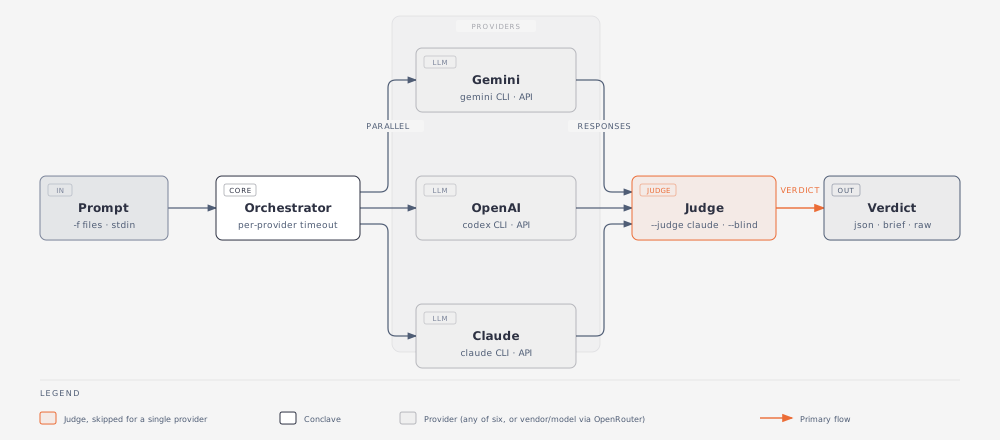
- Query Phase - Prompt sent to all providers in parallel, each under its own timeout
- Judge Phase - Designated LLM synthesizes the responses (skipped for a single provider)
- Output Phase - Formatted result with confidence and reasoning, priced in API mode
Multi-model judging
The judge does not average the panel. It sorts what the models said into what they agree
on and what they contest, turns the consensus into a reasoned verdict, and surfaces the
contested material as disagreements and blind spots rather than discarding it. --blind
hides which model said what so the sorting cannot favour a brand.
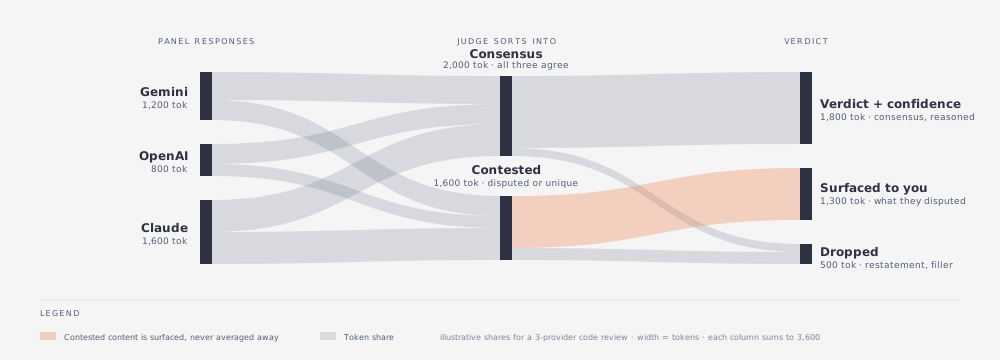
Diagram sources live in docs/diagrams/src/; python docs/diagrams/export.py regenerates the light and dark SVGs.
Use Cases
Single Provider (Unified Interface)
- Quick queries - Ask any LLM with consistent syntax
- Model comparison - Same prompt, different providers, see which you prefer
- Specialized tasks - Perplexity for search, Claude for code, Grok for X context
Multi-Provider (Consensus)
- Code Review - Multiple perspectives on security, quality, performance
- Fact-Checking - Cross-reference claims across models
- Architecture Decisions - Consensus on design trade-offs
- Research Synthesis - Combine knowledge from multiple sources
- Risk Assessment - Identify blind spots in analysis
Using Conclave from agents and scripts
--json is the contract for callers: additive fields only, status is always "success" or"error" per provider (a cache hit stays "success" and adds cached: true), andexecution.timeout_seconds reports the real -t. Pair --no-judge with your own
aggregation when you want a majority vote across runs, and --raw when you want the
bodies with no parsing at all. Nothing is ever prompted for when stdin is not a terminal.
Architecture Decisions
Key design decisions are recorded as ADRs in docs/adr/ — dual provider
modes, the LLM-as-judge synthesis, parallel/per-provider timeouts, the shared HTTP
client, credential precedence + OS-keyring fallback, the GLM Coding Plan transport, the
runtime pricing catalog, OpenRouter slash routing, and the opt-in response cache.
License
MIT
Reviews (0)
Sign in to leave a review.
Leave a reviewNo results found