MegaMemory
Health Pass
- License — License: MIT
- Description — Repository has a description
- Active repo — Last push 0 days ago
- Community trust — 137 GitHub stars
Code Fail
- process.env — Environment variable access in scripts/stress-test.js
- fs.rmSync — Destructive file system operation in src/__tests__/conflicts.test.ts
- fs.rmSync — Destructive file system operation in src/__tests__/db.test.ts
- fs.rmSync — Destructive file system operation in src/__tests__/get-concept.test.ts
Permissions Pass
- Permissions — No dangerous permissions requested
This tool is a Model Context Protocol (MCP) server that provides a persistent knowledge graph for AI coding agents. It allows agents to store, retrieve, and semantically search project concepts and architecture decisions across different work sessions using a local SQLite database.
Security Assessment
Overall risk: Low. The tool does not request explicitly dangerous permissions, execute arbitrary shell commands, or contain hardcoded secrets. The only flagged findings involve `fs.rmSync` (file deletion) which is appropriately isolated within the project's test suite (`__tests__/`), and `process.env` access located in a stress-test script. These are standard development practices and do not pose a risk in the production package. The tool does make network requests to automatically download an embedding model (~23MB) on first use, and it accesses environment variables for standard configuration.
Quality Assessment
The project appears to be actively maintained, with repository activity as recent as today. It uses the highly permissive MIT license and has an informative README with clear installation instructions. With 137 GitHub stars, it shows a healthy and growing level of community trust for a relatively new developer tool.
Verdict
Safe to use.
Persistent project knowledge graph for coding agents. MCP server with semantic search, in-process embeddings, and web explorer.
MegaMemory
Persistent project knowledge graph for coding agents.




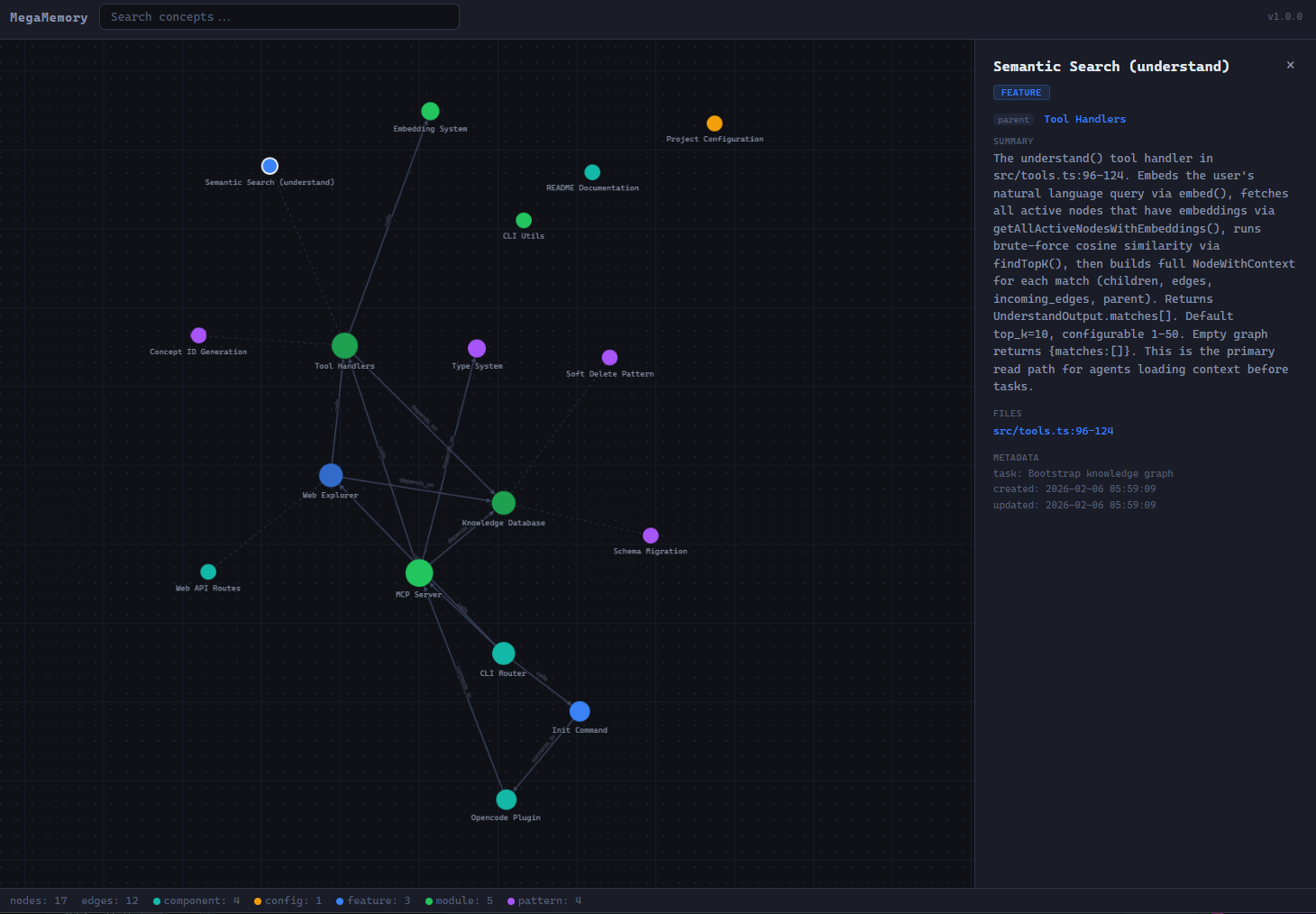
An MCP server that lets your coding agent build and query a graph of concepts, architecture, and decisions — so it remembers across sessions.
The LLM is the indexer. No AST parsing. No static analysis. Your agent reads code, writes concepts in its own words, and queries them before future tasks. The graph stores concepts — features, modules, patterns, decisions — not code symbols.
The Loop
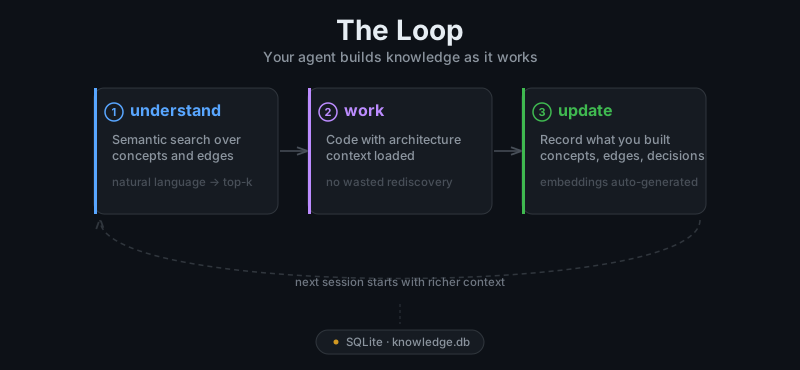
understand → work → update
- Session start — agent calls
list_rootsto orient itself - Before a task — agent calls
understandwith a natural language query (orget_conceptfor exact ID lookup) - After a task — agent calls
create_conceptorupdate_conceptto record what it built
Everything persists in a per-project SQLite database at .megamemory/knowledge.db.
Installation
npm install -g megamemory
[!NOTE]
Requires Node.js >= 18. The embedding model (~23MB) downloads automatically on first use.
Quick Start
megamemory install
Run the interactive installer and choose your editor:
With opencode
megamemory install --target opencode
One command configures:
- MCP server in
~/.config/opencode/opencode.json - Workflow instructions in
~/.config/opencode/AGENTS.md - Skill tool plugin at
~/.config/opencode/tool/megamemory.ts - Bootstrap command
/user:bootstrap-memoryfor initial graph population - Save command
/user:save-memoryto persist session knowledge
Restart opencode after running install.
With Claude Code
megamemory install --target claudecode
Configures:
- MCP server in
~/.claude.json - Workflow instructions in
~/.claude/CLAUDE.md - Commands in
~/.claude/commands/
With Antigravity
megamemory install --target antigravity
Configures:
- MCP server in
./mcp_config.json(workspace-level)
With Codex
megamemory install --target codex
Configures:
- MCP server in
~/.codex/config.toml - Workflow instructions in
~/.codex/AGENTS.md
With other MCP clients
Add megamemory as a stdio MCP server. The command is just megamemory (no arguments). It reads/writes .megamemory/knowledge.db relative to the working directory, or set MEGAMEMORY_DB_PATH to override.
{
  "megamemory": {
    "type": "local",
    "command": ["megamemory"],
    "enabled": true
  }
}
MCP Tools
| Tool | Description |
|---|---|
understand |
Semantic search over the knowledge graph. Returns matched concepts with children, edges, and parent context. |
get_concept |
Look up a concept by its exact ID. Returns full context including children, edges, incoming edges, and parent. |
create_concept |
Add a new concept with optional edges and file references. |
update_concept |
Update fields on an existing concept. Regenerates embeddings automatically. |
link |
Create a typed relationship between two concepts. |
remove_concept |
Soft-delete a concept with a reason. History preserved. |
list_roots |
List all top-level concepts with direct children. |
list_conflicts |
List unresolved merge conflicts grouped by merge group. |
resolve_conflict |
Resolve a merge conflict by providing verified, correct content based on the current codebase. |
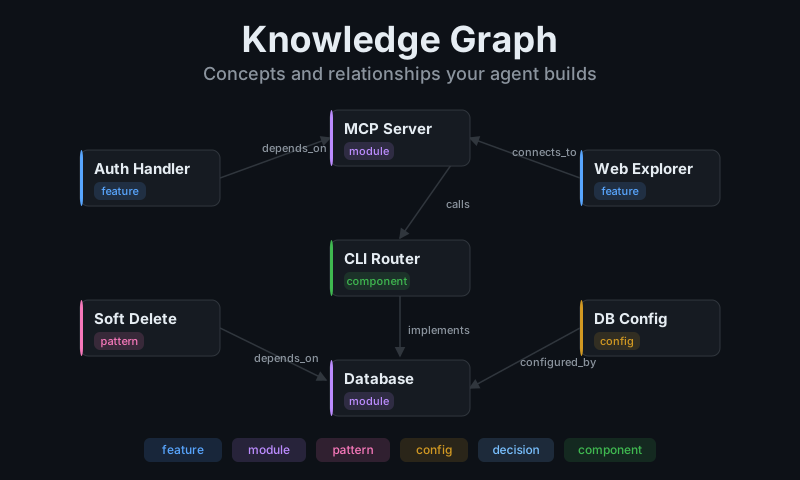
Concept kinds: feature · module · pattern · config · decision · component
Relationship types: connects_to · depends_on · implements · calls · configured_by
Knowledge Graph
Web Explorer
Visualize the knowledge graph in your browser:
megamemory serve
- Nodes are colored by kind and sized by edge count
- Dashed edges show parent-child links; solid edges show relationships
- Click any node to inspect summary, files, and edges
- Search supports highlight/dim filtering
- If port
4321is taken, you'll be prompted to pick another
megamemory serve --port 8080 # custom port
How It Works
src/
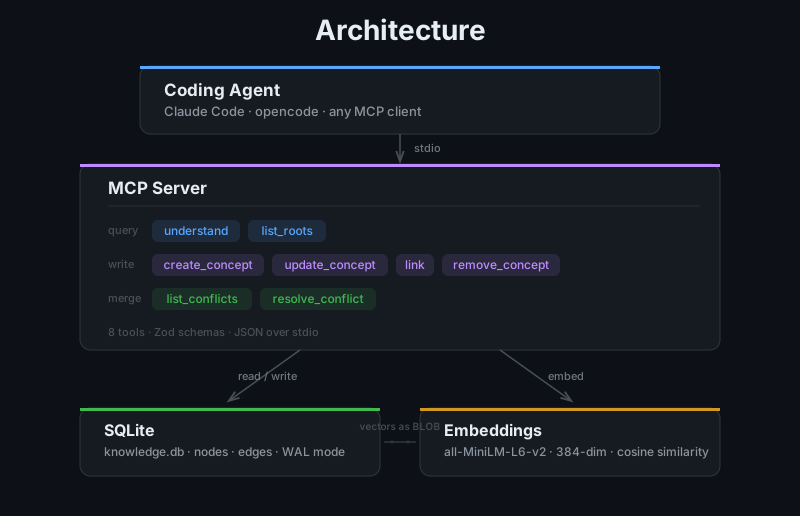
  index.ts       CLI entry + MCP server (9 tools)
  tools.ts       Tool handlers (understand, get_concept, create, update, link, remove, list_conflicts, resolve_conflict)
  db.ts          SQLite persistence (libsql, WAL mode, schema v3)
  embeddings.ts  In-process embeddings (all-MiniLM-L6-v2, 384 dims)
  merge.ts       Two-way merge engine for knowledge.db files
  merge-cli.ts   CLI handlers for merge, conflicts, resolve commands
  types.ts       TypeScript types
  cli-utils.ts   Colored output + interactive prompts
  install.ts     multi-target installer (opencode, Claude Code, Antigravity, Codex)
  web.ts         HTTP server for graph explorer
plugin/
  megamemory.ts  Opencode skill tool plugin
commands/
  bootstrap-memory.md  /user command for initial population
  save-memory.md       /user command to save session knowledge
web/
  index.html     Single-file graph visualization (d3-force + Canvas)
- Embeddings — In-process via Xenova/all-MiniLM-L6-v2 (ONNX, quantized). No API keys, and no network calls after the first model download.
- Storage — SQLite with WAL mode, soft-delete history, and schema migrations (currently v3).
- Search — Brute-force cosine similarity over node embeddings; fast enough for graphs with <10k nodes.
- Merge — Two-way merge with conflict detection by concept ID, with AI-assisted conflict resolution via MCP tools.
CLI Commands
| Command | Description |
|---|---|
megamemory |
Start the MCP stdio server |
megamemory install |
Configure editor/agent integration |
megamemory serve |
Launch the web graph explorer |
megamemory merge |
Merge two knowledge.db files |
megamemory conflicts |
List unresolved merge conflicts |
megamemory resolve |
Resolve a merge conflict |
megamemory --help |
Show help |
megamemory --version |
Show version |
Merging Knowledge Graphs
When branches diverge, each may update .megamemory/knowledge.db independently. Since SQLite files cannot be auto-merged by git, megamemory provides dedicated merge commands.
Merge two databases
megamemory merge main.db feature.db --into merged.db
Concepts are compared by ID: identical nodes are deduplicated, and conflicting nodes are kept as ::left/::right variants under one merge group UUID. Use --left-label and --right-label to replace default side labels with branch names.
megamemory merge main.db feature.db --into merged.db --left-label main --right-label feature-xyz
View conflicts
megamemory conflicts            # human-readable summary
megamemory conflicts --json     # machine-readable output
megamemory conflicts --db path  # specify database path
Resolve conflicts manually
megamemory resolve <merge-group-uuid> --keep left    # keep the left version
megamemory resolve <merge-group-uuid> --keep right   # keep the right version
megamemory resolve <merge-group-uuid> --keep both    # keep both as separate concepts
AI-assisted resolution
When an AI agent runs /merge, it calls list_conflicts, verifies both versions against current source files, then calls resolve_conflict with resolved: {summary, why?, file_refs?} plus a verification reason. It does not pick a side blindly; it resolves to what the codebase currently reflects.
License
Reviews (0)
Sign in to leave a review.
Leave a reviewNo results found