fish-audio-hermes
Health Gecti
- License — License: Apache-2.0
- Description — Repository has a description
- Active repo — Last push 0 days ago
- Community trust — 68 GitHub stars
Code Basarisiz
- rm -rf — Recursive force deletion command in acceptance/desktop/build.sh
- process.env — Environment variable access in acceptance/desktop/build.sh
- fs.rmSync — Destructive file system operation in acceptance/desktop/conv.mjs
- process.env — Environment variable access in acceptance/desktop/conv.mjs
Permissions Gecti
- Permissions — No dangerous permissions requested
Bu listing icin henuz AI raporu yok.
Your Hermes agent speaks and listens with Fish Audio: expressive voices in 80+ languages, voice design, live dictation.
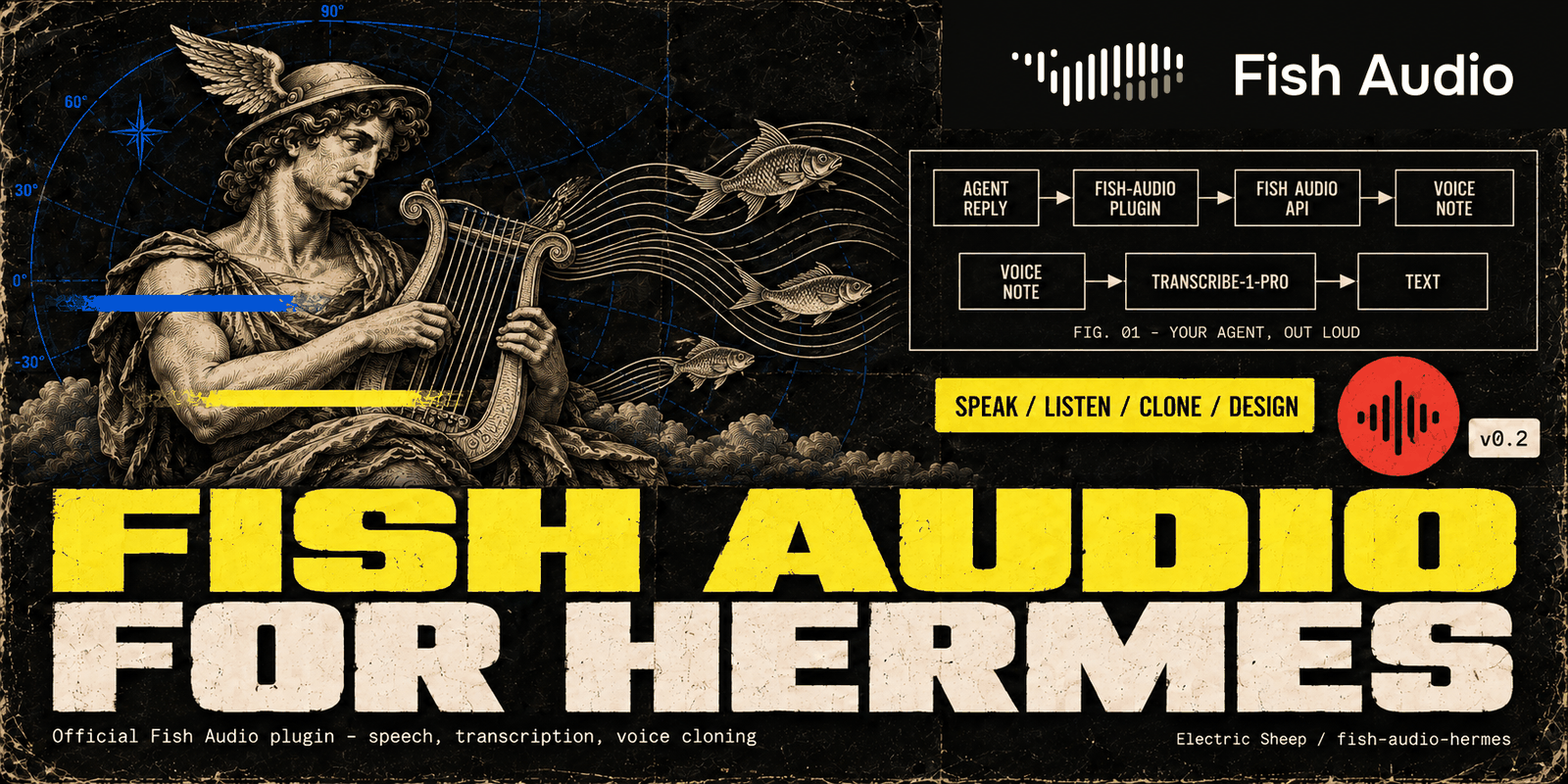
Fish Audio for Hermes
Your Hermes agent speaks and listens with Fish Audio: expressive voices in 80+ languages, voice design, live dictation.
The official Fish Audio plugin for Hermes Agent,
maintained by Electric Sheep. It works in the Hermes CLI, every messaging app Hermes supports and the Desktop app.




hermes plugins install 100yenadmin/fish-audio-hermes --enable --yes-deps
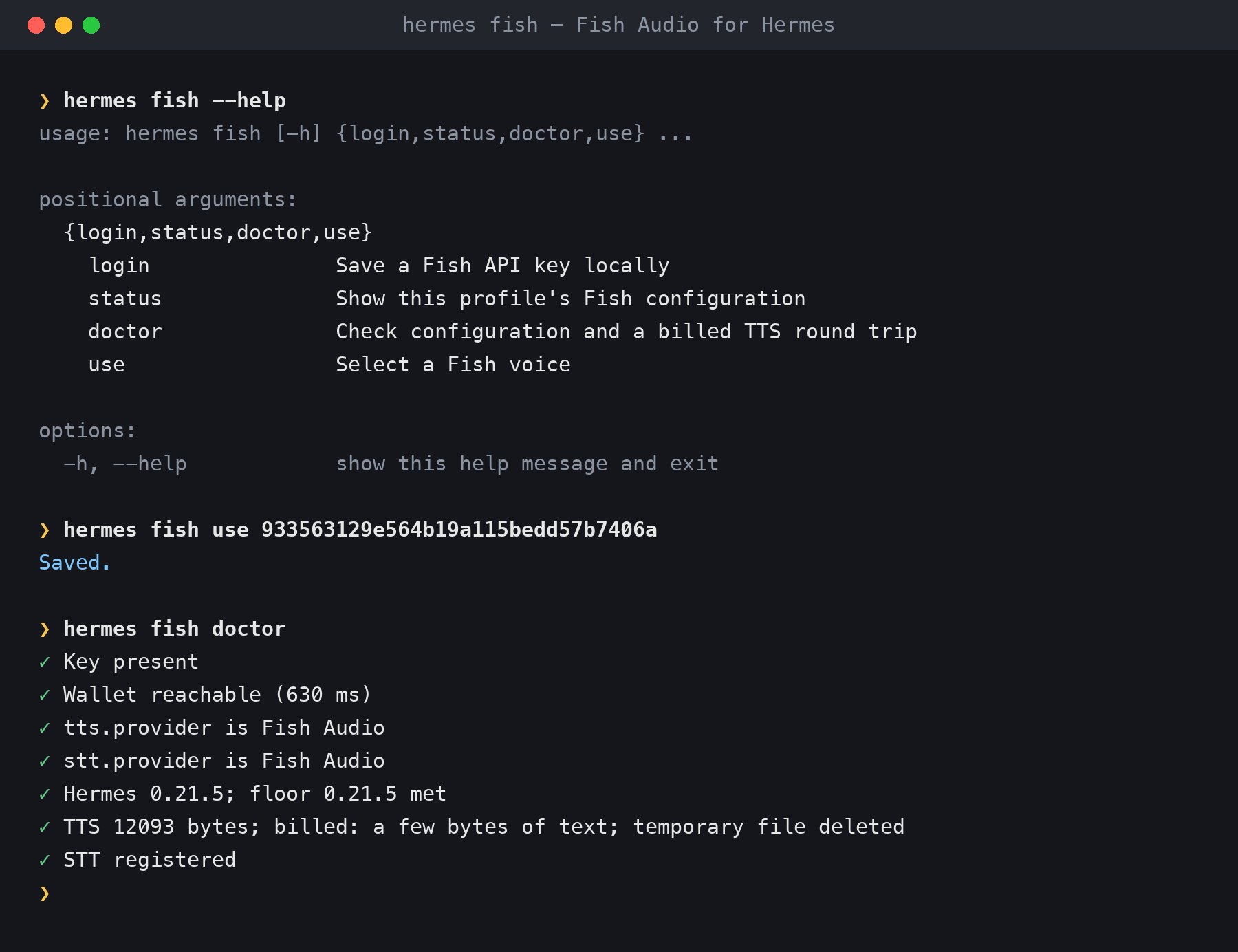
hermes fish login        # paste your key from https://fish.audio/app/api-keys
You need a Fish Audio API key (new accounts can start on Fish's free s2.1-pro-free model, free through 30 November
2026). --yes-deps installs the plugin's Python dependencies. Then run /fish setup in any chat to see what is left.
This line installs the latest release from this repository; main only ever holds a tagged, tested release.
The catalog name works too:
hermes plugins install fish-audio --enable --yes-deps
It installs the release pinned in the Hermes plugin catalog. On Hermes 0.23.0 it currently installs an older version,
because Hermes falls back to the catalog copy it shipped with
(NousResearch/hermes-agent#151856); check withhermes plugins list. If you already installed it by catalog name and hermes plugins list shows an older version,
remove it first (hermes plugins remove fish-audio), then run the first line. Installing over it is refused, andhermes plugins update stays on the catalog's pin.
Try it
- Install with the first line above, and save your key with
hermes fish login(or in Desktop: Voices ▸ Enter API key). - In any chat, send
/fish setup. It lists what is still missing and the next step, and ends with "Ready. Hear your voice:/fish preview". - Send
/fish preview, or ask your agent "Design yourself a voice that fits your personality". You hear a voice reply; previews and voice designs are billed Fish requests.
Contents: What you get · Setup · Use · Hermes Desktop ·
Configuration · Disclosure · Troubleshooting and reporting a bug ·
Known limitations · Releases ·
CHANGELOG · CONTRIBUTING · License
--yes-deps installs the plugin's Python dependencies without asking. Without it, Hermes 0.21.6 and newer asks
first, and an install with no terminal (a script, or an agent installing the plugin for you) leaves Fish Audio
installed but disabled. Hermes 0.21.5 installs them without asking and has no --yes-deps flag, so leave it out there. On either version,hermes plugins enable fish-audio afterwards also installs them.
hermes fish login checks the key against your Fish account and saves it to the active profile. It makes Fish
Audio the speech and transcription provider where none is set, and replaces another provider only if you confirm
at the prompt or pass --yes. Once Fish Audio is the provider, voice replies,
read-aloud and voice notes go through it.
What you get
| Expressive speech | Fish Audio S2 models follow emotion and delivery cues such as [excited], [whispering] and [laughing]. Drama 3 (drama-3) takes plain-language direction and word-level tags such as <whisper>…</whisper>. Multi-speaker dialogue and custom pronunciations are supported too. |
| Streaming voice | CLI voice mode and Desktop voice replies stream each sentence as it is ready. In our tests the first audio bytes arrived 0.24–0.38 s after a sentence was sent (see Streaming voice for how this was measured). |
| Voice library | Search Fish Audio's community voices from chat (/fish voices narrator) and switch with /fish use <id>. |
| Voice names | Save a voice under a short name (/fish alias add narrator <id>), then use the name wherever a voice id goes: /fish use narrator, /fish preview narrator or fish_speak. |
| Your own voices | Clone a voice from a short sample, or describe one in words and pick from the candidates. Cloning and deleting from chat go through Hermes's approval gate, so by default Hermes asks you first. |
| Speech-to-text | Voice notes use transcribe-1-pro. Live dictation uses native realtime (Preview) for word-by-word captions without sound or speaker tags in CLI voice mode, TUI and Desktop (Hermes 0.21.6+). fish_transcribe adds speaker turns, timestamps and SRT subtitles. |
| Desktop Voices page | In Hermes Desktop: browse and preview voices, pick one for the agent, clone or design your own, and check your credit. |
| Account at a glance | /fish balance shows your API credit and plan. When credits run out, tools and /fish commands reply with a top-up link; for voice replies, /fish status shows the last error. |
Setup
Run /fish setup from chat, follow its next step until Ready, then hear a short billed sample with /fish preview.
- Get a key at https://fish.audio/app/api-keys. New accounts can start on Fish's free
s2.1-pro-freemodel, free through 30 November 2026;
after that, add API credit. - Add it with
hermes fish loginon the machine running Hermes, or in Desktop: Voices ▸ Enter API key opens
the key field in Settings ▸ Plugins ▸ Fish Audio ▸ Agent settings (on older Desktop, open it with the gear on the
fish-audio row in Capabilities ▸ Plugins). Or usehermes tools▸ Text-to-Speech ▸ Fish Audio.loginchecks the key against your Fish wallet and saves it to the
active profile. It makes Fish Audio the speech and transcription provider where none is set; it replaces another
provider only if you confirm at the prompt or pass--yes.--key-stdinreads the key from standard input. - Check it with
hermes fish doctor, which makes one short billed synthesis (--no-synthskips it). A key saved in Desktop's
Agent settings field works right away; afterhermes fish loginorhermes tools, restart a running gateway or the
Desktop app to pick up the new key.
Never paste API keys into a chat. /fish refuses them and tells you to rotate the key.
Use
In conversation: just ask.
- "Read that back to me in an excited voice."
- "Find me a deep British narrator voice and use it."
- "Design a voice for our support agent and let me pick."
- "Transcribe meeting.m4a with speakers and give me subtitles."
Commands
| Command | What it does |
|---|---|
/fish setup |
Free profile checklist with the next setup step and a link to the spoken preview |
/fish status |
Key, providers, voice, model and why it was chosen, credit, last error |
/fish voices [query] |
Search the voice library |
/fish use <voice-id, name or own title> |
Use a voice for this profile; a unique title of your own voice works too |
/fish model <id> |
Pick a model (s2.1-pro, s2.1-pro-free, s2-pro, s1, drama-3) |
/fish preview [voice-id, name or own title] [text] |
Hear the current voice or a chosen voice (a billed synthesis); use a single-word title for previews |
/fish alias |
List your saved voice names |
/fish alias add <name> <voice-id> |
Save a name for a voice: 2–32 letters, digits, - or _, starting with a letter |
/fish alias remove <name> |
Delete a saved name |
/fish balance |
API credit and plan |
hermes fish login [--key-stdin] [--yes] |
Save and check a key, offer to switch providers |
hermes fish status · hermes fish use <voice-id, name or own title> |
Status and voice choice from your terminal |
hermes fish doctor [--no-synth] |
Check the setup with one billed synthesis, or without it |
Model tools (toolset fish_audio; synthesis, transcription, cloning and design are billed)
| Tool | What it does |
|---|---|
fish_speak |
Expressive or multi-speaker speech; with timestamps: true, word timings plus SRT and WebVTT subtitles |
fish_voices |
Search, list and inspect voices; clone, design, save, update and delete them |
fish_transcribe |
Rich transcription with speakers, timestamps and SRT |
fish_settings |
Check or set this profile's Fish voice, model, reading speed and saved names; set_speed accepts speed 0.5–2.0 or null to reset; get returns speed; free |
fish_account |
Balance/plan, dated model prices and offline cost estimates; free |
fish_pronunciations |
Create, publish, inspect and select reusable pronunciation dictionaries; free; deletes require approval |
Plain read-aloud uses Hermes's own text_to_speech tool, with Fish Audio as the provider. Include themedia_tag that fish_speak returns in the reply to deliver its audio; the plugin also appends missing audio tags
through its output hook. Plugin skills: fish-audio:fish-audio-setup, fish-audio:fish-audio-expressive-speech,fish-audio:fish-audio-voice-studio and fish-audio:fish-audio-report-problem (drafts a bug report and files it withgh only after you approve the draft).
To remember recurring company names, use fish_pronunciations: create with a name, then publish
with the returned dictionary_id and rules such as [{"key":"ES","value":"Electric Sheep","type":"alias"}].
Each version is the complete rule list. Publish fetches the latest version first unless you supplyexpected_latest_version_id (null for the first version); on a conflict, fetch, merge and publish again.
Use get, versions and get_version to inspect dictionaries and their rules. list and versions
accept cursor or page, page_size and include_total.
Set use with refs: [{"id":"DICTIONARY_ID","version":"VERSION_ID"}] to save up to three defaults for
this profile's ordinary voice replies and fish_speak; refs: [] clears them. Explicit version IDs stay
pinned when you publish an update. For one speech call, fish_speak accepts dictionaries with the same
references; dictionaries: [] drops the defaults. References are checked before use or per-call speech.
A fish_speak call cannot pass both dictionaries and per-call pronunciations or spoken_as: publish those
words into a version, or leave out dictionaries. Per-call words replace configured references for that call (as
before), and configured inline dictionaries still merge with per-call words.delete and delete_version use Hermes approval; the latest version cannot be deleted.
Hermes Desktop
The Voices page follows Hermes Desktop's display language: English, Simplified Chinese (zh), Traditional Chinese
(zh-hant), Japanese (ja), Arabic (ar), Russian (ru), French (fr), German (de) and Spanish (es).
Changing the display language updates the page, sidebar, status bar and command palette without a reload.
Fish Audio errors and the page's own messages are translated too, keeping the request id and Fish trace; numbers
and amounts use the language's own formats.
The translations are machine-authored and checked against Hermes Desktop's own wording; native-speaker corrections
are welcome as pull requests to devtools/src/desktop/locales/.
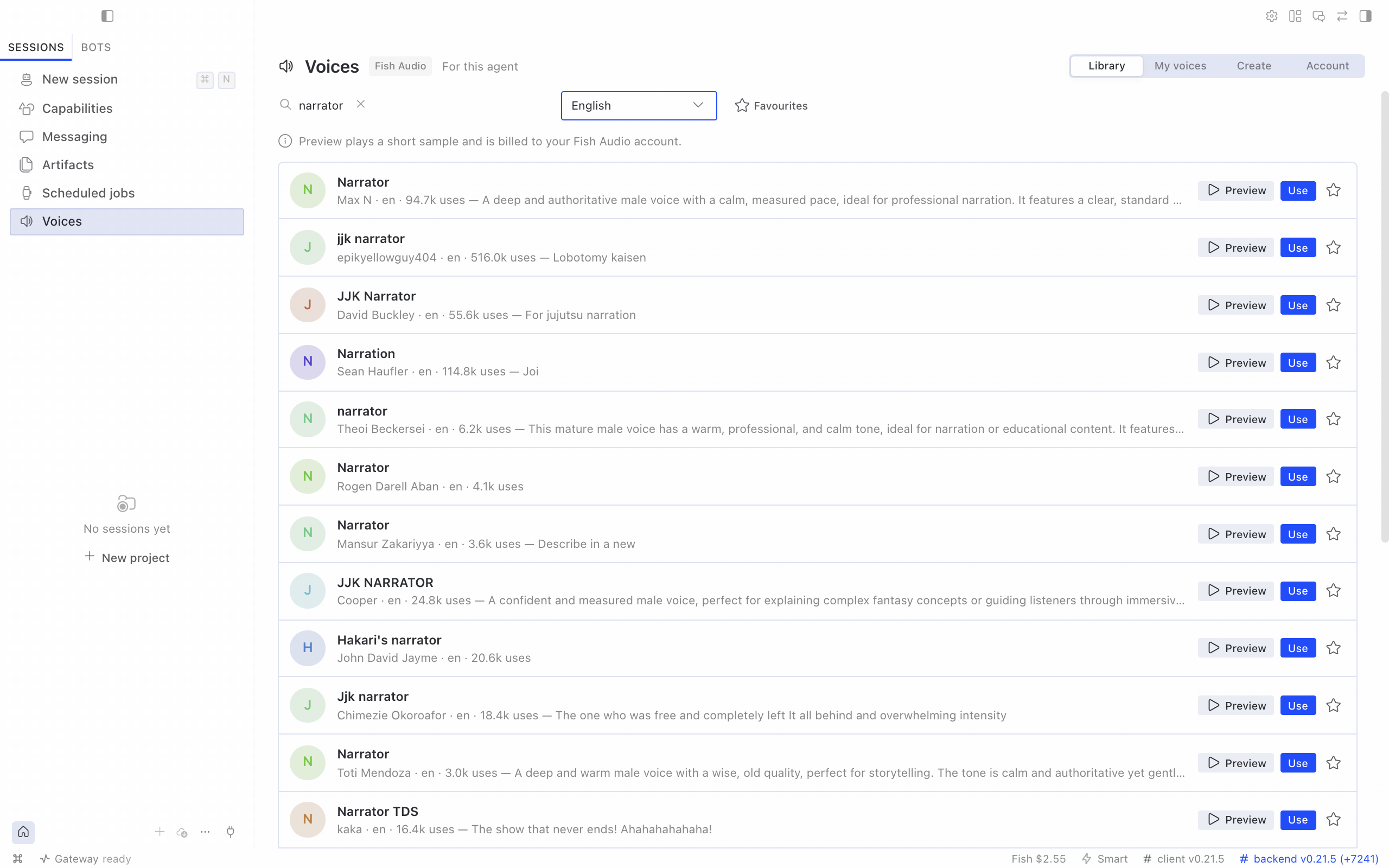
The plugin adds a Voices page to Hermes Desktop for the selected agent:
- Library: search Fish Audio's voices by name and language, preview them (a short billed sample), star
favourites, and choose Use to make a voice the agent's voice. - My voices: the voices you cloned or designed; delete one by typing its name.
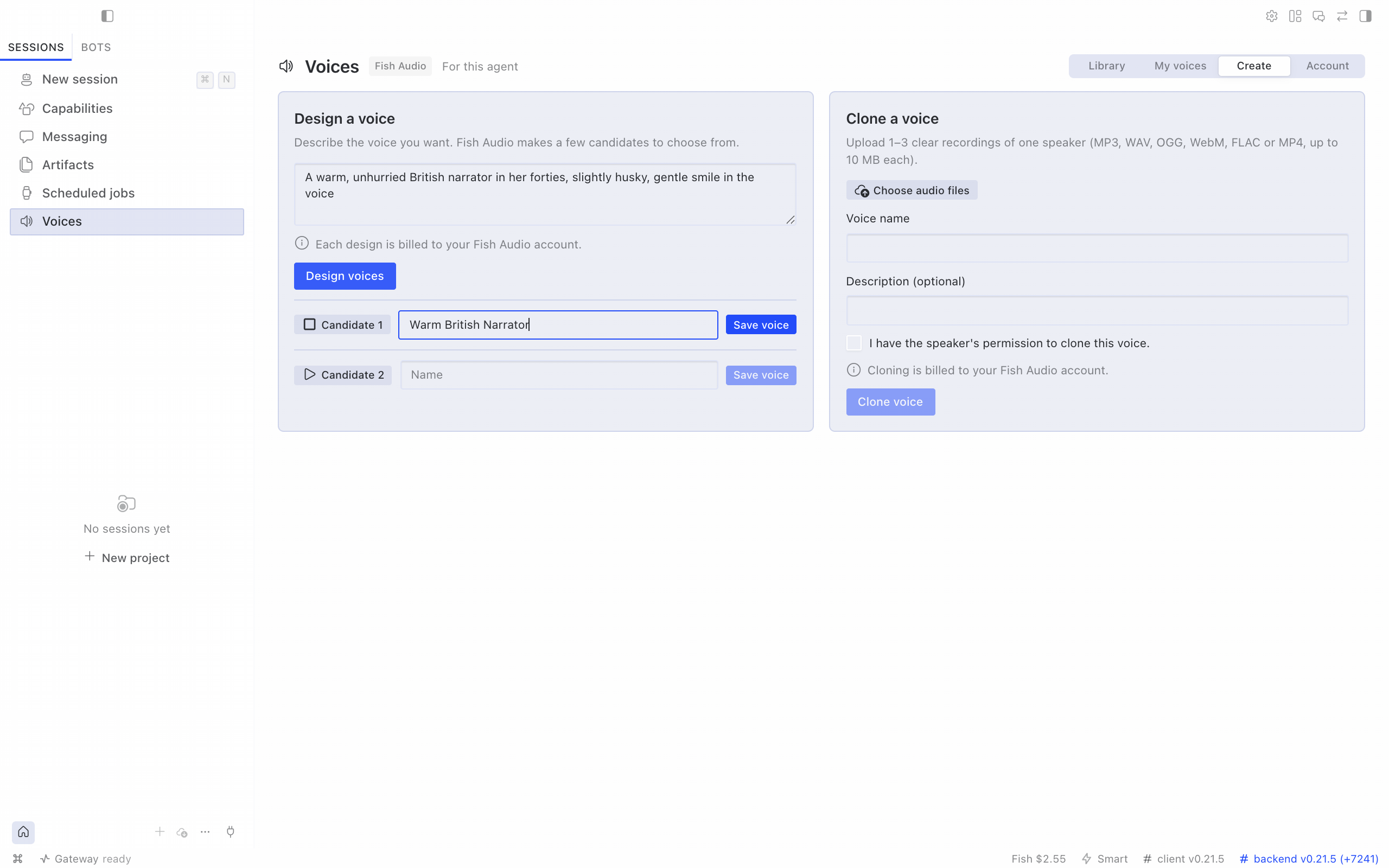
- Create: clone a voice from 1–3 recordings (up to 10 MB each, with the speaker's permission), or describe a
voice and save the candidate you like. - Account: API credit, plan credits and top-up links. The status bar shows your API credit, in orange when it
runs low.
| Create | Account |
|---|---|
 |
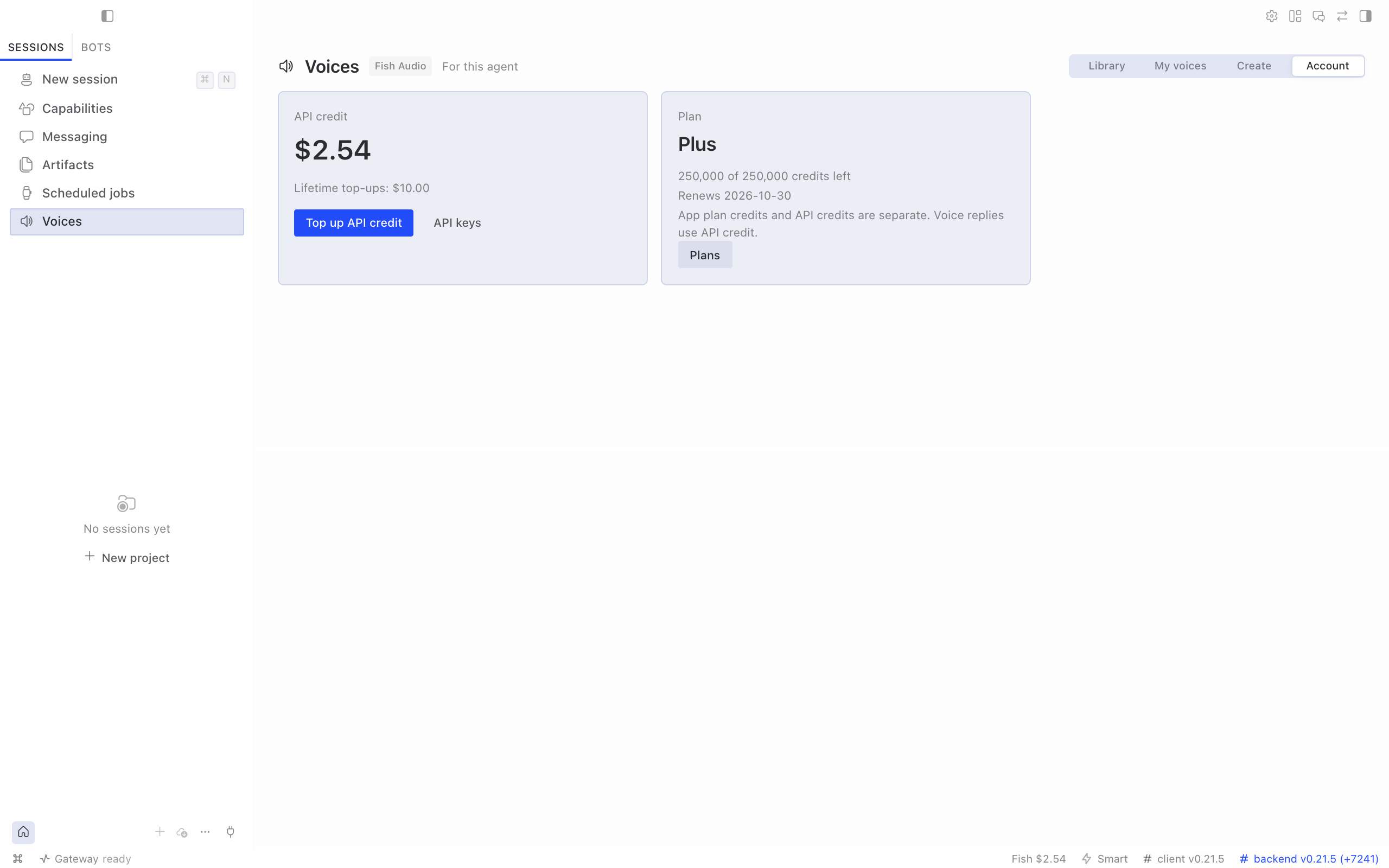 |
The page has two halves in one package: routes that run on the agent's gateway and screens that run in
Hermes Desktop. On the same computer, where Desktop and the agent share a Hermes home (the usual local install),
Desktop picks up the desktop half by itself after the CLI install. Open Capabilities → Plugins → Fish Audio,
switch on Desktop, and restart the gateway once.
For Desktop connected to an agent on another machine, install from Desktop:
- Open Capabilities → Plugins → Install from Git, enter
https://github.com/100yenadmin/fish-audio-hermes,
choose Review repository, then Install. Desktop installs the agent half into the connected agent and
the desktop half on this computer. - On Desktop 0.21.7 and newer, Install with Enable after install also switches on the desktop half. On
older Desktop, open Fish Audio in Capabilities → Plugins and switch on Desktop. - Restart the agent's gateway once. Hermes mounts plugin routes only at startup.
The Voices row appears only
for agents whose gateway has the plugin; an agent without a Fish Audio key shows a card that links to the key page
and the plugin's settings.
Settings page (Hermes Desktop 0.21.6 and newer)
Settings ▸ Plugins ▸ Fish Audio shows the selected agent's voice, speech model, reading speed and saved voice names, and lets you
change them. Reading speed ranges from 0.5× to 2.0× in steps of 0.05; choose Save speed to apply it to voice replies,
read-aloud and streaming. Reset removes tts.fish-audio.speed, returning to 1.0×. Operator-managed settings stay locked.
Change opens the Voices page to pick a voice. The plugin's own options (API key, server address,
streaming and transport) sit under the same entry as Agent settings.
The page acts on the agent selected in Desktop. Its header names that agent, or says "this agent" for the default
profile. Desktop's own Settings ▸ Voice doesn't list plugin speech providers or their voices yet
(NousResearch/hermes-agent#136485), so pick Fish voices here or on the Voices page. Desktop 0.21.5 has no plugin
settings pages; use the Voices page and /fish there.
Configuration
All settings are per profile.
| Setting | Where | What it does |
|---|---|---|
| Voice | tts.fish-audio.voice; /fish use, the Voices page, the settings page, fish_settings |
A Fish voice id. /fish use, the pages and fish_settings also take a saved name or one of your own voice titles and save its id. Unset: Fish's default voice. |
| Model | tts.fish-audio.model; /fish model, the settings page |
s2.1-pro, s2-pro, drama-3, s1 (deprecated) or s2.1-pro-free. Unset: chosen from your wallet (see "Which model?"). |
| Reading speed | tts.fish-audio.speed; the settings page, fish_settings set_speed |
0.5–2.0, default 1.0. A per-call speed wins. |
| Pronunciation dictionaries | tts.fish-audio.pronunciation_dictionary; fish_pronunciations use |
Up to three pinned dictionaries for ordinary voice replies. |
| Streaming | plugins.entries.fish-audio.settings.streaming |
auto streams sentence by sentence on Hermes 0.21.6+; "off" uses whole-file speech. |
| Live dictation | stt.streaming: true; live_transcription |
realtime (Preview, word by word) or compat (phrase captions). |
| Free-model policy | allow_free_model |
false never uses s2.1-pro-free, even when named. |
| API endpoint | base_url |
Fish's API by default; any https URL, or http on loopback, for a self-hosted endpoint. |
| Operator mode | operator_account |
The operator manages the key and billing; the agent hides amounts and account links. |
Set tts.fish-audio.language: es-MX (or pass language to fish_speak) for number, date and unit spelling and word timestamps; it never changes the voice, accent or audio quality.
tts:
  provider: fish-audio
  fish-audio:
    voice: 933563129e564b19a115bedd57b7406a   # any Fish voice id (this one: "Sarah", a conversational narrator)
    model: s2.1-pro                           # optional; see "Which model?"
    latency: balanced                         # normal | balanced | low
    temperature: 0.7
stt:
  provider: fish-audio
  streaming: true              # live dictation on Hermes 0.21.6+
  fish-audio:
    model: transcribe-1-pro
plugins:
  entries:
    fish-audio:
      settings:
        streaming: auto        # auto | "off"
        live_transcription: realtime # realtime (Preview) | compat
        allow_free_model: true # false = never use s2.1-pro-free
The plugins.entries.fish-audio.settings keys (base_url, streaming, transport, allow_free_model,live_transcription, operator_account) and the API key also appear in Desktop ▸ Settings ▸ Plugins ▸ Fish Audio ▸ Agent settings (on
older Desktop, the gear on the fish-audio row in Capabilities ▸ Plugins). Set the voice and model from the Fish Audio settings page, the Voices page, /fish use or/fish model. Saved voice names live in tts.fish-audio.aliases (name → voice id). On a managed agent, when the
operator sets the voice, model or names, the plugin says so instead of saving.
Which model? A valid tts.fish-audio.model is used as set (for fish_speak, a model named in the call comes
first); invalid ids are ignored. Otherwise the plugin uses s2.1-pro, and picks s2.1-pro-free only when Fish
reports a wallet with no API credit and no past top-ups that doesn't carry Fish's free-credit flag. If the wallet can't be read, it usess2.1-pro. Before 1 November 2026, its free-model notice says the model is free until 30 November 2026 and that
Fish Audio may use free-tier requests to improve its models; during November it adds a reminder to add API credit to keep speaking.
After 30 November it describes the announced end and suggests adding credit if speech fails, without changing the model sent.allow_free_model: false replaces s2.1-pro-free
with s2.1-pro everywhere, even when you name the free model yourself.
Streaming voice. With tts.provider: fish-audio on Hermes 0.21.6 or later, which has the plugin streaming hook,
the plugin streams 24 kHz PCM from POST /v1/tts to CLI and TUI voice playback, Desktop read-aloud and gateway
streaming. Hermes 0.21.5 uses whole-file synthesis instead: sentence by sentence in CLI voice mode, and the whole reply
in Desktop read-aloud and gateway voice. That includes the Desktop app and Termux builds still on 0.21.5. They stream
once they update; the plugin needs no change.
Each streamed sentence is one billed request. A sentence Fish turns away before sending any audio (busy, or a temporary 500/503) is retried, up to three attempts in all; once audio has started it is never retried, so nothing is spoken or billed twice. Measured first audio bytes: Fish HTTP API p50 243 ms (3 samples, 238–356
ms), CLI voice mode 373–381 ms, Desktop speak-stream handler 310 ms (in-process, not through the Electron UI);
these exclude the model's own reply time. Set streaming: "off" for whole-file speech; transport: ws switches to Fish's live
WebSocket for diagnosis.
Under host plugin isolation (plugins.isolation: host, newer Hermes builds), the hermes fish terminal command is
unavailable and voice replies use whole-file speech instead of streaming; /fish, the tools, the hooks and
both providers still work. Config changes apply to the active profile; managed installs may refuse writes.
Live dictation
On Hermes 0.21.6 or newer, set stt.provider: fish-audio and stt.streaming: true. Live dictation works in CLI
voice mode, the TUI and Desktop dictation (the composer mic). Native realtime STT (transcribe-stream-1, Preview)
is the default, with word-by-word draft captions. Sound tags and speaker tags are removed; the final text joins
all committed turns. Any doubt about completeness makes Hermes transcribe the recording as a file instead,
including a degraded turn, an early close or no final answer within 15 seconds of stopping.
The session opens with the first audio and closes once Fish confirms the last words, usually about a second after
you stop; if Fish never confirms, the plugin stops waiting after 15 seconds (a recording Hermes cancels or discards
closes 30 seconds after its last audio, because Hermes gives the plugin no cancel signal). Fish bills $0.36 per hour
of open session, per second, including silence and that final wait (about $0.001 for a 10-second dictation plus its
final second). Microphone PCM streams towss://api.fish.audio/v1/asr/realtime. Set plugins.entries.fish-audio.settings.live_transcription: compat to use
the old ElevenLabs-compatible endpoint with phrase captions and billing per committed phrase.
Remote self-hosted endpoints and plugin-host isolation keep file transcription; a loopback base_url receives
live audio. Language and prompt hints are ignored on both endpoints.
transcribe-1 is deprecated and retires on 2026-12-31; from then requests use transcribe-1-pro at the same price.
Choose transcribe-1-pro. The plugin never rewrites your configured model.
Operator-managed keys
Set plugins.entries.fish-audio.settings.operator_account: true (Desktop: Operator-managed account) when the
Fish account belongs to the agent operator. This hides balance, plan, billing and API-key links in chat and Desktop, and directs
setup or credit problems to the operator. Because one operator account can serve many agents, the account's own
voices aren't listed, edited or deleted from an agent (no My voices tab; fish_voices refuses mine, update anddelete); cloning and designing still work, and a voice created on the Voices page goes into that agent's Favourites. It defaults to false. Tool descriptions update after a gateway restart.
Operators should also pin tts.fish-audio.model or set allow_free_model: false, so the model never depends on
the wallet that users can't see.
Privacy and security
- No telemetry. The plugin talks only to Fish Audio's API (
api.fish.audio, or thebase_urlyou configure),
and only for the work you ask for. See SECURITY.md for exactly what each request carries. Links to
Fish Audio are plain links, with no tracking parameters. - Keys come from the active profile's secret scope. When one Hermes process serves several profiles, each
profile uses its own key; a single-profile install may also readFISH_API_KEYfrom the environment. Keys are
never logged or put in error messages. - Voice fields: search accepts
author_id,title_languageandlicensed, and returns booleanhas_more.
Design acceptsnum_step(1–128),guidance_scaleandinstruct_guidance_scale(finite, ≥ 0). Clone/update
accept private/unlistvisibilityandcover_image_path(PNG/JPEG/WebP, ≤ 5 MiB); clone also accepts booleangenerate_sample. Transcription returnslanguagewhen Fish supplies a string. - Files the model tools upload (
fish_voicesclone samples,fish_transcriberecordings) must be regular audio
files (covers must be images). They refuse symlinks, Hermes config and secret files, and SSH or cloud credential paths. - Approvals: cloning and deleting voices, and deleting pronunciation dictionaries or historical versions,
from chat or the model tools go through Hermes's approval gate and
follow your Hermes approval settings. By default Hermes asks you, and refuses when no one is there to answer. The
Desktop Voices page confirms them on the page instead (see Disclosure). - Report vulnerabilities privately; see SECURITY.md.
Disclosure
- Synthesis, transcription, cloning and voice design are paid Fish Audio requests billed to your Fish account (except
s2.1-pro-freewhile Fish offers it free, announced through 30 November 2026). fish_account balancereads the wallet and plan like/fish balance;modelsandestimatework offline.fish_settingsandfish_accounthave no Fish charge. Before a long or Drama 3 job, ask forfish_account estimate.fish_pronunciationsmanagement calls are free. They send dictionary names, descriptions, rules and IDs to Fish.usesaves verified version references in this profile'stts.fish-audio.pronunciation_dictionary; speech sends those references.
Dictionary operations are available in operator mode too, subject to the same config-write and delete approval gates.- Fish Audio may use free-model requests to improve its models.
- With live dictation on (
stt.streaming: true), microphone audio streams toapi.fish.audiowhile you speak,
through native realtime (Preview), billed $0.36 per hour of open session, per second;live_transcription: compat
uses the old endpoint billed per committed phrase. Sessions open with the first audio and close once Fish confirms the last words (usually about a second after
you stop; the plugin stops waiting after 15 seconds), or 30 seconds after the last audio of a cancelled recording.
If a live session fails or returns no text, Hermes transcribes the recording as a file instead, a separate billed
request. - The plugin sends your key and the text, audio, file names, voice details and cover images you ask it to process to
api.fish.audio(or thebase_urlyou configure), reads your wallet for balance and model choice, stores your key
in Hermes's.env, and collects no telemetry. SECURITY.md lists what each request carries. - It writes the profile's Fish voice, model and saved voice names (up to 50) to
config.yamlwhen you usefish_settings,/fish use,hermes fish use,/fish model,/fish alias, the settings page or the Voices page; choosing a voice
also makes Fish the speech provider when none is set.hermes fish loginchecks a key against your Fish wallet
before saving it, and sets the speech and transcription providers only when they are unset or you confirm. - Report-a-problem skill: when you say Fish Audio is broken or ask to report a problem, the agent runs
hermes fish doctor --no-synth,/fish status,hermes --versionandhermes plugins list --json, and reads
recent Hermes log lines that mention Fish (hermes logs --since 1h -n 2000 | grep -i fish). It searches this
plugin's GitHub issues for two or three key words (with yourghlogin, or a web tool without one), keeps the
search words and the draft in small local files, and files a public issue or comment only after you approve the
exact text. A billed reproduction runs only with your OK. Reports leave out keys, credit amounts and voice ids not
confirmed as public library voices; security problems go to the repository's private advisory form instead. - Voice-studio skill: when you ask for a voice that fits the agent, the agent reads its SOUL.md or persona and
sends Fish a one- or two-sentence voice description (never the whole persona) and a short sample text, as a billed
design of three candidates. - The Desktop Voices page adds gateway routes under /api/plugins/fish-audio/, behind the Hermes dashboard's
existing authentication. On that page, previews, clones and voice designs are billed; cloning a voice or saving a
designed one creates a voice in your Fish account; cloning and deleting are confirmed on the page (a
speaker-consent box, a typed voice name) instead of through Hermes's approval gate; and Use sets the
profile's Fish voice, and its speech provider when none is set. Preview and design audio files are deleted
from the gateway once returned; a design's audio is held in gateway memory so you can save it, until it is
saved, a later design or save finds it over an hour old, or the gateway stops; clone uploads are deleted
after the clone, or by the next upload once idle for 15 minutes. With a key set, Desktop reads your Fish
wallet when an agent is selected and about every five minutes, for the status-bar credit; favourites stay in
Desktop's plugin storage on that computer, and fetched previews stay in the window's memory until it closes.
Compatibility
Hermes Agent 0.21.5 or newer, Python 3.11+, macOS and Linux. Streaming voice and live dictation need 0.21.6 or newer. CI tests the
plugin against Hermes 0.21.5 (the floor), 0.21.6 (the catalog floor), the latest Hermes release, Hermes main and the
Electric Sheep fork. Windows is untested. CI also runs Python 3.14.
Performance
Measured on 2026-10-11 from Tokyo with plugin v1.3.2, N=3, p50: HTTP streaming time to first audio was
0.293 s on s2.1-pro, 0.266 s on s2-pro and 0.244 s on s1. Whole-file MP3 synthesis of 310 characters took
3.605 s on s2.1-pro and 2.209 s on s2-pro. On a clean synthetic speech corpus, transcribe-1-pro had English
word error rate (WER) 1.8% and Japanese/Chinese character error rate (CER) 0. These numbers depend on region and load.
Fish Audio's MCP server and this plugin
This plugin is Hermes's speech provider and uses a developer API key, billed to Fish API credit.
Fish's remote HTTP MCP server uses browser sign-in (OAuth, no API key) and is billed to your Fish plan's package credits.
Which to use:
- Speech replies, voice notes, dictation, the Desktop Voices page and the
fish_speak,fish_voicesandfish_transcribe,fish_settings,fish_accountandfish_pronunciationstools: this plugin. An MCP server cannot be Hermes's speech provider. - Story Studio audiobooks and podcasts, images and video: Fish's MCP server.
In Hermes 0.21.7 or newer, add the MCP server with:
hermes mcp add fish-audio --url https://api.fish.audio/mcp --auth oauth --connect-timeout 180
Hermes opens Fish's sign-in page: choose the team whose credits to use, then allow access. Fish may email a 6-digit
code first, and Hermes waits only 30 seconds for the sign-in unless you pass --connect-timeout.hermes mcp login fish-audio signs in again later.
Ask for each piece of speech through one tool only.
Fish's official plugin connects Claude Code, claude.ai, Codex and ChatGPT to its MCP server.
Fish Audio voice agents (phone agents) are not in this plugin.
Troubleshooting and reporting a bug
| Message | Fix |
|---|---|
| "Fish Audio isn't set up for this profile" | hermes fish login |
| "Top up Fish Audio API credits" | Top up at https://fish.audio/app/developers/billing. Plan credits and API credits are separate. |
| "Fish Audio concurrency limit reached" | Fish allows 5 concurrent requests below $100 of lifetime top-ups, 15 from $100, and 50 from $1,000. |
| "The voice id was not found" | The id is wrong or the voice is private to another account. Try /fish voices. |
| Voice replies stay silent | Run /fish status; it shows the last Fish error, with its Fish trace id when Fish sent one. |
| Fish tools missing after turning the plugin off and on (Hermes 0.21.6 and older) | Add them back with hermes tools. Hermes 0.21.7 and newer restore them. |
| Anything else | Run hermes fish doctor --no-synth; when speech itself fails, plain hermes fish doctor adds one short billed synthesis. Quote the Fish trace id from the error when you contact Fish Audio support. |
Run hermes fish doctor --no-synth to check setup without billed synthesis; it can read Fish account metadata.
Use /fish status for key presence, providers, voice, model, credit and the last failure; operator-managed accounts hide credit.
Under plugin-host isolation the terminal command is unavailable, so use /fish status.
Plain hermes fish doctor makes a billed synthesis; only run it with the user's OK.
Ask your Hermes agent to "report a problem with Fish Audio": it drafts a report and files nothing until you approve the draft.
On Hermes older than 0.21.6, plugin skills are not in the agent's system prompt; ask the agent to load the skillfish-audio:fish-audio-report-problem by that name (it appears in skills_list).
Use the bug report form, with versions and short, redacted logs.
Report security problems through the private advisory form.
Releases and notes: Releases · CHANGELOG. To contribute, see CONTRIBUTING.
Known limitations
In Hermes Desktop voice conversations, part or all of a reply sometimes goes unspoken because Desktop stops passing it
to speech mid-turn. This affects every speech provider; fixes are proposed
(NousResearch/hermes-agent#129305).
An empty API key field in Desktop Settings is hard to see, worst in the dark theme; a fix is proposed
(NousResearch/hermes-agent#138994).
Native live dictation is Preview, with word-by-word drafts; live_transcription: compat keeps phrase captions. It covers the composer mic,
CLI voice mode and TUI; Desktop voice conversations and messaging voice notes keep file transcription. Remote
self-hosted endpoints, Hermes 0.21.5 and plugin-host isolation also keep file transcription.
The auto-append fallback is per session. Mid-turn context compression can drop that fallback;
the model normally includes the returned media_tag itself.
Core gives plugins a .mp3 path for plain text_to_speech and re-encodes it to Opus for voice bubbles
(upstream #133133). Core's text normaliser
also alters <|speaker:N|> markup and Drama 3 closing tags such as </whisper> on that path: use fish_speak for
multi-speaker speech and Drama 3 word tags
(upstream #133131).
License
Apache-2.0. Maintained by Electric Sheep with the Fish Audio team.
Fish Audio is a trademark of Hanabi AI Inc.
Development
Weekly regression alarm: see bench/README.md.
Run JavaScript tooling from devtools/: cd devtools && npm ci && npm run typecheck && npm test.npm run check:bundle checks the committed desktop/plugin.js; npm run build rebuilds it.
Yorumlar (0)
Yorum birakmak icin giris yap.
Yorum birakSonuc bulunamadi