maskura
Health Uyari
- License — License: Apache-2.0
- Description — Repository has a description
- Active repo — Last push 0 days ago
- Low visibility — Only 6 GitHub stars
Code Gecti
- Code scan — Scanned 12 files during light audit, no dangerous patterns found
Permissions Gecti
- Permissions — No dangerous permissions requested
Bu listing icin henuz AI raporu yok.
Maskura is an open-source object data privacy gateway for AI agents.

Maskura



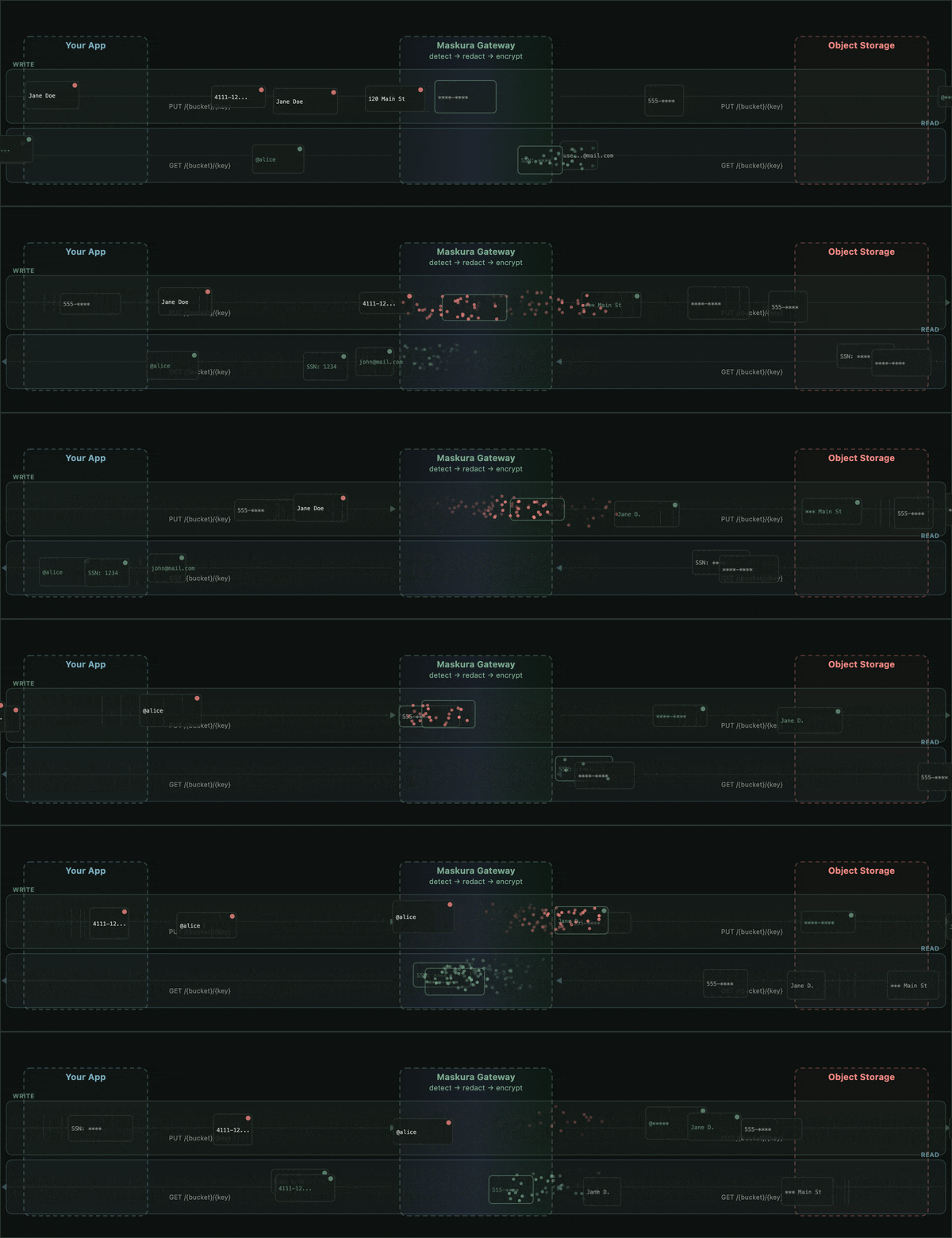
Maskura is a privacy boundary between agents and object data. It sits in front of your
existing S3-compatible storage and redacts or encrypts sensitive data on the way through,
so agents get the view you allow and the raw object never leaves your bucket.
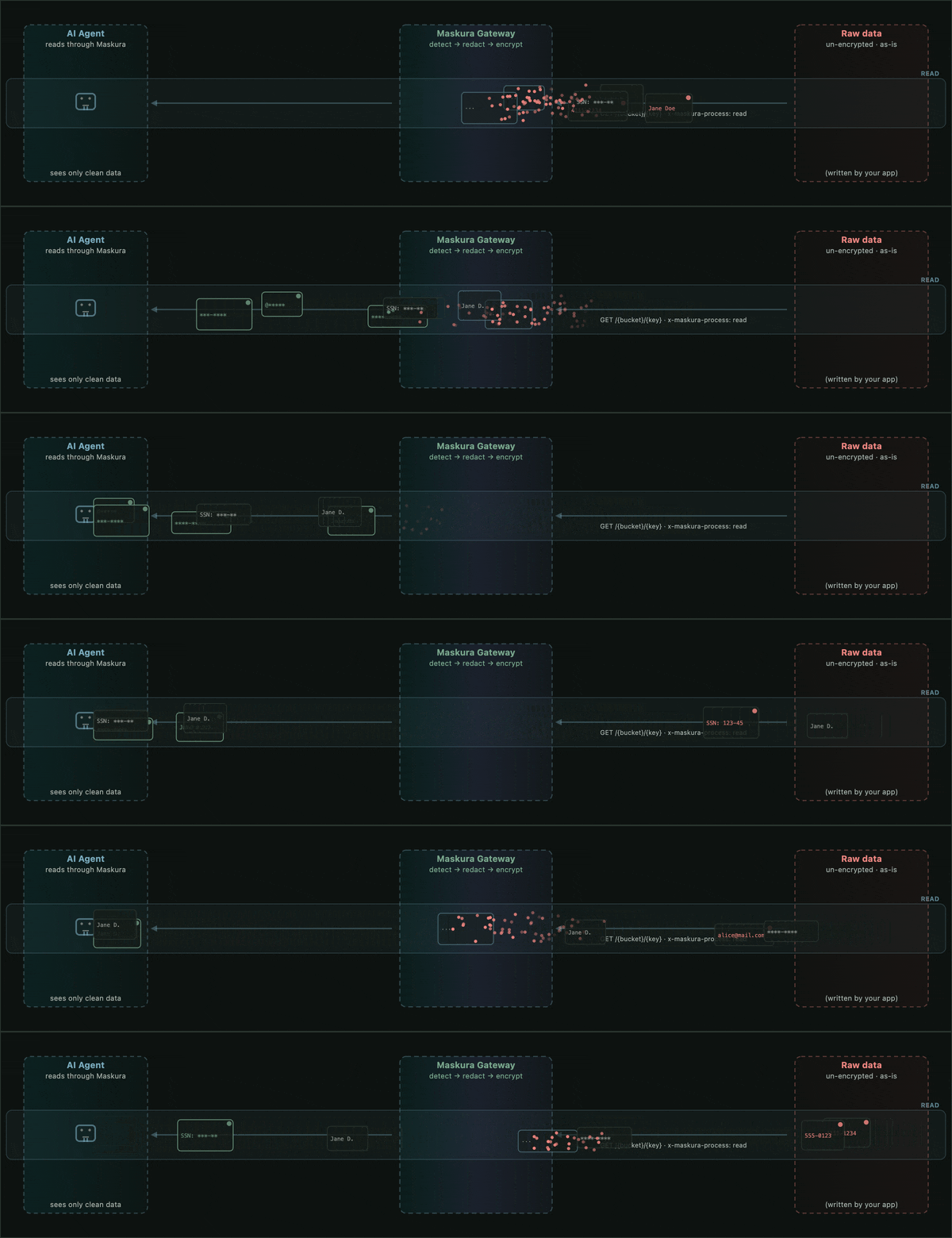
Read path — agents see the view you allow; the raw object stays in storage.
Write path — protection is applied before the object reaches storage.
- Pluggable pipeline — plugins run in order; each can emit, drop, or reject. A tiny
WIT interface (begin/transform/finish), pure byte-in/byte-out. - Sandboxed — wasmtime, 64 MiB memory, fuel-limited, no host imports.
- BYO plugins — write in Rust (or any Wasm-capable language), wrap with
wasm-tools component,maskura plugin upload. See docs/plugins.md. - Any S3-compatible storage — MinIO, AWS S3, Google Cloud Storage, Backblaze B2,
Cloudflare R2, Vultr Object Storage — single or multi-cloud (consistent-hash ring,
dual-write, read fail-over). MinIO is covered by the CI end-to-end suite;
Backblaze B2 is tested against a real bucket (redaction and
envelope-encryption round-trips). - Agent-safe reads — read data through Maskura with
x-maskura-process: read: the pipeline
runs on the way out, so AI agents get redacted/encrypted output while the object
at rest stays raw. No second cleaned copy to keep in sync. - Optional auth — run with auth disabled locally, or enable API keys (in-memory,
a JSON file, or Postgres). - Typed SDKs — generated Python and TypeScript clients, published with every release.
Filters shipped in-tree (as examples to learn from): noop, pii-default (redact
emails / SSNs / credit cards), email-detect, ssn-detect, card-detect,envelope-encrypt (per-field RSA-OAEP / AES-256-GCM), stable-encrypt
(deterministic encryption).
Contents
- Quickstart
- Install the CLI (optional)
- Compatibility
- Run your own plugin
- Usage examples
- Demo
- How it works
- Development
- Security
- Documentation
- LLM agents
- License
Quickstart
No cloud account, no database, no repo clone — run the published image:
docker run --rm -p 127.0.0.1:8791:8080 \
  -e AUTH_DISABLED=true \
  -e MASKURA_STREAMING_READ_MODE=passthrough \
  ghcr.io/231self/maskura/maskura:latest
# open http://localhost:8791 → demo dashboard (no sign-up)
The gateway speaks SigV4, so your existing aws s3 CLI works as-is:
export AWS_ACCESS_KEY_ID=demo AWS_SECRET_ACCESS_KEY=demo
printf '{"email":"[email protected]","card":"4111111111111111"}\n' > data.jsonl

# Write through the pipeline; pii-default redacts on the way in:
aws s3 --endpoint-url http://localhost:8791 \
  cp data.jsonl s3://s4-local/ingest/data.jsonl --content-type application/x-ndjson

# Read it back:
aws s3 --endpoint-url http://localhost:8791 cp s3://s4-local/ingest/data.jsonl -
# → {"email":"[REDACTED_EMAIL]","card":"[REDACTED_CARD]"}
curl works too — x-maskura-* headers are the non-SigV4 alternative:
echo "[email protected] 4111111111111111" > data.txt
curl -X PUT http://localhost:8791/s4-local/ingest/data.txt \
  -H "Content-Type: text/plain" --data-binary @data.txt
curl http://localhost:8791/s4-local/ingest/data.txt
# → [REDACTED_EMAIL] [REDACTED_CARD]
We map the container's 8080 to 8791 on your host so it doesn't collide with
anything you already run. The dashboard's copy-paste snippets use whateverhost:port you opened, so they just work.
Install the CLI (optional)
Prefer the CLI? Install it with cargo install, or grab the prebuilt Linux
(amd64/arm64) binaries attached to each
GitHub Release:
cargo install --git https://github.com/231self/maskura --bin maskura s4ctl
maskura local init                  # runs the published gateway image (Docker)
maskura plugin list                 # the pii-default plugin is preloaded

# A sample file to push through the pipeline:
echo "[email protected] 4111111111111111" > data.csv

# Write data through the pipeline; it is transformed before it reaches storage
maskura put ./data.csv ingest/data.csv --bucket s4-local

# Read it back
maskura get ingest/data.csv --bucket s4-local
maskura local init pulls the gateway image tagged with the CLI version
(ghcr.io/231self/maskura/maskura:v0.4.1 for maskura 0.4.1; CLI and gateway always
match, never :latest) and runs it in local mode (AUTH_DISABLED=true, keys
persisted on a volume, in-memory storage); it picks a free port (8080+) and only
listens on localhost. maskura local down stops it. For durable local
storage (MinIO), clone the repo and use just dev-up.
Compatibility
New integrations should use MASKURA_* environment variables andx-maskura-* headers. The s4ctl and s4-mcp binaries, s4_* MCP tools, s4_client Python
module, and S4Client SDK exports remain available.
Persistent and security-sensitive identifiers do not change: credentials still
use s4_/s4s_/s4m_, local CLI state remains under ~/.config/s4, existing
container/volume names remain shared, WIT namespaces remain s4:*, stored
metadata remains s4-*, and legacy images remain pullable fromghcr.io/231self/s4/s4.
Run your own plugin
# 1. Write a filter (Rust + wit-bindgen against wit/s4-filter/world.wit)
# 2. Build it:
cargo build --release --target wasm32-unknown-unknown
wasm-tools component new target/wasm32-unknown-unknown/release/my_filter.wasm \
  -o my-filter.component.wasm
# 3. Upload and enable it:
maskura plugin upload my-filter.component.wasm
maskura plugin enable <id>
# 4. Reorder the pipeline — output of one feeds the next:
maskura plugin reorder pii-default my-filter
Full guide: docs/plugins.md.
Typed binary codecs use a separate schema-aware reductor contract, not the
byte-oriented plugin pipeline. See docs/binary-adapters.md
when adding a custom logical-type adapter.
Opt-in Avro OCF processing (MASKURA_ENABLE_AVRO=true) and its supported subset are
documented in docs/avro.md. A runnable PUT/read example is in
examples/avro-demo.py.
The local stdio MCP server exposes put, get, list, and delete tools to agent
clients while preserving the gateway's normal auth, pipeline, and metering path.
See docs/mcp.md for Claude Desktop, Cursor, and Kilo setup, plus
the runnable examples/mcp-client.py lifecycle.
Usage examples
Everything below is copy-paste runnable.
Redaction — PII filtered on write
# Local gateway (published image, Docker, in-memory storage):
maskura local init
maskura put ./data.csv ingest/data.csv --bucket s4-local
maskura get ingest/data.csv --bucket s4-local     # emails/SSNs/cards redacted

# Durable local storage (MinIO) from a repo clone:
just dev-up
maskura put ./data.csv ingest/data.csv --bucket s4-local

# End-to-end validation:
just e2e                # see docs/e2e.md for the feature-by-feature breakdown
Agent-safe reads — raw at rest, scrubbed on the way out
# Data at rest stays raw (your app owns the originals).
maskura put ./customers.json customers/c1.json --bucket s4-local

# Transformed reads are deliberately opt-in. Unsafe component snapshots are
# staged encrypted before any response bytes are disclosed.
export MASKURA_STREAMING_READ_MODE=transformed
export MASKURA_TRANSFORMED_READ_SPOOL=encrypted
# Set this to the SHA-256 component digests reviewed for prefix-safe disclosure.
# Imported components are unsafe unless listed here.
export MASKURA_PREFIX_SAFE_COMPONENT_HASHES=<comma-separated-component-sha256-digests>

# An AI agent reads through Maskura: PII is redacted before the agent sees it.
curl -H "x-maskura-process: read" http://localhost:8080/customers/c1.json
# → {"email":"[REDACTED_EMAIL]","card":"[REDACTED_CARD]","note":"hi"}

# Same object, no header: the raw bytes your app owns.
curl http://localhost:8080/customers/c1.json
# → {"email":"[email protected]","card":"4111111111111111","note":"hi"}
One source of truth, two projections: the app gets full fidelity, the agent
gets only what you allow. Transformed reads require stored, version-bound
metadata and work with S3, managed storage, and in-memory backends. Presigned
backend URLs remain raw-only because they cannot provide a safe metadata
preflight.
Transformed reads reject Range, partNumber, non-identity source encodings,
unknown mandatory formats, and HEAD. They never fall back to raw bytes.MASKURA_STREAMING_READ_MODE=off (the default) rejects transformed reads;passthrough enables only raw streaming. transformed enables this path.
Without MASKURA_TRANSFORMED_READ_SPOOL=encrypted, a snapshot containing any
component not listed in MASKURA_PREFIX_SAFE_COMPONENT_HASHES is rejected before
its source body is consumed. Set MASKURA_SPOOL_DIR, MASKURA_SPOOL_MAX_OBJECT_BYTES,
and MASKURA_SPOOL_QUOTA_BYTES to a private, capacity-reserved volume; the quota
must cover encrypted framing overhead as well as plaintext output.
Encryption — per-field envelope encryption, decryptable only by you
# Round-trip against any S3-compatible bucket: pre-encrypt fixture →
# encrypted bytes fetched straight from the bucket → decrypted through Maskura:
export B2_S3_ENDPOINT=https://s3.us-east-005.backblazeb2.com
export B2_REGION=us-east-005
export B2_BUCKET=your-bucket
export B2_ACCESS_KEY_ID=your-key-id
export B2_SECRET_ACCESS_KEY=your-application-key
bash examples/b2-encrypt-demo.sh
Plugins — bring your own transform
maskura plugin list                              # pipeline order
maskura plugin upload my-filter.component.wasm   # runtime import, no rebuild
maskura plugin enable <id>
maskura plugin reorder pii-default my-filter     # output of one feeds the next
SDKs — Python
from maskura_client import MaskuraClient
client = MaskuraClient("http://localhost:8080", "s4_access_key", "s4s_secret_key")
priv, pub = client.generate_keypair()                  # RSA-2048
client.attach_public_key(pub)                          # bind to your API key
client.put_object("bucket", "key", b"[email protected] 4111111111111111")
blob = client.get_object("bucket", "key")
assert "[email protected]" not in blob.decode()          # stored encrypted
print(client.decrypt_payload(blob, priv))              # you hold the key
Full details: examples/README.md and
docs/plugins.md.
Demo

The same PII file, three ways — raw, redacted, and deterministic-encrypted — pushed
through aws s3 pointed at Maskura. Watch the interactive demo (pause, scrub, speed) →
How it works
S3 SDK / CLI / tool ──▶ Maskura Gateway (Wasm plugin pipeline) ──▶ storage
                            │
                            ├─ filter  → redact emails, SSNs, credit cards
                            ├─ encrypt → per-field envelope / deterministic encryption
                            └─ ...     → your plugins, in order
Development
just check        # fmt + clippy + build filters + tests
just e2e          # end-to-end against MinIO (Docker)
just build-sdks   # regenerate Python/TypeScript SDKs from the OpenAPI spec
Run CI/release locally (no GitHub minutes)
Two local pipeline runners, both with persistent caches:
just ci-local— runs the real.github/workflows/ci.ymlvia
act (local Docker;actions/cachebacked by act's
cache server, so cargo deps are reused across runs).just build-local/just image-local/just publish-local TAG=x— dagger
pipeline (dagger/main.py) with cargo registry + target dirs on persistent cache
volumes;publish-localpushes identical canonical and legacy tags toghcr.io/231self/maskura/maskuraandghcr.io/231self/s4/s4(needsdocker login ghcr.io
once).
See CONTRIBUTING.md.
Security
Maskura transforms sensitive data before it reaches storage and applies strict,
fail-closed guarantees on the streaming data plane. See
docs/security.md for the full model — what's guaranteed and
what's on you.
Found a vulnerability? Report it privately — via
Maskura private vulnerability reporting
or [email protected] — and never through a
public issue. See
SECURITY.md for the supported-version policy,
response timeline, and what to include in a report.
Documentation
- Docs site — the same docs, rendered:
https://231self.github.io/maskura/. examples/— runnable end-to-end demos (B2 encryption round-trip).docs/plugins.md— create and consume your own plugins.docs/security.md— the security model of the gateway.docs/adr/— architecture decision records.AGENTS.md— development conventions.CONTRIBUTING.md— contribution guide, tests, and author identity policy.OWNERS.md— maintainers and decision process.
LLM agents
Coding agents (Claude Code, Kilo, Cursor, …) read AGENTS.md from the repo root
automatically. For project-specific Maskura context, install the bundled skill:
# Claude Code (user-global):
mkdir -p ~/.claude/skills && ln -s "$(pwd)/skills/maskura" ~/.claude/skills/maskura
# Kilo (user-global):
mkdir -p ~/.kilo/skills && ln -s "$(pwd)/skills/maskura" ~/.kilo/skills/maskura
The skill teaches agents what Maskura is, the plugin pipeline, build/test/run commands,
crate layout, and the CI/release gotchas (BuildKit cache mounts, act/colima,
multi-arch builds).
License
Apache-2.0. See LICENSE.
Yorumlar (0)
Yorum birakmak icin giris yap.
Yorum birakSonuc bulunamadi