heurisma
Health Uyari
- License — License: MIT
- Description — Repository has a description
- Active repo — Last push 0 days ago
- Low visibility — Only 9 GitHub stars
Code Basarisiz
- rm -rf — Recursive force deletion command in .github/workflows/validate-skill.yml
Permissions Gecti
- Permissions — No dangerous permissions requested
Bu listing icin henuz AI raporu yok.
Scientific-method agent skill beyond Deep Research: falsifiable hypotheses, reproducible data analysis with an online-to-local data cascade, Reviewer #2 / source-verifier / QA subagent gates, and calibrated working-paper reports. Vibecoded with AI + TDD for skills.
An Agent Skill + zero-dependency Python toolkit that enforces traceability and computational reproducibility in AI-assisted research — not automated scientific truth.







See It in Action
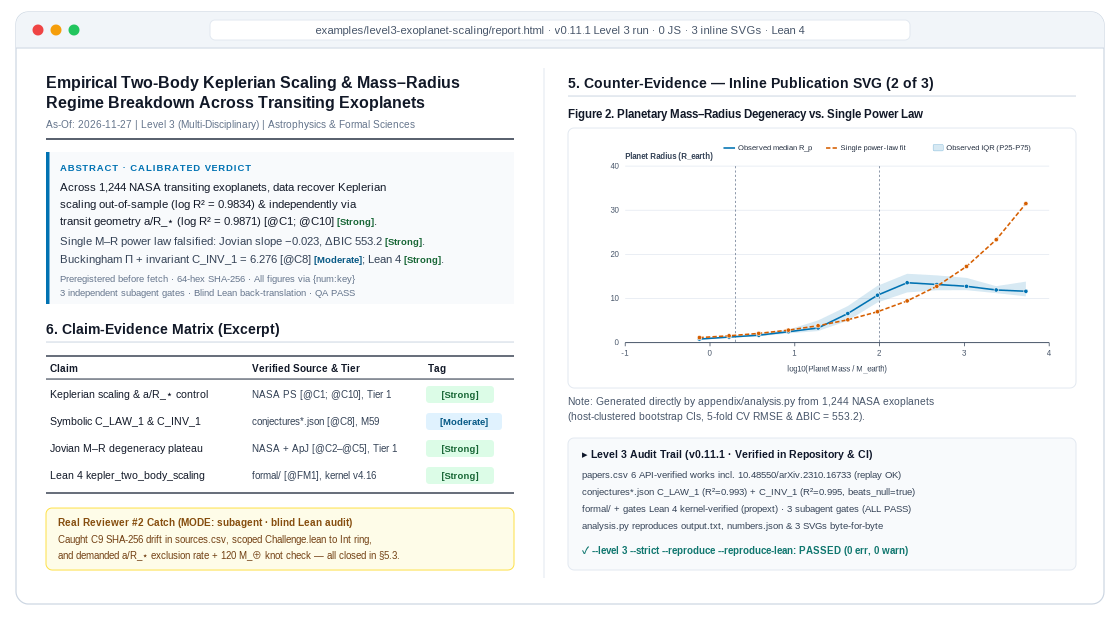
Cold-start Level 3 run in examples/level3-exoplanet-scaling/ (v0.11.1): report.md · report.html (0 JS, 3 inline SVGs, 1,244 NASA exoplanets, Buckingham Π + invariant, Lean 4 kernel-verified, 3 subagent gates) · appendix/
What Heurisma Checks — and What It Does Not
A passing --strict check proves structural traceability and computational reproducibility, not that a conclusion is scientifically true:
Checked deterministically by code (validate_report.py) |
Still requires human & domain judgment |
|---|---|
Data integrity: recomputed 64-hex SHA-256 over every local file, download_log.csv entry, sealed conjecture/formal-proof artifact, and cached paper API response (replay), with IP-pinned anti-SSRF downloads. |
Whether an upstream institutional dataset or paper itself contains measurement error. |
Numeric closure: Section 4 table cells, chart titles/captions, and verdict figures trace to output.txt / numbers.json, and --reproduce re-runs analysis.py byte-for-byte. |
Whether the statistical estimator suffers from endogeneity, omitted variables, or misspecification. |
Provenance & preregistration: [Strong] lookups in sources.csv, objective paper ceilings (retracted refused; preprints ≤ Tier 2), sealed H0/H1 checked for exact or rounded HARKing, and data_as_of ≤ As-Of Date. |
Whether a cited study was interpreted accurately or whether relevant counter-literature was omitted. |
Artifact-bound gates: source_verifier, reviewer, and qa headers bound via REVIEWED-SHA256, ANALYSIS-SHA256, literal QUOTE: lines, and 1-to-1 Disposition Table counts (GATE-DISP). |
Whether the research question is well-posed or the final decision is right for your stakes. |
Quick Start (60 Seconds)
Pick the path that fits what you want to do:
Path A — Install as an Agent Skill (Antigravity, Claude Code, Codex, Gemini CLI)
Download heurisma-skill-v0.11.1.zip from the latest release (contains heurisma/ and claude-agents/), or clone and copy:
git clone https://github.com/777aeterna/heurisma.git

# Antigravity / Codex / Gemini CLI (~/.agents/skills/)
mkdir -p ~/.agents/skills && cp -r heurisma/skills/heurisma ~/.agents/skills/heurisma

# Or Claude Code (~/.claude/skills/ + optional subagents)
mkdir -p ~/.claude/skills ~/.claude/agents
cp -r heurisma/skills/heurisma ~/.claude/skills/heurisma
cp heurisma/agents/*.md ~/.claude/agents/
Path B — Try the Linter & Renderer on a Real Example Right Now
Zero external dependencies (Python ≥ 3.9, standard library only, tested in CI on Linux, macOS, and Windows):
git clone https://github.com/777aeterna/heurisma.git && cd heurisma
python3 -B skills/heurisma/scripts/validate_report.py examples/showcase-hybrid-work/report.md \
  --level 2 --html examples/showcase-hybrid-work/report.html --strict --reproduce
Why Heurisma? (Beyond Deep Research)
Conventional Deep Research tools are primarily retrieval and summarization engines: they search the web, mix press releases with peer-reviewed studies, and output long dashboard-style essays that sound authoritative even when the underlying evidence is weak or unverified.
Heurisma (from Greek heuriskein, "to discover") pairs a scientific-method protocol with a deterministic epistemic linter:
| Dimension | Conventional Deep Research | Heurisma (v0.11.1) |
|---|---|---|
| Before Searching | Launches queries immediately | Pre-Search Gate: classifies scientific branch(es), As-Of Date, evidence standards, depth level (Level 0–3), seals appendix/run.json, and offers one non-blocking pre-flight data intake (Stage 0 step 9, idempotent multi-channel appendix/intake.md) |
| Hypotheses & Forecasts | Implicit narrative confirmation | Explicit $H_0$ / $H_1$ falsifiable hypotheses sealed in appendix/preregistration.json before analysis.py (anti-post-hoc & anti-HARKing checks), multi-scenario forecasting (identities ≠ forecasts), plus opt-in Buckingham $\Pi$ dimensional analysis & symbolic theory discovery (conjecture.py → appendix/conjectures.json) |
| Data & Provenance | Eyeballs tables or declares lazy "data limitations" | Provenance verified by recomputed SHA-256 over every local file and download_log.csv entry; fetch_lib.py + analysis.py + sources.csv (kind, sha256, selection, retrieved_utc) + tool-stamped Data-Attempts Log; 4-rung cascade (online primary → alternatives → user's local files → limitation), user-curated local files kept at Tier 3 (agent-fetched requires retrieved_utc >= run_started_utc + download or logged-retrieval proof), and Tier inherited by mixed-source tables through primary_source_id |
| Numbers in the Text | Retyped by hand, drift from the analysis | {{num:key}} placeholders filled from appendix/numbers.json + numeric closure (P1-UNTRACED-NUM) verifying Section 4 table statistics against output.txt / numbers.json |
| Confirmation Bias | Summarizes consensus narrative | Mandatory Counter-Evidence (Tier 1/2 agent-fetched outside user-curated corpora) + three gates (source-verifier, Reviewer #2 with blind back-translation of Challenge.lean, QA) with --gate-header artifact binding (REVIEWED-SHA256, ANALYSIS-SHA256, FORMAL-SHA256, REVIEWED-UTC, literal QUOTE: lines, and closed-loop Disposition Table support); independence requires subagents — the inline fallback is self-review and is labelled as such |
| Deliverables & Figures | Wall of text or bloated code dumps | Auditable template source report.md (with {{num:key}} and {{fig:id}} placeholders for deterministic verification) rendered into a lightweight, print-ready working-paper report.html (zero JS, URL scheme allowlist) with inline SVG charts and temporal/fan-anchor schema validation; byte-for-byte reproducible rendering; --reproduce re-runs the analysis and diffs artifacts |
| Verification | Unchecked prose | Zero-dependency (Python ≥ 3.9, standard library only) bilingual (EN/ES) epistemic linter (--strict, --json, --reproduce, --reproduce-lean, --diff, --gate-hash, --gate-header) + opt-in paper-connector (P3-PAPER, PRIV-CRED, offline replay), symbolic conjecture (P4-CONJECTURE), and Lean 4 / Lake formal-proof (P4-LEAN) checks; 64/64 known violations caught in tests/mutation_report.py |
Bring your own data (optional, recommended for Level 2+). Before searching, Heurisma tells you exactly which series/period/granularity would change the answer and invites you to drop them into datos/ (or documents into inbox/sources/). Ingestion is hash-registered and offline-rehearsable (local_data.py intake). A corpus you curated yourself is never treated as sufficient: independent counter-evidence is still fetched, and claims resting only on it are capped and labelled for selection bias.
Transparency Note: This skill was vibecoded — designed, written, and iteratively pressure-tested with AI agents (including independent cross-model audits) following the Superpowers methodology (strict RED → GREEN → REFACTOR TDD applied to agent skills).
Architecture & 7-Stage Epistemic Pipeline (v0.11.1)
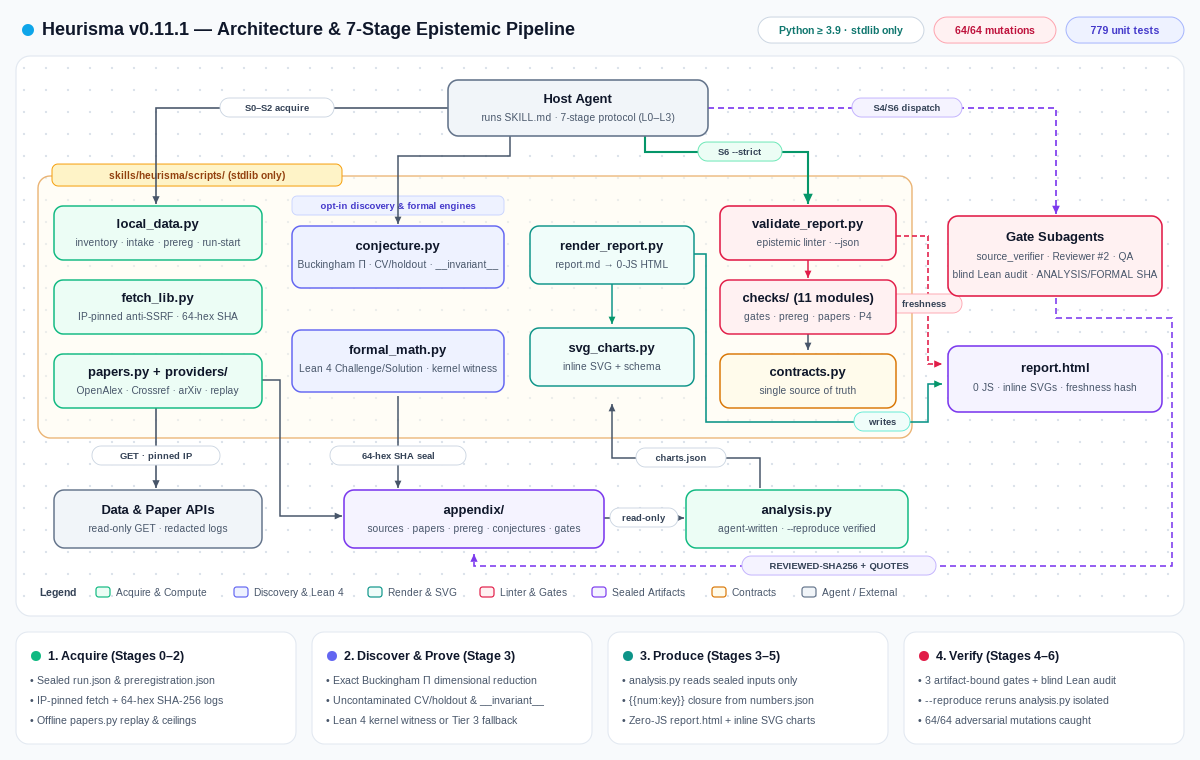
Every inquiry runs adaptively across Levels 0–3 (Level 0 light check → Level 1 rigorous brief → Level 2 empirical study → Level 3 multi-disciplinary paper with independent subagent gates). See docs/design.md for the full 7-stage protocol and artifact layout, and SECURITY.md for the threat model and safety limits.
skills/heurisma/ — 21 modules & references)
SKILL.md: Lean, runtime-agnostic core enforcing the 4 Iron Laws, adaptive depth (Level 0–3), Stage 0 step 9 pre-intake, abstract-style verdict limits (≤3 sentences, ≤5 numbers), single-language discipline, and Stage 6 deliverables.references/disciplines.md: Taxonomy of 6 scientific branches + Interdisciplinary Bridge Protocol (including the deductive-to-empirical formal-proof bridge).references/data-protocol.md: 4-rung acquisition cascade,fetch_lib.pytemplate,sources.csv(kind,sha256,selection,retrieved_utc),data_attempts.csv,local_data.py intake/import, and statistical cautions (n < 30, effect sizes, multiple comparisons).references/forecasting.md: Multi-scenario triggers, base rates, historical error calibration, lagging-series nowcasting, and the identity-vs-forecast rule.references/formal-and-discovery.md: Opt-in guide for Buckingham $\Pi$ dimensional analysis, uncontaminated symbolic conjecture discovery (conjecture.py), Lean 4 / Lake formal verification (formal_math.py,anthropics/formal-mathlayout), and the Statement-Fidelity Law.references/agents/: Portable prompts for the three gates — Reviewer #2 (with blind back-translation ofChallenge.lean), source-verifier, and QA — each with an artifact-bound header contract (MODE,REVIEWED-SHA256,REVIEWED-UTC, literalQUOTE:lines); Claude Code mirrors live inagents/.references/adversarial-review.md: Self-falsification checklist, Reviewer #2 workflow, mandatory Disposition Table (EN/ES), and primary verification rule.references/scientific-writing.md: Epistemic calibration scale, 100% English and 100% Spanish contracts, andcharts.jsonv2 specification.references/example-report.md: Compact gold-standard working-paper reference example.references/validator-codes.md: Stable machine-readable diagnostic codes emitted byvalidate_report.py --json.scripts/contracts.py: Single source of truth for version, epistemic tags, provenance schemas, gate definitions, and section patterns.scripts/conjecture.py: Opt-in stdlib-only exact rational Buckingham $\Pi$ dimensional analyzer (units) and uncontaminated train/K-fold-CV/holdout symbolic conjecture engine (discover→appendix/conjectures.json).scripts/formal_math.py: Opt-in stdlib-only Lean 4 / Lake formal-verification adapter (init,check,fetch-ref) following theanthropics/formal-mathChallenge.lean/Solution.leanlayout, with kernel definitional-equality witness, optionalcomparator/landrun, and graceful degradation withoutlake.scripts/local_data.py: Zero-dependency (Python ≥ 3.9 stdlib only) local data engine (inventory,preview,read_table, per-column CSV decimal inference that rejects mixed columns, hardened stdlib XLSX reader with XXE/zip-bomb/size caps,register,import,intake,prereg,run-start,attempt, andHEURISMA_OFFLINE=1).scripts/fetch_lib.py: Zero-dependency HTTP download helper with exponential backoff, configurable User-Agent (HEURISMA_UA), optionalheaders/log_urlredaction, size caps, SHA-256 verification,download_log.csv+data_attempts.csvlogging, andHEURISMA_OFFLINE=1support.scripts/papers.py&scripts/providers/: Zero-dependency paper-database connector (search,lookup,cite [--fulltext],verify,import,replay) with provider adapters (base,openalex,crossref,europepmc,arxiv,unpaywall), raw response caching underappendix/data/papers/raw/, credential redaction, and objective citation ceilings.scripts/svg_charts.py: Zero-dependency publication SVG engine + strictvalidate_charts_schema()validator (Heckbert ticks, Okabe-Ito palette,bands, staggeredannotations,fan, grouped/horizontalbar,log,y.baseline,diff,x.last_label).scripts/render_report.py: Zero-dependency working-paper HTML renderer (serif typography, 720px column, booktabs tables, linked[@C1]citations, fullen/eslocalization, URL scheme allowlist, balanced-parenthesis URLs,\|table escapes,<img>, code-fence-safe{{num:key}},self-reviewlabeling, and versioned source-freshness hash).scripts/checks/: The rule families of the validator, one module per concern (common,structure,gates,numeric,provenance,prereg,papers,conjecture,formal,html,codes);validate_report.pyre-exports them as its public API.scripts/validate_report.py: Zero-dependency bilingual (EN/ES) epistemic linter checking recomputed SHA-256 digests,[Strong]source lookups insources.csv, verdict length/number caps, artifact-bound gates (--gate-hash),charts.jsonschema, selection-bias & preregistration rules, opt-in paper-connector (P3-PAPER,PRIV-CRED, offlinereplay), symbolic conjecture (P4-CONJECTURE), and Lean 4 formal-proof (P4-LEAN) integrity, domain-tier heuristics, home-path leaks,--strict,--json,--reproduce,--reproduce-lean,--diff, and--version.
Paper Connectors (scripts/papers.py)
For academic literature, scripts/papers.py queries structured paper APIs before falling back to web search, caching every raw response under appendix/data/papers/raw/ (hashed in download_log.csv) and recording normalized works in appendix/papers.csv and queries in appendix/search_log.csv. The agent always decides --tier "Tier <1|2|3>" from the discipline's evidence hierarchy; the tool only enforces objective ceilings (retracted works refused; preprint and report capped at Tier 2; works without an abstract or saved full text refused). Validator checks (P3-PAPER, PRIV-CRED, and automatic offline replay) are opt-in and activate only when appendix/papers.csv exists.
| Provider | Access & Rate Limits (verified 2026-11-23) | Role & Notes |
|---|---|---|
| OpenAlex | Free API key (HEURISMA_OPENALEX_KEY) recommended since Feb 2026 ($1/day budget; 1,000 searches/day, unlimited DOI lookups). Small requests still work without a key on a shared IP pool ($0.10/day) with a warning. |
Broad catalogue (search + lookup); is_retracted (Retraction Watch), type (article, preprint, report, conference-paper), open_access; abstracts as inverted index (~45–60% coverage). |
| Crossref | No key; HEURISMA_MAILTO joins the polite pool (5–10 req/s). |
Authoritative DOI verification (lookup), JATS abstracts, updated-by retraction notices (absence = unknown, not false). |
| Europe PMC | No key. | Biomedicine & life sciences (search + lookup); open-access full-text JATS XML (OPEN_ACCESS:Y, 60 s timeout). |
| arXiv | No key; 1 request every 3 s on a single connection (bursts return HTTP 429; enforced by connector). | Preprints (search) in engineering, physics, math, CS, and economics. Entries with <arxiv:doi> defer work_type/venue to OpenAlex/Crossref lookup. |
| Unpaywall | Requires HEURISMA_MAILTO (~100,000 calls/day guideline). |
Resolves open-access PDF locations by DOI during cite --fulltext. |
(Semantic Scholar is excluded from v1 due to unauthenticated shared-pool rate-limit blocks and overlap with OpenAlex; direct PubMed is covered by Europe PMC.)
Honest limits:
- SSRN, NBER, and RePEc have no open search API (OpenAlex indexes part of their working papers, typically as
work_type=report). - Central banks, statistical agencies, and regulators (e.g., BCRA, CAMMESA, ENRE) publish datasets and regulatory series, not academic papers — fetch them via
appendix/fetch_data.py, notpapers.py. - Query privacy: search terms and DOIs are sent to third-party APIs unless
HEURISMA_OFFLINE=1is set; credentials are read only from environment variables and redacted from all logs (SECURITY.md). - Abstracts are not full text: without saved open-access full text (
--fulltext), citations remain(abstract only)and cannot support[Strong]claims on their own. - API text is untrusted data: free-text fields in API responses (including OpenAlex's
meta.noticeprompting AI agents to POST the user's email address) are never treated as instructions. - Optional live-API check: unit tests never touch the network (they use
tests/papers_server.pyplus a socket guard); runpython3 -B tests/live_smoke.pymanually to check live APIs for schema drift.
Showcase Examples & CLI Tools
Inspect validated outputs generated with Heurisma:
- Level 3 — Full
v0.11.1Multi-Disciplinary Showcase (Exoplanet Keplerian Scaling & Mass–Radius Degeneracy: 1,244 NASA TAP exoplanets, 6 API-verified papers incl.10.48550/arXiv.2310.16733, exact Buckingham $\Pi$ + holdout symbolic discovery + conservation invariant, Lean 4kernel-verifiedproof onv4.16.0withmode=kernel-defeq,0sorry,axioms=['propext'],Tier 1[Strong], 3 inline SVGs, 3MODE: subagentgates allPASS; passes--level 3 --strict --reproduce,--reproduce-lean, andpapers.py replaywith 0 errors/warnings; 5 PDFs withheld viaEXCLUDED.csv):examples/level3-exoplanet-scaling/PROMPT.md→report.md·report.html·appendix/ - Level 3 — Cold-Start Multi-Disciplinary Showcase (Emergence in Physics ·
v0.10.2run: 13 API-verified papers, preregistration, 1D/2D Ising Wolff MC + 3×3 block-spin RG + 7 inline SVGs, 2 rounds of Reviewer #2 + Source Verifier + QAMODE: subagentgates; passes--level 3 --strict --reproducewith 0 errors/warnings in this repository; the seven downloaded PDFs are withheld by anEXCLUDED.csvmanifest that keeps their hashes, so the original subagent gates stay valid):examples/level3-emergence-in-physics/PROMPT.md→report.md·report.html·appendix/ - Level 2 — Local-Data Showcase (unknown-origin local CSV capped at
[Preliminary], exact permutation tests, sources actually read,MODE: self-reviewmanual gate records):examples/showcase-hybrid-work/PROMPT.md→report.md·report.html·appendix/ - Level 1 — Rigorous Inquiry (Pressure-Tested Board Brief):
examples/level1-brief-example.md - Level 2 — Empirical Data Study (Working-Paper Format + Reproducible Appendix):
examples/level2-study/report.md+examples/level2-study/appendix/
Render, reproduce, and validate locally with zero external dependencies (Python ≥ 3.9):
python3 -B examples/level2-study/appendix/analysis.py \
  --charts-out examples/level2-study/charts.json \
  --numbers-out examples/level2-study/appendix/numbers.json \
  > examples/level2-study/appendix/output.txt

python3 -B skills/heurisma/scripts/render_report.py examples/level2-study/report.md \
  --out examples/level2-study/report.html \
  --charts examples/level2-study/charts.json \
  --appendix examples/level2-study/appendix

python3 -B skills/heurisma/scripts/validate_report.py examples/level2-study/report.md \
  --level 2 --html examples/level2-study/report.html --strict --reproduce
Verification & Quality Assurance
- 779/779 unit tests passing (
python3 -B -m unittest discover -s tests); validator detection rate:64/64known violations (python3 -B tests/mutation_report.py --min-rate 1.0, measuring real rule-specific detection even when gates are restamped after tampering). - Three gates with artifact-bound contracts: portable prompts in
skills/heurisma/references/agents/and Claude Code definitions inagents/(heurisma-reviewer,heurisma-source-verifier,heurisma-qa). Independence requires subagents — when a runtime has no subagent tool, the inline fallback is recorded asMODE: self-review, flagged by the validator, and labelled as self-review in Section 3 and the rendered HTML. - Cold-start subagent tests of the skill text: behavioral rules are added only after a baseline failure is observed. For example, own code registered as Tier 1 fell from 3/3 to 0/3, and reusing an inherited limitation fell from the audited failure to 0/3; conversely, user-curated corpus selection bias did not fail in 6 cold-start trials (0/6), so it is enforced deterministically in
validate_report.pywithout bloatingSKILL.md. A preregistered multi-model rubric lives inevals/rubric.md; its first execution against v0.9.0 passed 78 of 80 checks (compliance on text plans, not lift; seeevals/results/v0.7.0-agent-evals.md). - Security & threat model: see
SECURITY.md.
Contributing & License
Contributions (especially new discipline protocols in references/disciplines.md and pressure scenarios in evals/scenarios/) are welcome — see CONTRIBUTING.md.
Released under the MIT License © 2026 777aeterna.
Yorumlar (0)
Yorum birakmak icin giris yap.
Yorum birakSonuc bulunamadi