sabba
Health Uyari
- License — License: Apache-2.0
- Description — Repository has a description
- Active repo — Last push 0 days ago
- Low visibility — Only 8 GitHub stars
Code Gecti
- Code scan — Scanned 12 files during light audit, no dangerous patterns found
Permissions Gecti
- Permissions — No dangerous permissions requested
Bu listing icin henuz AI raporu yok.
SABBA - Security Templates CLI & MCP Server for coding agents that prove every finding by running it
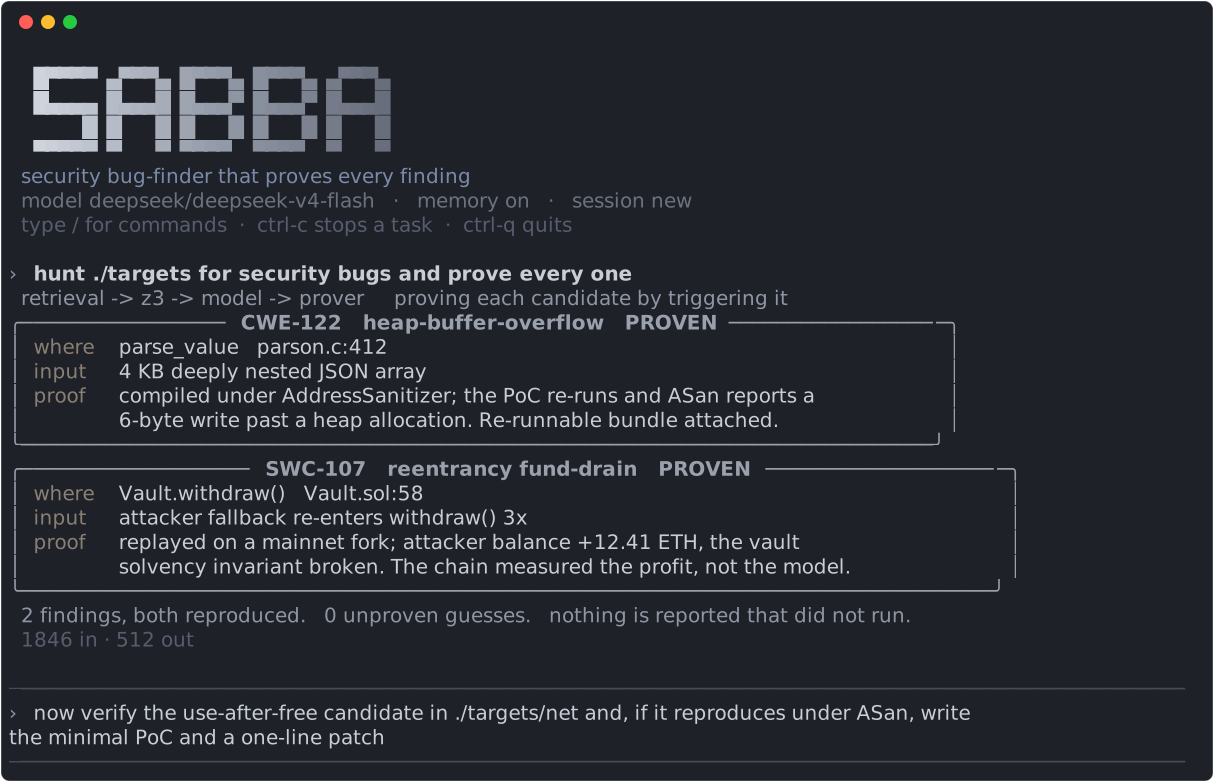
SABBA
Security Templates CLI & MCP Server for coding agents that prove every finding by running it.
Claude Code, Codex, OpenCode, Cursor, and Hermes call Sabba to prove a change, find and prove
bugs, vet a skill, and drive the security toolchain, authorized-scope-only.
If it does not run, Sabba does not report it.




Two real bugs in cJSON, found by Sabba and proved by running them: a stack exhaustion
(CWE-674) and a heap over-read in parse_object (CWE-125). Each is written up in
docs/scans with the exact input that triggers it and a bundle you can re-run on
your own machine to watch the sanitizer fire.
That is the whole design. Most tools that use a language model ask it "is this function
vulnerable?" That is close to a coin flip, even for large models, and unverified guesses bury
maintainers in false positives. Sabba takes the opposite stance: a model proposes candidates,
but an execution oracle runs an exploit and decides whether a security property actually
broke. Nothing is reported unless the exploit reproduces. A finding is not a score, it is a
re-runnable proof.

Use it from any coding agent (MCP)
Sabba runs as an MCP server, so Claude Code, Codex, OpenCode, Cursor, and Hermes can call it.
For Codex CLI, add it to ~/.codex/config.toml:
[mcp_servers.sabba]
command = "sabba"
args = ["mcp"]
For Claude Code:
claude mcp add sabba -- sabba mcp # after installing; see Install below
Fourteen tools, most token-free: verify_change (prove a change works in any of 16
languages: a new test fails on the base and passes on the head, via the bundled Magga engine)
and prove (the same differential, run natively for C/C++/EVM), verify / solve /hunt / scan (find and prove bugs), security_scan (vet a skill by running it under
observation), rank, run_sandboxed, and kali_run (drive nmap / nuclei / ffuf / sqlmap
and the rest, scope-enforced and sandboxed). Install the security command templates withsabba templates install. Full catalog and per-client configs in
docs/AGENT_INTEGRATION.md.
Correctness and security in one server. verify_change proves the change does what it
claims; prove / hunt / scan prove it added no new bug. The change-verification engine is
Magga, vendored as a submodule under magga/ and
driven through npx, so both halves ship as one tool.
What SABBA can do
Find a real bug and hand you the proof, not a hunch. Every finding ships as a bundle: the
input that triggers it, the target, the command that reproduces it, and the sanitizer output
it produced. You do not have to trust the report, you can re-run it. The cJSON bugs above are
two of these bundles.
Work across languages and across chains, with one rule. The oracle started on C and C++
memory safety and generalized into a registry of provers, one per runtime and vulnerability
class. Every prover obeys the same contract: a finding is minted only from a verdict that a
real, security-relevant crash happened inside the target.
| Domain | Runtime it proves on | What counts as proven | Examples |
|---|---|---|---|
| C / C++ | clang + AddressSanitizer / UBSan | the sanitizer reports a real memory error | heap / stack overflow, use-after-free |
| Solidity / EVM | Foundry mainnet fork | attacker ETH profit or a broken solvency invariant, measured on-chain | reentrancy fund-drain |
| Python | atheris | a crash raised in the target, not the harness | stack exhaustion, C-extension segfault |
| Go | go test -fuzz |
a recovered runtime panic at a target frame | index / slice out of range, nil deref |
| Java / JVM | Jazzer | a target throwable or a bug-detector finding | stack overflow, injection detectors |
| Node JS / TS | Jazzer.js | a target crash or a bug-detector finding | prototype pollution, ReDoS, path traversal |
Refuse to be fooled, even by a hostile harness. When a model writes the fuzz harness, a
hostile target could try to steer it into faking a crash. Sabba's fuzzing provers are
harness-untrusted: the fuzzer only discovers a candidate input, then a Sabba-owned
reproducer re-runs it and reads the verdict from channels the harness cannot forge (a real
exception's structured stack, or the parent's own measurement of a killed child). It reads
no stdout, no artifact file, no magic phrase. The full model is in
docs/PROVER_SOUNDNESS.md.
Prefer soundness over coverage, and say so. Where a crash cannot be soundly pinned to the
target (a hang or an out-of-memory that could just as easily be the harness spinning or
pre-filling the heap), Sabba surfaces it as an unverified candidate for a human, but never
mints it as a finding. It would rather miss a bug than report one that did not happen.
Meet you where you work. One command, several surfaces: a scriptable CLI (verify,solve, hunt) and an interactive REPL (pictured above) that streams the model, runs tools,
and renders each proof as a card. Running sabba with no arguments opens the REPL.
Run it locally, and let it learn where to look
The oracle and provers never needed a model, and the model-driven parts can run on your own
machine too. Point the reasoning at a local, OpenAI-compatible endpoint withSABBA_LLM_BACKEND=local, and train a small CPU risk ranker so retrieval looks at the risky
functions first:
sabba mltrain # trains a risk ranker (TF-IDF + logistic), saved to ~/.sabba
A three-tier cascade keeps work cheap: Reflex (no model: the ranker, Z3, the oracle), Resident
(the local model), and Teacher (a frontier model) only for the hard cases. The verdict rule
holds across tiers, so a cheaper tier costs coverage, never soundness. See
docs/LOCAL_ML.md.
Why it is different
                 model / z3 / retrieval  ->  candidate input
                                                   |
                                                   v
                     +---------------------------------------+
                     |   execution oracle  /  prover         |
                     |   compile, run the exploit, measure   |
                     +---------------------------------------+
                                    |            |
                              reproduces     does not
                                    |            |
                                  FINDING     dropped
The oracle is the one gate. Whether a candidate came from the Z3 synthesizer or from the
model, it is compiled and run before anything is reported. Z3 proposes an input, the oracle
decides. The model proposes an input, the oracle decides. The same discipline carries to
every domain in the table above: on an EVM fork the chain measures the attacker's profit,
not the model, so the model cannot grade its own work.
Install
pip install sabba # or: pipx install sabba / uvx sabba mcp
Then run sabba doctor to see what the toolchain can prove on this machine. verify_change
shells out to the Magga engine over npx, so it needs Node on your PATH but no extra install
step.
To work on Sabba itself, clone it with the submodule and use the installer, which sets up an
isolated environment under ~/.sabba and puts a sabba command on your PATH:
git clone --recurse-submodules https://github.com/8NobleTruths/sabba.git
cd sabba
./install.sh
Update later with sabba update, remove with sabba uninstall.
Provers use the toolchain of the domain you target: clang with AddressSanitizer for C and
C++, Foundry for EVM, and atheris, go, Jazzer, or Jazzer.js for the managed languages.sabba doctor reports what is present.
Quick start
sabba                                     # opens the REPL; type /setup for guided first-run setup

# no model needed, prove a known target:
sabba verify cwe121_stack_overflow
sabba solve  cwe121_stack_overflow
Those two names are demo targets that ship inside the package, so an installed Sabba can prove
a real bug on the first command, with no clone, no model, and no API key. Point the same
commands at a directory of your own holding a target.json to work on your code instead.
First run opens a guided setup: /setup shows a checklist, and each step explains why it is
worth doing, what happens if you skip it, and what happens when you do it. /local-llm-config
detects your CPU and RAM, recommends a Qwen2.5-Coder size, and pulls it with Ollama so the
model runs on your machine; /add-model-key uses a cloud model instead; /ml-config trains
the risk ranker. You can select any command from the / menu. /solve and /verify prove
bugs with no model at all, so they work before any setup.
Bring in a model through OpenRouter (or any OpenAI-compatible endpoint) to hunt fresh code:
export SABBA_LLM_BACKEND=openrouter
export OPENROUTER_API_KEY=...             # from openrouter.ai/keys
sabba hunt cwe122_heap_overflow --model qwen/qwen-2.5-coder-32b-instruct
Keys are read from the environment, never stored in the repo, and a pre-commit hook blocks
anything that looks like a credential (see CONTRIBUTING.md).
How it works, in more depth
- docs/SABBA_AGENT_DESIGN.md - the C and C++ bug-finder: the
oracle, retrieval, the Z3 synthesizer, and the reasoning agent. - docs/PROVERS_MULTI_DOMAIN_DESIGN.md - how the oracle
generalizes into the prover registry, including Web3 and Solidity. - docs/PROVER_SOUNDNESS.md - the harness-untrusted verification
model that makes the fuzzing provers sound against an adversarial harness. - docs/WATER_LAYER_DESIGN.md - the next layer: an agent that
keeps its skills as runnable code, runs without a frontier model, and can be rebuilt from a
seed. Provers are the skills it accumulates.
Status
The native oracle, retrieval, Z3 synthesis, the reasoning agent, and the full prover registry
across C/C++, Solidity/EVM, Python, Go, Java, and Node run today, each with live proofs. The
Water Layer and a broader symbolic-execution pass are next.
License
Apache-2.0. See LICENSE. The framework is open source. Trained model weights and
datasets are developed separately and are not part of this repository.
Yorumlar (0)
Yorum birakmak icin giris yap.
Yorum birakSonuc bulunamadi