Diverter
Health Pass
- License — License: MIT
- Description — Repository has a description
- Active repo — Last push 0 days ago
- Community trust — 12 GitHub stars
Code Pass
- Code scan — Scanned 12 files during light audit, no dangerous patterns found
Permissions Pass
- Permissions — No dangerous permissions requested
This is a Python-based agent that integrates with Codex to analyze tasks before execution. It identifies work that can be delegated and recommends a lineup of subagents, pausing to wait for user approval before any actual work begins.
Security Assessment
Overall Risk: Low. The tool operates primarily as an analytical advisor rather than taking direct action. The automated code scan reviewed 10 files and found no dangerous patterns, hardcoded secrets, or requests for elevated permissions. It does not appear to execute arbitrary shell commands or scrape sensitive data independently. By design, it specifically pauses for explicit user approval before proceeding, meaning it does not trigger background processes or network requests without the developer's knowledge.
Quality Assessment
The project is actively maintained, with its last push occurring today. It uses the permissive and standard MIT license, making it safe for most open-source and commercial use. The main drawback is its low community visibility; it currently only has 5 GitHub stars. This indicates that while the code is clean, it has not been widely battle-tested or rigorously peer-reviewed by a large audience. Community trust should be considered preliminary.
Verdict
Safe to use, but proceed with the standard caution applied to new, low-visibility open-source tools.
A Codex skill that suggests subagent lineups before Codex starts. Spots tasks worth delegating, recommends a 1-4 role lineup, and waits for your approval.
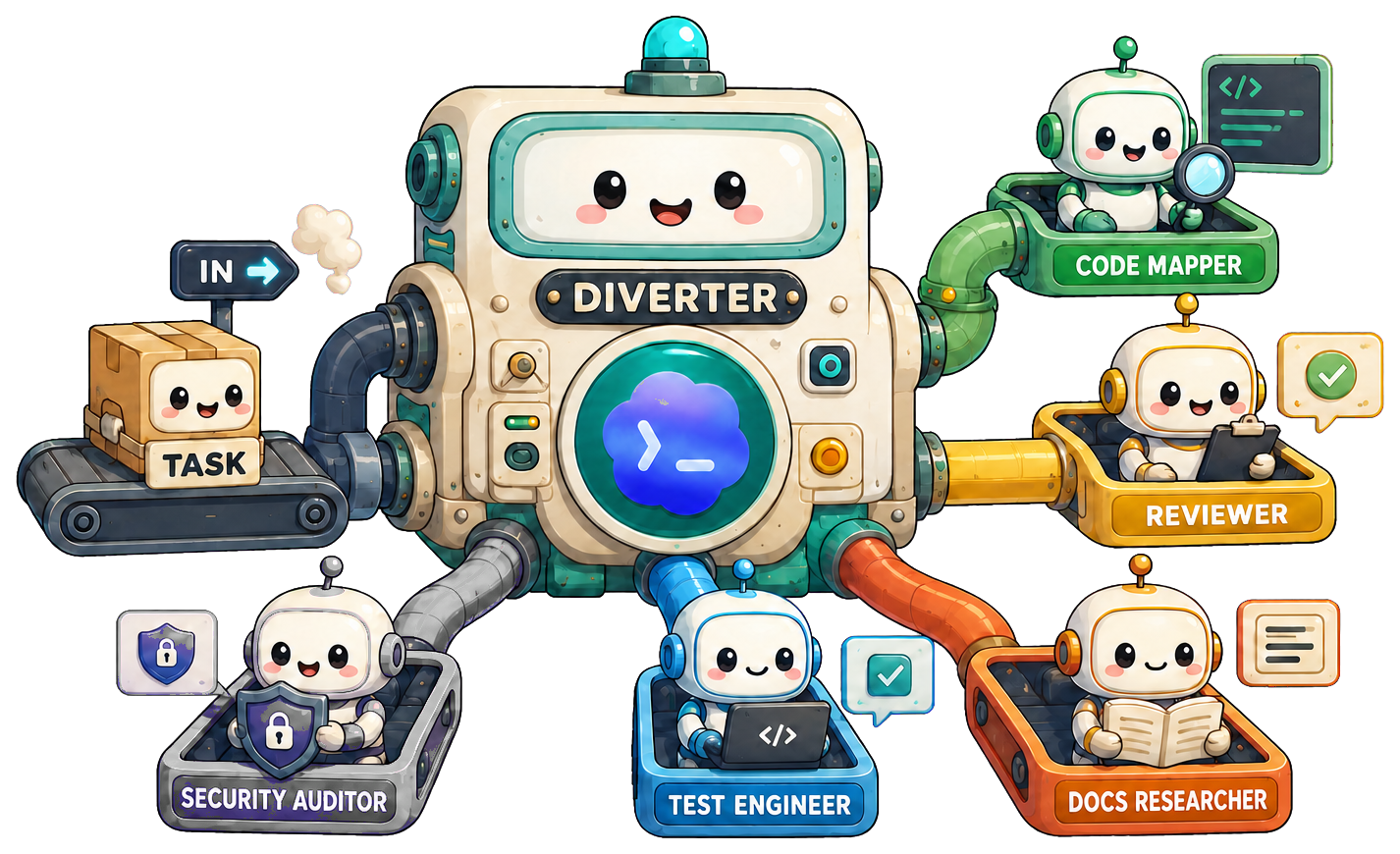
Diverter



Diverter routes suitable Codex work to a bounded specialist lineup while simple tasks stay in the main thread.
✨ A delegation instinct for Codex
Diverter knows when to stay focused, when to split the work, which specialists to bring in, and how to keep every handoff bounded.

|

|

|

|
🚀 Quick Start
Tell Codex:
Fetch and follow instructions from https://raw.githubusercontent.com/GML-MMGroup/Diverter/refs/heads/main/.codex/INSTALL.mdAfter installation, open
/hooks, review and trust Diverter'sSessionStartHook, then start or reopen a task.New installations start in
ask. Inspect or change the user-level policy with:$diverter-mode status $diverter-mode auto $diverter-mode ask
| Policy | Behavior |
|---|---|
ask |
Proposes one lineup and waits for approval before dispatching |
auto |
Announces one lineup and dispatches it immediately for any Work Mode |
Policy changes apply at the next SessionStart; restarting or reopening the task is the predictable way to apply one. auto changes dispatch authorization, not Codex permissions, sandboxing, or handoff write boundaries.
🎭 Roles
Diverter includes ten Bundled Subagents. The installer offers the recommended set (code-mapper, docs-researcher, reviewer, security-auditor, test-engineer, and test-automator), all roles, or a custom selection.
| Role | GPT-5.6 model | Reasoning effort | What it does |
|---|---|---|---|
code-mapper |
gpt-5.6-terra |
high |
Traces code paths, symbols, and ownership boundaries |
search-specialist |
gpt-5.6-luna |
medium |
Gathers focused repository or external evidence |
docs-researcher |
gpt-5.6-luna |
high |
Verifies official APIs, versions, and guarantees |
knowledge-synthesizer |
gpt-5.6-luna |
high |
Reconciles long or conflicting findings |
task-distributor |
gpt-5.6-sol |
medium |
Splits broad goals into bounded work packages |
reviewer |
gpt-5.6-sol |
medium |
Reviews correctness, regressions, and maintainability |
security-auditor |
gpt-5.6-sol |
high |
Audits trust boundaries, secrets, and agent-tool safety |
test-engineer |
gpt-5.6-luna |
xhigh |
Designs minimal test coverage for behavior and risk |
test-automator |
gpt-5.6-terra |
xhigh |
Adds bounded regression tests after behavior is clear |
web-performance-auditor |
gpt-5.6-luna |
xhigh |
Audits Web performance evidence and Core Web Vitals risks |
Diverter selects capabilities first, then maps them to roles available in your Codex environment. Missing preferred roles are reported rather than silently substituted. Custom role sets can adapt role-lineups.md.
🔄 Work Modes
| Work Mode | Boundary |
|---|---|
read-only |
Inspect and report; never write files |
mixed |
Investigate first, then perform bounded writes; writers stay serialized unless paths are explicitly disjoint |
write-capable |
Edit only within the explicit handoff and sandbox |
Diverter always names one Work Mode before dispatch.
🎯 When Diverter Delegates
At most intelligence levels, subagent delegation must be requested explicitly; Ultra may delegate proactively. Diverter fills the explicit-delegation path and silently steps aside when native proactive delegation owns the session. See OpenAI's subagent documentation.
| Delegates when | Stays focused when |
|---|---|
| Independent work lanes can run in parallel | The task is simple or single-lane |
| Code and official documentation need separate verification | Writes are tightly coupled, or one fact is needed first |
| Security, test, performance, or release risk calls for a specialist | The user opts out explicitly, or the request is still ambiguous |
Diverter matches the user's language. Role names and Work Mode tokens remain in English.
⚙️ How It Works
- The
SessionStartHook loads the user-level Delegation Policy and activates the Delegation Gate. - Diverter first yields to native proactive delegation. Otherwise it decides whether to stay in the main thread or select one lineup of up to four roles and one Work Mode.
askwaits for approval;autoannounces and dispatches immediately. The execution backend then runs bounded handoffs through native custom agents or temporary leafcodex execworkers.
Every handoff carries an explicit goal, scope, write policy, and verifiable deliverable. See delegation-contract.md and handoff-schema.md.
🙏 Acknowledgments
- The always-on gate and session-bootstrap pattern was inspired by obra/superpowers.
- The bundled role pack is a curated adaptation of VoltAgent/awesome-codex-subagents.
- Review, security, test, and Web performance role design was informed by addyosmani/agent-skills.
🤝 Contributing & License
Issues and pull requests are welcome. Useful contributions improve task-shape rules, role mappings, positive and negative examples, or eval scenarios. A good new rule includes both a prompt that should trigger delegation and a similar prompt that should stay focused.
Start with decision-rules.md, role-lineups.md, and evals/scenarios.md.
This project is released under the MIT License.
Reviews (0)
Sign in to leave a review.
Leave a reviewNo results found