cktclaw
Health Gecti
- License — License: MIT
- Description — Repository has a description
- Active repo — Last push 0 days ago
- Community trust — 14 GitHub stars
Code Gecti
- Code scan — Scanned 12 files during light audit, no dangerous patterns found
Permissions Gecti
- Permissions — No dangerous permissions requested
Bu listing icin henuz AI raporu yok.
CktClaw is an open-source AI-powered EDA agent framework for autonomous chip design, supporting RTL generation, verification, logic synthesis, timing analysis, and multi-agent workflows.
CktClaw
An Open-Source Multi-Agent Framework for Chip Design and EDA Automation
AlexWang · PhD Student · Shanghai Jiao Tong University


Email: [email protected]
中文文档 | English
🎯 CktClaw
CktClaw is a multi-agent AI terminal for chip design. Describe your task in natural language, and CktClaw automatically identifies the design domain, orchestrates EDA tools, drives multi-stage workflows, and delivers complete analysis results.
Highlights:
- Natural-language chip design — Type "synthesize this adder targeting minimum area" and CktClaw auto-routes to the synthesis orchestrator, executing constraint → compile → QC → sign-off stages
- 14 chip design domains — Architecture / RTL / Verification / Formal / Synthesis / DFT / STA / HLS / Physical Design / SoC / Compiler / Firmware / FPGA / Infrastructure
- 20+ EDA tools auto-detected — Scans Yosys, Verilator, OpenSTA, NextPNR, etc. at startup and configures MCP servers automatically
- Intelligent context management — 4-layer memory + automatic compression keeps critical info across long sessions
- Circuit reverse engineering — AIG → Verilog semantic recovery with AI-powered Q&A
- Multi-provider LLM — Cloud DeepSeek / Anthropic Claude / OpenAI (and any OpenAI-compatible local endpoint such as vLLM / Ollama), plus local LogicRT & Qwen2.5-3B — switch and configure API keys at runtime with
/model
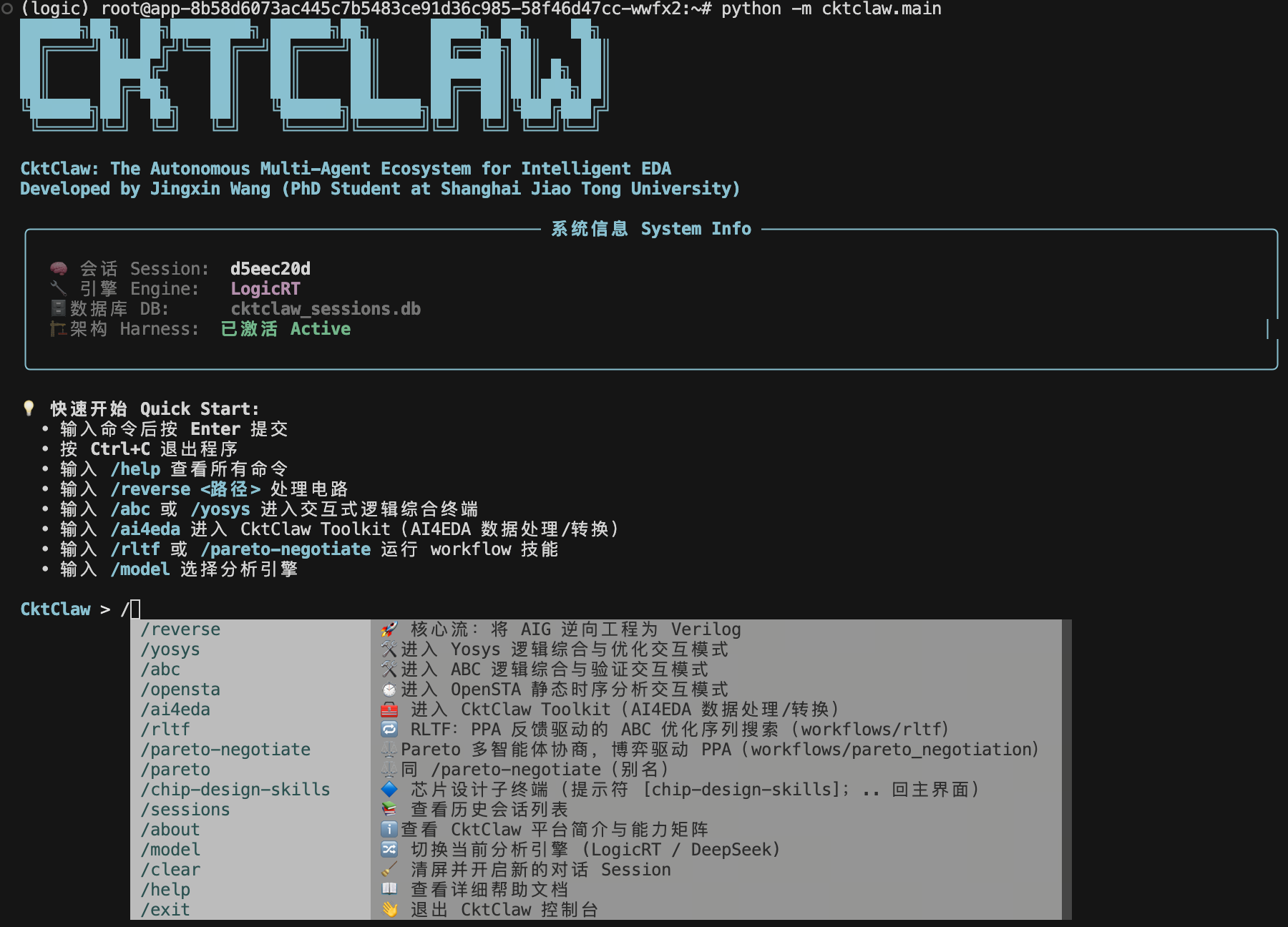
🚀 Quick Start
Option 1: pip install (recommended)
git clone [email protected]:959AI994/cktclaw.git
cd cktclaw

conda create -n cktclaw python=3.10 -y
conda activate cktclaw

# Basic install (cloud DeepSeek engine)
pip install -e .

# Full install (includes local LogicRT engine)
pip install -e ".[full]"
Option 2: Docker (batteries included)
The image ships with Yosys, ABC, Verilator, OpenSTA, SymbiYosys, nextpnr, AI4EDA Toolkit, and all 14-domain orchestrators pre-installed.
# Build from source (first build ~20-30 min, cached afterwards)
git clone [email protected]:959AI994/cktclaw.git && cd cktclaw
docker build -t cktclaw .

# Launch (pass your DeepSeek API key)
docker run -it --rm -e DEEPSEEK_API_KEY="sk-xxx" cktclaw

# Mount local design files into the container
docker run -it --rm \
  -e DEEPSEEK_API_KEY="sk-xxx" \
  -v $(pwd)/designs:/workspace \
  cktclaw
Or use Docker Compose:
# Set DEEPSEEK_API_KEY=sk-xxx in a .env file
docker compose up
Option 3: One-Click Script (auto-installs EDA tools + dependencies)
git clone [email protected]:959AI994/cktclaw.git && cd cktclaw
bash setup.sh            # Full install (Yosys/ABC/Verilator/OpenSTA etc.)
bash setup.sh --minimal  # Python deps only, skip EDA tools
The script handles: Conda env → pip install -e . → download oss-cad-suite → build OpenSTA → clone digital/analog/HLS/RTL-repair agent repos + AI4EDA Toolkit → generate .env + activate.sh.
The full installer also prepares the expanded agent/toolchain layer used by
the full-chip workflow:
| Capability | Repo / Tool | Installed Path / Env |
|---|---|---|
| Digital design orchestrators | chuanseng-ng/digital-chip-design-agents |
deps/digital-chip-design-agents, CHIP_AGENTS_ROOT |
| Analog / AMS / RF orchestrators | chuanseng-ng/analog-chip-design-agents |
deps/analog-chip-design-agents, ANALOG_CHIP_AGENTS_ROOT |
| Verilog generation skill | Eriemon/verilog-generator |
deps/verilog-generator, VERILOG_GENERATOR_ROOT |
| HLS generation skill | Eriemon/hls-generator |
deps/hls-generator, HLS_GENERATOR_ROOT |
| RTL repair research adapter | NVlabs/RTLFixer |
deps/RTLFixer, RTLFIXER_ROOT |
| FPGA skill library | FPGA-Agent-skills |
deps/FPGA-Agent-skills, FPGA_AGENT_SKILLS_ROOT |
Run cktclaw --doctor or /doctor to verify which repos and toolchain binaries
are visible to the current shell.
Launch
source activate.sh  # Activate env (first time; can skip afterwards)
cktclaw
██████╗██╗  ██╗████████╗ ██████╗██╗      █████╗ ██╗    ██╗
██╔════╝██║ ██╔╝╚══██╔══╝██╔════╝██║     ██╔══██╗██║    ██║
██║     █████╔╝    ██║   ██║     ██║     ███████║██║ █╗ ██║
██║     ██╔═██╗    ██║   ██║     ██║     ██╔══██║██║███╗██║
╚██████╗██║  ██╗   ██║   ╚██████╗███████╗██║  ██║╚███╔███╔╝
 ╚═════╝╚═╝  ╚═╝   ╚═╝    ╚═════╝╚══════╝╚═╝  ╚═╝ ╚══╝╚══╝

CktClaw > _
📖 Usage
Natural Language Interaction (Most Common)
Just type your task in plain English (or Chinese). CktClaw auto-detects the design domain:
CktClaw > synthesize a 4-bit adder with Yosys, minimize area
→ Auto-routed to chip-synthesis

╭── Orchestrator Started ──────────────────────────────────────╮
│ synthesis-orchestrator                                        │
│ Stages: constraint_setup → compile_explore → compile_final    │
│         → netlist_qc → synthesis_signoff                      │
╰──────────────────────────────────────────────────────────────╯

━━━ Stage: constraint_setup (1/5) ━━━
  ... (AI executes automatically)

━━━ Stage: compile_explore (2/5) ━━━
  ╭── compile_explore → PASS ──╮
  │ QoR: area_cells=20         │
  │       unmapped_cells=0     │
  │       logic_levels=4       │
  ╰────────────────────────────╯

  ... (remaining stages auto-advance)

╭── Orchestrator Summary ──────────────────────────────────────╮
│ synthesis-orchestrator — 5/5 stages passed                    │
╰──────────────────────────────────────────────────────────────╯
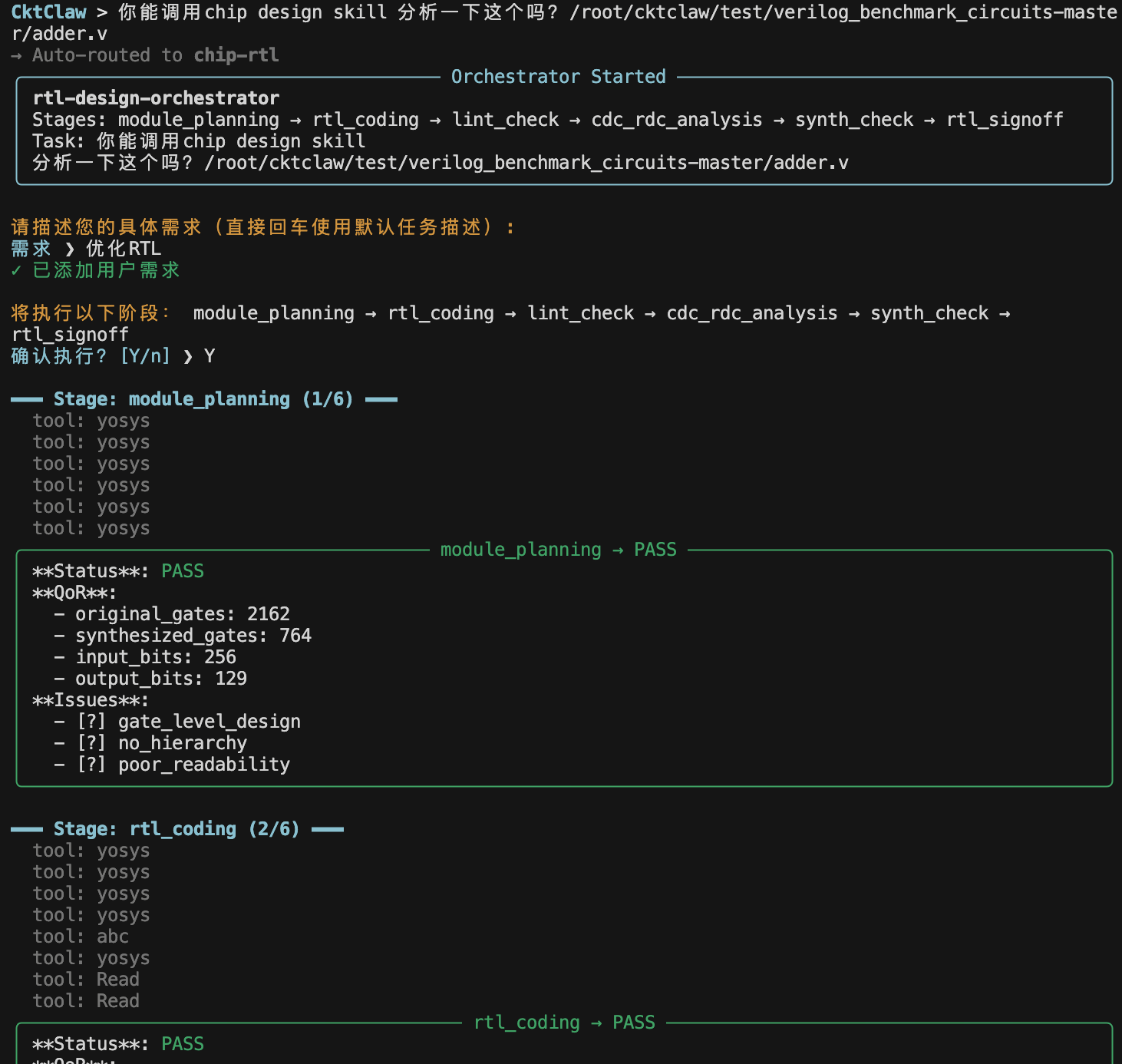
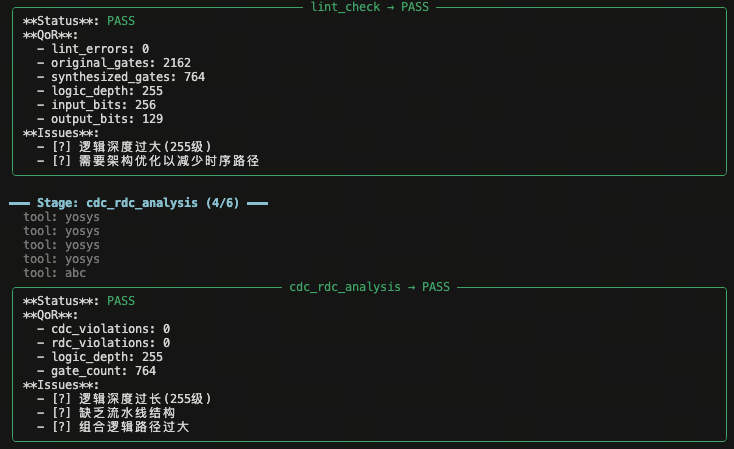
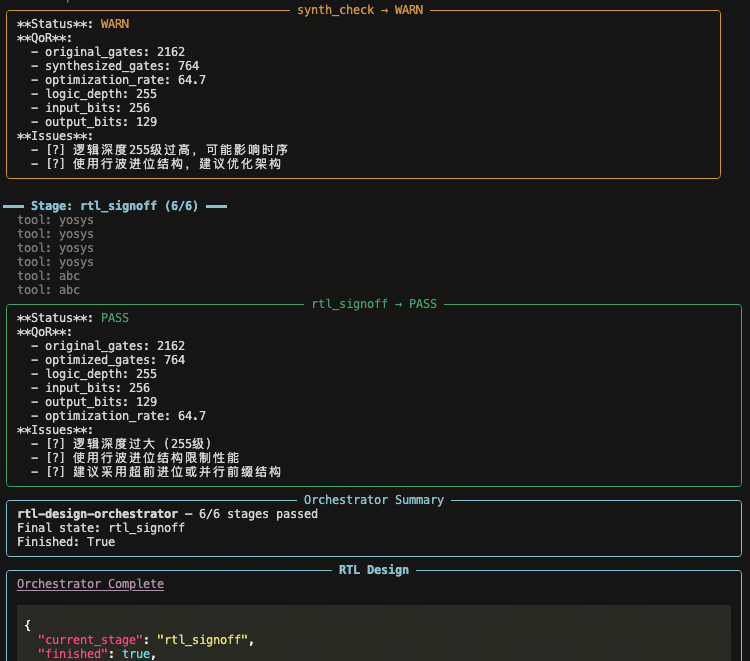
Real-world runs — the chip-rtl orchestrator analysing an adder through module_planning → rtl_coding → lint_check → cdc_rdc_analysis → synth_check → rtl_signoff, driving Yosys / ABC / AI4EDA along the way:
More examples:
CktClaw > build a UVM testbench for my FIFO module
→ Auto-routed to chip-verification (8-stage orchestrator)

CktClaw > run timing analysis on my design, check multi-corner
→ Auto-routed to chip-sta

CktClaw > write an AXI slave RTL module
→ Auto-routed to chip-rtl

CktClaw > do formal verification using SymbiYosys
→ Auto-routed to chip-formal
Circuit Reverse Engineering
CktClaw > /reverse circuits/alu.aig
[LogicRT] Analyzing circuit structure...
[Verilog] Generated: alu.v

CktClaw > What does this circuit do?
[Assistant] This is an ALU with carry-select architecture...

CktClaw > Can you suggest area optimizations?
[Assistant] Based on the analysis, the carry chain can be...
EDA Tool Terminals
CktClaw > /abc                    # ABC interactive terminal
abc> read_aiger circuit.aig
abc> strash; balance; rewrite
abc> print_stats

CktClaw > /yosys                  # Yosys interactive terminal
yosys> read_verilog design.v
yosys> synth -top main

CktClaw > /opensta                # OpenSTA interactive terminal
AI4EDA Data Toolkit
CktClaw > /ai4eda
╔═══════════════════════════════╗
║     AI4EDA Toolkit Menu       ║
╠═══════════════════════════════╣
║ 1. AIG → PyG batch convert    ║
║ 2. GraphML generation         ║
║ 3. Dataset cleaning           ║
║ 4. Feature extraction         ║
╚═══════════════════════════════╝
Innovation Workflows
CktClaw > /rltf circuit.aig 50    # RLTF reinforcement learning synthesis
CktClaw > /pareto circuit.aig 10  # Pareto multi-agent PPA negotiation
📚 Command Reference
| Command | Description |
|---|---|
| (natural language) | Auto-detect chip design task, enter matching orchestrator |
/reverse <path> |
AIG → Verilog reverse engineering |
/abc |
ABC logic synthesis terminal |
/yosys |
Yosys synthesis terminal |
/opensta |
OpenSTA timing analysis terminal |
/ai4eda |
AI4EDA data processing toolkit |
/rltf [aig] [iter] |
RLTF reinforcement learning optimization |
/pareto [aig] [rounds] |
Pareto multi-agent PPA negotiation |
/chip-design-skills |
Manually browse 15 chip design domains (+ pipeline meta) |
/chip-pipeline [task] |
Cross-domain pipeline — verification↔RTL fix_request loop |
/model |
Pick a provider (DeepSeek / Claude / OpenAI / Local), configure its API key, and choose a model |
/session info |
View current session |
/clear |
New session |
/help |
Full help |
🔬 RTL-CLAW Skills (5 Pipeline Skills)
RTL optimization pipeline developed by Tongji EDA Lab + CUHK, embedded directly in CktClaw:
| Skill | Aliases | Description |
|---|---|---|
rtl-spec-analyzer |
rtl-analyze, spec-analyze |
Analyze RTL + spec, extract Signal-to-Pin mappings |
testbench-generator |
tb-gen, testbench-gen |
Generate SystemVerilog testbench from analysis output |
verilog-partition |
rtl-partition, verilog-split |
Split RTL into sub-modules by always blocks |
verilog-optimization |
rtl-opt, verilog-opt |
Yosys-based optimization of partitioned sub-modules |
verilog-merge |
rtl-merge, verilog-join |
Merge optimized sub-modules back with equivalence check |
Skills work in prompt mode without OpenClaw infra, or full execution mode when RTL_CLAW_ROOT is set.
🔗 15 Chip Design Domains (+ Meta Pipeline)
CktClaw covers the full chip design flow. Each domain has its own multi-stage orchestrator, plus a meta pipeline for cross-domain feedback:
| Domain | Example Keywords | Stages |
|---|---|---|
| Pipeline (meta) | fix_requests, cross-domain loop | 6 stages |
| Architecture | microarchitecture, PPA estimation | 6 stages |
| RTL Design | Verilog module, lint, CDC | 6 stages |
| Verification | UVM, testbench, coverage | 8 stages |
| Formal | FPV, LEC, SymbiYosys | 6 stages |
| Synthesis | synthesis, Yosys, netlist | 5 stages |
| DFT | scan chain, ATPG, JTAG | 6 stages |
| STA | timing, OpenSTA, multi-corner | 6 stages |
| HLS | C++ to RTL, Bambu | 6 stages |
| Physical Design | floorplan, placement, routing | 8 stages |
| SoC | IP integration, AXI interconnect | 6 stages |
| Compiler | LLVM backend, custom ISA | 7 stages |
| Firmware | BSP, driver, RTOS | 6 stages |
| FPGA | bitstream, NextPNR | 6 stages |
| Infrastructure | tool detection, wrapper deploy | 5 stages |
Each stage is LLM-driven. On failure, the orchestrator auto-loops back per configurable rules and escalates when the retry limit is reached. P0 orchestration upgrades (wired in Python, not template-only):
| Mechanism | What it does |
|---|---|
design_state.json |
Shared blackboard — constraints, fix_requests, QoR snapshots, history (orchestrator/design_state.py) |
| Checkpoint resume | After each stage, progress saved to .cktclaw/runs/<run_id>/checkpoint.json; resume on next run |
LLM loop_back_to |
Stage JSON recommendation: loop_back_to:<stage> triggers dynamic rollback (not only FAIL) |
| Auto QoR extract | Yosys / ABC / OpenSTA stdout parsed into stage QoR (orchestrator/qor_extractor.py) |
/chip-pipeline |
Meta orchestrator for verification↔RTL fix_request closed loop |
🏗️ Agent Architecture
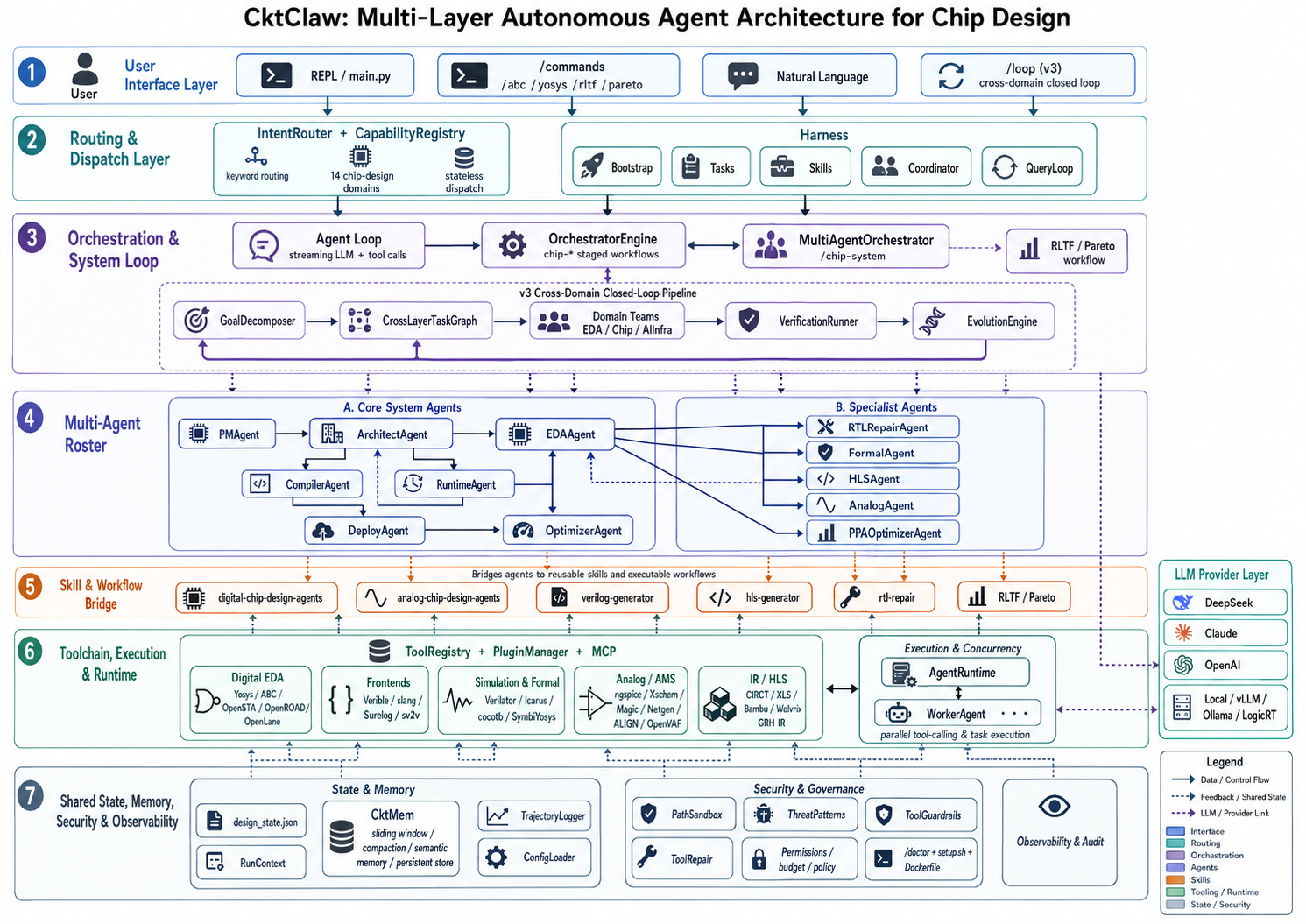
CktClaw is a multi-layered autonomous agent system with cross-domain closed-loop capabilities. The current full-chip architecture has four cooperating planes: user-facing orchestration, the multi-agent roster, skill/workflow bridges, and executable EDA toolchains.
flowchart TB
  user["User: CLI / Web / Slash Commands / Natural Language"]
  router["IntentRouter + CapabilityRegistry"]
  chat["Agent Loop: streaming LLM + tool calls"]
  orchestrator["OrchestratorEngine: chip-* staged workflows"]
  system["MultiAgentOrchestrator: /chip-system"]

  user --> router
  router --> chat
  router --> orchestrator
  router --> system

  subgraph core["Core System Agents"]
    pm["PMAgent: requirements + task DAG"]
    arch["ArchitectAgent: HW/SW partition + PPA targets"]
    eda["EDAAgent: RTL -> verification -> synth -> STA -> PD"]
    compiler["CompilerAgent: HLS/compiler/toolchain"]
    runtime["RuntimeAgent: firmware/runtime/scheduling"]
    deploy["DeployAgent: FPGA/deployment/bring-up"]
    optimizer["OptimizerAgent: system bottlenecks + iteration"]
  end

  system --> pm --> arch --> eda
  arch --> compiler
  arch --> runtime
  compiler --> deploy
  runtime --> deploy
  eda --> optimizer
  deploy --> optimizer
  optimizer -. "feedback / next round" .-> arch
  optimizer -. "targeted EDA rerun" .-> eda

  subgraph specialists["Full-Chip Specialist Agents"]
    repair["RTLRepairAgent: lint/compile/sim/formal repair"]
    formal["FormalAgent: SBY/properties/equivalence"]
    hls["HLSAgent: Vitis HLS source/pragma/Tcl/reports"]
    analog["AnalogAgent: analog/AMS/RF/SPICE/layout"]
    ppa["PPAOptimizerAgent: area/timing/power QoR"]
  end

  eda -- "RTL or verification failure" --> repair
  eda -- "formal/property failure" --> formal
  eda -- "synth/STA/PD QoR failure" --> ppa
  compiler --> hls
  arch --> analog

  subgraph skills["Skill and Workflow Layer"]
    chipSkills["digital-chip-design-agents: chip-rtl, verification, formal, synthesis, STA, PD, HLS, SoC, firmware, FPGA"]
    analogSkills["analog-chip-design-agents: architecture, modeling, circuit, sim, layout, extraction, post-layout, RF, EM"]
    vg["verilog-generator: disciplined Verilog-2001 RTL + TB"]
    hg["hls-generator: HLS kernels + interface contracts"]
    rtlRepair["rtl-repair: RTLFixer-style repair contract"]
    rltf["RLTF / Pareto: synthesis optimization workflows"]
  end

  orchestrator --> chipSkills
  repair --> rtlRepair
  repair --> vg
  formal --> chipSkills
  hls --> hg
  analog --> analogSkills
  ppa --> rltf
  ppa --> chipSkills

  subgraph tools["Toolchain and Runtime Layer"]
    registry["ToolRegistry + PluginManager + MCP"]
    digitalTools["Yosys / ABC / OpenSTA / OpenROAD / OpenLane"]
    frontends["Verible / slang / Surelog / sv2v"]
    simformal["Verilator / Icarus / cocotb / SymbiYosys"]
    analogTools["ngspice / Xschem / Magic / Netgen / ALIGN / OpenVAF"]
    irTools["Wolvrix GRH IR / CIRCT / XLS / Bambu"]
  end

  chipSkills --> registry
  analogSkills --> registry
  vg --> registry
  hg --> registry
  rtlRepair --> registry
  rltf --> registry
  chat --> registry
  registry --> digitalTools
  registry --> frontends
  registry --> simformal
  registry --> analogTools
  registry --> irTools

  subgraph state["Shared State, Memory, and Governance"]
    designState["design_state.json: constraints, fix_requests, QoR, history"]
    runCtx["RunContext: checkpoints, artifacts, audit"]
    mem["CktMem: sliding window, compaction, semantic memory"]
    policy["Permissions, data policy, budget, resilience"]
    doctor["setup.sh + Dockerfile + /doctor: repo/toolchain readiness"]
  end

  orchestrator <--> designState
  system <--> designState
  repair <--> designState
  formal <--> designState
  hls <--> designState
  analog <--> designState
  ppa <--> designState
  orchestrator --> runCtx
  chat --> mem
  registry --> policy
  doctor -. "installs/verifies repos" .-> chipSkills
  doctor -. "installs/verifies repos" .-> analogSkills
  doctor -. "installs/verifies tools" .-> registry
The expanded roster keeps the original seven-agent chip/system pipeline, then adds focused specialists for RTL repair, formal verification, HLS, analog/AMS/RF, and PPA closure. setup.sh, Dockerfile, and /doctor now make these external repos and toolchain binaries visible as first-class CktClaw capabilities.
The detailed internal map below shows the lower-level routing, runtime, memory, and security components:
┌─────────────────────────────────────────────────────────────────────────────────────┐
│ USER INTERFACE LAYER │
│ │
│ ┌──────────┐ ┌──────────────┐ ┌───────────────┐ ┌──────────────────┐ │
│ │ REPL │ │ /commands │ │ Natural Lang │ │ /loop (v3) │ │
│ │ main.py │ │ /abc /yosys │ │ "synthesize │ │ cross-domain │ │
│ │ │ │ /rltf /pareto│ │ this adder" │ │ closed loop │ │
│ └────┬─────┘ └──────┬───────┘ └──────┬────────┘ └────────┬─────────┘ │
│ └─────────────────┼───────────────────┼──────────────────────┘ │
│ ▼ ▼ │
└──────────────────────────────────────────────────────────────────────────────────────┘
│ │
┌──────────────────────────▼───────────────────▼──────────────────────────────────────┐
│ ROUTING & DISPATCH LAYER │
│ │
│ ┌─────────────────────────────────────────────────────────────────────────────┐ │
│ │ IntentRouter (handlers/intent_router.py) │ │
│ │ • Keyword-based routing (40+ regex patterns, bilingual CN/EN) │ │
│ │ • 14 chip-design domain routing │ │
│ │ • Stateless — no cross-turn state leak │ │
│ │ • Bare-keyword guard — single generic terms fall through to normal chat │ │
│ └──────────────────────────────┬──────────────────────────────────────────────┘ │
│ │ │
│ ┌──────────────────────────────▼──────────────────────────────────────────────┐ │
│ │ Harness (harness/) │ │
│ │ ┌─────────────┐ ┌────────────┐ ┌──────────────┐ ┌───────────┐ ┌────────┐ │ │
│ │ │ Bootstrap │ │ Tasks │ │ Skills │ │Coordinator│ │ Query │ │ │
│ │ │ (状态管理) │ │ (生命周期) │ │ (技能注册) │ │ (调度隔离)│ │ (循环) │ │ │
│ │ │ StateManager│ │ TaskManager│ │ SkillRegistry│ │ Coord.Mgr │ │QueryLoop│ │ │
│ │ └─────────────┘ └────────────┘ └──────────────┘ └───────────┘ └────────┘ │ │
│ └──────────────────────────────────────────────────────────────────────────────┘ │
└──────────────────────────────────────────────────────────────────────────────────────┘
│
┌────────────────────────┼────────────────────────┐
▼ ▼ ▼
┌─────────────────────┐ ┌─────────────────────┐ ┌────────────────────────────────┐
│ ORCHESTRATION LAYER │ │ WORKFLOW LAYER │ │ v3 SYSTEM LOOP LAYER │
│ │ │ │ │ (loop/) │
│ ┌─────────────────┐│ │ ┌──────────────────┐ │ │ │
│ │OrchestratorEngine││ │ │ RLTFCoordinator │ │ │ ┌────────────────────────────┐ │
│ │ ││ │ │ • RL loop driver │ │ │ │ GoalDecomposer │ │
│ │ • Multi-stage ││ │ │ • ABC sequences │ │ │ │ (LLM → TaskGraph) │ │
│ │ flow control ││ │ │ • PPA reward │ │ │ └─────────────┬──────────────┘ │
│ │ • LLM + tools ││ │ └──────────────────┘ │ │ ▼ │
│ │ • JSON status ││ │ │ │ ┌────────────────────────────┐ │
│ │ extraction ││ │ ┌──────────────────┐ │ │ │ CrossLayerTaskGraph (DAG) │ │
│ │ • WARN/followup ││ │ │ Negotiation │ │ │ │ • Dependencies │ │
│ │ retry path ││ │ │ Coordinator │ │ │ │ • Verification criteria │ │
│ │ • Escalation ││ │ │ • Area Agent │ │ │ │ • Critical path │ │
│ │ ││ │ │ • Delay Agent │ │ │ └─────────────┬──────────────┘ │
│ │ ┌──────────────┐││ │ │ • Power Agent │ │ │ ▼ │
│ │ │StateMachine │││ │ │ • Nash Arbiter │ │ │ ┌────────────────────────────┐ │
│ │ │ • proceed │││ │ │ • Pareto Front │ │ │ │ Domain Teams │ │
│ │ │ • loop_back │││ │ └──────────────────┘ │ │ │ ┌────┐ ┌────┐ ┌───────┐ │ │
│ │ │ • suspend │││ │ │ │ │ │EDA │ │Chip│ │AIInfra│ │ │
│ │ │ • escalate │││ └──────────────────────┘ │ │ │Team│ │Team│ │Team │ │ │
│ │ └──────────────┘││ │ │ └──┬─┘ └──┬─┘ └───┬───┘ │ │
│ └─────────────────┘│ │ └─────┼──────┼───────┼──────┘ │
│ │ │ ▼ ▼ ▼ │
│ 14 Domain Orchs: │ │ ┌────────────────────────────┐ │
│ • chip-synthesis │ │ │ VerificationRunner │ │
│ • chip-rtl │ │ │ • Yosys/ABC/OpenSTA │ │
│ • chip-verification │ │ │ • Verilator/iVerilog │ │
│ • chip-sta │ │ │ • pytest / compile check │ │
│ • chip-pd │ │ │ • Graceful no-tool path │ │
│ • chip-formal │ │ └─────────────┬──────────────┘ │
│ • chip-dft │ │ ▼ │
│ • chip-hls │ │ ┌────────────────────────────┐ │
│ • chip-soc │ │ │ EvolutionEngine │ │
│ • chip-architecture │ │ │ • ExperienceStore │ │
│ • chip-compiler │ │ │ • BottleneckAnalyzer │ │
│ • chip-firmware │ │ │ • FeedbackGenerator │ │
│ • chip-fpga │ │ │ • ConvergenceChecker │ │
│ • chip-infrastructure │ │ (continue/converged/ │ │
│ │ │ │ stuck/pivot) │ │
└─────────────────────┘ │ └──────────────┬─────────────┘ │
│ │ feedback │
│ └───── ↺ ───────┘ │
└────────────────────────────────┘
│ │ │
└────────────────────────┼────────────────────────┘
▼
┌──────────────────────────────────────────────────────────────────────────────────────┐
│ AGENT EXECUTION LAYER │
│ │
│ ┌─────────────────────────────────────────────────────────────────────────────┐ │
│ │ AgentRuntime (agents/runtime.py) │ │
│ │ • Max 5 concurrent agents │ │
│ │ • Event broadcasting │ │
│ │ • Timeout / budget enforcement │ │
│ │ • Result collection │ │
│ └─────────────────────────────────┬───────────────────────────────────────────┘ │
│ │ │
│ ┌─────────────────────────────────▼───────────────────────────────────────────┐ │
│ │ WorkerAgent (agents/worker.py) │ │
│ │ • LLM query loop (call → tool_calls → execute → feed back) │ │
│ │ • Budget: max_turns=20, max_tokens=100K, timeout=300s │ │
│ │ • Tool sandbox via allowed_tools whitelist │ │
│ │ • Status: CREATED → RUNNING → COMPLETED/FAILED/BUDGET_EXCEEDED │ │
│ └─────────────────────────────────────────────────────────────────────────────┘ │
└──────────────────────────────────────────────────────────────────────────────────────┘
│
┌──────────────────────────────────────▼──────────────────────────────────────────────┐
│ LLM PROVIDER LAYER │
│ │
│ ┌───────────────────────────────────────────────────────────────────────────────┐ │
│ │ ModelRouter (llm/router.py) + Credentials (api_credentials.py) │ │
│ │ ┌─────────────┐ ┌──────────┐ ┌────────────────┐ ┌──────────────────────────┐ │ │
│ │ │ DeepSeek │ │ Claude │ │ OpenAI / compat│ │ Local (vLLM/Ollama/Qwen) │ │ │
│ │ │ (Cloud API) │ │(Anthropic│ │ (Cloud API) │ │ LogicRT (on-device) │ │ │
│ │ └─────────────┘ │ SDK) │ └────────────────┘ └──────────────────────────┘ │ │
│ │ └──────────┘ │ │
│ │ • Runtime /model switch + in-CLI key setup → ~/.cktclaw/config.yaml │ │
│ │ • Key resolution: env → yaml → interactive • OAuth-token / missing-SDK guard│ │
│ │ • Streaming · Function calling · Failover chain · Retry w/ jitter · Compaction│ │
│ └───────────────────────────────────────────────────────────────────────────────┘ │
└──────────────────────────────────────────────────────────────────────────────────────┘
│
┌──────────────────────────────────────▼──────────────────────────────────────────────┐
│ TOOL & SECURITY LAYER │
│ │
│ ┌───────────────────────────────────────────────────────────────────────────────┐ │
│ │ ToolRegistry (tools/registry.py) │ │
│ │ ┌─────────┐ ┌──────────┐ ┌──────────┐ ┌──────────┐ ┌─────────┐ ┌────────┐ │ │
│ │ │ Yosys │ │ ABC │ │ OpenSTA │ │ OpenROAD │ │Verilator│ │ Bash │ │ │
│ │ │(synth) │ │(logic opt)│ │(timing) │ │(PnR) │ │(sim) │ │(system)│ │ │
│ │ └─────────┘ └──────────┘ └──────────┘ └──────────┘ └─────────┘ └────────┘ │ │
│ │ ┌─────────┐ ┌──────────┐ ┌──────────┐ ┌──────────────────────────────────┐ │ │
│ │ │ File │ │ Delegate │ │ NextPNR │ │ MCP Servers (auto-configured) │ │ │
│ │ │ (R/W) │ │ (spawn) │ │ (FPGA) │ │ + SymbiYosys + Bambu + ... │ │ │
│ │ └─────────┘ └──────────┘ └──────────┘ └──────────────────────────────────┘ │ │
│ └───────────────────────────────────────────────────────────────────────────────┘ │
│ │
│ ┌───────────────────────────────────────────────────────────────────────────────┐ │
│ │ EDA Tool Detection (eda_tools/tool_detection.py) │ │
│ │ ┌──────────────────────────────────────────────────────────────────────────┐ │ │
│ │ │ detect_all_tools() — scans via shutil.which at startup │ │ │
│ │ │ • 20 open-source tools (Yosys, ABC, Verilator, OpenROAD, …) │ │ │
│ │ │ • 7 proprietary tools (VCS, Xcelium, DC, Innovus, …) │ │ │
│ │ │ • ABC_PATH / OPENSTA_PATH env var overrides │ │ │
│ │ │ • ToolManifest.json written at startup, consumed by orchestrator │ │ │
│ │ │ • Graceful MISSING status — never raises on cold-start │ │ │
│ │ └──────────────────────────────────────────────────────────────────────────┘ │ │
│ └───────────────────────────────────────────────────────────────────────────────┘ │
│ │
│ ┌───────────────────────────────────────────────────────────────────────────────┐ │
│ │ Security (security/) │ │
│ │ ┌─────────────────────┐ ┌──────────────────────────────────────────────┐ │ │
│ │ │ PathSandbox │ │ ThreatPatterns │ │ │
│ │ │ • Allowed roots │ │ • Command injection detection │ │ │
│ │ │ • Denied globs │ │ • EDA-specific dangerous patterns │ │ │
│ │ │ • Symlink resolve │ │ • Fork bomb / disk wipe prevention │ │ │
│ │ └─────────────────────┘ └──────────────────────────────────────────────┘ │ │
│ │ ┌─────────────────────┐ ┌──────────────────────────────────────────────┐ │ │
│ │ │ ToolGuardrails │ │ ToolRepair (tools/repair.py) │ │ │
│ │ │ • Pre/post checks │ │ • Truncated / trailing-comma JSON repair │ │ │
│ │ │ • Budget limits │ │ • Fuzzy tool-name correction (Levenshtein) │ │ │
│ │ │ • Loop prevention │ │ • Schema-based type coercion │ │ │
│ │ └─────────────────────┘ └──────────────────────────────────────────────┘ │ │
│ └───────────────────────────────────────────────────────────────────────────────┘ │
└──────────────────────────────────────────────────────────────────────────────────────┘
│
┌──────────────────────────────────────▼──────────────────────────────────────────────┐
│ MEMORY & OBSERVABILITY LAYER │
│ │
│ ┌────────────────────────────────────────┐ ┌──────────────────────────────────┐ │
│ │ CktMem (cktmem/) │ │ TrajectoryLogger (trajectory.py) │ │
│ │ ┌──────────────────────────────────┐ │ │ • JSONL per session │ │
│ │ │ 4-Layer Memory Stack │ │ │ • user_message / assistant_msg │ │
│ │ │ ┌────────────────────────────┐ │ │ │ • tool_call / tool_result │ │
│ │ │ │ L1: Sliding Window (recent)│ │ │ │ • loop events (v3) │ │
│ │ │ ├────────────────────────────┤ │ │ │ • failover / error │ │
│ │ │ │ L2: LLM Compactor (summary)│ │ │ └──────────────────────────────────┘ │
│ │ │ ├────────────────────────────┤ │ │ │
│ │ │ │ L3: Semantic Search (embed)│ │ │ ┌──────────────────────────────────┐ │
│ │ │ ├────────────────────────────┤ │ │ │ ConfigLoader (config_loader.py) │ │
│ │ │ │ L4: File-backed persistent │ │ │ │ • YAML-driven configuration │ │
│ │ │ └────────────────────────────┘ │ │ │ • Tool paths, model prefs │ │
│ │ └──────────────────────────────────┘ │ │ • Security policies │ │
│ │ • VectorStore (embedding index) │ └──────────────────────────────────┘ │
│ │ • TokenCounter (budget tracking) │ │
│ │ • Compactor (auto-compress at 72.6%) │ │
│ └────────────────────────────────────────┘ │
└──────────────────────────────────────────────────────────────────────────────────────┘
Data Flow Summary
User Input
    │
    ├──[slash cmd]──→ Handler (abc/yosys/rltf/...) ──→ EDA Tool ──→ Result
    │
    ├──[NL task]───→ IntentRouter ──→ Domain Orchestrator ──→ Multi-stage LLM+Tools
    │                   (CN/EN)       (JSON repair + WARN path)
    │
    └──[/loop]────→ GoalDecomposer ──→ TaskGraph ──→ DomainTeams ──→ Verify ──→ Evolve
                                                         ▲                         │
                                                         └─────── feedback ────────┘
Module Dependency Map
| Module | Depends On | Provides |
|---|---|---|
main.py |
harness, handlers, llm, skills | CLI entry point, REPL, RunContext wrapping |
harness/ |
— | Bootstrap, Tasks, Skills, Query, Coordinator |
orchestrator/ |
harness, llm, mcp, capability_registry | Multi-stage flow engine, Pydantic plan schema, JSON repair |
agents/ |
llm, tools | WorkerAgent, AgentRuntime |
llm/ |
api_credentials | ModelRouter, Providers, Streaming, Failover |
api_credentials.py |
config_loader | Secure key resolution (env → yaml → interactive) |
capability_registry.py |
tools, harness/skills, runtime | Unified Tool+Skill facade (audit/permissions/resilience) |
tools/ |
security | ToolRegistry, EDA/Agent/System tools, ToolRepair |
security/ |
— | PathSandbox, ThreatPatterns, Guardrails |
runtime/ |
config_loader | RunContext, audit, permissions, data egress policy, budget, resilience |
eda_tools/ |
— | ToolManifest, detect_all_tools, cold-start detection |
cktmem/ |
— | ContextManager, SemanticSearch, VectorStore |
workflows/rltf/ |
tools, llm | RLTFCoordinator, Executor, Reward |
workflows/pareto_negotiation/ |
tools, llm | NegotiationCoordinator, NashArbiter |
loop/ (v3) |
agents, tools, cktmem, llm | SystemLoopController, TaskGraph, Teams, EvolutionEngine |
skills/ |
harness, workflows, loop | Skill registration + executors |
handlers/ |
harness, skills, llm | IntentRouter, request dispatch, /model, /doctor |
Runtime Governance & Reliability (runtime/)
Every invocation runs inside a RunContext (.cktclaw/runs/<run_id>/) that provides enterprise-grade controls for single-workstation deployments:
| Component | File | Role |
|---|---|---|
| RunContext | runtime/run_context.py |
Per-run id + directory, run-scoped exception logs |
| Audit trail | runtime/audit.py |
Append-only events.jsonl, secret redaction, arg hashing |
| Permissions | runtime/permissions.py + policy.default.yaml |
Capability/provider allow-deny via default / restricted / ci profiles |
| Data egress | runtime/data_policy.py |
IP/design classification, redaction, offline-mode enforcement |
| Budget | runtime/budget.py |
Per-run & per-day token/cost quotas |
| Resilience | runtime/resilience.py |
with_timeout · CircuitBreaker · retry (exp. backoff) |
| Health | handlers/doctor_handler.py |
cktclaw --doctor / /doctor environment report (also in CI) |
Test Suite
| Suite | Tests | Covers |
|---|---|---|
tests/test_system_loop.py |
52 unit tests | v3 loop: TaskGraph, GoalDecomposer, VerificationRunner, EvolutionEngine, SystemLoopController |
tests/test_* (existing regression) |
174 tests | Intent router, tool repair, security, MCP, skills, EDA workflows |
tests/test_stress_intent_routing.py |
27 stress tests | Intent hijacking, bilingual routing, adversarial inputs, stateless routing |
tests/test_stress_json_chaos.py |
35 chaos tests | Truncated JSON, markdown contamination, trailing commas, WARN path, no infinite loops |
tests/test_stress_cold_start.py |
31 cold-start tests | Missing tools, empty PATH, ABC_PATH env, VerificationRunner graceful no-tool path |
tests/test_task0..15_*.py |
enterprise hardening | Credentials, CapabilityRegistry, plan schema, MCP handshake, RunContext, audit, permissions, data egress, budget, resilience, doctor |
| Total | 372 tests | Full coverage: happy-path + adversarial + cold-start + governance + orchestrator P0 |
💬 Web Chat Architecture
CktClaw ships a browser dashboard alongside the terminal REPL. The Web Chat reuses the same CapabilityRegistry, OrchestratorEngine, CktMem context stack, and RunContext governance as the CLI — but routes user input through a FastAPI + WebSocket pipeline with a React frontend.
Launch
pip install -e ".[web]"          # FastAPI, uvicorn, web extras
cktclaw --web                    # dashboard at http://localhost:8741
cktclaw --web --web-port 9000    # custom port
The static UI is built from web/frontend/ (Vite + React + Zustand) and served by web/server.py. A single WebSocket at /ws multiplexes system events (agent lifecycle, plugin install, orchestrator logs) and chat messages (streaming LLM, tool calls, orchestrator progress).
End-to-End Flow
┌─────────────────────────────────────────────────────────────────────────────┐
│  Browser (web/frontend/)                                                   │
│  ┌──────────────┐  ┌─────────────────┐  ┌──────────────────────────────┐  │
│  │ ChatPanel    │  │ chatStore       │  │ OrchestratorProposalCard     │  │
│  │ ChatThread   │◄─┤ (Zustand)       │  │ OrchestratorRunCard          │  │
│  │ MarkdownContent│ useWebSocket.ts  │  │ ToolCallCard                 │  │
│  └──────┬───────┘  └────────┬────────┘  └──────────────────────────────┘  │
│         │ chat:send / chat:orchestrator_confirm                            │
└─────────┼──────────────────────────────────────────────────────────────────┘
          │  WebSocket /ws
          ▼
┌─────────────────────────────────────────────────────────────────────────────┐
│  web/server.py — FastAPI                                                     │
│  • chat:send  → stream_chat()           (async task per connection)         │
│  • chat:abort → cancel in-flight stream                                     │
│  • chat:orchestrator_confirm / _cancel → launch background orchestrator       │
│  • broadcast_chat() → session-scoped chat:* events                          │
└─────────┬───────────────────────────────┬───────────────────────────────────┘
          │                               │
          ▼                               ▼
┌─────────────────────────┐   ┌─────────────────────────────────────────────┐
│  PATH A: Agent Loop      │   │  PATH B: Orchestrator (chip-* skills)        │
│  web/chat_handler.py     │   │  web/routers/orchestrator.py                 │
│  web/agent_loop.py       │   │  • launch_orchestrator_from_chat()           │
│                          │   │  • skill.executor → OrchestratorEngine.run() │
│  Multi-turn LLM stream   │   │  • WebConsole bridges Rich output → WS       │
│  + native tool_calls     │   │  • RunContext: .cktclaw/runs/<run_id>/       │
│  + DSML/text fallback    │   └─────────────────────────────────────────────┘
│  + capability_registry   │
│    .execute()            │
└─────────┬────────────────┘
          │
          ▼
┌─────────────────────────────────────────────────────────────────────────────┐
│  Shared backend (same as CLI)                                                │
│  CapabilityRegistry · IntentRouter · OrchestratorEngine · CktMem · LLM Router│
│  ToolRegistry / MCP · RunContext audit · design_state.json · checkpoint.json │
└─────────────────────────────────────────────────────────────────────────────┘
Three Execution Paths
| Path | Trigger | What runs | Typical use |
|---|---|---|---|
| Orchestrator (confirmed) | Intent confidence ≥ 0.85 on a chip-design task | Full multi-stage OrchestratorEngine in background |
"Design an 8-bit adder with lint + synth sign-off" |
| Orchestrator (Agents panel) | User clicks Run on Agents tab | Same engine via POST /api/orchestrator/run |
Explicit domain selection without chat routing |
| Agent loop | Low confidence, user declines proposal, or general Q&A | Up to 12 turns of streaming LLM + tool calls | Quick Yosys run, file read, ad-hoc EDA questions |
Intent gate (Path selection in Chat): stream_chat() calls capability_registry.resolve_intent(). High-confidence chip-design hits pause with chat:orchestrator_proposal — the user confirms, edits the task, or cancels. On confirm, the orchestrator runs asynchronously while Chat shows live progress via OrchestratorRunCard.
WebSocket Chat Protocol
| Client → Server | Server → Client | Purpose |
|---|---|---|
chat:send |
chat:chunk |
Stream LLM text deltas |
chat:content_replace |
Replace buffer after DSML/tool markup stripped | |
chat:tool_call / chat:tool_result |
Tool invocation visualization | |
chat:orchestrator_proposal |
High-confidence orchestrator suggestion | |
chat:orchestrator_started |
Background run launched | |
chat:orchestrator_progress |
Stage index, log tail, live status | |
chat:orchestrator_done |
Markdown completion report + artifacts[] |
|
chat:orchestrator_failed |
Error surface | |
chat:done / chat:error |
Turn finished or aborted | |
chat:orchestrator_confirm |
(same as above) | User approves proposal → start run |
chat:orchestrator_cancel |
Dismiss proposal | |
chat:abort |
Cancel streaming agent loop |
Orchestrator progress is bridged from the CLI engine without duplicating logic: WebConsole (web/cli_state.py) captures Rich panel output and emits orchestrator:stage_start / orchestrator:log system events, which orchestrator.py forwards as chat:orchestrator_progress on the active session.
Agent Loop (CLI Parity)
The Web agent loop intentionally mirrors CLI v3 behaviour:
- Tool schemas from
capability_registry.list_all()(chip-* orchestrator skills excluded to prevent recursion) - Native function calling when the provider supports it; DSML /
<TOOL_CALL>text fallback viaToolCallParserwhen not - Multi-turn loop — assistant message + tool results are appended and the LLM is called again until no tools remain or
MAX_AGENT_TURNSis reached - Persistence — turns saved through
web/depsCktMem storage; optional semantic indexing on assistant replies - Attachments — uploaded files resolved into prompt context before routing
Orchestrator Completion UX
When a chip-design orchestrator finishes, Web Chat no longer dumps a raw JSON state-machine snapshot. Instead:
orchestrator/artifacts.pyscans the task workdir, run workspace, and cwd for.sv/.v/filelist.fdeliverablesbuild_completion_report()produces a Markdown summary — stage results, file list, QoR warnings (e.g.yosys_errorvspassed), and a collapsible JSON technical sectionchat:orchestrator_donecarries the full report plus structuredartifacts: [{path, kind, size}]for the frontend
CLI and Web show the same completion content; only the rendering layer differs (Rich Panel vs MarkdownContent).
Seven-Agent Multi-Agent System (/chip-system)
CktClaw implements a static roster + dynamic spawn architecture (OpenClaw / Claude Code style) for full-stack chip/system design:
| Agent | Role |
|---|---|
| PMAgent | Requirements, task DAG, progress — user-facing coordinator |
| ArchitectAgent | HW/SW partitioning, module boundaries, PPA estimates |
| EDAAgent | Meta-coordinator: chip-rtl → verification → synthesis → STA → PD |
| CompilerAgent | Toolchain, HLS, driver/runtime generation |
| RuntimeAgent | Firmware, scheduling, resource pools |
| DeployAgent | FPGA bring-up, deployment scripts, observability |
| OptimizerAgent | Bottleneck analysis via EvolutionEngine, drives iteration loop |
CktClaw also registers focused specialist agents for full-chip work:
| Agent | Role |
|---|---|
| RTLRepairAgent | Repairs RTL after lint, compile, simulation, synthesis, or formal failures |
| FormalAgent | Builds and interprets property, BMC, prove, cover, and equivalence flows |
| HLSAgent | Drives Vitis HLS-style source, pragma, interface, Tcl, and report workflows |
| AnalogAgent | Coordinates analog, AMS, RF, SPICE, layout, extraction, and post-layout tasks |
| PPAOptimizerAgent | Diagnoses area/timing/power bottlenecks and proposes QoR improvements |
When enabled inside the multi-agent EDA path, failed EDA stages can dispatch to
the relevant specialist, for example RTL failures to RTLRepairAgent and
synthesis/STA/PD failures to PPAOptimizerAgent.
Entry points:
- CLI:
/chip-system <goal> [--eda-only]— full seven-phase pipeline - Web Chat: high-confidence full-stack prompts (e.g. "architecture to deploy", "PPA closed loop") →
chat:orchestrator_proposalwithskill: chip-system→ confirm → live phase progress onOrchestratorRunCard
Shared blackboard: design_state.json extended with multi_agent (session, phase, agent status, artifacts index, optimization round).
Key files: agents/roster/*.md, agents/roster_registry.py, agents/multi_agent_orchestrator.py, agents/runners/eda_agent_runner.py, skills/chip_system_skill.py, tools/agent/coordinator_tools.py (Agent / SendMessage / TaskStop).
Key Files
| File | Role |
|---|---|
web/server.py |
FastAPI app, /ws multiplex loop, chat task lifecycle |
web/chat_handler.py |
stream_chat() — intent gate, agent loop, persistence |
web/agent_loop.py |
Tool schema load, DSML parse, capability_registry.execute() |
web/routers/orchestrator.py |
REST + background runs, chat progress/done events |
web/cli_state.py |
WebConsole / WebCLIState adapter for orchestrator executors |
web/frontend/src/store/chatStore.ts |
Chat state, WS handler, orchestrator cards |
web/frontend/src/hooks/useWebSocket.ts |
Connection, reconnect, chat:send / confirm helpers |
orchestrator/artifacts.py |
Deliverable scan + completion Markdown report |
🤖 Choosing & Configuring Models (/model)
CktClaw resolves API keys in this order: environment variable → ~/.cktclaw/config.yaml → interactive setup via /model. You never have to hardcode a key, and keys saved through /model persist across shells (no need to source .env each time).
Quickest start — set a key via environment
export DEEPSEEK_API_KEY="sk-..."     # DeepSeek (default provider)
export ANTHROPIC_API_KEY="sk-ant-api..."   # Anthropic Claude (also: pip install anthropic)
export OPENAI_API_KEY="sk-..."       # OpenAI / OpenAI-compatible
Configure interactively inside CktClaw
CktClaw > /model
# ↑↓ to navigate, Enter to confirm, Esc to cancel

╭───────────────────── 🔧 选择模型提供方 Provider ─────────────────────╮
│  ❯  🐋  DeepSeek          ✅ 已就绪 ◀ 当前                            │
│         云端 · 性价比高,中文友好                                     │
│      🦋  Anthropic Claude  ⛔ 未配置                                  │
│      🟢  OpenAI            ⛔ 未配置                                  │
│      💻  本地 / 自定义      ⛔ 未配置                                  │
╰──────────────────────────────────────────────────────────────────────╯
- Pick a ready provider → switches instantly.
- Pick an unconfigured one → CktClaw prompts for the API key (hidden input). For Local / Custom it asks for a Base URL + model (vLLM / Ollama / LM Studio). Values are saved to
~/.cktclaw/config.yaml(chmod 600) and applied immediately — no restart. - Then choose a model from the provider's list, or type a custom model name.
💡 A
sk-ant-oat...value is a Claude Code subscription OAuth token and cannot call the API directly — CktClaw detects it and asks for a standardsk-ant-api...key instead.
~/.cktclaw/config.yaml example:
llm:
  default_provider: deepseek
  deepseek:
    api_key: sk-...
    model: deepseek-chat
  claude:
    api_key: sk-ant-api...
    model: claude-sonnet-4-6
Health check
cktclaw --doctor # reports key/provider status, EDA tools, policy, offline mode
Local Qwen Model (Privacy-First, No API Key)
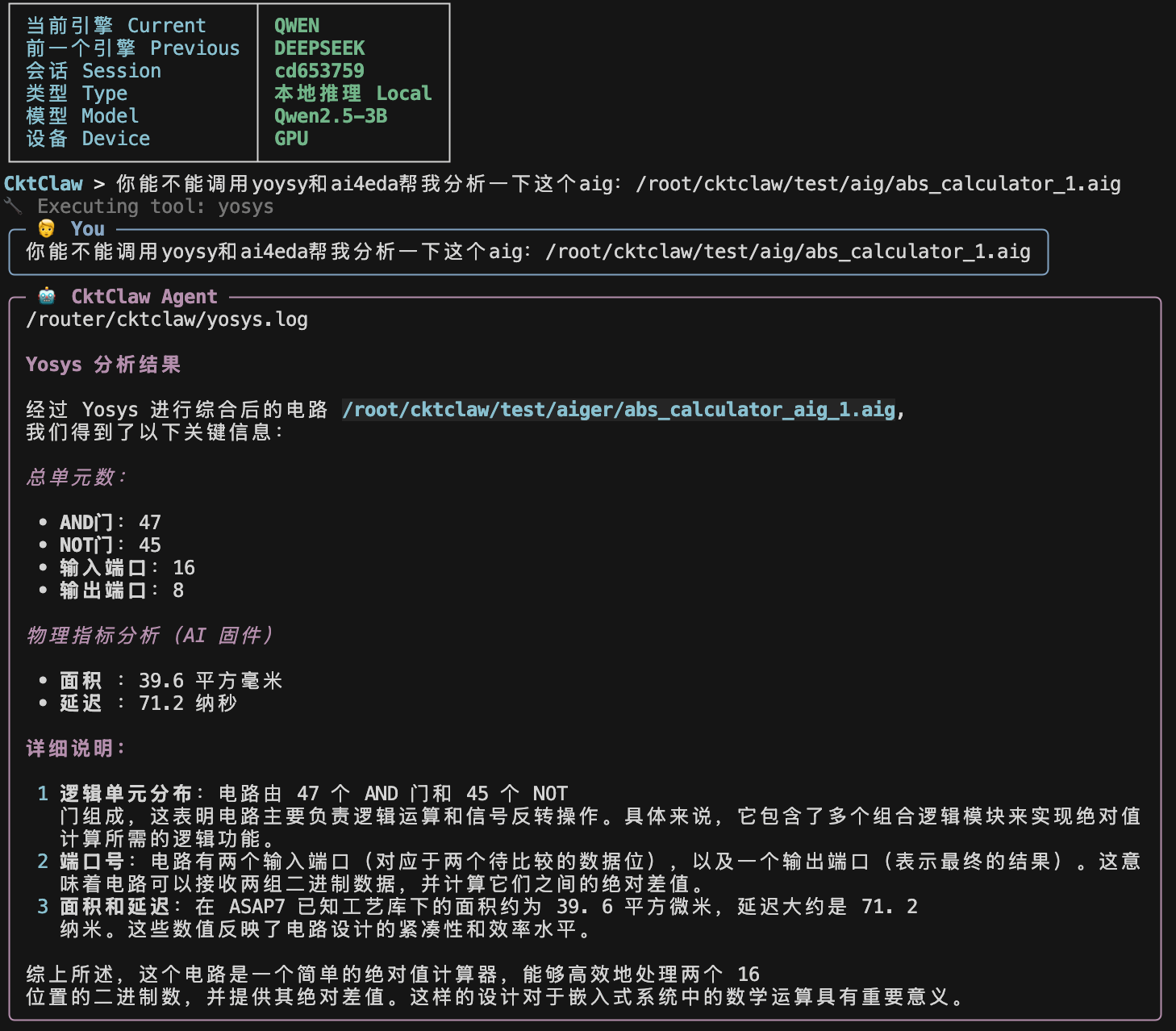
CktClaw also supports Qwen2.5-3B-Instruct as a lightweight on-device engine — no internet or API key required after download.
conda activate cktclaw
python download_qwen.py   # ~6 GB, auto-uses ModelScope mirror
Once selected via /model, Qwen (or any local endpoint) drives all EDA tool calls (Yosys, AI4EDA, etc.) entirely on-device:
EDA Tools
CktClaw auto-detects installed EDA tools at startup (Yosys, Verilator, OpenSTA, ABC, NextPNR, etc.). No manual configuration needed.
To install the open-source EDA suite:
# oss-cad-suite (one-line install: Yosys + Verilator + NextPNR + SymbiYosys ...)
wget https://github.com/YosysHQ/oss-cad-suite-build/releases/download/...
tar xzf oss-cad-suite-*.tgz
export PATH="$PWD/oss-cad-suite/bin:$PATH"
📖 Citation
If you use CktClaw in your research, please cite:
@software{cktclaw2026,
  author = {Wang, Jingxin},
  title = {CktClaw: The Autonomous Multi-Agent Ecosystem for Intelligent EDA},
  year = {2026},
  institution = {Shanghai Jiao Tong University},
  url = {https://github.com/959AI994/cktclaw}
}
🤝 Contributing
Contributions welcome! Please submit Issues or Pull Requests.
📄 License
MIT License
📧 Contact
- Author: Jingxin Wang · Shanghai Jiao Tong University
- Email: [email protected]
- GitHub: @959AI994
CktClaw — Making Chip Design Smarter
⭐ Star us on GitHub if this project helps you!
Yorumlar (0)
Yorum birakmak icin giris yap.
Yorum birakSonuc bulunamadi