dsh-computer-use
Health Pass
- License — License: MIT
- Description — Repository has a description
- Active repo — Last push 0 days ago
- Community trust — 23 GitHub stars
Code Warn
- process.env — Environment variable access in lib/cua.js
- process.env — Environment variable access in lib/vision.js
- network request — Outbound network request in lib/vision.js
Permissions Pass
- Permissions — No dangerous permissions requested
No AI report is available for this listing yet.
Cross-platform Computer Use plugin for DeepSeek Harness: observable desktop automation with an isolated virtual cursor, AX/UIA observation, screenshot vision, and 12 guarded tools.
dsh-computer-use
让 DeepSeek Harness 像人一样操作桌面。 观察屏幕、定位界面元素、移动独立虚拟光标、点击、输入、滚动和拖拽。
Give DeepSeek Harness a safe, observable Computer Use layer. Observe desktop applications, locate UI elements, and act through an isolated virtual cursor.







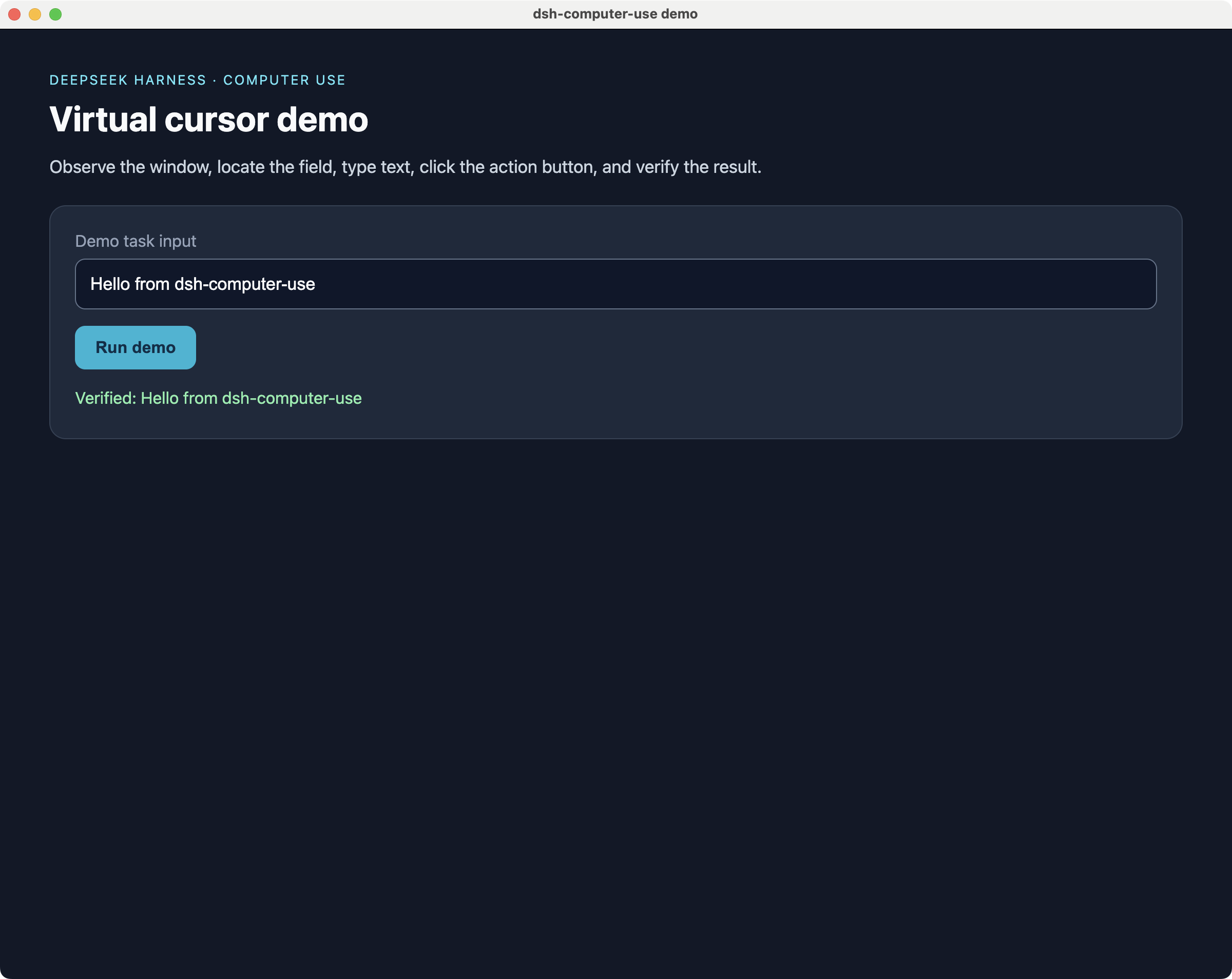
真实演示 · Real demo: a local, non-sensitive page was observed, filled, clicked, and verified through the Computer Use action loop.
中文文档 · English documentation
生态入口 · Ecosystem
| 入口 | 作用 | Link |
|---|---|---|
| harness-desktop | 开箱即用的 DeepSeek Harness 桌面客户端 · Ready-to-use desktop client | 下载 / Download |
| AI House | 发现 AI 工具、模型和 Agent · Discover AI tools and agents | 工具中心 / Tools |
| npm | 安装和查看包信息 · Install and inspect the package | dsh-computer-use |
| awesome-dsh-plugin | 发现更多 DeepSeek Harness 插件 · Discover more plugins | Plugin list |
| Gitee 镜像 | 国内访问入口 · China mirror | Gitee |
中文文档
这是什么?
dsh-computer-use 是 DeepSeek Harness 的跨平台 Computer Use 插件,为 AI Agent 增加一套可观察、可约束、可验证的桌面操作能力。
它不是传统的鼠标宏:Agent 必须先观察目标窗口,再基于新鲜快照执行动作。点击、双击和右键操作通过 cua-driver 的独立虚拟光标完成,用户可以看到操作过程,而不是让程序悄悄发送一串不可见事件。
适合用于:
- 让 DeepSeek Harness 操作原生 macOS、Windows 和 Linux 桌面应用;
- 操作 Electron、Canvas 或游戏等 Accessibility/AX 信息不完整的界面;
- 构建“打开应用 → 观察 → 点击 → 输入 → 再观察验证”的 Agent 闭环;
- 为桌面自动化、内部工具和个人工作流增加可审计的 Computer Use 执行层;
- 研究 Computer Use、视觉定位和安全护栏。
本项目是开源社区插件,不是 DeepSeek 官方产品,也不代表 DeepSeek 的官方立场。
为什么需要它?
普通文本 Agent 可以生成答案,但无法直接完成很多桌面任务。dsh-computer-use 把桌面交互拆成三个阶段:
观察 Observation → 决策 Decision → 受约束执行 Guarded Action
flowchart LR
    A[DeepSeek Harness Agent] --> B[dsh-computer-use]
    B --> C[安全护栏 Guard]
    C --> D[AX / UIA 界面树]
    C --> E[虚拟光标与键盘]
    D --> F[cua-driver]
    E --> F
    F --> G[桌面应用 Desktop Apps]
核心原则:
- 先观察,再操作:没有新鲜观察快照时,动作会被拒绝;
- 模型所见即所点:元素编号和坐标来自同一窗口截图空间;
- 语义优先:优先使用
element编号,坐标模式保留视觉操作自由度; - 失败关闭:目标不明确、快照过期、应用不在白名单时不继续执行。
能力一览
| 能力 | 说明 |
|---|---|
| 屏幕观察 | 读取目标窗口元数据、Accessibility/AX/UIA 元素和坐标 |
| 三种观察模式 | ax 零视觉 Token、native 主模型直读图片、vision 视觉观察者 |
| 独立虚拟光标 | 点击、双击、右键会显示虚拟光标移动和操作过程,不抢用户真实鼠标 |
| 文本与快捷键 | 输入文本、发送 return、cmd+c、ctrl+shift+p 等按键 |
| 滚动与拖拽 | 支持上下左右滚动和窗口本地截图坐标拖拽 |
| 应用管理 | 列出运行中的应用,后台启动应用,按需前置窗口 |
| 安全护栏 | 快照 TTL、应用白名单、危险操作审批、密码框保护 |
| 跨平台 | macOS、Windows、Linux 均已完成插件测试 |
12 个模型工具
| 工具 | 作用 | 主要参数 |
|---|---|---|
screen_observe |
获取窗口、AX/UIA 元素、坐标或截图 | window, mode, query, maxElements |
screen_zoom |
截取并放大窗口局部区域 | window_id, pid, x1, y1, x2, y2 |
computer_click |
点击元素或截图坐标 | element 或 x,y,可选 count |
computer_double_click |
双击元素或坐标 | element 或 x,y |
computer_right_click |
右键点击元素或坐标 | element 或 x,y |
computer_type |
向焦点或指定元素输入文本 | text, 可选 element |
computer_key |
发送按键或快捷键 | key,例如 return、cmd+c |
computer_scroll |
在目标窗口滚动 | direction, amount, 可选 element |
computer_drag |
拖拽窗口中的区域 | from_x, from_y, to_x, to_y |
computer_wait |
等待界面加载或动画完成 | ms,最大 60000 |
app_list |
列出正在运行的应用 | 无 |
app_launch |
启动应用 | name 或 bundle_id,可选 bring_to_front |
快速开始
方式一:使用 harness-desktop
普通桌面用户建议先下载 harness-desktop。它是一个开箱即用的 DeepSeek Harness 桌面客户端,支持 macOS、Windows 和 Linux。
1. 下载并启动 harness-desktop
2. 完成首启配置
3. 安装本插件
4. 重启 harness-desktop
5. 在对话中让 Agent 操作桌面
方式二:从 GitHub 源码安装
git clone https://github.com/988hj7tczd-oss/dsh-computer-use.git
cd dsh-computer-use

# 先预演,不写入配置
./install.sh --dry-run

# 安装到用户级 patch 层
./install.sh

# 安装后重启 harness-desktop
安装脚本只做两件事:
- 将插件链接到
$DSH_HOME/profiles/web/node_modules/dsh-computer-use; - 在
$DSH_HOME/cordis.patch.yml注册插件。
脚本使用用户级 patch 层,不修改项目代码,也不修改其他 profile 的配置。
Windows / Linux
install.sh 默认使用 macOS 的 DSH_HOME 路径。Windows 或 Linux 用户请先指定自己的 DSH home:
export DSH_HOME="/path/to/your/dsh-home"
./install.sh --dry-run
./install.sh
如果系统不支持符号链接,请使用宿主 DSH 的插件管理方式,或按照 docs/store-evidence.md 中的手动安装说明操作。
方式三:npm 包
npm install -g dsh-computer-use
安装后仍需要让 DSH profile 加载该 bundle,并确认 cua-driver 已经安装且在 PATH 中,或设置:
export CUA_DRIVER_BIN=/path/to/cua-driver
安装完成后重启宿主,再通过 app_list 或 screen_observe 验证工具是否出现。
第一个完整任务
安装并授权后,可以让 Agent 执行下面的任务:
请完成以下桌面任务:

1. 使用 app_list 列出正在运行的应用;
2. 使用 app_launch 打开一个普通桌面应用;
3. 使用 screen_observe 观察目标窗口;
4. 找到目标按钮,优先使用 element 编号点击;
5. 使用 computer_type 输入一段非敏感测试文本;
6. 再次使用 screen_observe 验证文本已经出现;
7. 如果界面发生变化,请重新观察,不要使用旧元素编号继续操作;
8. 如果动作被安全护栏拒绝,请报告拒绝原因,不要绕过护栏。
推荐的操作循环
app_list / app_launch
        ↓
screen_observe
        ↓
computer_click / computer_type / computer_key
        ↓
computer_wait(如需等待)
        ↓
screen_observe 验证结果
每一次界面明显变化后,都应重新调用 screen_observe。元素编号属于某一次观察快照,不应跨页面、弹窗或长时间等待复用。
观察模式
screen_observe 的 mode 有三种选择:
| 模式 | 原理 | 成本 | 适用场景 |
|---|---|---|---|
ax(默认) |
读取 AX/UIA 界面树并返回编号和坐标 | 不消耗视觉 Token | 原生应用、元素树完整的界面 |
native |
将截图作为图片块交给当前对话模型 | 图片 Token;不额外调用视觉观察者 | Canvas、游戏、Electron 或 AX 树为空的界面 |
vision |
通过 Harness 的 ctx.llm 调用视觉模型,返回结构化元素列表 |
额外一次视觉模型调用 | 当前主模型不支持图片输入时 |
native 模式
当前对话模型必须声明支持 image 输入,例如视觉模型。插件通过 Harness attachments 传递图片,不额外发起独立视觉 API 请求。
screen_observe(mode="native")
vision 模式
默认观察模型为:
provider: deepseek-official
model: deepseek-v4-flash-vision-exp
老版本 Harness 需要在模型配置中声明:
models:
  - id: deepseek-v4-flash-vision-exp
    input: [text, image]
当 DeepSeek 视觉观察者不可用时,插件可以尝试 GLM 视觉兜底。GLM 兜底需要 ZHIPU_API_KEY,并可能受到免费模型访问量限制。
自动降级
当 AX/UIA 树为空时,插件会尝试:
native(当前路由支持图片时)
  → vision(宿主存在可用视觉模型时)
  → ax(返回可用的界面树信息或明确错误)
坐标语义
从 v0.2.0 起,所有坐标均为:
窗口本地截图像素(window-local screenshot pixels)
这意味着:
- 坐标原点在目标窗口左上角;
screen_observe输出的@(x,y)与computer_click(x=,y=)使用同一坐标系;- 不需要乘以 2;
- 不需要加屏幕坐标或窗口偏移;
- 使用
screen_zoom时,返回图片是局部区域,但点击仍应使用整窗截图坐标。
优先使用:
computer_click(element=5)
只有在元素无法通过 AX/UIA 识别,或视觉模式给出坐标时,才使用:
computer_click(x=640, y=420)
安全模型
已内置的安全机制
- 无快照拒绝:没有先调用
screen_observe,动作不会执行; - 观察快照 TTL:快照过期后动作被拒绝,必须重新观察;
- 应用白名单:配置
allowedApps后,只允许指定应用接受操作; - 危险操作审批:元素标签命中删除、支付、购买、转账、退出登录等词时请求用户确认;
- 密码框保护:检测到
AXSecureTextField/AXPasswordField时拒绝自动输入; - 固定 argv 调用:通过宿主以非 shell 方式启动
cua-driver; - 权限边界声明:插件本身不读取用户文件、不读取凭据、不发起普通网络请求,也没有 npm lifecycle 安装脚本。
重要限制
语义安全检测依赖观察到的元素标签,主要对 element 编号模式有效:
x/y坐标模式无法提前知道目标语义,主要依赖快照 TTL 和可见操作;computer_type和computer_key作用于当前焦点时,无法预判最终目标内容;computer_key不会阻止cmd+q、ctrl+alt+delete等系统快捷键;- 不要把本插件的操作权限授予不可信 Agent;
- 密码、API Key 和其他敏感信息必须由用户本人输入。
配置
插件配置位于 DSH 的用户级 patch 层:
- id: dsh-computer-use
  config:
    ttlMs: 30000
    maxElements: 500
    allowedApps: []
    cursorTheme: com.dsh.computeruse.rainbow
    nativeImage: auto
    visionProvider: deepseek-official
    visionModel: deepseek-v4-flash-vision-exp
| 配置项 | 默认值 | 说明 |
|---|---|---|
ttlMs |
30000 |
观察快照有效期,单位毫秒;多步任务建议显式设置 30000-60000 |
maxElements |
500 |
单次观察最多返回的编号元素数量 |
allowedApps |
[] |
空数组表示不限制;非空时只允许列表中的应用 |
cursorTheme |
com.dsh.computeruse.rainbow |
虚拟光标主题;空字符串使用引擎默认主题 |
nativeImage |
auto |
auto 自动降级;full 原图;compact 始终使用小图 |
visionProvider |
deepseek-official |
vision 模式使用的 provider |
visionModel |
deepseek-v4-flash-vision-exp |
vision 模式使用的视觉模型 |
安装脚本或 bundle patch 可能覆盖代码层默认值。请以实际生成的
$DSH_HOME/cordis.patch.yml为准;多步任务建议显式写入ttlMs,不要依赖隐式默认值。
平台支持 · Platform Support
| 平台 | 状态 | 说明 |
|---|---|---|
| macOS | ✅ 已测试 | 可能需要 Accessibility 和 Screen Recording 权限 |
| Windows | ✅ 已测试 | 使用普通用户桌面会话;管理员权限窗口属于系统边界 |
| Linux | ✅ 已测试 | 桌面环境、Accessibility 栈和窗口管理器可能影响元素识别 |
测试通过不代表所有应用的界面树都完全一致。AX/UIA 不完整时,请使用 native 或 vision 模式,并在提交问题时附上操作系统、目标应用和 screen_observe 输出。
故障排查
| 现象 | 常见原因 | 处理方式 |
|---|---|---|
cua-driver not found |
引擎不在 PATH | 安装 cua-driver,或设置 CUA_DRIVER_BIN |
| 没有可见窗口 | 图形会话或窗口权限不可用 | 确认目标应用正在运行并重新观察 |
| 快照已过期 | 超过 ttlMs |
重新调用 screen_observe |
| 元素编号点击失败 | 界面已经变化 | 重新观察后再使用新编号 |
| AX/UIA 树为空 | Canvas、游戏、Electron 或特殊窗口 | 使用 native 或 vision |
| native 被拒绝 | 当前主模型没有 image 输入能力 | 切换视觉模型或使用 vision |
| vision 模型不可用 | provider/model 未注册 image 输入 | 配置 visionProvider / visionModel |
| GLM fallback 不可用 | 没有 ZHIPU_API_KEY 或遇到限流 |
配置 Key,或使用 Harness 视觉模型 |
| 危险操作被拒绝 | 需要用户审批 | 检查审批提示,不要绕过安全护栏 |
| Windows 管理员窗口无法操作 | 目标窗口权限级别更高 | 使用普通用户窗口 |
开发与验证
项目使用隔离 profile 开发,避免污染真实 GUI 配置:
npm install
npm run check

# 运行时验证需要已安装 harness-desktop 和 cua-driver
node verify-runtime.mjs
macOS headless 验证示例:
DSH_HOME=$PWD/.dsh-p0 ELECTRON_RUN_AS_NODE=1 \
  /Applications/harness-desktop.app/Contents/MacOS/harness-desktop --expose-internals \
  /Applications/harness-desktop.app/Contents/Resources/app/node_modules/@deepseek-ai/dsh/lib/bin.js \
  --profile test "请调用 screen_observe 观察当前窗口并报告"
更多证据:
相关项目
- harness-desktop:开箱即用的 DeepSeek Harness 桌面客户端;
- awesome-dsh-plugin:DeepSeek Harness 插件精选列表;
- AI House 工具中心:发现更多 AI 工具、模型和 Agent;
- cua-driver:底层跨平台桌面驱动;
- npm package:安装包和版本信息;
- Gitee mirror:国内镜像。
License
English Documentation
What is dsh-computer-use?
dsh-computer-use is a cross-platform Computer Use plugin for DeepSeek Harness. It gives an AI agent an observable, guarded, and verifiable desktop action layer.
The plugin is designed around an explicit loop:
Observe → Decide → Execute with Guardrails → Observe and Verify
It can inspect desktop windows, expose actionable AX/UIA elements, use a screenshot-based visual fallback, and operate through an isolated virtual cursor. It is useful for desktop automation, Computer Use research, internal workflows, and agentic applications that need bounded desktop actions.
This is a community plugin, not an official DeepSeek product and not affiliated with DeepSeek.
Highlights
- Observe native desktop windows and accessibility trees;
- Use
ax,native, orvisionobservation modes; - Click, double-click, right-click, type, press keys, scroll, and drag;
- Launch applications and list running applications;
- Bind actions to fresh observation snapshots;
- Restrict actions to an application allowlist;
- Request approval for risky semantic targets;
- Refuse automated typing into password fields;
- Fall back to screenshots when AX/UIA data is incomplete;
- Tested on macOS, Windows, and Linux.
Quick Start
Recommended desktop experience
Download harness-desktop, the ready-to-use DeepSeek Harness desktop client. After the host is installed, install this plugin and restart the host.
Install from source
git clone https://github.com/988hj7tczd-oss/dsh-computer-use.git
cd dsh-computer-use

./install.sh --dry-run
./install.sh
The installer creates a user-level plugin link and registers the bundle in the DSH home patch layer. It does not modify project source files or other profiles.
On Windows or Linux, set DSH_HOME to the actual DSH home directory before running the script:
export DSH_HOME="/path/to/your/dsh-home"
./install.sh
Install the npm package
npm install -g dsh-computer-use
Make sure the host loads the bundle and that cua-driver is available in PATH, or set CUA_DRIVER_BIN to its absolute path.
Tools
| Tool | Purpose | Main parameters |
|---|---|---|
screen_observe |
Observe a window, AX/UIA elements, coordinates, or a screenshot | window, mode, query, maxElements |
screen_zoom |
Capture a smaller region for visual inspection | window_id, pid, x1, y1, x2, y2 |
computer_click |
Click an element or screenshot coordinate | element or x,y; optional count |
computer_double_click |
Double-click an element or coordinate | element or x,y |
computer_right_click |
Right-click an element or coordinate | element or x,y |
computer_type |
Type into the focused or selected field | text, optional element |
computer_key |
Send a key or shortcut | key, e.g. return, cmd+c |
computer_scroll |
Scroll a target window | direction, amount, optional element |
computer_drag |
Drag between screenshot coordinates | from_x, from_y, to_x, to_y |
computer_wait |
Wait for a page load or animation | ms, max 60000 |
app_list |
List running applications | none |
app_launch |
Launch an application | name or bundle_id; optional bring_to_front |
The standard action loop
app_list / app_launch
        ↓
screen_observe
        ↓
computer_click / computer_type / computer_key
        ↓
computer_wait
        ↓
screen_observe to verify the result
A snapshot is observation-local. If the UI changes, observe again before using an element index or coordinate from the previous state.
Observation modes
| Mode | How it works | Best for |
|---|---|---|
ax |
Returns a compact AX/UIA tree with indexed elements and coordinates | Native applications with usable accessibility data |
native |
Returns the screenshot as an image block for the current multimodal model | Canvas, games, Electron, or windows with incomplete AX/UIA data |
vision |
Uses a Harness ctx.llm vision model to describe the screenshot |
Text-only main models that need a separate observer |
native requires the current route to declare image input support. vision uses the configured visionProvider and visionModel; the default model is deepseek-v4-flash-vision-exp. The optional GLM fallback requires ZHIPU_API_KEY and may be rate-limited.
When the accessibility tree is empty, the fallback order is:
native → vision → ax
The plugin chooses a path that is available and returns an explicit error when no visual route can be used.
Coordinate semantics
Since v0.2.0, all coordinates are window-local screenshot pixels:
- the origin is the top-left corner of the target window;
- coordinates returned by
screen_observeand coordinates accepted bycomputer_clickshare the same space; - do not multiply by two;
- do not add a screen or window offset;
screen_zoomreturns a cropped image, but click coordinates remain coordinates in the full-window screenshot space.
Prefer semantic element actions:
computer_click(element=5)
Use x,y when the target is not exposed through AX/UIA or when a visual observer provides coordinates.
Security model
The plugin includes:
- Observe-before-act: actions without a fresh observation are rejected;
- Snapshot TTL: expired snapshots require a new observation;
- Application allowlists:
allowedAppscan restrict the operation scope; - Risky-action approval: labels such as delete, pay, purchase, transfer, or sign out can require user approval;
- Password-field protection: automated typing into password fields is refused;
- Fixed non-shell driver invocation: the host starts
cua-driverwith fixed argv; - Explicit permission boundaries: the plugin does not read user files, credentials, or use npm lifecycle scripts.
Semantic checks are strongest for element-based actions. Coordinate actions and unfocused computer_type/computer_key calls cannot predict the final semantic target. computer_key does not validate system shortcuts. Do not give this capability to an untrusted agent, and always type passwords and secrets yourself.
Configuration
- id: dsh-computer-use
  config:
    ttlMs: 30000
    maxElements: 500
    allowedApps: []
    cursorTheme: com.dsh.computeruse.rainbow
    nativeImage: auto
    visionProvider: deepseek-official
    visionModel: deepseek-v4-flash-vision-exp
| Option | Default | Description |
|---|---|---|
ttlMs |
30000 |
Observation lifetime in milliseconds |
maxElements |
500 |
Maximum indexed elements returned by observation |
allowedApps |
[] |
Empty means unrestricted; otherwise only listed apps are allowed |
cursorTheme |
com.dsh.computeruse.rainbow |
Virtual cursor theme; empty uses the engine default |
nativeImage |
auto |
auto, full, or compact screenshot strategy |
visionProvider |
deepseek-official |
Provider used by vision mode |
visionModel |
deepseek-v4-flash-vision-exp |
Image-capable observer model |
If an installer or bundle patch overrides the code-level default, the generated $DSH_HOME/cordis.patch.yml is authoritative. For multi-step tasks, set ttlMs explicitly instead of relying on an implicit default.
Platform support
| Platform | Status | Notes |
|---|---|---|
| macOS | ✅ Tested | Accessibility and Screen Recording permissions may be required |
| Windows | ✅ Tested | Use a regular-user desktop session; elevated windows remain a system boundary |
| Linux | ✅ Tested | Desktop environment, accessibility stack, and window manager can affect element discovery |
All three platforms have passed plugin testing. This does not mean every application exposes an identical accessibility tree. For incomplete AX/UIA data, use native or vision and include the OS, target application, and observation output in bug reports.
Troubleshooting
| Symptom | Likely cause | Action |
|---|---|---|
cua-driver not found |
Driver is not in PATH |
Install it or set CUA_DRIVER_BIN |
| No visible windows | Missing graphical session or permission | Confirm the target app is visible and observe again |
| Snapshot expired | ttlMs elapsed |
Call screen_observe again |
| Element click failed | The UI changed | Observe again and use the new index |
| Empty AX/UIA tree | Canvas, game, Electron, or special window | Use native or vision |
native rejected |
Main route is not image-capable | Switch to an image-capable model or use vision |
| Vision model unavailable | Provider/model lacks image input declaration | Configure visionProvider / visionModel |
| GLM fallback unavailable | Missing ZHIPU_API_KEY or rate limit |
Configure the key or use a Harness vision model |
| Risky action rejected | User approval was not granted | Follow the approval result; do not bypass the guard |
| Windows elevated window rejected | Target has a higher privilege level | Use a regular-user window |
Development and verification
npm install
npm run check
node verify-runtime.mjs
The runtime verification requires a working harness-desktop installation and cua-driver. Additional evidence is available in:
Ecosystem
- harness-desktop — a ready-to-use DeepSeek Harness desktop client;
- awesome-dsh-plugin — a curated list of DeepSeek Harness plugins;
- AI House Tools — discover AI tools, models, and agents;
- cua-driver — the underlying cross-platform desktop driver;
- npm package — package versions and downloads;
- Gitee mirror — China mirror.
License
Not affiliated with DeepSeek. DeepSeek Harness is an open-source project by DeepSeek AI.
Reviews (0)
Sign in to leave a review.
Leave a reviewNo results found