claude-booping
Health Warn
- License — License: MIT
- Description — Repository has a description
- Active repo — Last push 0 days ago
- Low visibility — Only 5 GitHub stars
Code Pass
- Code scan — Scanned 12 files during light audit, no dangerous patterns found
Permissions Pass
- Permissions — No dangerous permissions requested
This agent provides a self-learning scrum and sprint workflow for Claude Code, turning feature requests into an iterative development loop. It manages project artifacts like plans, retrospectives, and lessons in local markdown files organized in an Obsidian-ready folder structure.
Security Assessment
The tool poses a Low overall security risk. It requires access to the local filesystem to create and manage markdown files within a specific directory, but it does not request inherently dangerous system permissions. The automated code scan of 12 files found no dangerous patterns, malicious code, or hardcoded secrets. It does optionally integrate with the Gemini API for cross-validation during the grooming phase, which requires configuring an environment variable (`GEMINI_API_KEY`). While the tool itself does not hardcode secrets, users should be aware that this network request to a third-party AI service will send local project details to Google for analysis. It operates primarily as a local workflow wrapper.
Quality Assessment
The project is actively maintained, with its most recent push occurring just today. It uses the standard and highly permissive MIT license. The biggest drawback is its extremely low community visibility and adoption, currently sitting at only 5 GitHub stars. The documentation is comprehensive, realistic about its beta status, and explicitly targets experienced developers who can critically review code rather than blindly trust automated outputs.
Verdict
Safe to use, provided you review the generated code and are comfortable with optional Gemini API data sharing.
Self-learning scrum workflow for Claude Code
booping
A self-learning, project-scoped sprint workflow for Claude Code. booping turns a feature idea into a durable, on-disk loop — groom → develop → retro → learn — that effectively utilizes sub-agents to avoid context rot and cross-validates each plan against Gemini before development begins. Every artifact (plans, retros, lessons, sprint snapshots) lives under ~/Claude/{project}/, one folder per codebase, so weeks-long programs stay legible long after the session ends.
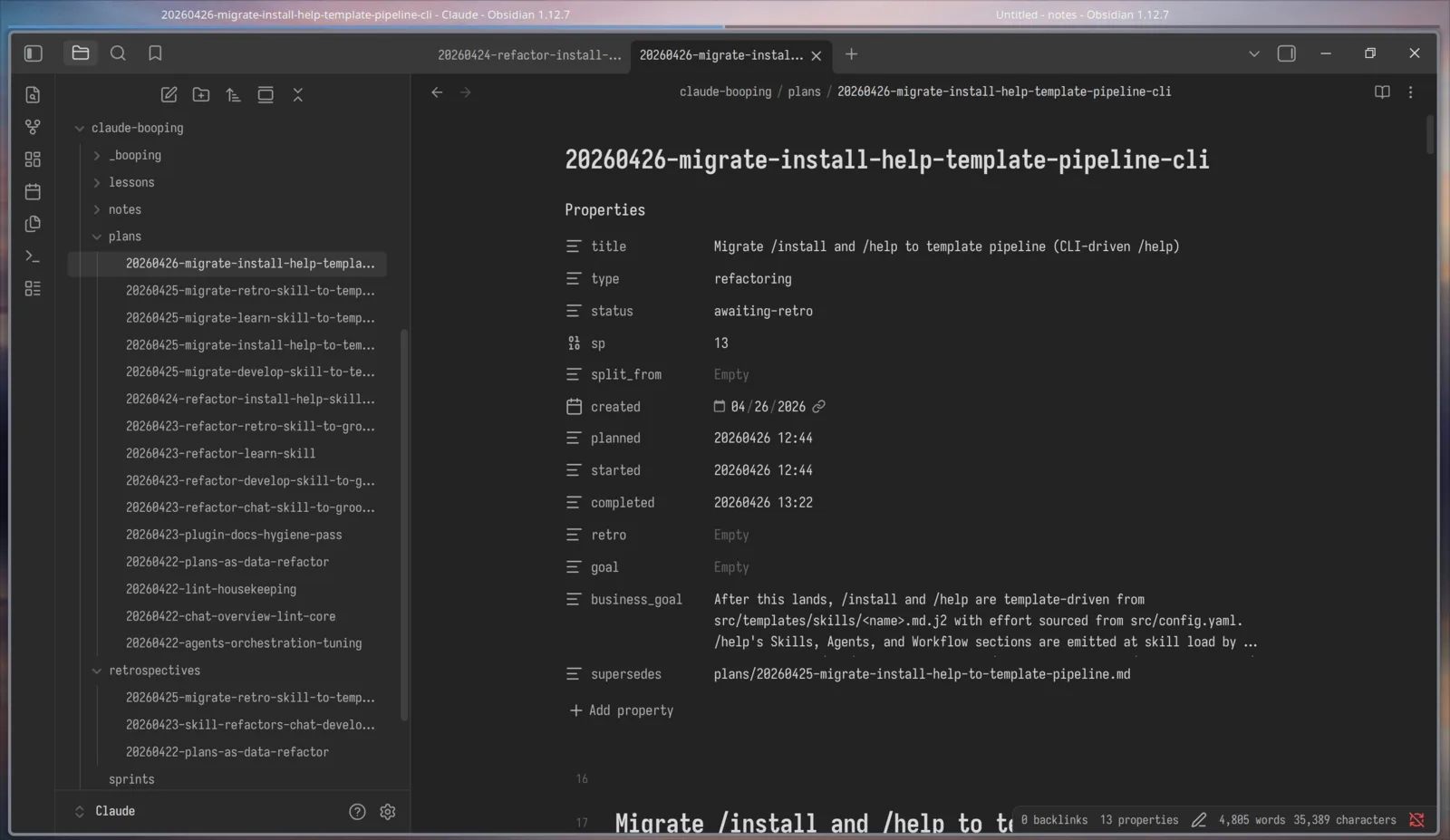
Each project's vault is a plain Obsidian-friendly folder of markdown files.
Obsidian-ready by design
The vault at ~/Claude/{project}/ is markdown-only with YAML frontmatter that Obsidian renders natively as Properties. One vault per project, side-by-side with whatever else you keep in ~/Claude/. No proprietary database, no lock-in — just files you can grep, version, and edit by hand.
Disclaimer
booping is aimed at experienced developers and tech leads — people comfortable making architectural calls, decomposing work, and reviewing code critically. The skills assume you can tell a sharp plan from a vague one and a sound diff from a sloppy one.
It's built for iterative, agile-style development: maintenance, incremental features, or growing a project sprint by sprint. It is not a waterfall tool — don't hand it a whole-project spec and expect a finished product. One plan is one sprint; the loop compounds across many.
The framework is in beta. Per-project configuration is now live: place a ~/Claude/{project}/config.yaml file in your vault and it deep-merges over the plugin's src/config.yaml at render time — the lifecycle, sprint scale, and agent wiring are the natural targets for per-project tuning. The /code-review skill is now available as a side-route for stack-aware review of in-progress diffs against the active plan.
Dependencies
Required: uv and git. Optional: GEMINI_API_KEY environment variable for /groom cross-validation against Gemini.
# macOS
brew install uv git

# Linux (Debian/Ubuntu)
sudo apt install -y git
curl -LsSf https://astral.sh/uv/install.sh | sh
Installation
Inside Claude Code, register the marketplace once, then install the plugin:
/plugin marketplace add A/claude-booping
/plugin install booping@booping
Update later via /plugin update booping (or from the /plugin UI).
After installing, cd into the target repo and run /install. That single step scaffolds ~/Claude/{project}/ (with plans/, retrospectives/, lessons/, notes/, _booping/).
Quick start
For a hand-holding walkthrough and per-command reference, see the docs site.
The full loop is five commands. Run them in order:
# Inside the target repo, once:
/install

# Spec a feature, bug, or refactor — free-text description.
# The more detailed your brief, the sharper the resulting plan:
/groom Add per-tenant rate limiting to the public API

# Execute the next ready plan (auto-claims from the queue):
/develop
# …or target a specific one (path relative to ~/Claude/{project}/):
/develop plans/20260426-per-tenant-rate-limiting.md

# Retrospect on what shipped:
/retro plans/20260426-per-tenant-rate-limiting.md

# Fold the retro's findings into durable rules:
/learn retrospectives/20260426-per-tenant-rate-limiting.md
The skills will list candidates if you forget the exact filename.
Workflow
A plan moves through a small set of statuses. /groom shapes the spec and waits for explicit user approval before handing off; /develop claims the next ready plan and executes milestone by milestone; /retro compares what shipped to the original spec; /learn distils the retrospective into rules that bind the next sprint.
The status vocabulary below is the canonical set in src/config.yaml plan.statuses:
/groom    backlog → in-spec → awaiting-plan-review → ready-for-dev
          (loopback: awaiting-plan-review → in-spec)
          (parking: in-spec → backlog)
          (cancellation: backlog/in-spec/awaiting-plan-review → cancelled)

/develop  ready-for-dev → in-progress → awaiting-retro
          (failure: in-progress → fail)

/retro    awaiting-retro → awaiting-learning
          (skip: awaiting-retro → done)

/learn    awaiting-learning → done

Terminal states: cancelled · done · fail
Statuses
A plan carries one of the following statuses in its frontmatter. Terminal states are marked.
backlog— Parked plan. Split-sibling stubs and user-filed ideas not yet in grooming.in-spec—/groomis actively researching, designing, and drafting.awaiting-plan-review— Draft complete;/groomis presenting and awaiting explicit user approval, change request, or cancellation.ready-for-dev— Approved. Queued for/developto claim.in-progress—/develophas claimed the plan and is executing milestones.awaiting-retro— All milestones done; waiting for/retroto write the retrospective.awaiting-learning— Retro written; waiting for/learnto absorb lessons.done(terminal) —/learnhas absorbed all lessons.cancelled(terminal) — User shelved the plan.fail(terminal) —/develophit an unrecoverable blocker.
src/config.yaml plan.statuses is the canonical contract for the full transition table — including triggers (when), gates, artifacts, and on_exit mutations. Read it there if you need the exact rules; this README only narrates them.
Sprints & SPs
In booping, a plan is a sprint — the unit /groom produces and /develop executes end-to-end. Story Points (SP) measure the sprint's complexity and review burden, not effort or time. A 20-SP sprint might take a couple of hours on one project, a full session on another, and a full day on a third; what matters is that SPs give you a feel for the size and review weight of the sprint, independent of how fast the underlying work happens.
The 1–5 scale (src/config.yaml sprint.scale):
- 1 SP — Simple text/config change, no risk.
- 2 SP — Simple task, predictable, no risk.
- 3 SP — Medium task, minor risks but predictable overall.
- 4 SP — Complex task, medium risk, may need small research but clear enough.
- 5 SP — Research task — developer needs to clarify and decompose further before proceeding.
In practice, sprints over 35 SP (sprint.default_threshold_sp) get hard to keep reviewable, so /groom ends up suggesting a split into sibling sprints above that mark. It's a soft cap, not a velocity — booping has no fixed cadence and no per-week capacity. Tasks at 5 SP must be re-decomposed; tasks at 1 SP should be grouped into a single agent briefing.
Extensibility
Wide-domain skills stay stack-agnostic. Project-specific concerns live entirely in your vault:
~/Claude/{project}/_booping/skill_<name>.md— per-skill extension. Loaded automatically into the skill's context at invocation. Use it to teach/groomyour codebase's conventions or/developyour test runner.~/Claude/{project}/_booping/agent_<name>.md— per-agent extension. Injected into the matching agent's body at load time so worker agents inherit project rules without separate reads.~/Claude/{project}/plan_templates/*.md— project-local plan templates. Discovered alongside the core templates (backend,frontend,claude-skill,cli); can override a core one by sharing itsnameor add entirely new ones.~/Claude/{project}/review_templates/*.md— project-local code-review templates. Loaded by/code-reviewalongside the core templates (coding-architecture,python,security); the skill picks the matching subset by inspecting the repo's manifests and reading each template'sdescriptionfrontmatter.~/Claude/{project}/lessons/— accumulated rules from/learn. Read by skills' Preflight on every invocation.
Learning
/retro and /learn are the loop that makes booping worth more than the sum of its sprints.
/retro reads the plan, scans the session logs and git diff for what actually shipped, and writes a retrospective at ~/Claude/{project}/retrospectives/YYYYMMDD-{kebab-title}.md — what worked, what didn't, divergences from spec, the business goal outcome.
/learn then reviews the retrospective with the user, picks the durable findings, and writes them into two surfaces: project-wide lessons (~/Claude/{project}/lessons/{N}_{title}.md) and extra instructions for the matching skill or agent (~/Claude/{project}/_booping/skill_<name>.md, _booping/agent_<name>.md). Lessons are loaded by future /groom and /develop invocations; extension files travel with the matching skill or agent at load time. The user confirms each finding before it lands.
What booping doesn't do
booping is a feedback loop, not an autopilot. Three things stay your job:
- Plan review is still on you.
/groomproduces a draft and waits atawaiting-plan-reviewfor a reason — sharpen it, push back, ask for splits. As lessons accumulate, plans drift toward your style and constraints, but only if you fed the loop honest reviews. Shit in, shit out. - Code review is still on you.
/developships milestones; you own the quality bar./code-reviewis a helper that runs stack-aware passes against the in-progress diff and surfaces findings — but reading those findings, deciding what's off, and bringing the feedback into/retroso/learncan turn it into rules is still your job. - Learning isn't automatic.
/retroand/learnare scaffolding for a feedback loop, not a substitute for one. You still need to sit with the retrospective, confirm which findings are durable, and let/learnwrite them down. Skip that step and the loop stalls.
Invest in the loop and it compounds. Treat it as a magic box and you'll get magic-box results.
License
MIT — see LICENSE.
Reviews (0)
Sign in to leave a review.
Leave a reviewNo results found