agistry
Health Warn
- License — License: MIT
- Description — Repository has a description
- Active repo — Last push 0 days ago
- Low visibility — Only 5 GitHub stars
Code Fail
- rm -rf — Recursive force deletion command in build.sh
- process.env — Environment variable access in clients/claude-code/channel/agistry-channel.mjs
- network request — Outbound network request in clients/claude-code/channel/agistry-channel.mjs
- process.env — Environment variable access in clients/claude-code/channel/test-channel.mjs
- network request — Outbound network request in clients/claude-code/channel/test-channel.mjs
- rm -rf — Recursive force deletion command in clients/claude-code/install.sh
- rm -rf — Recursive force deletion command in clients/claude-code/uninstall.sh
Permissions Pass
- Permissions — No dangerous permissions requested
No AI report is available for this listing yet.
Registry, mailbox and device leases for coordinating AI coding agents (Claude Code, Codex): see who's working on what, hand off work, share phones without collisions. Single Go binary + SQLite + dashboard.
agistry
A registry, mailbox and device-lease service for coordinating AI coding agents.
See which Claude Code, Codex,
opencode, pi and
Mastra Code sessions
are working on what, hand off work between them, and share devices without
collisions. One Go binary, SQLite, and a built-in dashboard.


Quick start · Connect your agents · Resources & leases · The operator · Slack · API
Features
- Registry: every agent session registers itself and declares a task and role
(TASK-42:reviewer), so you can see who is doing what across machines. - Mailbox: durable messages between agents, addressed to a session or to a
task:rolethat hasn't joined yet. Delivered live into running sessions of every
supported agent. - Leases: agents claim shared devices (Android phones, iPhones, GPUs) for a
bounded time; a holder that dies releases them automatically. - The operator: the human is a participant agents can message (
send operator),
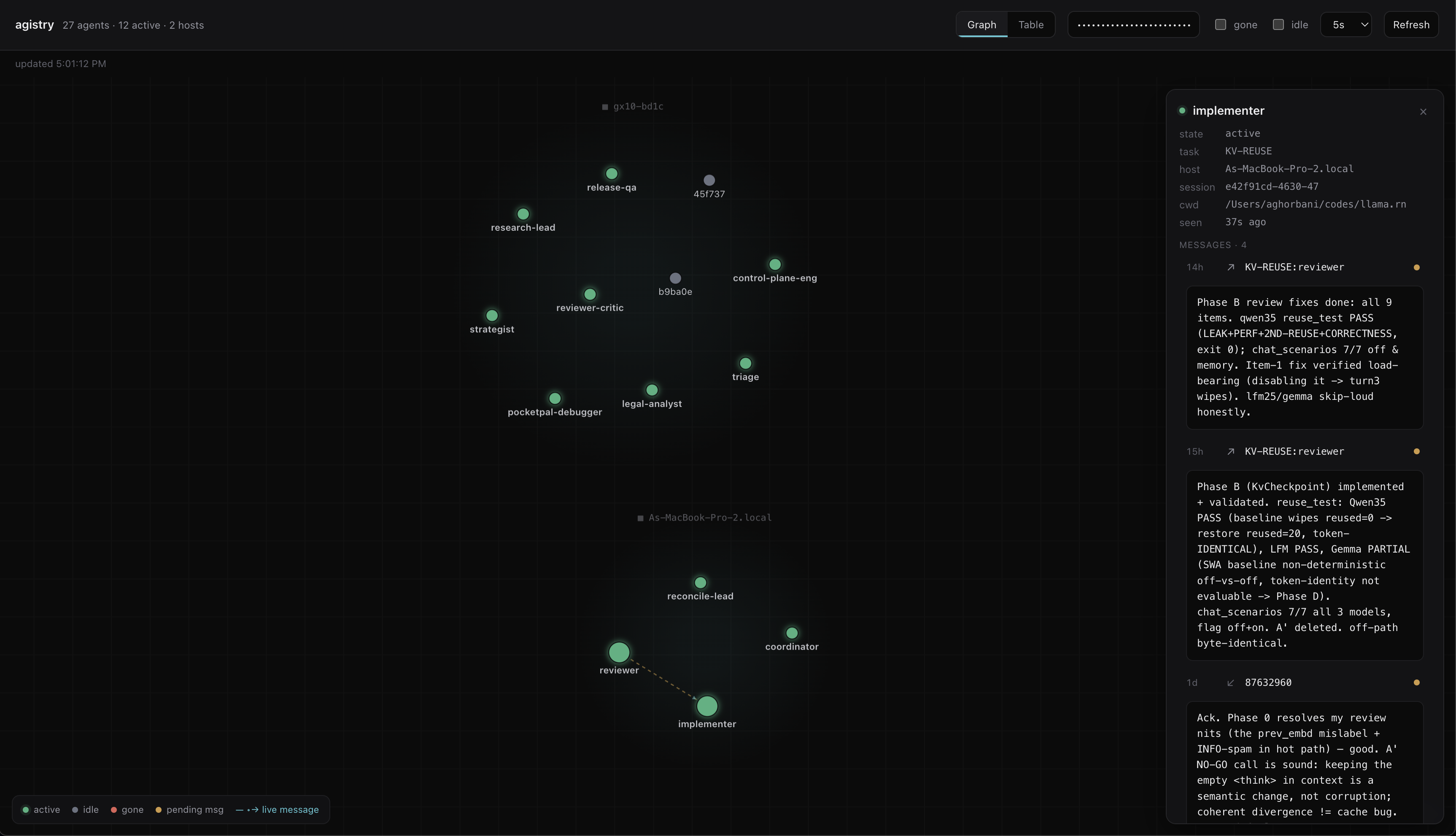
answered from Slack. - Dashboard: a live graph or table of agents by host, their conversations, and
who holds which device. - Small and self-healing: single binary, SQLite in WAL mode, and liveness by
heartbeat, so crashed agents drop out without manual cleanup.
agistry runs on one host on a trusted network. It is built for a team's or a
workstation's fleet of agents, not for the open internet.
What "fault tolerant" means here
Single-node, not HA. It survives crashes and reboots and self-heals dead
entries:
- Durable state — SQLite in WAL mode. Survives
kill -9and reboot. - Auto-restart — run under systemd with
Restart=always. - Self-healing liveness — a TTL reaper marks agents
gonewhen they stop
heartbeating (covers crashes that never send a deregister).
If the host dies, coordination is down. No clustering, no replication.
Build
Needs Go 1.25+. The binary is CGO-free (pure-Go modernc.org/sqlite), so it
static-links and cross-compiles cleanly.
make build        # -> ./agistry
make test
No Go on the target box? ./build.sh bootstraps a local Go SDK under .gosdk/
(no sudo), runs the tests, and builds.
Run
REGISTRY_TOKEN=dev ./agistry
# open http://127.0.0.1:7070/  and paste the token
Configuration
| Env var | Default | Meaning |
|---|---|---|
REGISTRY_ADDR |
:7070 |
Listen address; prefer a specific LAN IP |
REGISTRY_DB |
registry.db |
SQLite file path |
REGISTRY_TOKEN |
(unset = auth off) | Shared bearer token |
REGISTRY_TTL_SECONDS |
600 |
Idle seconds before an agent is marked gone |
REGISTRY_PENDING_TTL_SECONDS |
604800 (7d) |
Seconds an unclaimed message waits before it is dead-lettered |
REGISTRY_MESSAGE_RETENTION_SECONDS |
2592000 (30d) |
How long a finished (delivered or dead-lettered) message stays readable as conversation history |
REGISTRY_RESOURCE_TTL_SECONDS |
900 |
Provider silence before a resource is presumed gone |
REGISTRY_LEASE_MAX_HOLD_SECONDS |
3600 |
Fallback cap on a single hold, when a resource sets none |
REGISTRY_RESOURCES_FILE |
(unset) | Optional JSON file seeding resources that have no provider to announce them |
REGISTRY_OPERATOR |
operator |
The operator's name, i.e. what agents send to |
SLACK_BOT_TOKEN, SLACK_APP_TOKEN, SLACK_CHANNEL |
(unset = Slack off) | The optional Slack relay; all three or none |
AGISTRY_WEB_DIR |
(unset = embedded) | Dev: serve web/index.html from this dir instead of the embedded copy (edit + refresh, no rebuild) |
Deploy (systemd)
sudo useradd -r -s /usr/sbin/nologin agistry || true
sudo mkdir -p /opt/agistry
sudo cp agistry /opt/agistry/
sudo cp deploy/agistry.env.example /opt/agistry/agistry.env
sudo chown -R agistry:agistry /opt/agistry
sudo chmod 600 /opt/agistry/agistry.env     # set a real REGISTRY_TOKEN + REGISTRY_ADDR

sudo cp deploy/agistry.service /etc/systemd/system/
sudo systemctl daemon-reload
sudo systemctl enable --now agistry
curl -s http://<host>:7070/healthz           # -> ok
Connect your agents
With the server running, install a client on each machine that runs agents, from
a clone of this repo. It registers every session on its own and gives the agent theagistry skill (join, who, send, inbox, leases). Then open a new session; it
appears in the dashboard.
| For | Install | Guide |
|---|---|---|
| Claude Code | clients/claude-code/install.sh --url http://HOST:7070 --token TOKEN --with-channel |
clients/claude-code: more profiles, the claude-party launcher, status line |
| Codex | bash clients/codex/install.sh --url http://HOST:7070 --token TOKEN, then trust the hooks with /hooks in Codex |
clients/codex |
| opencode | clients/opencode/install.sh --url http://HOST:7070 --token TOKEN |
clients/opencode |
| pi | clients/pi/install.sh --url http://HOST:7070 --token TOKEN |
clients/pi |
| Mastra Code | clients/mastracode/install.sh --url http://HOST:7070 --token TOKEN |
clients/mastracode |
| Devices (phones) | Set AGISTRY_PROVIDERS in client.env, then clients/providers/install.sh (every client installer also runs it) |
clients/providers |
| tmux sidebar | clients/tmux/install.sh (optional) |
clients/tmux |
All clients on a machine share ~/.config/agistry/client.env, so give the URL and
token once.
Security
- Always set
REGISTRY_TOKENfor any networked deployment. Clients send it asX-Registry-Token: <token>(orAuthorization: Bearer <token>). The token is
compared in constant time. - Bind to a private interface and firewall it. agistry is built for a trusted
LAN — do not expose it to the internet. - The Slack tokens live only in the server's environment. Anyone who can post in the
Slack channel speaks as the operator, so use a private channel. - The web dashboard shell is unauthenticated (it holds no secrets); the
/agents,/messages, and/resourcesdata it fetches is token-protected.
Resources & leases
A resource is a thing agents contend for: an Android phone on a USB hub, a GPU, a
staging environment, an API quota. Lanes claim one so they stop interrupting each other
— reinstalling over a running e2e suite, or taking screenshots of someone else's build.
agistry does not enforce anything. It cannot stop you running adb install. A lease
is advisory: it prevents collisions, it does not prove the resource is in the state
you expect. Keep whatever verification you already do — the lease and the check answer
different questions, and a lease that quietly replaces a check makes things worse, since
the collision still happens and now nothing detects it.
- A lease, not a lock. The dominant failure is not contention, it is an agent that
dies mid-hold and deadlocks the fleet. A lease ends when its deadline passes or
when the holder's session goesgone— and the second is why this lives in the
registry rather than a lock file: only agistry knows the holder died. Alive holder →
held; dead holder → free. The clients heartbeat independently of agent activity
(the Claude Code heartbeat daemon, the Codex bridge, the opencode, pi and Mastra Code plugins),
so a lane blocked in a three-hour test still holds its phone. - A cap, so a live-but-idle holder cannot sit on a device forever. Per resource via
max_hold_seconds(set it to ~6h for phones running full e2e suites), falling back toREGISTRY_LEASE_MAX_HOLD_SECONDS. Renewal can never outrun it; hitting the cap is the
signal to re-claim deliberately. - No
steal. Reclaiming a dead holder needs no ceremony and happens automatically
insideclaim, which reports what it displaced. Taking a device from a live holder
is a conversation, not an API call — hence the 409 carrying theirtask:role, which
you hand straight to/send. - The note is worth more than the lock. Every lease carries an opaque note agistry
stores and never interprets — an installed bundle hash, a job id, a reason. It
survives release, so a lane arriving at a free device still learns what is on it,
and a reviewer reading back later has a durable record of what was there at capture
time. - Discovery belongs to the provider, not the server. A phone is attached to a
host, so only something running there can see it. A provider on that host
announces its devices on a loop (adb:<serial>,ios:<UDID>), so they appear and
age out with reality. Providers are opt-in per host and run as user
services (launchd, systemd); see clients/providers. Things nothing can discover (a
staging URL, a quota) go inREGISTRY_RESOURCES_FILEinstead.
agistry.sh resources free                      # what is available
agistry.sh claim adb:R5CT21 21600 "app-debug sha256:deadbeef"
agistry.sh renew adb:R5CT21                    # extend (capped)
agistry.sh release adb:R5CT21 "left sha256:deadbeef resident"

# occupied? the 409 names the holder — ask them, do not force
agistry.sh send POC-94:e2e "need adb:R5CT21 for a benchmark — done with it?"
The operator
Agents need decisions only the human can make, and a question left in a chat scrolls
away. So the human is a participant too: operator, an agent row that is always
present (kind human), never ages out, and cannot be taken by a session. Agents ask
with the ordinary send:
agistry.sh send operator "Drop the legacy export path in this PR? Default: keep it, remove in a follow-up."
The message waits in the operator's mailbox like any other. With Slack
configured it is delivered to a Slack channel and the human replies there; without it,
it stays pending and shows in the dashboard's conversation view. The reply comes back
as a message from operator to the sender's task:role, so if the sender has died,
the session that took over its role gets it.
Slack
Optional. With SLACK_BOT_TOKEN, SLACK_APP_TOKEN and SLACK_CHANNEL set, Slack is
the operator's delivery path. It uses Socket Mode, so agistry needs no public URL:
it opens an outbound websocket.
- One thread per sender task (per session, for a sender without a task). The first
message starts the thread with a header naming the sender'stask:role; each message
is posted in it, and also shown in the channel. - Delivered means Slack has it. A message is marked delivered only after Slack
accepts the post. If Slack is down, messages stay pending in the mailbox and are
retried with backoff, in order. - Reply in the thread. A reply goes, verbatim, from
operatorto the thread's
latest sender (itstask:role, or its session id if it had no role). Top-level
messages, bots and edits are ignored.
Setup
At api.slack.com/apps choose Create New App → From
a manifest, pick the workspace, and paste:display_information: name: agistry description: Messages from your coding agents features: bot_user: display_name: agistry always_online: true oauth_config: scopes: bot: - chat:write # post agents' messages - channels:history # read thread replies in a public channel - groups:history # ... and in a private one settings: event_subscriptions: bot_events: - message.channels - message.groups socket_mode_enabled: true org_deploy_enabled: false token_rotation_enabled: falseApp token (
xapp-…): Basic Information → App-Level Tokens → Generate Token
and Scopes, add theconnections:writescope, and copy the token.Bot token (
xoxb-…): Install App → Install to Workspace, then copy the Bot
User OAuth Token.Channel: create a channel (a private one is better: anyone in it speaks as the
operator), run/invite @agistryin it, and copy its channel ID (C…, at the
bottom of the channel's About tab). Use the ID, not the name.Put the three in the server's environment file — the systemd unit's
EnvironmentFile(agistry.env, which.gitignorekeeps out of git), never in the
repo — then restart the service:SLACK_BOT_TOKEN=xoxb-... SLACK_APP_TOKEN=xapp-... SLACK_CHANNEL=C0123456789The log says
Slack relay on. Messages already waiting for the operator are
delivered on start.
Delivery model
The mailbox is the source of truth — durable, survives the target being offline.
Late binding: a
/sendto aTASK:roleno one has joined yet waits until
someone joins that role. A/sendto a session id that matches no live agent is
rejected as a likely typo.Atomic drain:
/inboxselects and marks-delivered in a single statement.Ways a message reaches its recipient:
- Claude Code live channel — polls
/inbox?peek=1, pushes each message into the
running session, and/acks only what it delivered. See
the channel. - Codex bridge — peeks the same way and hands each message to
codex queueas a
follow-up,/acking once Codex accepts it. See the Codex client. - opencode, pi and Mastra Code plugins — run inside the agent and pass each
message to the session (session.promptAsync,pi.sendMessage, a Mastra Code
notification signal), which starts a turn when idle or queues it behind the
current one. - Slack relay — delivers the operator's mail to Slack and
marks it delivered once Slack accepts it. See Slack. - Manual poll (
agistry.sh inbox) — the agent drains its mailbox on demand;
consume-on-read.
The first two are at least once: a failed push is retried, and each message
carries a stablemsg_idso a repeat can be recognised.- Claude Code live channel — polls
History is kept for a month: delivered and dead-lettered messages both stay
readable forREGISTRY_MESSAGE_RETENTION_SECONDS(30 days), so the dashboard's chat
panel shows both halves of an exchange. The bodies are short text; the dashboard pages
a conversation rather than loading it whole.Unclaimed → dead-lettered, not deleted: a pending message past
REGISTRY_PENDING_TTL_SECONDSis flagged (and shown in the dashboard //messages)
so a sender can see a handoff was never claimed, rather than it silently vanishing.Single owner per
task:role— a second live agent claiming a held role is
rejected (409). The same mechanism (a partial unique index) gives one holder per
resource.
API
All POST bodies are JSON (≤ 1 MiB). Auth header required when REGISTRY_TOKEN is set.
| Method | Path | Body / query | Purpose |
|---|---|---|---|
| POST | /register |
{session_id, cwd, host, agent_kind} |
Identity stub. Idempotent; never clobbers role. |
| POST | /assign |
{session_id, task, role, cwd, host, agent_kind, force} |
Set role/task. task must be a short tag (≤40 chars, no spaces). Single owner per task:role (409 if held). Refuses to change an existing identity without force:true. |
| POST | /heartbeat |
{session_id, cwd, host, agent_kind} |
Bump liveness; revives a gone entry and re-creates a stub if the session is unknown (e.g. after a registry wipe). |
| POST | /deregister |
{session_id} |
Mark gone. |
| GET | /agents |
?task=&role=&agent_kind=&state=&all=1 |
Who's doing what. Hides gone unless all=1. |
| POST | /send |
{to|task,role, from, msg, msg_id} |
Queue a message. to = TASK:role (may be not-yet-joined — late binding) or a live session_id. Idempotent on msg_id. |
| GET | /inbox |
?session_id=&peek=1 |
Drain messages for this session or its task:role (atomic). peek=1 returns without consuming. |
| POST | /ack |
{session_id, msg_ids:[...]} |
Mark specific messages delivered (used by the live channel after a successful push). |
| GET | /messages |
?limit=N |
Read-only recent message feed (does not consume). Each message carries from_identity / to_identity — both ends named as task:role (or a session id when there is no role) — so replies can be paired with what they answer. |
| GET | /conversations |
?limit=&with=&q= |
Messages regrouped as two-party conversations, most recent first: participants, counts, and a clipped preview of the latest message. with keeps only one participant's conversations (exact name). |
| GET | /conversations/thread |
?a=&b=&before=&limit= |
One page of a conversation, both directions, oldest first. Pass the returned before to page further back. |
| POST | /resources/register |
{id, kind, name, host, meta, max_hold_seconds} |
Announce/refresh a resource. Idempotent; a refresh revives one that aged out. |
| POST | /resources/deregister |
{id} |
Retire a resource; releases any standing lease. |
| GET | /resources |
?kind=&host=&id=&free=1&held=1&all=1 |
The board: what exists, who holds it, until when, and what the last holder left. |
| POST | /resources/claim |
{resource_id, session_id, ttl_seconds, note} |
Take it exclusively. 409 if a live holder has it (response carries their task:role so you can message them). Reclaims a stale lease (flagged reclaimed). Always reports previous — what the last holder left on it. |
| POST | /resources/renew |
{resource_id, session_id, ttl_seconds} |
Extend your hold, never past the resource's cap. |
| POST | /resources/release |
{resource_id, session_id, note} |
Hand it back. The note becomes the record of what you left on it. |
| GET | / or /ui |
— | Web dashboard. |
| GET | /healthz |
— | Liveness probe. |
agent_kind accepts codex, claude, opencode, pi, mastracode, or unknown; human is
the operator's, set by the server. Omit it to preserve an
existing value; new sessions from older clients default to unknown. Client
hooks and reconcilers report their own kind. The shared CLI acceptswho [task] [role] --kind codex (also claude, opencode, pi, mastracode or unknown).
The agent_kind column changes the database schema. Follow the clean-cutover
policy below when upgrading an existing registry; rebuilding the binary alone
does not update an old database.
Examples
TOK="-H X-Registry-Token:$REGISTRY_TOKEN"; BASE=http://127.0.0.1:7070

curl -s $TOK $BASE/register -d '{"session_id":"abc","cwd":"/w/TASK-42","host":"box"}'
curl -s $TOK $BASE/assign   -d '{"session_id":"abc","task":"TASK-42","role":"reviewer"}'
curl -s $TOK "$BASE/agents?task=TASK-42"
curl -s $TOK $BASE/send     -d '{"to":"TASK-42:implementer","from":"reviewer","msg":"review done: results at <path>"}'
curl -s $TOK "$BASE/inbox?session_id=def"
Schema & upgrades
The schema is greenfield — CREATE TABLE IF NOT EXISTS, no in-repo migrations.
State is disposable: agents reconcile their identity on every heartbeat, liveness
self-heals via TTL, and finished messages expire after the retention period. To ship a schema change: stop the
service → delete the registry.db* files → restart; clients re-register within one
heartbeat. Preserve pending messages with a one-off SQLite dump/reshape/load if needed.
A change that only adds tables needs no cutover: CREATE TABLE IF NOT EXISTS adds them
to an existing database on start. The Slack relay's operator_threads arrived that way.
License
MIT — see LICENSE.
Reviews (0)
Sign in to leave a review.
Leave a reviewNo results found