cgx
Health Warn
- No license — Repository has no license file
- Description — Repository has a description
- Active repo — Last push 0 days ago
- Low visibility — Only 6 GitHub stars
Code Fail
- rm -rf — Recursive force deletion command in .github/workflows/ci.yml
- fs module — File system access in .github/workflows/deploy-pages.yml
Permissions Pass
- Permissions — No dangerous permissions requested
No AI report is available for this listing yet.
Turn any Git repo into a queryable knowledge graph. Tree-sitter + git history + DuckDB + WebGL graph. MCP server for Cursor & Claude Code.
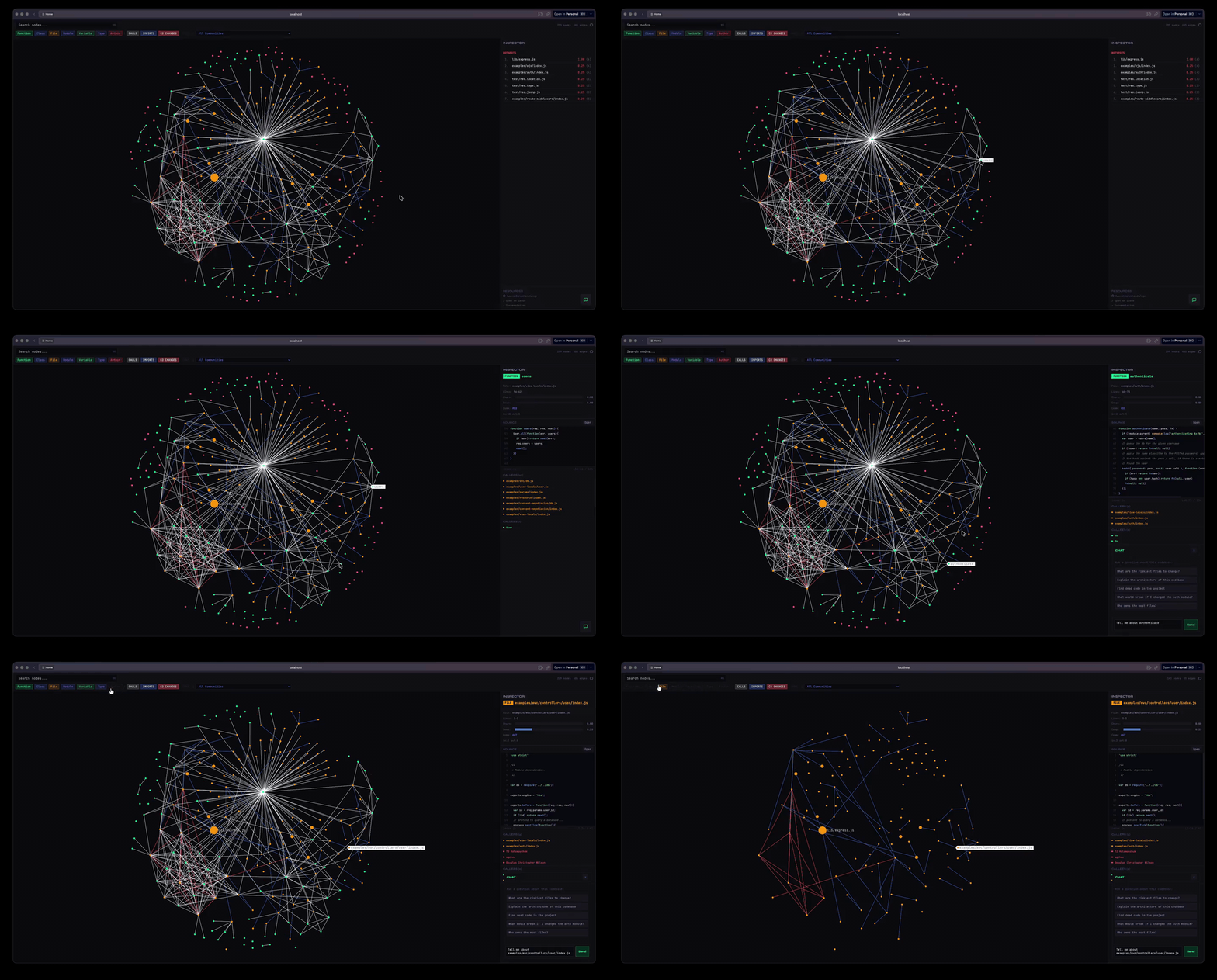




🚀 v0.5.2 —
cgx todosno longer flags JSDoc prose (Note:,**Warning:**, the word "bugs") as annotations: matching is now case-sensitive with word boundaries, and the displayed text shows the actual matching line instead of the/**block opener.cgx todoson an indexed repo with no annotations now says "No annotation comments found." instead of suggestingcgx analyze. The terminal graph layout falls back to a deterministic grid when the force-directed simulation diverges, fixing a rare NaN/Inf crash in the TUI. README clarifications: vault layout diagram,node_count_maxpredicate. v0.5.2 →v0.5.1 — bisect-friendly git hooks: the cgx-managed
post-checkout/post-commithooks now skip duringgit bisect,git rebase, andgit merge, socgx bisect-scriptworks insidegit bisect runwithout dirtyingAGENTS.md/CGX_SKILL.md. Bisect-script also now exits125(skip) on empty predicate files and whenrule_violations_maxis set without--rule-violations N, instead of silently passing. v0.5.1 →v0.5.0 —
cgx docs generate --vaultturns your indexed repo into an Obsidian-ready documentation vault (project overview, dep purposes, unused-dep detection, per-file TL;DR, role classification) · docstring extraction now covers Rust, Go, Java, PHP, Python (was TypeScript-only) ·cgx bisect-scriptplugs intogit bisect runto find commits that break declarative graph predicates · newGraphDbqueries:get_file_summary,get_public_api,list_entry_points,get_cross_cluster_deps. Release notes →Earlier: v0.4.0 —
cgx watch,cgx query context, Claude Code PreToolUse hook, cache management.
A codebase has two graphs
   STRUCTURAL                         TEMPORAL
   what calls what                    what changes together

   AuthService                        payments.ts ─┐
       │                                            │ 87% co-change
       ├── login()                                  │ (no import edge!)
       │     └── db.query()           flags.ts  ────┘
       └── logout()                          ▲
             └── session.clear()             │
                                       hidden coupling
                                       lives here
Every other code-analysis tool only shows you the left side. cgx builds both — by parsing your AST with Tree-sitter and overlaying your full Git history. The temporal graph is where most bugs and refactor risk actually live.
Quick Start
# 1. Install
brew install aayushbahukhandi/cgx/cgx       # or: cargo install cgx-cli

# 2. Index your repo (functions, imports, git history — all in seconds)
cd your-project && cgx analyze

# 3. Open the WebGL graph in your browser
cgx view --web

# 4. Ask architectural questions in milliseconds
cgx query blast-radius "AuthService"        # what breaks if I change this?
cgx hotspots                                # high churn × coupling = danger zone

# 5. Wire up your AI editor (Cursor, Claude Code, Windsurf, Codex)
cgx setup
After cgx analyze, two files land in your repo root: CGX_SKILL.md (instructs your AI to query the graph instead of opening files) and AGENTS.md (prose architecture summary). Both auto-regenerate on every commit.
Generating a documentation vault (new in v0.5)
cgx docs generate --vault           # writes into your Obsidian vault (auto-detected or configured)
cgx docs generate --local           # writes into ./cgx-docs/
cgx docs generate --vault --force   # full rebuild
cgx docs generate --vault --incremental   # only regenerate files whose graph slice changed
cgx docs status                     # show what would regenerate
cgx docs prompts --next             # stream unfilled AI prose stubs into Claude/Cursor
The vault has a layered structure built straight from your graph:
cgx-docs/
├── .obsidian/                          ← Obsidian workspace settings (auto-created)
├── README.md                           ← project description + dep summary + nav
├── 00-Overview/
│   ├── Architecture.md                 ← stack, languages, dep purposes + unused-dep detection,
│   │                                     files-by-role, largest groups, entry points
│   ├── HowToNavigate.md                ← reading path for new contributors
│   └── Glossary.md                     ← node kinds + communities
├── 10-PublicAPI/<group-slug>.md        ← exported symbols per source directory
│                                         (e.g. source-core.md, test-helpers.md)
├── 20-Architecture/
│   ├── Groups.md                       ← primary navigation: by source directory
│   ├── Communities.md                  ← raw Louvain clusters
│   ├── CrossClusterDeps.md
│   └── EntryPoints.md
├── 30-Modules/<role>/<file>.md         ← per-file: TL;DR + role badge + structure table
│                                         with inline docstring descriptions + callers/
│                                         callees + tests + ownership + `<!-- cgx-prompt -->`
│                                         AI stub. <role> is `source` or `test`.
├── 40-Risk/
│   ├── Hotspots.md
│   ├── ComplexityHigh.md
│   ├── DeadCode.md
│   └── Duplicates.md
└── 50-Ownership/
    ├── Owners.md
    └── BlameGraph.md
cgx itself never calls an LLM. Each module note ends with a self-contained <!-- cgx-prompt --> block that bundles every fact your AI needs to write prose (exported symbols, callers/callees, tests, owners, metrics, existing docstrings). Paste it into Claude/Cursor — your schedule, your API key, your cost.
Configure the default vault in .cgx/config.toml:
[docs]
vault_path = "/Users/you/Documents/Obsidian Vault"   # used by --vault
output_dir = "./cgx-docs"                             # used by --local
wiki_links = "obsidian"                               # or "markdown"
prompt_packets = true
frontmatter = true
git bisect on the graph (new in v0.5)
cgx bisect-script plugs into git bisect run and evaluates declarative predicates over the freshly-indexed graph at each commit:
# 1. Generate a starter predicate file
cgx bisect-script --example > .cgx/bisect.toml

# 2. Edit .cgx/bisect.toml — anything you can express against the graph:
#    node_count_min, node_count_max, nodes_exist, nodes_missing, nodes_alive,
#    rule_violations_max

# 3. Bisect
git bisect start
git bisect bad HEAD
git bisect good v0.4.1
git bisect run cgx bisect-script --analyze
Exit codes: 0 = good, 1 = bad, 125 = skip — exactly what git bisect run expects. Use --analyze to re-index on every commit visited.
Why it matters
| cgx | Reading source files | |
|---|---|---|
Answer "what breaks if I change AuthService?" |
cgx query blast-radius AuthService → ~50 tokens, 0.3s |
open 40 files → 15,000–50,000 tokens |
| Architecture overview for an AI agent | get_repo_summary → ~150 tokens |
recursive ls + reads → 50,000+ tokens |
| Find hidden coupling | cgx hotspots → co-change scores |
grep-and-pray |
| One-shot symbol briefing | cgx query context login → ~400 tokens |
2–15K per file |
Highlighted Features
| Feature | What it does |
|---|---|
cgx docs generate --vault |
Generate a layered, Obsidian-ready documentation vault from the graph — project overview, per-file TL;DR + role badge, public APIs, hotspots, dep purposes with unused-dep detection, plus AI prose stubs you fill in on your schedule |
cgx bisect-script |
Drop into git bisect run to bisect on declarative graph predicates (node exists, count bounds, no dead-code, ...). Exits 0/1/125 — git does the binary search |
| Tree-sitter AST parsing | TS/TSX, JS/JSX, Python, Rust, Go, Java, PHP — parsed in parallel, with docstring extraction across all six languages (TypeScript, Rust, Go, Java, PHP, Python) |
| Git history overlay | Churn scores, co-change edges, ownership — the temporal graph |
cgx query blast-radius |
Direct + transitive callers with risk scoring |
cgx watch |
Debounced live re-indexing on every save |
cgx query context <sym> |
Callers + deps + community + risk in one ~400-token block |
| MCP server (10 tools) | Cursor, Claude Code, Windsurf, Codex — _summary field on every response |
| Claude Code PreToolUse hook | Auto-injects file context before every Edit/Write |
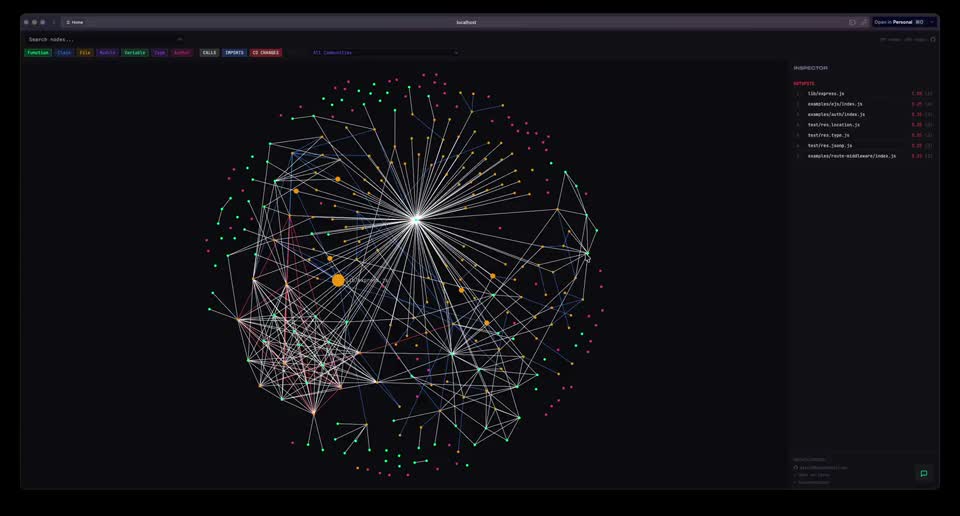
| WebGL graph + share links | Sigma.js renders thousands of nodes; cgx share → no-install gist viewer |
| Feature | Description |
|---|---|
| Documentation Vault | cgx docs generate --vault writes a layered Obsidian vault with project overview, per-file TL;DR + role classification, public APIs grouped by directory, hotspots/dead code, dependency table with curated purposes and unused-dep flags, and AI prose stubs you fill on demand |
| Bisect Script | cgx bisect-script evaluates declarative graph predicates (node exists / missing, count bounds, dead-code) and exits 0/1/125 for git bisect run |
| Multi-language docstring extraction | Rust (///, /** */, including across #[derive]), Go (// SymbolName), Java/PHP (/** */, skipping annotations), Python (triple-quoted body docstring), TypeScript — all extracted at parse time |
| AST Parsing | Tree-sitter parses TS/TSX, JS/JSX, Python, Rust, Go, Java, PHP in parallel |
| JSX Caller Tracking | React component usages (<MyComp />) are tracked as call edges |
| JSX Comment Extraction | {/* TODO */} expression comments and commented-out JSX code are extracted and tagged separately from code comments |
| Annotation Index | cgx todos lists all TODO/FIXME/HACK/NOTE/BUG/OPTIMIZE/WARN/XXX tags with comment_type (code vs jsx) |
| Docs Coverage | cgx docs coverage reports what % of exported functions have doc comments, by community |
| Complexity Scoring | cgx complexity ranks functions by cognitive complexity score (if/for/switch/ternary nesting) |
| Test Coverage Overlay | cgx test coverage / cgx test gaps maps test files → source functions via TESTS edges |
| Dependency Health | cgx deps health parses package.json / Cargo.toml / requirements.txt / go.mod, cross-references OSV for CVEs |
| PR Review Assistant | cgx review generates a structured brief: blast radius, hotspot alerts, missing tests, suggested reviewers |
| Architecture Rules | cgx rules check runs SQL or built-in rules (no_cycles, max_coupling, etc.) with GitHub Actions output |
| Duplicate Detection | cgx dupes finds near-identical function bodies via normalized AST fingerprints + Jaccard similarity |
| Architecture Explainer | cgx explain AuthService / cgx explain --onboard generates structured Markdown docs from the graph |
| Timeline | cgx timeline snapshots the graph at each commit; scrubber in the web UI lets you watch architecture evolve |
| Git Intelligence | Churn scores, co-change edges, ownership — the temporal graph |
| DuckDB Storage | Zero-server embedded graph database. Instant queries. |
| Community Detection | Leiden algorithm auto-clusters your codebase into modules |
| Terminal TUI | Force-directed graph in Ratatui. Works over SSH. |
| WebGL Browser Graph | Sigma.js renders thousands of nodes at 60fps |
| AI Chat | Ask questions about your code in natural language. Ollama supported. |
| MCP Server | 10 typed tools for Cursor, Claude Code, Windsurf, Codex/OpenCode |
| Skills System | CGX_SKILL.md auto-generated — works in any AI assistant; /cgx slash command in Claude Code via cgx setup |
| Build artifact exclusion | web-ui-dist/, .next/, coverage/, *.min.js etc. excluded automatically; customizable via .cgxignore |
| Share Links | cgx share uploads your graph to a Gist — anyone views it in a browser, no install needed |
| GitHub Pages Publish | cgx publish pushes a self-contained graph site to your gh-pages branch |
| Graph Diff | See how your architecture changed between commits |
| Dead Code Detection | Five categories: unreferenced exports, unreachable private functions, unused variables, disconnected nodes, zombie files — with High/Medium/Low confidence and false-positive hints |
| Self-contained binary | Web UI is embedded in the binary — Homebrew and cargo install work out of the box |
| Live Re-indexing | cgx watch watches your repo and runs debounced incremental analysis on every file change |
| Agent Context Briefing | cgx query context <symbol> returns callers + deps + community + risk in one ~400-token block (vs 2–15K to read a file). Supports --json. |
| Claude Code Hook | cgx setup --hooks installs a PreToolUse hook that auto-injects file context before every Edit/Write |
| Cache Management | cgx clean --orphaned sweeps stale db files; cgx clean --budget 2G does LRU eviction. Opt-in auto-eviction via CGX_MAX_CACHE_BYTES |
Installation
Homebrew (macOS / Linux) — recommended
brew install aayushbahukhandi/cgx/cgx
To update:
brew upgrade aayushbahukhandi/cgx/cgx
cargo
cargo install cgx-cli
The installed binary is named cgx. If cgx --version prints command not found, add Cargo's bin directory to your PATH:
# zsh (~/.zshrc) or bash (~/.bashrc / ~/.bash_profile)
export PATH="$HOME/.cargo/bin:$PATH"
# fish (~/.config/fish/config.fish)
fish_add_path "$HOME/.cargo/bin"
cargo installcompiles from source and may take a few minutes. Run it again to update.
Pre-built binary (Windows, macOS, Linux)
Download the latest release from GitHub Releases. Replace VERSION with the tag shown on that page (e.g. v0.4.0).
# macOS arm64 (Apple Silicon)
curl -L https://github.com/AayushBahukhandi/cgx/releases/latest/download/cgx-VERSION-aarch64-apple-darwin.tar.gz | tar xz
sudo mv cgx /usr/local/bin/

# macOS x86_64 (Intel)
curl -L https://github.com/AayushBahukhandi/cgx/releases/latest/download/cgx-VERSION-x86_64-apple-darwin.tar.gz | tar xz
sudo mv cgx /usr/local/bin/

# Linux x86_64
curl -L https://github.com/AayushBahukhandi/cgx/releases/latest/download/cgx-VERSION-x86_64-unknown-linux-gnu.tar.gz | tar xz
sudo mv cgx /usr/local/bin/
Windows: download the .zip from the releases page and place cgx.exe in a directory on your %PATH%.
Verify
cgx --version
cgx doctor      # checks your setup and editor integrations
Staying up to date
Starting from v0.1.6, cgx checks for updates once a day and prints a notice when a newer version is available. You can also check and update manually:
cgx update          # show installed version, latest version, and upgrade instructions
cgx update --auto   # detect your install method and upgrade automatically
Set CGX_NO_UPDATE_CHECK=1 to disable the background check.
On v0.5.1? Run
cgx update --autoor reinstall. v0.5.2 is a polish release:cgx todosno longer reports JSDoc prose (Note:,**Warning:**, the word "bugs") as annotation tags, and the displayed text is now the matching line rather than the/**opener — re-runcgx analyze --forceto re-extract tags. The TUI also gets a deterministic grid fallback when the force-directed sim diverges, preventing a rare NaN/Inf crash. No schema changes.On v0.5.0? Run
cgx update --autoor reinstall. v0.5.1 fixes the cgx-managed git hooks so they no-op duringgit bisect/rebase/merge(previouslygit bisect run cgx bisect-scriptwould dirtyAGENTS.mdandCGX_SKILL.mdat every step and break the next checkout).cgx bisect-scriptalso now exits125(skip) instead of silently passing when the predicate file is empty or whenrule_violations_maxis set without--rule-violations N. Re-runcgx analyzeonce after upgrading so the new hook template is installed.On v0.4.x? Run
cgx update --autoor reinstall. v0.5.0 addscgx docs generate --vault(Obsidian documentation vault with project overview, per-file TL;DR, role classification, dep purposes + unused-dep detection, AI prose stubs),cgx bisect-script(drop intogit bisect run), docstring extraction for Rust/Go/Java/PHP/Python (was TypeScript-only), and four newGraphDbquery methods. Re-runcgx analyzeafter upgrading to populate the newdoc_commentdata.On v0.3.0? Run
cgx update --autoor reinstall. v0.3.1 fixescgx complexity --combined(now uses file-level churn), addscgx test coverage --by=community, improvescgx todosempty-result messages, shows available built-in rules incgx rules list, and adds a stale-index warning tocgx complexity. Also adds previously undocumented commands:cgx impact,cgx init,cgx list,cgx query deps,cgx query community.On v0.2.x? Run
cgx update --autoor reinstall. v0.3.0 addscgx todos,cgx docs coverage,cgx complexity,cgx test coverage/gaps,cgx deps health,cgx review,cgx rules check,cgx dupes,cgx explain, andcgx timeline— a full suite of advanced code intelligence commands. Re-runcgx analyze --forceafter upgrading to refresh the graph with new columns (complexity, doc_comment, is_tested, test_count).On v0.1.9 or older? Run
cgx update --autoor reinstall. v0.2.0 added dead code detection (cgx query dead-code) and fixed cross-file call tracking —new ClassName(), static method calls, and module-level function calls now all create proper edges, eliminating the majority of false positives.
AI Integration
Method 1 — Skills (works everywhere, zero config)
After cgx analyze, a CGX_SKILL.md file appears in your repo root. Any AI assistant that can read files and run terminal commands — Claude Code, Cursor, GitHub Copilot Chat, Gemini CLI — will automatically use it.
The skill file tells your AI:
- When to call
cgx queryinstead of reading source files - Both MCP tool names (
get_blast_radius) and CLI equivalents (cgx query blast-radius) in one place - Live stats about your codebase (hotspots, communities, entry points)
- Mandatory trigger language so the AI fires cgx without being asked
Result: Your AI stops reading source files to answer an architectural question and runs one cgx query command instead. get_repo_summary costs ~150 tokens; reading a single large source file costs 15,000–50,000. Same answer, without opening a file.
Method 1b — /cgx slash command in Claude Code
cgx setup # installs ~/.claude/skills/cgx/SKILL.md + registers /cgx
After running cgx setup, type /cgx in Claude Code to analyze any repo interactively — even repos that haven't been pre-indexed. Works like /graphify but for structural code queries rather than knowledge graph building.
Method 2 — MCP Server (Cursor, Claude Code, Windsurf, Codex/OpenCode)
cgx setup # auto-detects your editors and writes their MCP configs
Restart your editor. cgx now exposes 10 typed tools your AI can call directly:
| Tool | What it answers | Typical tokens |
|---|---|---|
get_repo_summary |
Architecture overview: nodes, communities, hotspots, god nodes | ~150 |
find_symbol |
Where is X defined? File + line | ~50 |
get_neighbors |
What does X depend on? What depends on X? | ~50 |
get_blast_radius |
What breaks if I change X? Risk level + affected count | ~50 |
get_call_chain |
Trace from A to B through the call graph | ~100 |
get_community |
All nodes in the auth/db/payments cluster | ~200 |
search_graph |
Full-text search over all symbol names | ~100 |
get_hotspots |
Highest churn × coupling files | ~100 |
get_file_owners |
Git blame ownership for any file | ~50 |
get_dead_code |
Unreferenced exports, unreachable functions, zombie files — with confidence + false-positive hints | ~100 |
run_query |
Raw SQL SELECT against the graph (read-only) | varies |
Every response includes a _summary field — a plain-text sentence the model reads first before parsing JSON, so it can skip deeper inspection when not needed.
Example: Ask "refactor the login function to add rate limiting" in Claude Code. It calls get_blast_radius, get_neighbors, and get_file_owners — 3 tool calls, under 200 tokens total — then writes the code knowing exactly what it needs to update.
How cgx Compares
| cgx | GitNexus | Graphify | |
|---|---|---|---|
| Tree-sitter parsing | ✅ | ✅ | ✅ |
| JSX/TSX caller tracking | ✅ | ❌ | ❌ |
| Cross-file resolution | ✅ | ✅ | ❌ |
| Git history (churn/blame) | ✅ | ❌ | ❌ |
| Co-change graph | ✅ | ❌ | ❌ |
| Dead code detection | ✅ | ❌ | ❌ |
| Cognitive complexity scoring | ✅ | ❌ | ❌ |
| TODO/FIXME annotation index | ✅ | ❌ | ❌ |
| Doc coverage reporting | ✅ | ❌ | ❌ |
| Test coverage overlay | ✅ | ❌ | ❌ |
| Dependency CVE health | ✅ | ❌ | ❌ |
| PR review brief generator | ✅ | ❌ | ❌ |
| Architecture fitness rules | ✅ | ❌ | ❌ |
| Duplicate / clone detection | ✅ | ❌ | ❌ |
| Architecture explainer | ✅ | ❌ | ❌ |
| Commit timeline snapshots | ✅ | ❌ | ❌ |
| Terminal TUI | ✅ | ❌ | ❌ |
| WebGL browser graph | ✅ | ❌ | ✅ |
| AI Chat (multi-provider) | ✅ | ❌ | ❌ |
| Ollama / local LLM | ✅ | ❌ | ❌ |
| MCP server | ✅ | ✅ | ❌ |
| Skills system | ✅ | ❌ | ✅ |
| Share links (no install) | ✅ | ❌ | ❌ |
| GitHub Pages publish | ✅ | ❌ | ❌ |
| Self-contained binary | ✅ | ❌ | ❌ |
| LLM required for indexing | ❌ Never | ❌ Never | ✅ Always |
| Session context overhead | ~1,300 tokens | unknown | ~15,000 tokens |
get_repo_summary cost |
~150 tokens | n/a MCP | no MCP |
| License | MIT | Non-commercial | MIT |
Demo videos
|
CLI
|
Web UI
|
Core Commands
Analysis
cgx analyze                        # index current repo
cgx analyze ./path                 # index any local path
cgx analyze github:owner/repo      # clone from GitHub and index (stored in ~/.cgx/clones/)
cgx analyze --watch                # live-reload on file save
cgx analyze --incremental          # re-parse only changed files (used by git hooks)
cgx analyze --no-git               # skip git history layer
cgx analyze --force                # full clean re-index
cgx analyze --verbose              # verbose output during analysis
cgx analyze --no-cluster           # skip community detection
cgx analyze --quiet                # suppress output
Visualize
cgx view                       # terminal TUI (works over SSH)
cgx view --web                 # browser WebGL graph — auto-analyzes if not indexed
cgx view --community=3         # scope TUI view to a cluster
In the terminal TUI, press
eon a selected node to view its ego-graph (neighbors up to 2 hops).
Share
cgx share                      # upload graph to a GitHub Gist → hosted viewer URL
cgx share --token ghp_xxx      # use a specific GitHub token
cgx share --public             # make the Gist public (default: secret)
# To unshare: gh gist delete <gist-id>   (shown in cgx share output)
cgx share requires a GitHub token with gist scope. It uses (in order): --token, GITHUB_TOKEN env var, or gh auth token if you have the GitHub CLI installed.
The returned URL looks like:
https://aayushbahukhandi.github.io/cgx/?data=https://gist.githubusercontent.com/...
Anyone can open that link in a browser — no cgx install needed.
Publish to GitHub Pages
cgx publish                    # push self-contained graph site to gh-pages branch
cgx publish --dry-run          # preview what would be pushed
cgx publish --badge            # print README badge markdown
Query
cgx query find "AuthService"            # locate any symbol
cgx query find "login" --kind=Function  # filter by kind
cgx query deps "AppError"               # dependencies of a node
cgx query blast-radius "deleteUser"     # what breaks if this changes?
cgx query chain "login -> AppError"     # trace a call chain (format: "from -> to")
cgx query community 7                   # all nodes in community #7
cgx query dead-code                     # unreferenced exports, unreachable functions, zombie files
cgx query dead-code --kind=exports      # filter: exports | functions | variables | files | disconnected
cgx query dead-code --confidence=high   # only high-confidence candidates
cgx query dead-code --summary           # count table by category and confidence
cgx query search "session"             # search by symbol name
cgx query owners src/payments/index.ts  # git blame ownership for a file
Git Intelligence
cgx hotspots                   # high churn × high coupling = danger zone
cgx blame-graph                # ownership by contributor
cgx diff HEAD~5                # architecture diff between commits
cgx impact                     # downstream impact of changes in the last 7 days
cgx impact --since=14          # look back N days
Documentation & Annotations
cgx todos                                    # list all TODO/FIXME/HACK/NOTE tags
cgx todos --kind=FIXME                       # filter by tag kind
cgx todos --comment-type=jsx                 # only JSX {/* */} comments
cgx todos --comment-type=jsx_commented_code  # JSX code blocks that are commented out
cgx todos --json                             # output as JSON
cgx docs coverage                            # % of exported functions with doc comments
Complexity
cgx complexity                     # top 20 functions by cognitive complexity
cgx complexity --threshold=0.15    # functions with score > 0.15
cgx complexity --combined          # sort by complexity × churn combined risk
Test Coverage
cgx test coverage                  # overall test coverage stats
cgx test coverage --by=community   # breakdown by cluster
cgx test gaps                      # untested high-coupling functions
cgx test suggest                   # prioritized test-writing list
Dependency Health
cgx deps health                    # full report — packages, versions, CVE counts
cgx deps health --critical         # only CVE-affected packages
cgx deps audit                     # fast CVE count per package
cgx deps outdated                  # packages with newer versions available
PR Review Assistant
cgx review                         # current branch vs main/master
cgx review feature/my-branch       # specific branch vs main
cgx review HEAD~5                  # last 5 commits
cgx review --format=markdown       # GitHub PR comment format
cgx review --format=github-actions # GitHub Actions annotation format
Architecture Rules
cgx rules check                    # run all rules in .cgx/rules.toml
cgx rules check --rule=no-cycles   # run a specific rule
cgx rules list                     # list all defined rules
Example .cgx/rules.toml:
[[rules]]
name = "no-circular-dependencies"
built_in = "no_cycles"
severity = "error"

[[rules]]
name = "no-direct-db-access-outside-repository-layer"
description = "Only repository files should import from db/"
severity = "error"
query = """
SELECT n.path, e.dst FROM edges e
JOIN nodes n ON n.id = e.src
WHERE e.kind = 'IMPORTS' AND e.dst LIKE '%/db/%'
  AND n.path NOT LIKE '%/repository/%'
"""
Built-in rules: no_cycles, max_coupling, max_complexity, require_docs_for_public.
Duplicate Detection
cgx dupes                          # all clone pairs (threshold 80%)
cgx dupes --threshold=0.9          # near-identical clones only
cgx dupes --kind=exact             # exact duplicates only
Architecture Explainer
cgx explain AuthService            # explain a specific symbol
cgx explain src/auth/              # explain a folder
cgx explain --onboard              # full onboarding guide for the repo
cgx explain --onboard --out=ARCHITECTURE.md  # write to file
Timeline
cgx timeline                       # snapshot last 20 commits
cgx timeline --commits=50          # last N commits
cgx timeline --since=2024-01       # since a date
cgx timeline --json                # output as JSON
Export
cgx export --format=json       # full graph JSON
cgx export --format=mermaid    # paste into any README
cgx export --format=graphml    # import into Gephi / yEd
Maintenance
cgx summary                    # repo stats: nodes, edges, languages, communities
cgx doctor                     # run diagnostics on your install
cgx clean                      # remove indexed data for current repo
cgx clean --all                # remove ALL indexed repos
cgx status                     # show index status for registered repos
cgx init                       # create .cgx/config.toml with defaults
cgx init --yes                 # non-interactive with defaults
cgx list                       # list all indexed repos with node/edge counts
AI Chat
The browser UI (cgx view --web) includes a built-in chat panel. Ask natural language questions about your codebase.
Supported AI Providers
OpenAI
export OPENAI_API_KEY=sk-...
cgx serve
Anthropic
export ANTHROPIC_API_KEY=sk-ant-...
export CGX_CHAT_PROVIDER=anthropic
export CGX_CHAT_MODEL=claude-haiku-4-5
cgx serve
Ollama (fully local, no API key)
ollama pull codellama
export CGX_CHAT_PROVIDER=ollama
export CGX_CHAT_MODEL=codellama
cgx serve
Any OpenAI-compatible API
export CGX_CHAT_PROVIDER=openai-compatible
export CGX_CHAT_BASE_URL=https://api.together.ai/v1
export CGX_CHAT_API_KEY=your-key
export CGX_CHAT_MODEL=meta-llama/Llama-3-70b-chat-hf
cgx serve
cgx serve                              # start server (auto-opens browser)
cgx serve --no-open                    # start server without opening browser
Privacy note: cgx chat sends only graph metadata to the AI — node names, file paths, churn scores, community labels. It never sends your source code. With Ollama, nothing leaves your machine.
Supported Languages
| Language | Parser | Status |
|---|---|---|
| TypeScript / TSX | tree-sitter-typescript | ✅ Stable — incl. JSX comment extraction |
| JavaScript / JSX | tree-sitter-javascript | ✅ Stable — incl. JSX comment extraction |
| Python | tree-sitter-python | ✅ Stable |
| Rust | tree-sitter-rust | ✅ Stable |
| Go | tree-sitter-go | ✅ Stable |
| Java | tree-sitter-java | ✅ Stable |
| PHP | tree-sitter-php | ✅ Stable |
| C# | tree-sitter-java (fallback) | 🔧 Beta |
| C / C++ | — | 📋 Planned |
| Swift | — | 📋 Planned |
| Ruby | — | 📋 Planned |
Want a language added? Open an issue or submit a PR — new parsers are one file in crates/cgx-engine/src/parsers/.
Configuration
cgx has no config file for basic usage. Everything has sensible defaults.
Excluding paths from analysis
cgx automatically skips build artifacts: node_modules/, target/, dist/, *-dist/ (e.g. web-ui-dist/), .next/, coverage/, vendor/, venv/, *.min.js, *.bundle.js, and similar.
For custom exclusions, create .cgxignore in your repo root — same syntax as .gitignore:
# .cgxignore
generated/
proto/
vendor/
*_pb.ts
.cgxignore files in subdirectories also work (scoped to that subtree).
Advanced configuration
For further customization, create .cgx/config.toml in your repo root:
[analyze]
# Languages to parse (default: all supported)
languages = ["typescript", "javascript", "python"]

# Directories to skip (prefer .cgxignore for per-repo exclusions)
exclude = ["vendor/", "generated/", "*.pb.go"]

# Git history window for churn calculation (days)
churn_window_days = 90

# Minimum co-change count to create a CO_CHANGES edge
co_change_threshold = 2

[chat]
# Default provider (openai | anthropic | ollama | openai-compatible)
provider = "ollama"
model = "codellama"
ollama_host = "http://localhost:11434"

[serve]
port = 7373
auto_open = true

[skill]
auto_generate = true
Architecture
cgx is built in Rust (core engine) and TypeScript (web UI).
cgx-engine  — Tree-sitter parsing, DuckDB storage, git analysis,
              Leiden clustering, export, skill generation
cgx-cli     — All user-facing commands, TUI (Ratatui), HTTP server (Axum),
              web UI embedded via rust-embed (self-contained binary)
cgx-mcp     — MCP stdio server (JSON-RPC 2.0)
web-ui      — Vite + React + Sigma.js WebGL graph
The graph is stored locally at ~/.cgx/repos/<hash>.db — one DuckDB file per repo. No external services, no cloud, no network required for local use.
Contributing
cgx is MIT licensed and welcomes contributions.
git clone https://github.com/AayushBahukhandi/cgx
cd cgx
cargo build --workspace
npm install && npm run build

# Run tests
cargo test --workspace

# Lint
cargo clippy --workspace -- -D warnings -D clippy::unwrap_used
cargo fmt --all
Best places to contribute:
- New language parsers — one file in
crates/cgx-engine/src/parsers/ - New export formats
- TUI improvements
- Web UI features
See CONTRIBUTING.md for the full guide.
Roadmap
v0.4.0 — Live Indexing & Agent Workflow (shipped)
-
cgx watch— top-level watch command with debounced incremental re-analyze on file changes (--debounce-mstunable) -
cgx query context <symbol>— one-shot agent briefing: callers + deps + community + risk in ~400 tokens, with--jsonfor tool consumption -
cgx hook+cgx setup --hooks— opt-in Claude Code PreToolUse hook that injects file context on Edit/Write/MultiEdit -
cgx clean --orphaned— sweeps stale registry entries AND unreferenced.dbfiles in~/.cgx/repos/ -
cgx clean --budget <SIZE>— LRU eviction (e.g.--budget 2G); opt-in auto-eviction viaCGX_MAX_CACHE_BYTESenv var -
RepoEntry.last_used_at— touched on every query for LRU tracking - Spinner UX during analyze phases (walk / parse / resolve / store / git / cluster) via indicatif
- Colored "⚡ Update available" notice via
console::style - Bug fix: incremental analyze no longer double-upserts edges (resolved DuckDB ART index error on large repos)
- Bug fix:
cgx doctorhints atcgx clean --orphanedwhen orphaned registry entries are detected
v0.3.2 — Bug Fixes (shipped)
-
cgx share— fixed: viewer now loads the shared graph instead of the published cgx graph when?data=URL param is present -
cgx publish— fixed: crash on repos with subdirectories inassets/(invalid git tree entry) -
cgx share— now printsgh gist delete <id>in output so users know how to unshare
v0.3.1 — Bug Fixes & Documentation (shipped)
-
cgx complexity --combined— fixed: now correctly uses file-level churn (not always-zero function churn) -
cgx test coverage --by=community— implemented: community-level test coverage breakdown table -
cgx todosempty-result messages — fixed: "No FIXME annotation comments found." instead of "Run cgx analyze" -
cgx complexitystale warning — warns when all scores are 0.00 and suggests--forcere-index -
cgx rules list— now shows all 4 available built-in rules even without a.cgx/rules.toml -
cgx query chainformat — README corrected to"A -> B"format -
cgx query search— clarified as symbol-name search (not full-text code search) -
cgx impact,cgx init,cgx list,cgx query deps,cgx query community— documented in README
v0.3.0 — Advanced Code Intelligence (shipped)
-
cgx todos— annotation index (TODO/FIXME/HACK/NOTE/BUG/OPTIMIZE/WARN/XXX, JSX comments) -
cgx docs coverage— documentation coverage by community -
cgx complexity— cognitive complexity scoring per function -
cgx test coverage/cgx test gaps— test coverage overlay via TESTS edges -
cgx deps health/cgx deps audit— dependency CVE health (OSV API) -
cgx review— PR review brief (blast radius, hotspots, missing tests, reviewers) -
cgx rules check— architecture fitness functions (SQL + built-in rules) -
cgx dupes— duplicate/clone detection via normalized AST fingerprints -
cgx explain— architecture explainer for symbols, folders, and full onboarding -
cgx timeline— git commit timeline snapshots
Next
-
cgx changelog— generate changelogs from graph diffs - VS Code extension
- Per-query token budget (
cgx query <cmd> --budget=tokenswith importance-ranked truncation) - Mermaid diagram auto-commit to docs/ on every push (GitHub Action)
- Ruby, Swift, C/C++ parsers
- Semantic code search (
cgx query search --semanticwith optional LLM summaries) - cgx cloud — shared graphs for teams (hosted)
License
MIT — use it in anything, commercial or otherwise.
Built with Rust 🦀 · Tree-sitter · DuckDB · Sigma.js
Star this repo if cgx saves you time.
Reviews (0)
Sign in to leave a review.
Leave a reviewNo results found