Cortex
Health Uyari
- License — License: MIT
- Description — Repository has a description
- Active repo — Last push 0 days ago
- Low visibility — Only 6 GitHub stars
Code Gecti
- Code scan — Scanned 12 files during light audit, no dangerous patterns found
Permissions Gecti
- Permissions — No dangerous permissions requested
This MCP server provides a persistent knowledge system for AI agents, utilizing an OWL-RL ontology, SPARQL graph, and SQLite to capture, reason, and retrieve information.
Security Assessment
Overall risk: Low. The light code audit found no dangerous patterns, hardcoded secrets, or requests for dangerous system permissions. The tool is designed to store data locally and requires an external LLM API key (e.g., Anthropic) to function, which is saved in a local configuration file (`~/.cortex/.env`). Users should be aware that it makes external network requests to the configured LLM provider. No unexpected shell executions or suspicious data exfiltration behaviors were detected.
Quality Assessment
The project is actively maintained (last updated today) and distributed under the permissive MIT license. It appears well-documented with clear setup instructions and offers multiple installation methods, including PyPI and Homebrew. However, community visibility and trust are currently very low, as reflected by having only 6 GitHub stars. This means the codebase lacks broad peer review and real-world testing from the wider open-source community.
Verdict
Safe to use, but exercise standard caution regarding local API key storage and the tool's early-stage community adoption.
Persistent ontology driven knowledge system with formal OWL-RL reasoning, SPARQL graph + SQLite, and 22 MCP tools for AI agent memory.
Cortex




Cognitive knowledge system with formal ontology, reasoning, and intelligence serving.
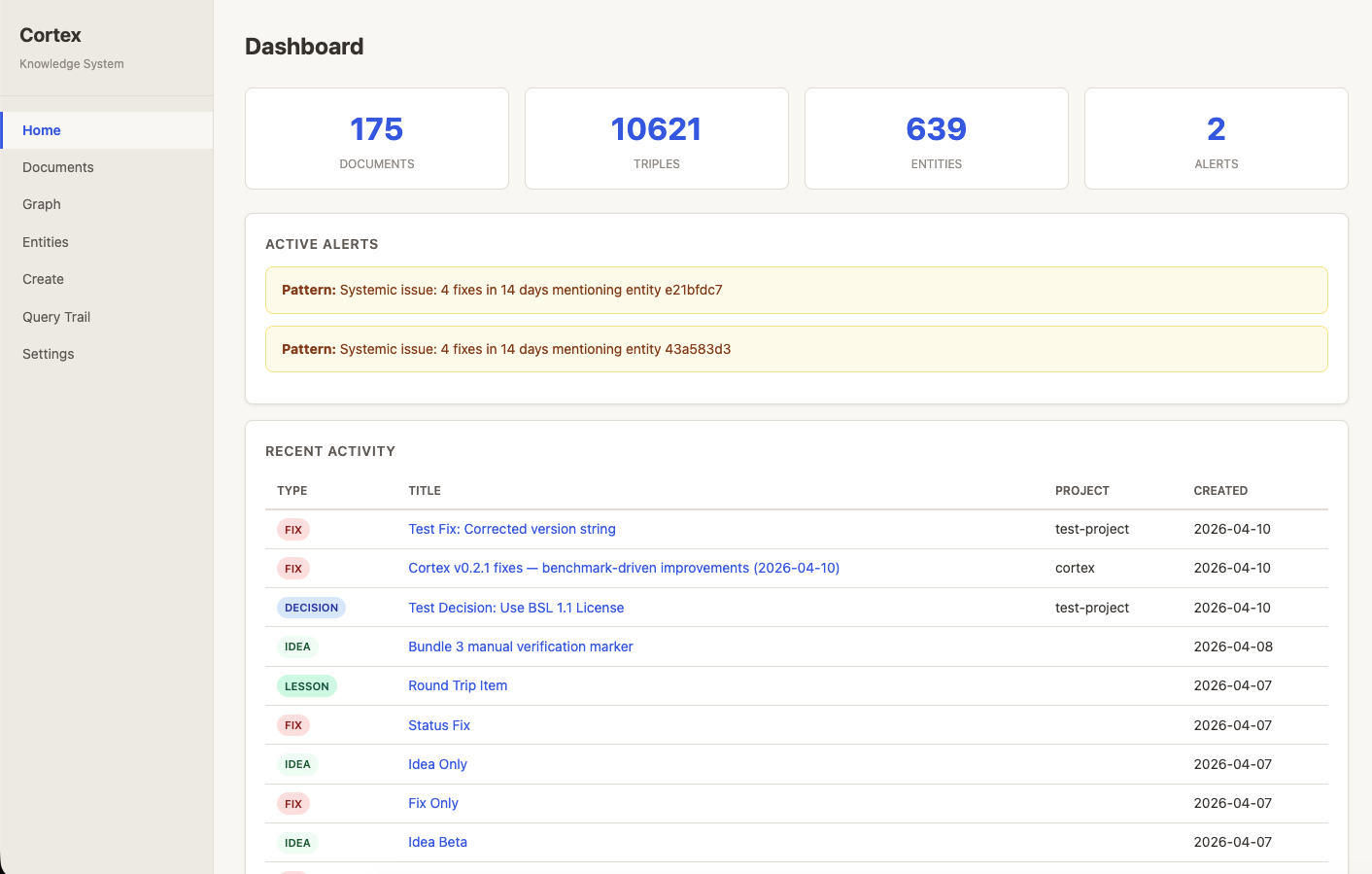
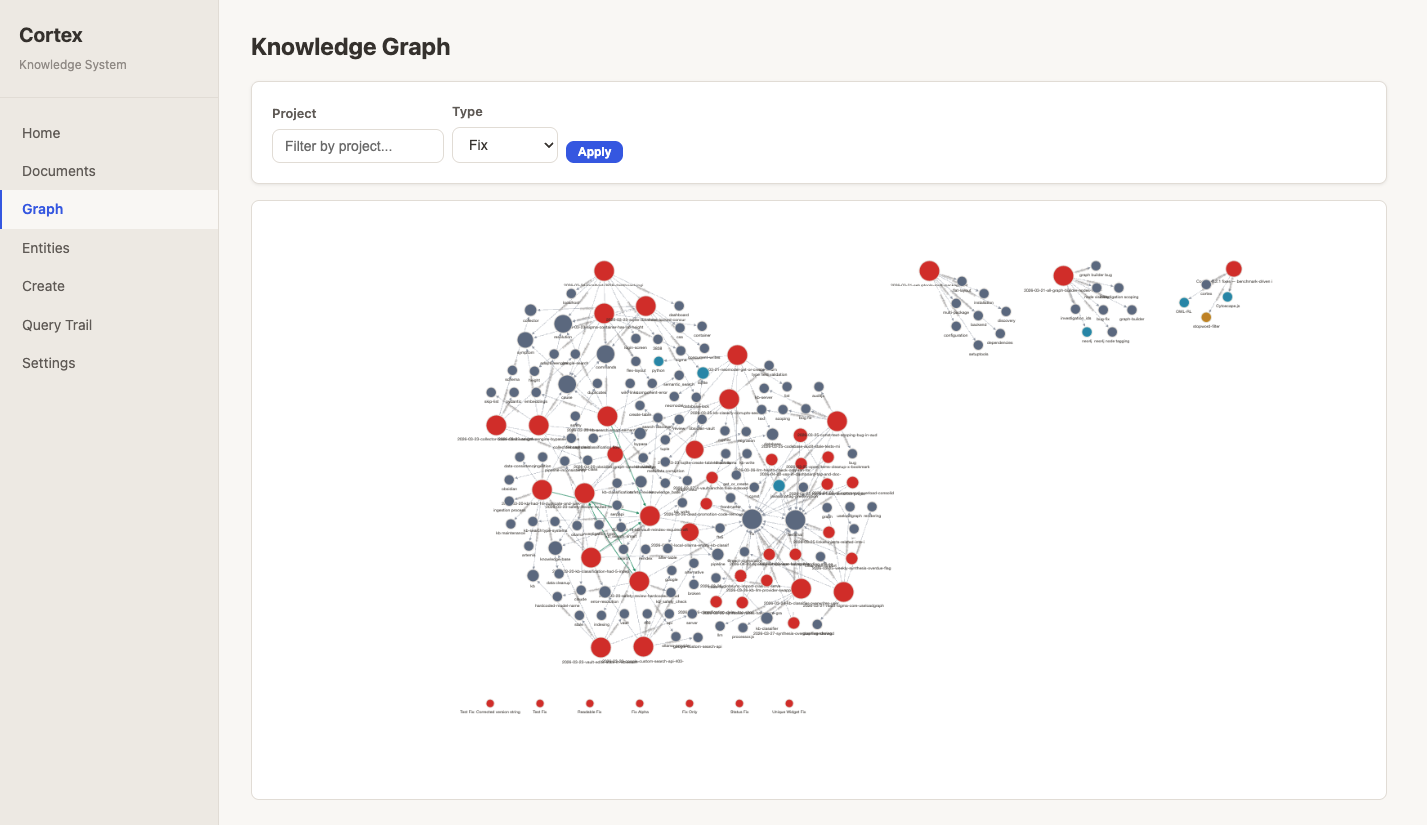
Cortex captures knowledge objects (decisions, lessons, fixes, sessions, research, ideas), classifies them with an OWL-RL ontology, discovers relationships, reasons over the graph, and serves intelligence through hybrid retrieval.
Install
pip install abbacus-cortex[embeddings]
cortex setup
The setup wizard configures everything: LLM provider, embeddings, dashboard password, background services, and Claude Code registration.
Other install methodsLightweight (no PyTorch — wizard offers to install embeddings):
pip install abbacus-cortex
cortex setup
Homebrew:
brew install abbacusgroup/tap/abbacus-cortex
cortex setup
From source:
git clone https://github.com/abbacusgroup/Cortex.git && cd Cortex
uv sync --extra embeddings
cortex setup
Docker:
docker compose up -d
For non-interactive installs (CI, scripts): cortex setup --auto uses environment variables.
Quick Start
cortex capture "Fix: Neo4j pool exhaustion" --type fix --content "Root cause was..."
cortex search "Neo4j"
cortex list
cortex context "Neo4j"
cortex dashboard                    # web UI at http://localhost:1315
Configuration
cortex setup writes configuration to ~/.cortex/.env. You can also edit it directly:
CORTEX_LLM_PROVIDER=anthropic
CORTEX_LLM_MODEL=claude-sonnet-4-20250514
CORTEX_LLM_API_KEY=sk-...
CORTEX_EMBEDDING_MODEL=all-mpnet-base-v2
See .env.example for all options.
CLI Commands
| Command | Description |
|---|---|
cortex init |
Initialize data directory and stores |
cortex setup |
Interactive setup wizard |
cortex install |
Install background services (macOS/Linux) |
cortex uninstall |
Remove background services |
cortex register |
Register MCP server with Claude Code |
cortex capture |
Capture a knowledge object |
cortex search |
Hybrid keyword + semantic search |
cortex read |
Read object in full |
cortex list |
List objects with filters |
cortex status |
Health and counts |
cortex context |
Briefing mode (summaries) |
cortex dossier |
Entity-centric intelligence brief |
cortex graph |
Show object relationships |
cortex synthesize |
Cross-document synthesis |
cortex entities |
List resolved entities |
cortex serve |
Start MCP or HTTP server |
cortex dashboard |
Start web dashboard |
cortex backup |
Backup data directory to archive |
cortex restore |
Restore from backup archive |
cortex doctor |
Diagnostics: check, unlock, logs, repair |
cortex pipeline |
Re-run intelligence pipeline on an object |
cortex reason |
Run advanced reasoning (contradictions, patterns, gaps) |
cortex import-v1 |
Import from Cortex v1 database |
cortex import-vault |
Import from Obsidian vault |
MCP Tools
22 tools for AI agent integration. Localhost-bound HTTP exposes all; non-localhost binds expose only the public set.
Public: cortex_search, cortex_context, cortex_dossier, cortex_read, cortex_capture, cortex_link, cortex_feedback, cortex_graph, cortex_list, cortex_classify, cortex_pipeline
Admin (localhost only): cortex_status, cortex_synthesize, cortex_delete, cortex_reason, cortex_query_trail, cortex_graph_data, cortex_list_entities, cortex_export, cortex_safety_check, cortex_debug_sessions, cortex_debug_memory
Architecture
Cortex runs as a single MCP HTTP server that owns the graph store. Claude Code, the dashboard, the CLI, and the REST API are all HTTP clients of that one server.
┌───────────────┐    ┌────────────┐    ┌─────────────┐
│ Claude Code   │    │  Dashboard │    │     CLI     │
│ (MCP client)  │    │ (browser)  │    │  (terminal) │
└───────┬───────┘    └─────┬──────┘    └──────┬──────┘
        │                  │                  │
        │ HTTP JSON-RPC    │ HTTP MCP         │ HTTP MCP (default)
        │                  │                  │ direct (--direct)
        ▼                  ▼                  ▼
        ┌──────────────────────────────────────┐
        │   cortex serve --transport mcp-http  │
        │   (canonical MCP HTTP server)        │
        │   PID-locked owner of graph.db       │
        └──────────────────────────────────────┘
                          │
                          ▼
            ┌─────────────────────────────┐
            │  ~/.cortex/                 │
            │    graph.db   (Oxigraph)    │
            │    cortex.db  (SQLite WAL)  │
            └─────────────────────────────┘
- Ontology: OWL-RL formal ontology with 8 knowledge types and 8 relationship types
- Storage: Oxigraph (RDF/SPARQL) + SQLite (FTS5/BM25) dual-write
- Pipeline: Classify → Extract entities → Link → Enrich → Reason
- Retrieval: Hybrid keyword + semantic + graph-boosted ranking
- Serving: 5 presentation modes (briefing, dossier, document, synthesis, alert)
- Transports: MCP (stdio + HTTP), REST API, Web Dashboard
Service Management
# Install both MCP server and dashboard as background services
cortex install

# Install only the MCP server
cortex install --service mcp

# Remove all services
cortex uninstall
On macOS, this creates LaunchAgent plists (auto-start on login, auto-restart on crash).
On Linux, this creates systemd user units.
Raw templates are available in deploy/ for manual setup.
--direct escape hatch
By default, CLI commands route through the running MCP server. If the server is down:
cortex --direct list               # bypass MCP, open store directly
cortex --direct pipeline --batch   # required for bulk SQL operations
Bootstrap commands (init, setup, import-v1, import-vault) always run directly.
Docker
docker compose up -d
# Server at http://localhost:1314
Troubleshooting
Crashed MCP server
If the MCP server is killed hard, stale lock files auto-recover on next start. For manual cleanup:
cortex doctor unlock              # normal cleanup
cortex doctor unlock --dry-run    # report only
cortex doctor unlock --force      # bypass live-holder check
Log management
cortex doctor logs                # show log file sizes and status
cortex doctor logs --tail 20      # last 20 lines
cortex doctor logs --rotate       # rotate log files (safe while running)
Claude Code session staleness
After restarting the MCP server, restart Claude Code to clear its stale session ID. claude --resume restores your conversation. The dashboard and CLI do not have this issue.
Knowledge Types
decision, lesson, fix, session, research, source, synthesis, idea
Relationship Types
causedBy, contradicts (symmetric), supports, supersedes (transitive), dependsOn, ledTo (inverse of causedBy), implements, mentions
Privacy
Cortex stores all data locally. No telemetry, no analytics, no phone-home. If you configure an LLM provider (via CORTEX_LLM_API_KEY), object content may be sent to that provider for classification and reasoning. Embeddings are computed locally by default using sentence-transformers.
License
Copyright (c) 2026 Abbacus Group. Licensed under the MIT License.
Trademark Notice
Cortex is a project of Abbacus Group and is not affiliated with any other product named Cortex.
Yorumlar (0)
Yorum birakmak icin giris yap.
Yorum birakSonuc bulunamadi