claude-md-compiler
Health Uyari
- License — License: MIT
- Description — Repository has a description
- Active repo — Last push 0 days ago
- Low visibility — Only 7 GitHub stars
Code Gecti
- Code scan — Scanned 12 files during light audit, no dangerous patterns found
Permissions Gecti
- Permissions — No dangerous permissions requested
This Python-based CLI and library compiles structured repository policies from configuration files into a versioned lockfile. It then acts as a deterministic judge, enforcing these workflow rules against runtime evidence and git diffs, primarily for local runs or CI pipelines.
Security Assessment
The tool does not request dangerous permissions, and a light source code audit of 12 files found no dangerous patterns or hardcoded secrets. The primary function involves reading configuration files, monitoring local git diffs, and enforcing rules offline. Because it reads local repository files, it inherently has access to whatever code exists in the working directory, but there are no indications of unauthorized network requests or malicious shell command executions. Overall risk: Low.
Quality Assessment
The project is very new and currently labeled as "Alpha" status. It has an active repository (last pushed 0 days ago), uses a standard MIT license, and leverages established development practices like pytest. However, it suffers from very low community visibility. Having only 7 GitHub stars means it has not yet been widely peer-reviewed or battle-tested by a large user base. Community trust level is currently low due to the lack of public adoption.
Verdict
Use with caution — the code itself appears safe and well-intentioned, but its alpha status and minimal community adoption mean you should review it carefully before relying on it for critical CI workflows.
Compile CLAUDE.md into a lockfile, then enforce repo changes against it in local runs, staged diffs, or CI.
claude-md-compiler
Compile structured Claude Code workflow policy into versioned artifacts and enforce it against runtime evidence, hooks, and git diffs.






What it does
cldc is a Python CLI and a typed library that compiles structured
repository policy from CLAUDE.md fenced cldc code blocks,.claude-compiler.yaml, and policies/*.yml into a versioned lockfile, then
checks reads, writes, commands, claims, and git diffs against that policy.
It is purpose-built for Claude Code workflows that need a deterministic,
offline, exit-coded judge sitting between Claude and the working tree.
In plain English
Anthropic's own Claude Code docs make the boundary clear:
Claude treats them as context, not enforced configuration.
Source: How Claude remembers your project
That is the gap cldc is built to close for Claude-specific workflows.CLAUDE.md is excellent for guidance, memory, and project conventions; it is
not a deterministic policy engine. Native Claude permissions are excellent for
tool/path allow-deny decisions; they are not a versioned workflow-policy
artifact with CI-readable reports and remediation plans.
cldc closes that gap with three ideas borrowed from compiler and policy engineering.
1. Compile explicit policy into a contract
A compiler turns structured source into a precise artifact. cldc does that for
Claude Code workflow policy: it reads fenced cldc code blocks insideCLAUDE.md, .claude-compiler.yaml, bundled presets, and policies/*.yml,
validates them against a strict schema, and writes .claude/policy.lock.json
plus deterministic reports. From that moment, "the policy" is a reviewed
artifact, not a best-effort memory of repo prose.
2. Separate policy, evidence, and decision
Most "AI guardrail" tools tangle these three things together. cldc keeps them apart on purpose:
- Policy is the set of rules in the lockfile (
deny_write,require_read,require_command,require_command_success,couple_change,require_claim). - Evidence is what actually happened on a given run: files read, files written, commands executed, claims asserted. You hand it to
cldcvia flags, a JSON file, stdin, or a git diff. - Decision is the pure function
evaluate(policy, evidence) -> {pass, warn, block}plus a structured report. No hidden state, no network calls, no LLM in the loop.
This split is the whole point. The agent (or a human, or CI) produces evidence; cldc is the judge. The judge never guesses; if required evidence is missing, the rule fails closed.
3. The harness, not the model, enforces the rules
In agentic systems, the harness is the wrapper around the model: the loop that decides which tool calls to allow, which files to expose, when to stop. Asking the model to police itself is unreliable — the same machinery that hallucinates code can hallucinate compliance. Reliable agentic systems push enforcement out of the model and into deterministic code that runs around every tool call or before every commit. cldc is built to be that piece. cldc check is fast, offline, exit-coded (0/1/2), and JSON-structured precisely so a harness, a pre-commit hook, or a CI step can call it and act on the result without parsing English.
What this looks like end-to-end
CLAUDE.md             ─┐
.claude-compiler.yaml ─┼─►  cldc compile  ─►  .claude/policy.lock.json
policies/*.yml        ─┘                                │
                                                        ▼
agent run / git diff / pre-commit ─►  evidence  ─►  cldc check  ─►  pass | warn | block  + JSON report
                                                                                │
                                                                                ▼
                                                                            cldc fix  ─►  remediation plan
You compile once per change to the policy sources. You check on every meaningful action. You explain when a result needs a human-readable rendering. You ask fix for a plan when you want guidance instead of just a verdict.
Why a lockfile, specifically
A lockfile is the smallest unit of trust that survives time and travel:
- Reproducible: byte-identical from the same inputs, with sorted keys and explicit schema/version fields.
- Reviewable: it diffs cleanly in a PR — policy changes are visible, not buried in a cache.
- Refusable:
cldc checkrejects a stale or schema-drifted lockfile instead of silently re-deriving one. If yourCLAUDE.mdmoved and the lockfile didn't, the next check fails until you recompile. That refusal is the feature.
Where cldc is strongest
cldc is strongest when it acts as a workflow policy engine, not as a
replacement for Claude's native permissions. Its highest-value rules are the
ones that native allow/deny settings do not express well:
require_read: read required context before editing sensitive pathsrequire_command: run validation commands before a change is considered donerequire_command_success: require the validation run to actually passrequire_command_success: require an explicit successful validation runcouple_change: require companion edits such as source + testsrequire_claim: require an explicit sign-off or CI claim before finishing
Those rules pair with the project's strongest artifacts:
- a versioned policy lockfile
- a deterministic check report for hooks and CI
- a deterministic fix plan for remediation tooling
The core abstraction is deliberate: policy / evidence / decision. Claude
Code produces evidence. cldc judges it. CI can reproduce the same decision later.
What cldc deliberately does not do
- It does not call any LLM. There is no model in the runtime path.
- It does not auto-edit your repo.
fixproduces a plan; humans or the agent execute it. - It does not invent rule kinds. Unsupported rules are a hard error, never a silent pass.
- It does not phone home. Every check is local, offline, and deterministic.
- It does not replace Claude's native permissions, managed settings, or sandbox.
Use those for tool/path authorization. Usecldcfor repo workflow invariants
and deterministic policy artifacts.
Why it exists
CLAUDE.md is usually advisory text. cldc turns repo rules into a
deterministic artifact that local runs, CI, and review tooling can enforce the
same way every time.
Who it is for
- Developers using agentic coding tools in real repositories.
- Platform or infra teams that want repo-level guardrails.
- Maintainers who want explainable, local-first policy checks instead of hidden heuristics.
Table of contents
- What it does
- In plain English
- Why it exists
- Who it is for
- Install
- 60-second tour
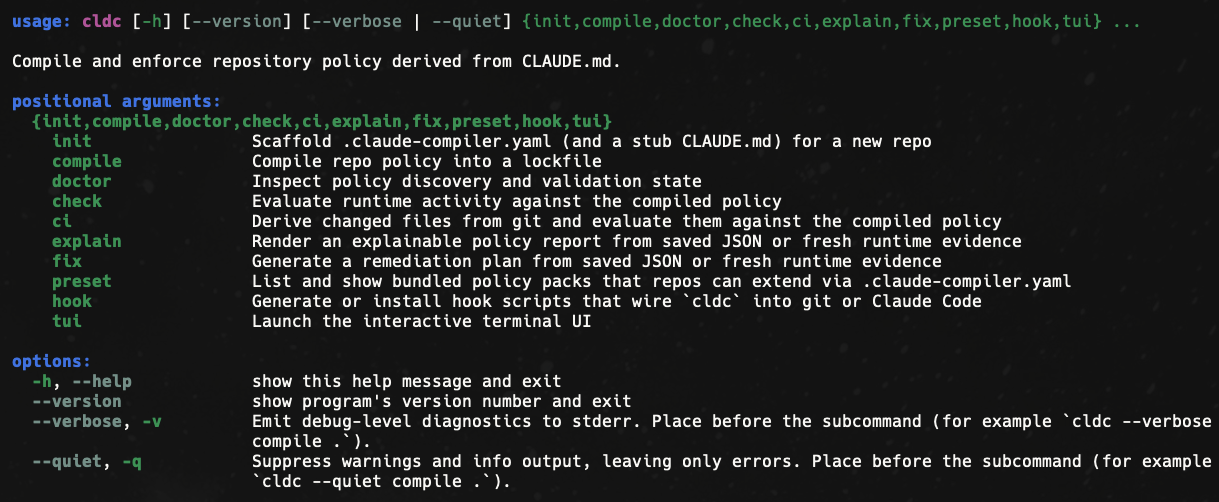
- Command surface
- Interactive TUI
- Automatic enforcement hooks
- Exit codes and JSON contracts
- End-to-end test against a real repo
- How policy is authored
- Potential next feature: semantic extraction
- Preset policy packs
- Rule model
- Evidence inputs
- Library API
- Architecture
- Development
- Project status
- Learn more
- License
Install
cldc requires Python 3.11+. The recommended path is a tool-style install
through uv or pipx, which keeps the CLI on its own venv:
# persistent install (recommended)
uv tool install claude-md-compiler

# or
pipx install claude-md-compiler

# one-shot, no install
uvx --from claude-md-compiler cldc --version
For local development inside this repository, use the
development workflow instead of installing the project into
itself.
60-second tour
Bootstrap a brand-new repo, compile policy, and enforce it on the very next
file edit:
# 1. Scaffold .claude-compiler.yaml + a stub CLAUDE.md
cldc init . --preset default --preset strict

# 2. Compile policy into .claude/policy.lock.json
cldc compile .

# 3. Check a hypothetical change directly
cldc check . --write src/main.py --command "pytest -q"

# 4. Render a human-readable report
cldc explain . --write src/main.py --format markdown

# 5. Build a deterministic remediation plan
cldc fix . --write src/main.py --format markdown

# 6. Gate a staged diff or PR range from CI
cldc ci . --staged
cldc ci . --base origin/main --head HEAD

# 7. Explore everything interactively in the terminal
cldc tui .

# 8. Wire enforcement into git and Claude Code automatically
cldc hook install git-pre-commit .
cldc hook generate claude-code > .claude/settings.json
Command surface
| Command | What it does |
|---|---|
cldc init |
Scaffold .claude-compiler.yaml (and a stub CLAUDE.md) for a fresh repo, extending one or more bundled presets. |
cldc compile |
Compile sources into a deterministic .claude/policy.lock.json lockfile. |
cldc doctor |
Inspect discovery, parsing, and lockfile health; surface stale/drifted artifacts. |
cldc check |
Evaluate runtime evidence (reads, writes, commands, claims) against the lockfile. |
cldc ci |
Derive write paths from git diff --cached or git diff base...head and run check. |
cldc explain |
Render a saved report (or fresh evidence) as text or Markdown. |
cldc fix |
Build a deterministic remediation plan from a saved report or fresh evidence. |
cldc preset list / show |
Browse the bundled preset policy packs. |
cldc hook generate / install / claim |
Emit hook artifacts, install the git pre-commit hook, or append an explicit claim to the active Claude Code session. |
cldc tui |
Launch the interactive Textual-based policy explorer. |
Interactive TUI
cldc tui launches a Textual-powered terminal UI for exploring a repo's policy
without leaving the shell. It shows the discovered sources, the rule table with
live mode badges, the selected rule's full definition, a four-field evidence
form (reads / writes / commands / claims), and a colored decision panel that
updates on every check.
Keybindings:
| Key | Action |
|---|---|
c |
Compile the repo (cldc compile) |
r |
Run a check against the current evidence |
d |
Open the doctor report |
p |
Browse bundled preset packs |
R |
Reload sources from disk |
ctrl+l |
Clear the evidence form |
? |
Show help |
q |
Quit |
The TUI uses only the same library calls as the non-interactive CLI, so the
behavior you see on screen is the behavior a cldc check in CI would produce.
Automatic enforcement hooks
cldc hook covers two complementary enforcement moments:
- Git hooks for commit-time gating with
cldc ci --staged. - Claude Code lifecycle hooks for session-time evidence capture and
completion gating.
# Print a portable POSIX git pre-commit script that runs `cldc ci --staged`
cldc hook generate git-pre-commit

# Install it directly into .git/hooks/pre-commit and mark it executable
cldc hook install git-pre-commit .

# Refuse to clobber an existing hook unless --force is passed
cldc hook install git-pre-commit . --force

# Print a .claude/settings.json snippet that wires the full Claude Code
# hook lifecycle into cldc's session adapter
cldc hook generate claude-code
cldc hook generate claude-code --json

# Append an explicit claim to the active Claude Code session
cldc hook claim . ci-green

# Or target a specific Claude Code session id explicitly
cldc hook claim . qa-reviewed --session abc123
The git pre-commit script is self-contained and skips gracefully (with
a warning) if cldc is not on PATH, so checking out the hook on a
machine without cldc installed will not break commits. Usegit commit --no-verify to bypass it for a single commit.
The Claude Code snippet is generate-only by design. It is meant to be copied
or merged into an existing .claude/settings.json, not written blindly over
operator-managed settings.
The generated Claude Code settings wire the lifecycle this way:
SessionStartinitializes machine-local session state for the repo.PreToolUseblocks true write preconditions before the edit happens:
blockingdeny_writeand blockingrequire_read.PostToolUserecords successfulRead,Edit,Write,MultiEdit, andBashevidence, then emits Claude-visible JSON feedback when warnings or
blocking workflow requirements remain.PostToolUseFailurerecords failedBashcommands separately, keeps them
in outcome-aware evidence, and tells Claude that failed commands do not
satisfyrequire_command_success.Stopevaluates the full accumulated session state and returns a blocking
payload while blocking workflow invariants remain unmet, includingcouple_change,require_command, andrequire_claim.SessionEnddeletes the mutable session state while leaving the latest
saved report on disk for later inspection.
By default, the adapter stores machine-local state under~/.claude/cldc/projects/<repo-hash>/.... Set CLDC_CLAUDE_STATE_DIR to
override that root. Claims stay explicit because Claude Code does not emit a
native claim event; use cldc hook claim when a human, harness, or CI system
needs to append one.
Saved hook reports are first-class handoff artifacts. You can render the most
recent one directly without hunting for a path:
cldc explain . --hook-report --format markdown
cldc fix . --hook-report --json

# Or target a specific Claude Code session id
cldc explain . --hook-report --hook-session abc123
Near-term Claude adapter roadmap
- Keep
PreToolUsefocused on true preconditions and reserve final workflow
completion gating forStop. - Capture richer tool metadata as Claude Code hook payloads evolve, especially
more precise multi-path edits and richer tool response details. - Make the saved per-session report easier to hand off into
cldc explainandcldc fixflows. - Improve claim plumbing so external CI and review systems can append explicit
claims with less manual wiring.
Exit codes and JSON contracts
cldc is built to be called from a harness, a CI step, or a pre-commit hook,
not just from a human shell. Every command behaves predictably in those
contexts:
| Exit code | Meaning |
|---|---|
0 |
Clean run, or a non-blocking result (decisions pass or warn). |
1 |
Runtime or input error (malformed repo, bad evidence payload, git failure, stale lockfile, etc.). |
2 |
Blocking policy violations (decisions block). |
Every command supports --json for machine-readable output and --output <file> to persist that output to disk (parent directories are created on
demand). When a command fails (exit 1), the --json error payload carries:
{
  "command": "check",
  "ok": false,
  "error": "compiled lockfile not found at .claude/policy.lock.json; run `cldc compile` before `cldc check`",
  "error_type": "FileNotFoundError"
}
error_type is the Python exception class name (e.g. LockfileError,GitError, EvidenceError, RepoBoundaryError, FileNotFoundError) so
downstream tooling can route on the failure mode without regex-parsing the
message.
Three JSON artifacts are versioned contracts and carry both $schema and a
string format_version:
| Artifact | $schema |
format_version |
|---|---|---|
| Policy lockfile | https://cldc.dev/schemas/policy-lock/v1 |
1 |
| Check report | https://cldc.dev/schemas/policy-report/v1 |
1 |
| Fix plan | https://cldc.dev/schemas/policy-fix-plan/v1 |
1 |
Mismatched versions are rejected outright instead of being interpreted on a
best-effort basis. Re-run cldc compile after upgrading the package.
Global flags on the top-level cldc command:
--verbose,-v: emit debug-level diagnostics to stderr and print the full
traceback on errors. Use this when filing bugs.--quiet,-q: suppress warnings, leaving only errors.--version: print the package version.
End-to-end demo against a real repo
The repo ships a narrated e2e demo that walks the full cldc pipeline
against a real upstream repo. By default it clones
langchain-ai/langchain,
drops a hand-authored .claude-compiler.yaml (undertests/e2e/compiler.yaml) alongside the repo's existing CLAUDE.md
context, and shows each stage explicitly:
- ingest: which policy sources were discovered and what each one means,
- parse: which structured rules were normalized out of those sources,
- compile: the lockfile artifact and its deterministic metadata,
- runtime: red and green evidence sets rendered as human-readable reports,
- doctor: post-compile health and freshness checks,
- fix-plan: deterministic remediation from a failing report.
Launch the visual demo with:
make e2e
make e2e-interactive
make e2e-fast
make e2e is screen-recording friendly by default: a visible pipeline map,
colored stage cards, explicit module/input/output explainers, rendered reports,
and short pauses between steps. Use make e2e-interactive to wait for a
keypress between stages instead.
The raw pytest regression suite is still available and excluded from the
default pytest run via the e2e marker:
make e2e-test
# or
uv run pytest -m e2e -v
Both flows require git on PATH and network access so the upstream repo
can be cloned.
How policy is authored
Policy authoring in a Claude Code repo has two layers:
- Claude context: free-form prose in
CLAUDE.mdthat Claude reads at
session start. - Enforced policy: explicit fenced
cldccode blocks,.claude-compiler.yaml, bundled presets, andpolicies/*.yml.
Today only the explicit structured layer becomes enforceable rules. cldc
does not semantically extract arbitrary CLAUDE.md prose into rules yet.
Sources are discovered from the repo root or any nested path inside the repo.
The authored bundle is tracked in deterministic order:
CLAUDE.mdas the authored context source- inline fenced
cldccode blocks insideCLAUDE.md .claude-compiler.yamlor.claude-compiler.yml- bundled presets referenced from
.claude-compiler.yamlviaextends: policies/*.ymlandpolicies/*.yaml
Example:
# CLAUDE.md

```cldc
rules:
  - id: generated-lock
    kind: deny_write
    mode: block
    paths: ["generated/**"]
    message: Generated files must not be edited by hand.
```
# .claude-compiler.yaml
default_mode: warn
extends:
  - default        # bundled preset: generated/** is read-only, lockfile-follows-manifest
  - strict         # bundled preset: tests-follow-source, arch-read, ci-green claim
rules:
  - id: keep-tests-in-sync
    kind: couple_change
    paths: ["src/**"]
    when_paths: ["tests/**"]
    message: Update tests when source changes.
Only items 2 through 5 become enforceable rules today. Item 1 remains Claude
context and human review context, but it is still part of the tracked source
bundle so lockfile freshness reflects the authored policy surface around those
rules.
Potential next feature: semantic extraction
A plausible next feature is semantic extraction at authoring time:
reading free-form CLAUDE.md prose and proposing structured rule candidates
for review.
That authoring-time phase could be powered by an LLM or agent:
- reading prose instructions and inferring candidate
cldcrules - showing the mapping from prose statements to proposed rule definitions
- asking a maintainer to accept, edit, or reject those candidates before they
become part of the repo's structured policy
What that would improve:
- lower the friction of turning prose conventions into enforceable rules
- surface gaps between "what the repo says" and "what the lockfile enforces"
- bootstrap
.claude-compiler.yamlor fencedcldccode blocks from
existing project instructions
How that would differ from the current architecture:
- Today: the compiler only accepts explicit structured policy as input to
the deterministic ingest → parse → compile → evaluate pipeline. - With semantic extraction: an optional LLM- or agent-assisted
authoring layer would propose or generate explicit rules first, then those
reviewed rules would flow through the same deterministic pipeline.
In other words, semantic extraction would help authors produce policy. It
would not put an LLM into the runtime enforcement path. The runtime judge would
stay deterministic, offline, and artifact-driven. The model would only help
with authoring candidate rules; compile, check, doctor, and fix would
still operate on explicit reviewed artifacts.
Preset policy packs
cldc ships with opinionated rule packs you can merge into your repo policy via extends: in .claude-compiler.yaml.
| Preset | What it does |
|---|---|
default |
Blocks writes to generated/**, dist/**, build/**; warns when a dependency manifest changes without a matching install/sync/tidy command. |
strict |
Requires tests to move with source, requires an architecture/RFC read before editing src/**, and requires a ci-green claim to ship src/** changes. |
docs-sync |
Couples public CLI / runtime / API changes with README/docs updates, and couples version bumps with changelog entries. |
Inspect the bundled packs:
cldc preset list
cldc preset show default
cldc preset show strict --json
Use them by listing one or more names under extends::
# .claude-compiler.yaml
extends:
  - default
  - docs-sync
Preset rules merge alongside your own rules. Duplicate rule IDs fail the compile, so pick unique IDs for your own rules.
Rule model
| Kind | Required fields | Meaning |
|---|---|---|
deny_write |
paths |
Paths matching paths must not be written. |
require_read |
paths, before_paths |
Writing paths requires a prior read matching before_paths. |
require_command |
commands, when_paths |
Writing when_paths requires at least one listed command to run, regardless of outcome. |
require_command_success |
commands, when_paths |
Writing when_paths requires at least one listed command to complete successfully. |
forbid_command |
commands (optional when_paths) |
The listed commands must not run; scoped to when_paths when provided, otherwise repo-wide. |
couple_change |
paths, when_paths |
Writing paths requires a companion write matching when_paths. |
require_claim |
claims, when_paths |
Writing when_paths requires at least one listed claim to be asserted. |
Example require_claim rule — block edits to src/** until a reviewer asserts qa-reviewed:
rules:
  - id: qa-sign-off
    kind: require_claim
    mode: block
    when_paths: ["src/**"]
    claims: ["qa-reviewed", "security-reviewed"]
    message: QA or security must sign off before editing source.
| Mode | Meaning |
|---|---|
observe |
Record the result but do not block. |
warn |
Report the result but do not block. |
block |
Report the result and exit 2. |
fix |
Report the result as blocking and include remediation guidance. |
Evidence inputs
Runtime commands accept evidence three ways:
# direct flags
cldc check . --read docs/spec.md --write src/main.py --command "pytest -q" --claim qa-reviewed

# outcome-aware command evidence
cldc check . --write src/main.py --command-success "pytest -q"
cldc check . --write src/main.py --command-failure "pytest -q"

# JSON file
cldc check . --events-file .cldc-events.json --json

# stdin JSON
cat .cldc-events.json | cldc check . --stdin-json --json
Use --claim once per asserted claim; claims satisfy require_claim rules in the compiled policy.
Use --command-success and --command-failure when the workflow needs to
distinguish an attempted command from a confirmed successful one.
Accepted payload shape:
{
  "read_paths": ["docs/spec.md"],
  "write_paths": ["src/main.py"],
  "commands": ["pytest -q"],
  "command_results": [
    {"command": "pytest -q", "outcome": "success"}
  ],
  "claims": ["qa-reviewed"],
  "events": [
    {"kind": "read", "path": "docs/spec.md"},
    {"kind": "write", "path": "src/main.py"},
    {"kind": "command", "command": "pytest -q", "outcome": "success"},
    {"kind": "claim", "claim": "qa-reviewed"}
  ]
}
Saved report workflow:
cldc check . --write src/main.py --json --output artifacts/policy-report.json
cldc explain . --report-file artifacts/policy-report.json --format markdown --output artifacts/policy-report.md
cldc fix . --report-file artifacts/policy-report.json --json --output artifacts/policy-fix-plan.json
Library API
cldc is a typed Python library as well as a CLI. The package ships apy.typed marker so downstream type checkers pick up the inline annotations,
and every public type lives under a stable import path:
from cldc import __version__
from cldc.compiler.policy_compiler import compile_repo_policy, doctor_repo_policy
from cldc.runtime.evaluator import check_repo_policy, CheckReport, Violation
from cldc.runtime.events import load_execution_inputs, ExecutionInputs
from cldc.runtime.git import collect_git_write_paths
from cldc.runtime.remediation import build_fix_plan, render_fix_plan
from cldc.runtime.reporting import load_check_report, render_check_report
from cldc.runtime.hooks import generate_hook, install_hook
from cldc.scaffold import initialize_repo_policy
from cldc.errors import (
    CldcError,           # base class, inherits from ValueError
    LockfileError,
    EvidenceError,
    ReportError,
    PolicySourceError,
    PresetError,
    PresetNotFoundError,
    RuleValidationError,
    RepoBoundaryError,
    GitError,
)
A minimal end-to-end run from a Python script:
from pathlib import Path

from cldc.compiler.policy_compiler import compile_repo_policy
from cldc.runtime.evaluator import check_repo_policy

repo = Path(".")
compile_repo_policy(repo)

report = check_repo_policy(
    repo,
    write_paths=["src/main.py"],
    commands=["pytest -q"],
    claims=["ci-green"],
)

if report.decision == "block":
    for violation in report.violations:
        print(f"[{violation.mode}] {violation.rule_id}: {violation.message}")
    raise SystemExit(2)
See docs/library-usage.md for the full library
reference, including every public dataclass, the JSON shapes thatto_dict() produces, and worked examples for each rule kind.
Architecture
cldc has a pure-core / thin-shell shape:
src/cldc/ingest/— discover the repo root and load canonical policy sources.src/cldc/parser/— validate and normalize rule documents.src/cldc/compiler/— build.claude/policy.lock.jsonand doctor the repo state.src/cldc/runtime/— evaluate evidence, render reports, build fix plans, and integrate with git.src/cldc/presets/— bundled opinionated policy packs and the loader API.src/cldc/scaffold.py—cldc initonboarding scaffolder.src/cldc/cli/— thin argparse shell that exposes the commands and exit codes.src/cldc/tui/— Textual-based interactive policy explorer.
See ARCHITECTURE.md for the full data flow, invariants,
schema contracts, and extension points.
Development
git clone https://github.com/AbdelStark/claude-md-compiler
cd claude-md-compiler
uv sync --locked

# Run the full local quality gate (lint + format-check + types + tests + build + smoke)
make all

# Or step by step
uv run pytest -q
uv run ruff check src tests
uv run ruff format --check src tests
uv run pyright src
uv build
Useful local commands:
uv run cldc --help
uv run cldc compile tests/fixtures/repo_a
uv run cldc check tests/fixtures/repo_a --write src/main.py --json
uv run cldc ci tests/fixtures/repo_a --base HEAD --head HEAD --json
uv run cldc explain tests/fixtures/repo_a --write src/main.py --format markdown
uv run cldc fix tests/fixtures/repo_a --write src/main.py --json
uv run cldc tui tests/fixtures/repo_a
The repository does not require runtime environment variables. SeeCONTRIBUTING.md for the full contributor workflow.
Project status
cldc is published on PyPI asclaude-md-compiler and is
currently in alpha. The contracts that downstream tooling cares about — the
lockfile, the check report, and the fix plan — are versioned with $schema
and format_version fields, and a major-version bump is required to break
their shape. The CLI surface (init, compile, doctor, check, ci,explain, fix, preset, hook, tui) is stable and covered by 260+
tests including Hypothesis property tests, an opt-in end-to-end suite that
runs against a real upstream repository (langchain-ai/langchain), and a
post-build smoke test against the freshly built wheel. The library reaches
92 % combined branch + statement coverage under pytest --cov.
Learn more
- ARCHITECTURE.md — layered design, data flow, schema contracts, and extension points
- docs/library-usage.md — library reference and worked examples
- docs/rfcs/ — frozen specification documents for the JSON contracts
- CONTRIBUTING.md — contributor workflow and quality gates
- CHANGELOG.md — release history in Keep a Changelog format
- SECURITY.md — supported versions and how to report a vulnerability
License
MIT © claude-md-compiler contributors.
Yorumlar (0)
Yorum birakmak icin giris yap.
Yorum birakSonuc bulunamadi