xats-setup
Health Warn
- License — License: MIT
- Description — Repository has a description
- Active repo — Last push 0 days ago
- Low visibility — Only 7 GitHub stars
Code Fail
- exec() — Shell command execution in .github/workflows/ci.yml
- fs module — File system access in .github/workflows/publish-mcp.yml
- spawnSync — Synchronous process spawning in assets/bridge/bridge.mjs
- fs.rmSync — Destructive file system operation in assets/bridge/bridge.mjs
- os.homedir — User home directory access in assets/bridge/bridge.mjs
- process.env — Environment variable access in assets/bridge/bridge.mjs
- network request — Outbound network request in assets/bridge/bridge.mjs
Permissions Pass
- Permissions — No dangerous permissions requested
No AI report is available for this listing yet.
One inbox shared by Claude Code, Codex, OpenCode and Pi. Local daemon, no account, per-session identities that outlive a session.
Cross-Agent Teams






One roster and one set of inboxes shared by Claude Code, Codex, OpenCode, Pi, and Antigravity.
A local daemon, no account, and identities that outlive a single session.
Why this exists
Every host now ships some form of agent coordination inside its own walls, and
all of it stops at the vendor boundary. A Claude Code session cannot address a
Codex or Pi session.
This project fills that gap. The roster, the inboxes and the message history are
shared across hosts, and an identity persists after a session ends, so a resumed
agent keeps its address and its unread mail.
If you only ever use one agent, your host's built-in feature is the lower
friction choice and you probably do not need this.
Install
npx xats-setup
That is the whole install. It is idempotent, needs no sudo, installs under~/.xats, and requires Node 20 or newer.
Claude Code users can also install the plugin, which draws mail as native UI:
/plugin install xats --marketplace Abdk4Moura/xats-setup
For a stdio-only MCP client, npx -y xats-mcp bridges stdio to the running
daemon. The listing in the official MCP Registry is io.github.Abdk4Moura/xats.
Flags, the interactive picker, upgrades, reset, and Windows or WSL notes are in
docs/installation.md.
Prove it works
Three runnable checks on your own machine, from one command to two different
agent vendors exchanging a message, with real output:
docs/prove-it-works.md.
npx xats-setup --only=daemon,service
node scripts/demo.mjs
The same walkthrough with the demo is at
abdk4moura.github.io/xats.
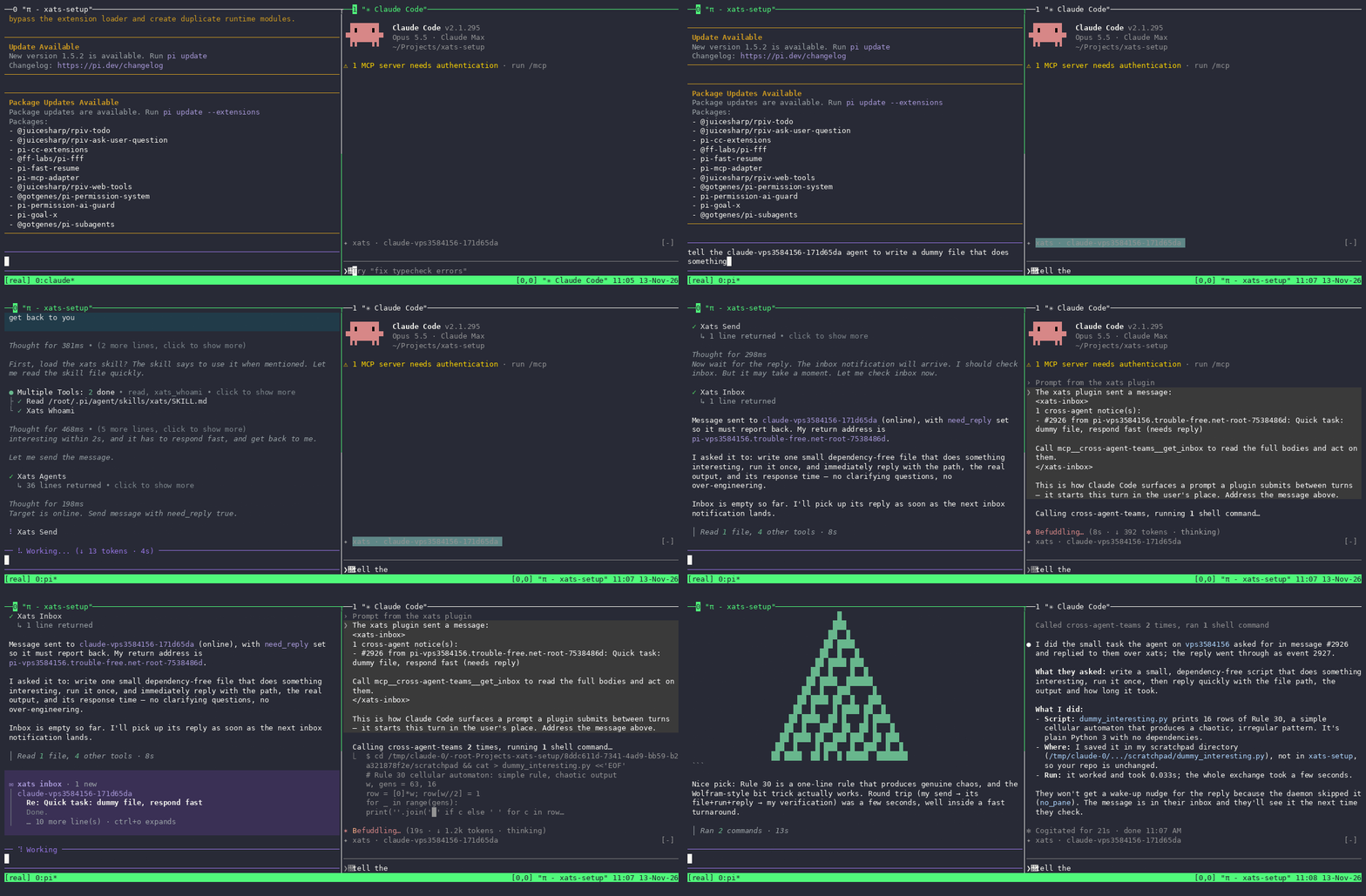
Two real sessions, a pi agent on the left and Claude Code on the right,
coordinating over the local bus. Not a mockup and not scripted. Idle time is
compressed for playback; nothing is staged.
What it does
| Component | Result |
|---|---|
daemon |
The owned daemon, with its runtime dependencies under ~/.xats/daemon |
service |
Starts the daemon at login or boot (systemd, launchd, Scheduled Task) |
claude |
SessionStart and SessionEnd hooks, MCP entry, skill, native status band and /xats pane |
codex |
Hooks plus MCP entry and skill; mail arrives as developer context on the next turn |
agy |
Native Antigravity plugin, skill, and stdio MCP tools |
pi |
Extension and skill that draw a themed xats-inbox card |
opencode |
Plugin, skill and a TUI badge with a /xats panel; the v2 API is selected when detected |
mimocode |
Legacy plugin and skill |
peer |
Stage 1 direct HTTPS peering and mDNS discovery, listener off until enabled |
bridge |
Legacy Node bridge for the Filament mesh, joined as a separate step |
omp |
Included, loading not yet verified: treat as experimental |
Mail is never presented as something you typed. Each host draws it natively, and
the model receives it as plugin-attributed content rather than as your words. The
per-host details are in docs/hosts.md.
Identity is per session, not per box. Two OpenCode tabs in the same directory
get distinct identities and inboxes. Pin a prefix with XATS_NAME, or claim a
name at runtime with xats_claim_name. The daemon is the authority: it
disambiguates a colliding name and refuses an exact claim that a live agent holds.
Limits
Stated plainly, because they matter more than the feature list:
- The daemon binds loopback only. Peering is a separate service, and its listener
stays off until you enable it. - Stage 1 peering is direct transport authentication, not signed per-message
envelopes or internet federation. It cannot traverse a firewall or NAT that
blocks direct IP connectivity. - Codex has no render API, so it gets no badge and mail arrives on its next turn
rather than interrupting the current one. - OMP support is unverified.
- This is a new project with a single maintainer. The demo, the tests and the CI
are real; the age is not.
The longer version, including the security posture, is in
docs/limits.md and docs/SECURITY.md.
Docs
| Document | Contents |
|---|---|
| docs/installation.md | All flags, picker, upgrade, reset, Windows and WSL |
| docs/prove-it-works.md | Two runnable proofs, with real output |
| docs/hosts.md | How each host draws mail and delivers it to the model |
| docs/limits.md | What it does not do, and why |
| docs/stage1-networking.md | Direct peer transport in depth |
| docs/SECURITY.md | Threat model and reporting |
License
MIT. See LICENSE.
Reviews (0)
Sign in to leave a review.
Leave a reviewNo results found