KIN
Health Uyari
- License — License: MIT
- Description — Repository has a description
- Active repo — Last push 0 days ago
- Low visibility — Only 7 GitHub stars
Code Basarisiz
- eval() — Dynamic code execution via eval() in core/src/browser/browser_controller.ts
- process.env — Environment variable access in core/src/browser/browser_controller.ts
- exec() — Shell command execution in core/src/computer/desktop_controller.ts
- process.env — Environment variable access in core/src/computer/desktop_controller.ts
- os.homedir — User home directory access in core/src/context/output_spiller.ts
- process.env — Environment variable access in core/src/context/output_spiller.ts
Permissions Gecti
- Permissions — No dangerous permissions requested
Bu listing icin henuz AI raporu yok.
Sovereign Multi-Agent Desktop OS (Alpha). Zero-cloud, event-sourced local architecture in Rust, Tauri v2, SQLite, and Ollama.
KIN — The Autonomous Local-First Workforce Operating System
Multi-Agent Coordination • Governed Computer Use • Crash-Resilient Checkpointing • Zero Cloud Telemetry







Architecture • Product Specifications • Verification Suite • Quick Start
🌟 Overview
KIN is an autonomous, local-first operating system designed to orchestrate collaborative multi-agent software engineering teams on your physical workstation. Unlike brittle cloud wrappers or stateless chatbots, KIN operates with authoritative local state, turn-by-turn crash recovery, dynamic hardware resource governors, and governed desktop/browser control.
Whether your PC experiences an unexpected power outage, an LLM provider enforces API rate limits (HTTP 429), or multiple agents collaborate on a complex dependency DAG, KIN guarantees zero lost context, atomic task checkout, and non-destructive execution.
⚡ Core Pillars & Innovations
1. 🛡️ Crash Resilience & Turn-by-Turn Checkpointing
- Atomic Turn Snapshots: Every tool action and reasoning turn in
agent_loop.tspersists an immutable snapshot to SQLitecheckpoints. - Unexpected Shutdown Recovery: When KIN starts up after a system crash, power loss, or app termination, the supervisor automatically reconciles stale heartbeat leases and presents an interactive Docked Crash Recovery Banner in the UI.
- One-Click Resumption: Choose Resume All to continue all interrupted runs from their exact last recorded turn, Inspect State to audit the prior trajectory, or Discard to release task leases cleanly.
2. ⏳ HTTP 429 Quota Guard & Local Fallback
- Non-Destructive Quota Pauses: When external providers (Anthropic, OpenAI, Gemini) return HTTP 429 or
RESOURCE_EXHAUSTED, KIN intercepts the error, saves a turn checkpoint, and transitions the run toquota_paused. - Live Countdown Timer: The UI displays a docked Quota Banner with a real-time countdown to provider reset.
- Instant Local Fallback: Seamlessly resume immediately via Resume Now or switch the in-flight run to local Ollama with a single click.
3. 🎯 Antigravity Slash Command Suite
/plan <topic>: Decomposes objectives into sequential milestone DAG tasks with explicit dependency chaining and SQLite persistence./boost <target>: Runs real-time git porcelain checks, verifies SQLite WAL metrics, and engages maximum-autonomy execution./teamwork-preview: Discovers all active project specialists, roles, assigned channels, and local Ollama model readiness./goal <title> [| desc] [| criteria]: Registers persistent goal milestones into authoritative project records./btw <query>: Lightweight, ephemeral side-queries answered immediately with a💡 [Side Query / BTW]badge without creating DAG tasks or polluting active execution./grill-me [topic]: Interactive architectural interview mode that interrogates requirements, renders selectable questionnaire cards, and records authoritative Architectural Decision Records (ADR)./schedule&/routine: Proactive timed autonomy and cron-based background wakeups without GPU/CPU busy-polling.
4. 🖥️ Dynamic Computer Allocation & Desktop Control
- RAM-Aware Dynamic Limiter: Inspects
os.freemem()before allocating browser contexts or shell processes to prevent host out-of-memory lockups. - Persistent Isolated Profiles: Each agent routes browser tasks through partitioned directory profiles (
.kin/browser_profiles/<agentId>) preserving cookies, logins, and storage with 3-minute idle eviction. - Win32
DesktopLockMutex: Serializes physical mouse and keyboard inputs across agents via a single-flight Promise mutex. - Financial Safety Shield: Restricts checkout/billing actions to
CRITICAL RISKrequiring explicit human approval.
5. 🔒 Atomic Distributed Task Leases & OCC Protection
- Lease Locks: Tasks are claimed atomically (
claimTaskWithLease) withclaimed_by_run_idandlease_expires_at, preventing race conditions during swarm execution. - Optimistic Concurrency Control (OCC): Computes SHA-256 hashes on file reads (
handleReadFile) and validates them before writes (handleWriteFile) to eliminate stale-write conflicts. - Goal Ancestry Propagation: Automatically compiles the complete
Workspace -> Project -> Goal -> Task -> Runchain into agent prompts so subagents never suffer goal drift.
6. 📊 Formal Agent Evaluations & BYOK Credential Vault
- Benchmark Evaluator: Quantitative assessment engine scoring agents across Reasoning Depth, Factuality, Tool Compliance, and Latency (0–100%).
- Bring-Your-Own-Key (BYOK): Centrally managed credential vault with encrypted storage, scoped provider grants, and daily token spend caps.
📸 Visual Showcase
1. Docked Crash Recovery Warning Banner
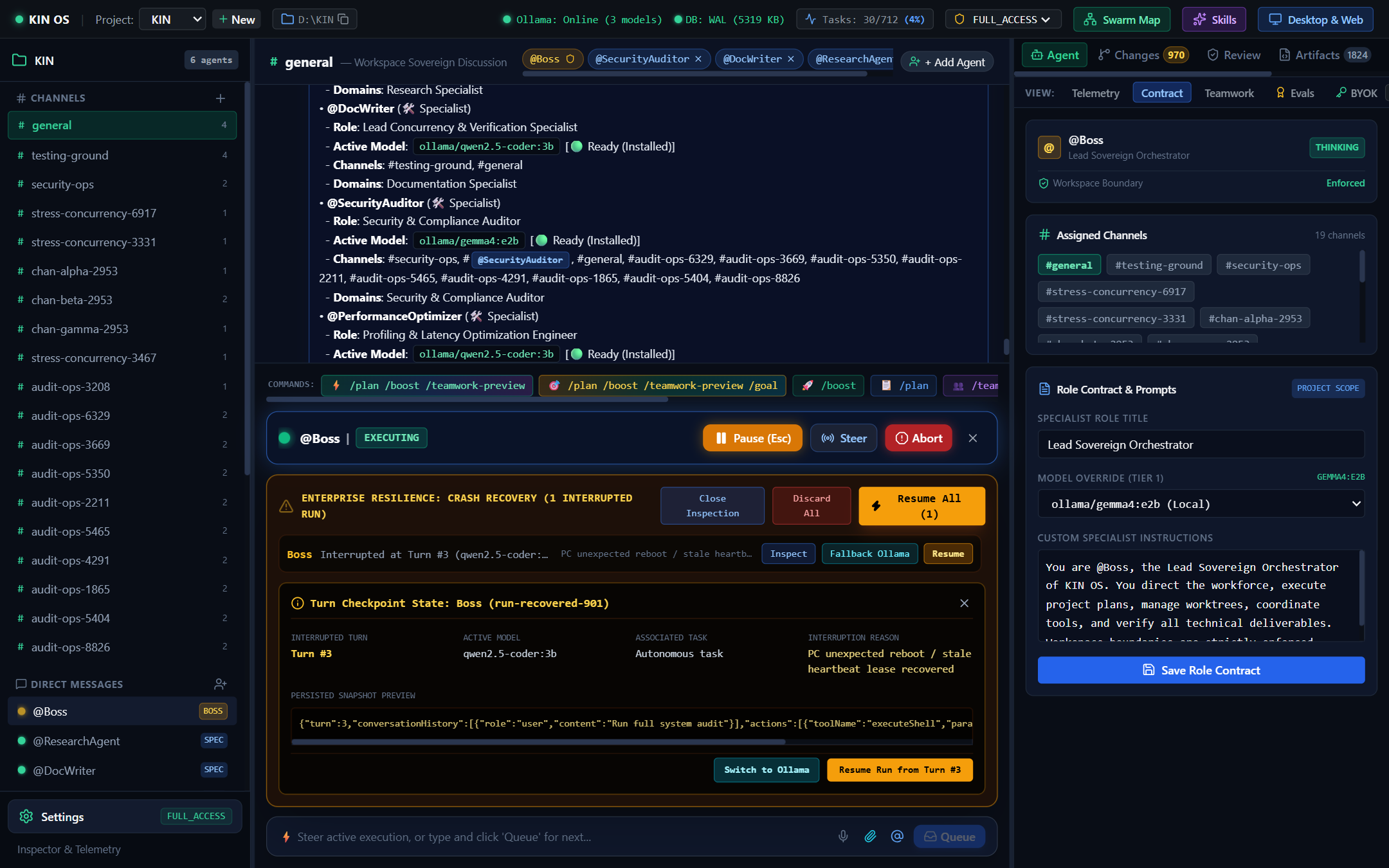
Interactive Crash Recovery Banner alerting the operator to interrupted agent runs after an unexpected shutdown, featuring 1-click Resume All, Inspect State, and Discard controls.
2. HTTP 429 Quota Guard & Local Model Fallback
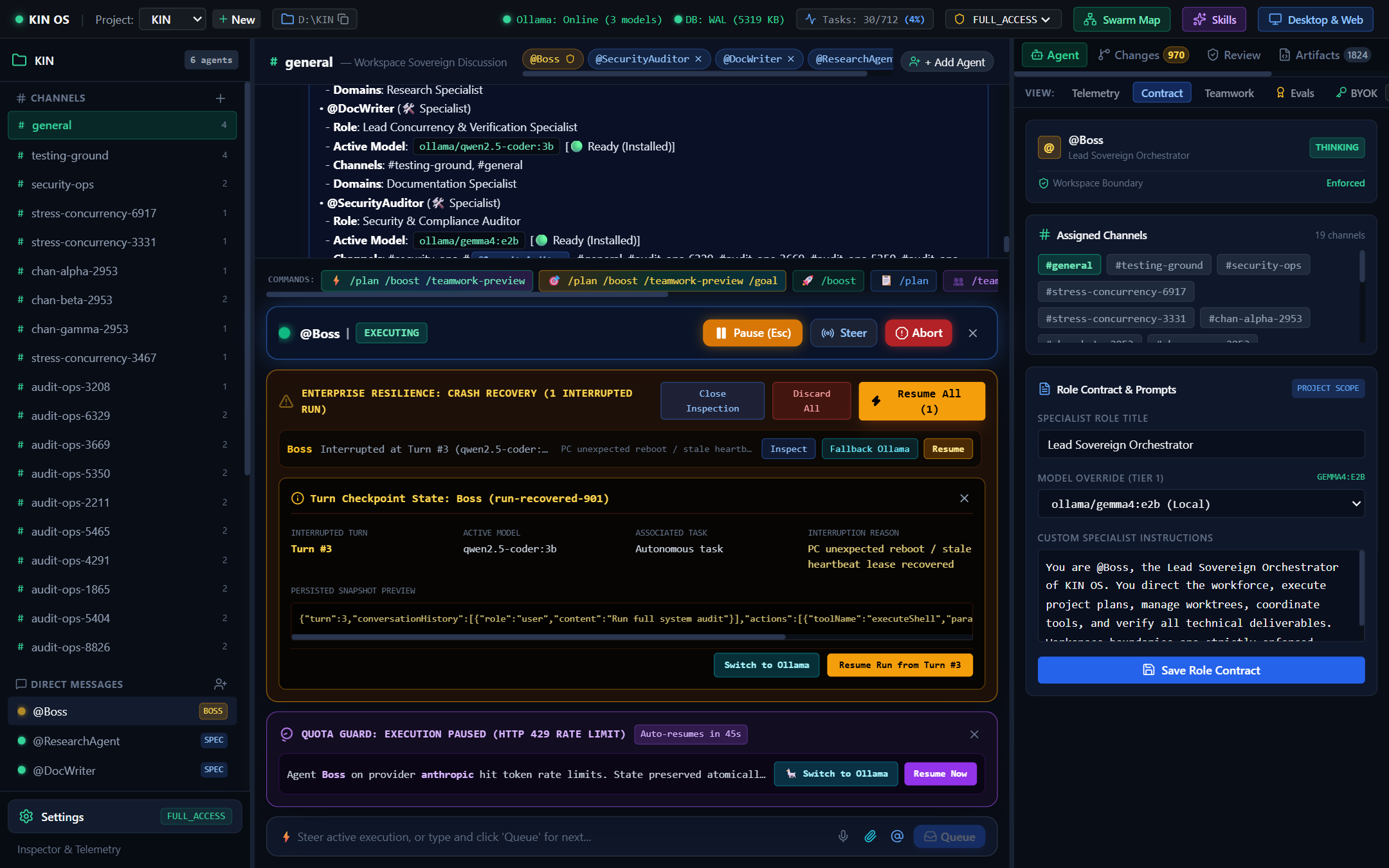
Active Quota Pause Banner presenting a live 45-second countdown timer until provider reset, an instant Resume Now button, and a 1-click Switch to Ollama local fallback.
3. /btw Ephemeral Side-Query Execution
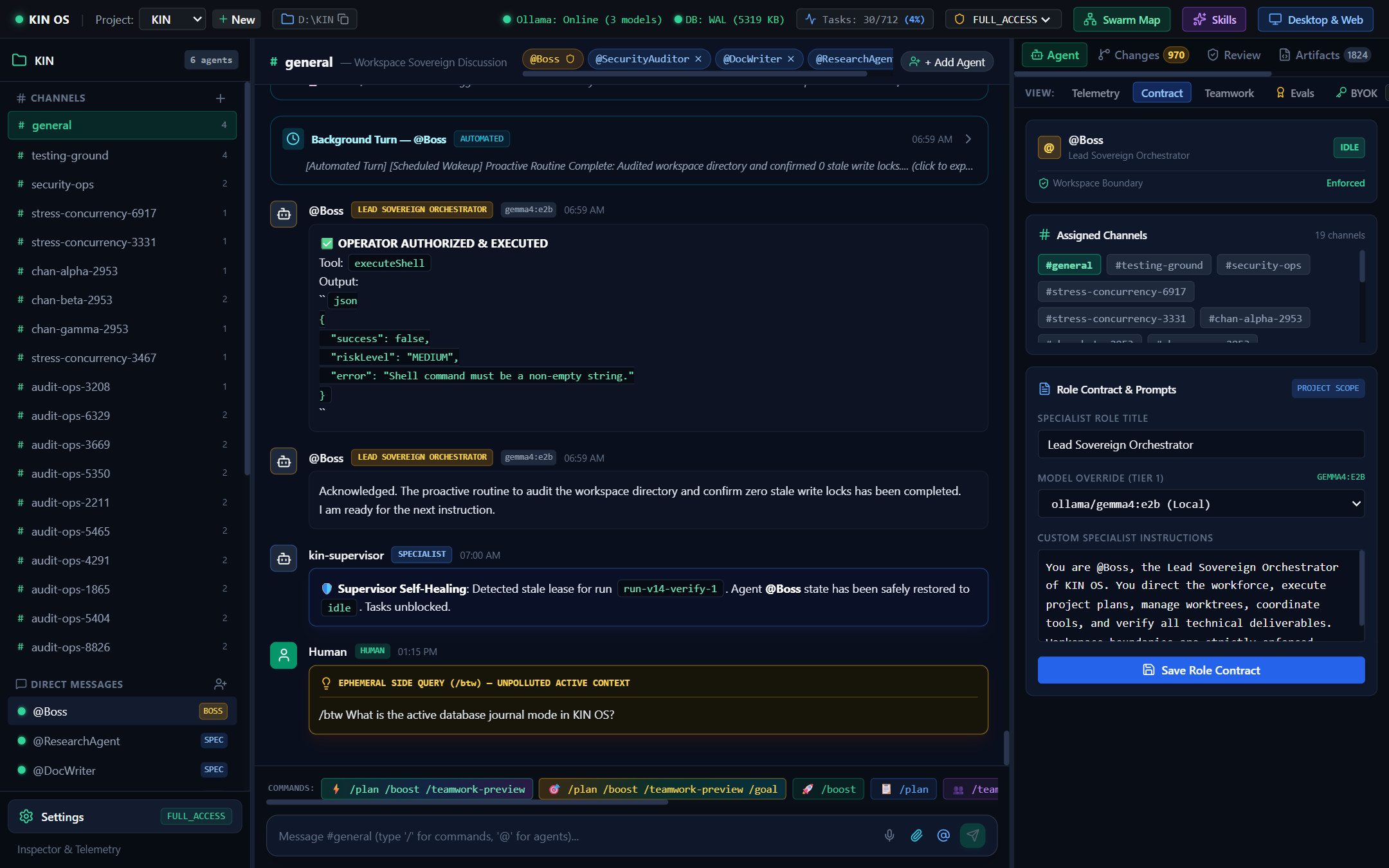
Non-blocking /btw side-query rendered with 💡 [Side Query / BTW] pill badge, delivering immediate architectural context without task creation or channel clutter.
4. Interactive /grill-me Questionnaire & ADR Synthesis
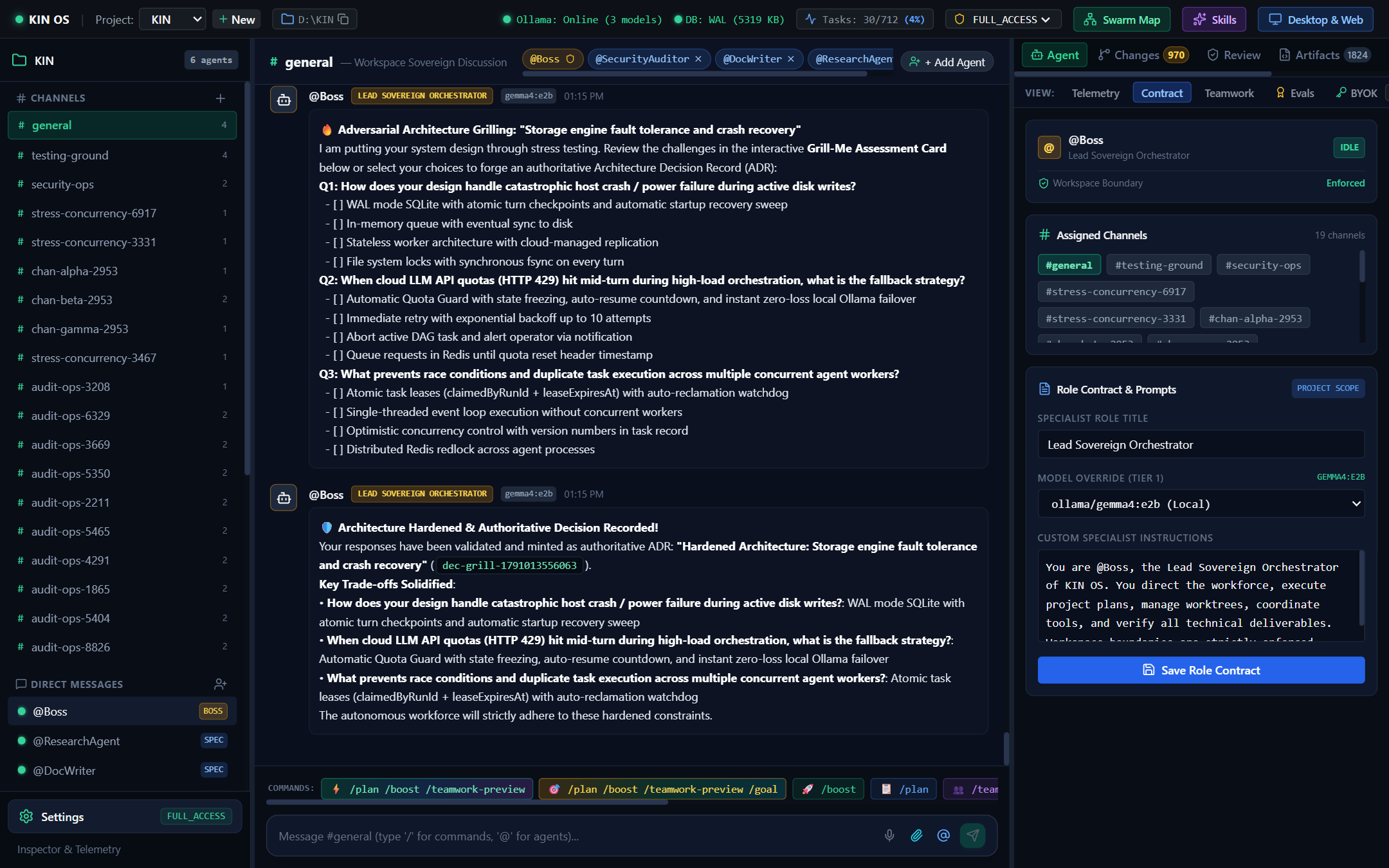
Adversarial /grill-me architectural interrogation card with interactive radio option selection, user submission, and synthesized Architectural Decision Record (ADR).
5. Agent Benchmark Evaluations & BYOK Credential Vault

Agent Inspector displaying quantitative benchmark scores (88% Overall), evaluation rubrics, and the Bring-Your-Own-Key (BYOK) credential management vault.
🏗️ Monorepo Architecture
KIN/
├── core/                        # Authoritative Node.js Agent Kernel
│   ├── src/
│   │   ├── automation/          # Proactive Scheduler & Cron Engine
│   │   ├── browser/             # Persistent Headful Browser Controller
│   │   ├── computer/            # Desktop Discovery & Win32 Mutex Controller
│   │   ├── context/             # 5-Block Context Compiler & Goal Ancestry
│   │   ├── domain/              # Repositories (Agents, Tasks, Memory, Projects)
│   │   ├── execution/           # Model Gateway & Tool Gateway with OCC
│   │   ├── kernel/              # AgentLoopRunner, AgentKernel & WakeupQueue
│   │   ├── policy/              # Policy Engine & Financial Safety Shield
│   │   ├── recovery/            # Self-Healing & Verification Engine
│   │   ├── server/              # CoreServer (REST API, SSE Event Bus)
│   │   ├── skills/              # Continuous Learning & Candidate Harvester
│   │   └── storage/             # SQLite 3 Database & Migration Runner
│   └── test/                    # 113 Unit & Integration Vitest Suites
├── ui/                          # Presentation Layer (React 18 + Vite)
│   └── src/
│       ├── components/          # CenterView, Sidebar, AgentInspector, Modals
│       └── store/               # Authoritative Zustand State Store (kinStore.ts)
├── docs/                        # Complete Engineering Documentation
│   ├── PRD.md                   # Authoritative Product Requirements Document
│   ├── TRD.md                   # Technical Requirements & IPC Contracts
│   └── assets/                  # High-Resolution Logos & Verified Screenshots
└── tests/                       # E2E & Physical Chrome Verification Scripts
    └── verification/            # Puppeteer-Core Real-Browser Test Suites
🚀 Quick Start
Prerequisites
- Node.js: v20.x or higher
- npm: v10.x or higher
- Git: Installed and available on
PATH - Google Chrome: For physical desktop & browser automation
- Ollama (Optional for local models): ollama.ai (
ollama run qwen2.5-coder:3b)
1. Clone & Install Dependencies
git clone https://github.com/abhayzangir1/KIN.git
cd KIN
npm install
2. Build Core & UI Packages
npm run build --workspace=core
npm run build --workspace=ui
3. Run Automated Vitest Test Suite
npm test --workspace=core
# Output: Test Files 11 passed (11) | Tests 113 passed (113)
4. Launch KIN Core Daemon & Dev Server
Open two terminal windows:
Terminal 1 (Core Daemon):
npm run daemon --workspace=core
# Listening on http://127.0.0.1:54321
Terminal 2 (React UI):
npm run dev --workspace=ui
# Serving at http://localhost:5173
Navigate to http://localhost:5173 to access the full KIN Operating System.
🛡️ Security & Privacy Guarantees
- 100% Local Storage: All messages, tasks, goals, memories, checkpoints, and credentials reside in local SQLite storage (
kin_storage.sqlite). Zero third-party telemetry. - Strict Worktree Jails: File read/write tools are strictly confined to project roots. Directory traversal attacks (
../../) are rejected with403 Forbidden. - Optimistic Concurrency Control: Prevents accidental overwrites through baseline SHA-256 content hashing.
- Governed Automation: High-risk shell commands and browser actions trigger interactive approval gates in
ALWAYS_ASKmode.
📜 License
KIN is released under the MIT License.
Yorumlar (0)
Yorum birakmak icin giris yap.
Yorum birakSonuc bulunamadi