ui-craft
Health Uyari
- License — License: MIT
- Description — Repository has a description
- Active repo — Last push 0 days ago
- Low visibility — Only 6 GitHub stars
Code Gecti
- Code scan — Scanned 4 files during light audit, no dangerous patterns found
Permissions Gecti
- Permissions — No dangerous permissions requested
Bu listing icin henuz AI raporu yok.
Agent skill that makes mobile UI look like a shipped app: rules with real numbers, screen recipes and a fast screenshot review, from 2,600 screens of 44 iOS apps. Claude Code, Codex, Cursor, Gemini CLI. By Achref Arabi.
ui-craft — an agent skill for mobile UI that looks like a real app
By Achref Arabi · LinkedIn · Instagram



Your coding agent reads it before it touches a screen: rules with real numbers, screen
recipes and a fast screenshot review, built from 4,500 screens of 78 apps people love.
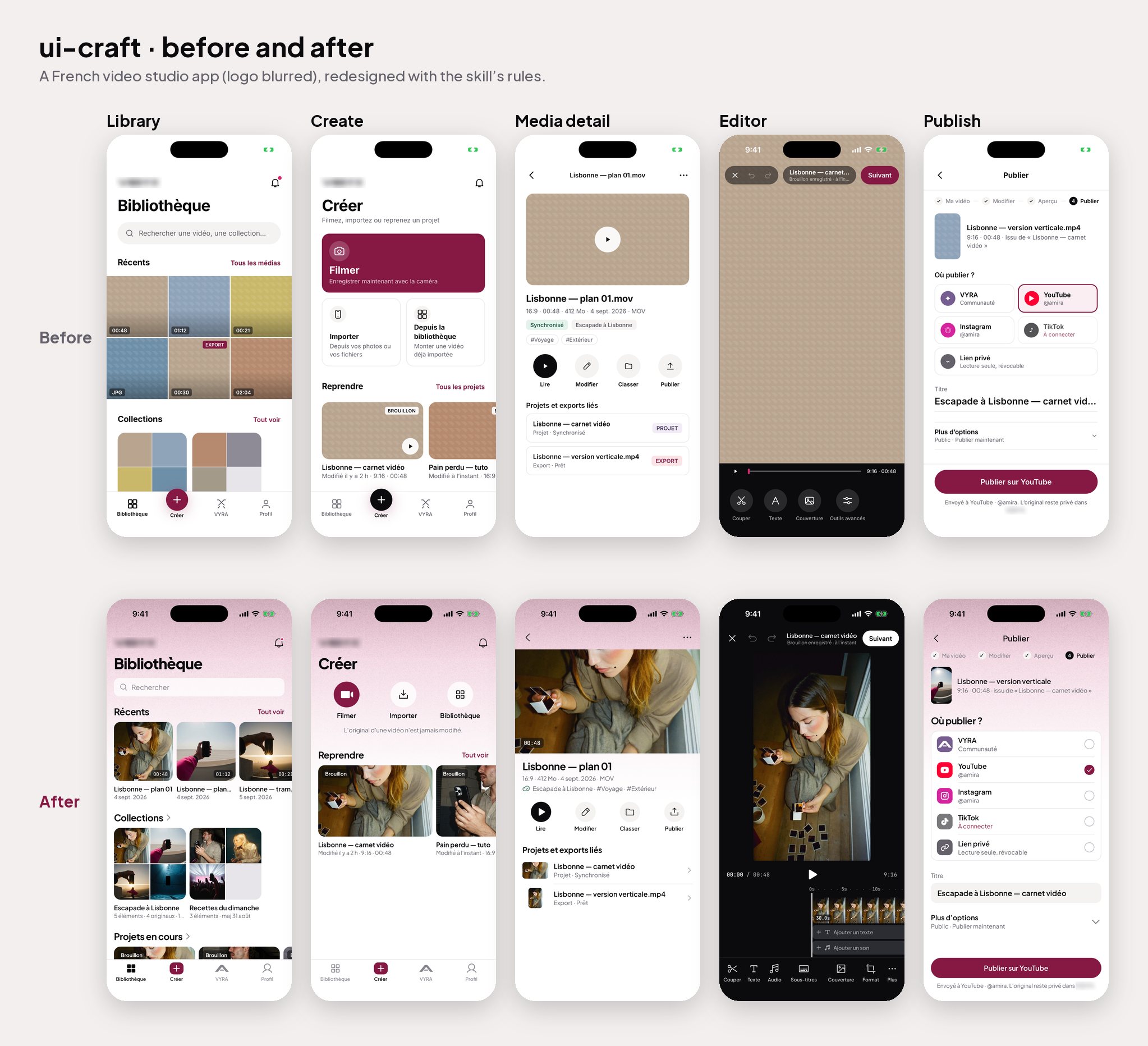
The same app, a French video studio with a social space, before and after applying the skill and one round of review by its product owner (logos blurred).
If ui-craft makes your screens better, a ⭐ helps other developers find it.
Quick start
git clone --depth 1 https://github.com/Achref23illi/ui-craft ~/.claude/skills/ui-craft
Open Claude Code in your app's repository and ask "Design the settings screen with
ui-craft" or "Review these screenshots with ui-craft: ./shots". Setup for Codex,
Cursor and Gemini CLI is below.
What's inside
A skill for Claude Code (and any agent that reads SKILL.md) built from a study of
78 shipped iOS apps — Spotify, Airbnb, Instagram, TikTok, Apple Music, Apple TV,
Netflix, VSCO, Halide, Denim, Photoshop, Riverside, Moises, Revolut, Wise, Coinbase,
PayPal, Linear, Notion, Cron, ChatGPT, Gemini, Claude, Uber, Uber Eats, Google Maps,
Apple Books, The Athletic, Nike Training Club and more — 4,536 screens read for how
they spend space, how few things they show, and how each element earns its place.
What you get:
SKILL.md— 23 rules with the numbers behind them, a table of reusable
measurements for a 390-pt screen, 29 screen recipes (home, media detail, player,
editor, publish, settings, comments, paywall, onboarding, money home, send, asset
detail, product grid and page, cart and checkout, filters, map with a sheet,
calendar, task editor, inbox, sign-in, passcode, onboarding question, permission
sheet, AI chat, reader, live workout, destructive confirm…), a done-checklist and
the anti-patterns that separate cheap screens from real ones.refs/recipes.md— about 200 measured recipes in 28 screen types, each citing
the exact screen it was measured on.refs/notes.md— per-app observations with measurements, 78 apps.refs/ux-research.md— sourced findings: choices per screen, icon labels, tap targets, typefaces, icon systems.refs/lessons.md— what changed when the research met real screens and a product owner's review, with screenshots inrefs/lessons-img/.examples/before-after/— one app, before and after, screen by screen.refs/patterns.md— 500 patterns under 29 headings → which apps and sheets to look at.refs/INDEX.md— the 78 apps and what each is good for.refs/screens/andrefs/sheets/— the reference library itself: 4,536 screens
from the 78 apps and 760 contact sheets of six screens each, so an agent can study six
real screens in one image read.refs/screens-index.csvmaps each screen to its sheet
and position.scripts/—refs.py(references for a pattern, and--screento find a cited
screen),sheet.py(contact sheets
from screenshots, for fast reviews),measure.py(sizes, gutters and gaps in points
from a screenshot),doctor.py(checks the install and the reference index).AGENTS.md— the same workflow for Codex, Cursor, Gemini CLI and other agents.
Before and after, screen by screen
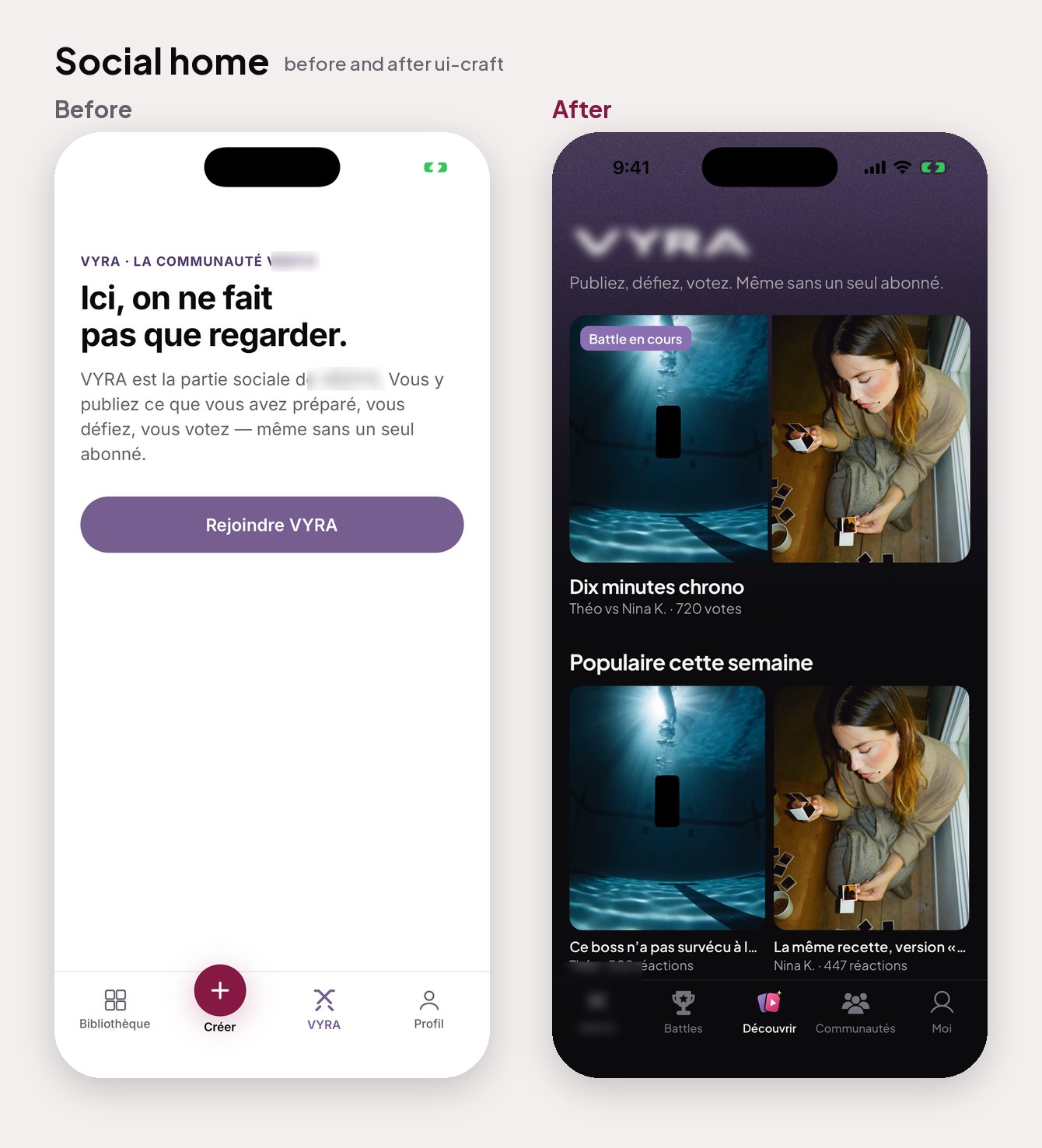
Screen by screen: library ·
create · media detail ·
editor · publish ·
social home. What changed and why, with
screenshots, is in refs/lessons.md.
What's new in v2
- 34 more apps, collected through Refero: Wise, Coinbase, PayPal, Acorns, Copilot,
Uber Eats, Target, Asos, SSENSE, Kitchen Stories, Google Maps, komoot, Tripsy, Tinder,
Apple Invites, X, Todoist, Cron, Structured, Gmail, Bear, Apple Books, Apple News,
Apple Podcasts, The Athletic, Substack, CARROT Weather, Calm, Train Fitness, Dropset,
Nike Training Club, Google Gemini, Luminar, Wispr Flow — 1,934 screens, 326 sheets. - Every sheet read, old and new (760), and the key screens measured in points with
scripts/measure.py, which now reads the library's own screens at the right scale. - Five new rules: numbers as content on money and data screens, selection and
disabled states, maps as a stage, staying native through help, legal and payment, and
readable secondary text. Rules 3–13 are sharpened with the measured ranges (gutters,
row classes, grid gaps, colour roles, sheets, states, labels, button sizes). - 20 new screen recipes in
SKILL.mdandrefs/recipes.md, about 200 measured
recipes by screen type, each citing its screen. refs/patterns.mdgrew from about 70 to 500 patterns under 29 headings, andscripts/refs.pynow also prints the closest measured recipes and finds a cited
screen (--screen "App NN·k").
Setup
Requirements
- An agent that can read files and run shell commands (Claude Code, Codex, Cursor,
Gemini CLI…). - Python 3.9 or later. Pillow for contact sheets:
python3 -m pip install pillow. - To review a mobile app: a way to screenshot it (Xcode's iOS Simulator, an Android
emulator withadb, or a browser for mobile web).
1 · Install
Claude Code, for all your projects
git clone --depth 1 https://github.com/Achref23illi/ui-craft ~/.claude/skills/ui-craft
Claude Code, for one project only (committed with the project, shared with the team)
git clone --depth 1 https://github.com/Achref23illi/ui-craft .claude/skills/ui-craft
The reference library makes the clone about 400 MB; --depth 1 skips the history. For
the rules only, delete refs/screens/ and refs/sheets/ after cloning (RULES mode).
Codex, Gemini CLI, Aider and other agents: clone it anywhere (for example~/.agents/ui-craft) and add one line to the project's AGENTS.md (or GEMINI.md):
Before any mobile UI work, read ~/.agents/ui-craft/SKILL.md and follow its "Start here" section.
Cursor: clone it into the project (.cursor/ui-craft) and create.cursor/rules/ui-craft.mdc:
---
description: Mobile UI design and review
globs: ["**/*.tsx", "**/*.swift", "**/*.dart", "**/*.kt"]
---
Read .cursor/ui-craft/SKILL.md and follow its "Start here" section for any screen work.
2 · Check the install
python3 ~/.claude/skills/ui-craft/scripts/doctor.py
It lists what is present and the mode: FULL when the reference sheets are there
(the default after cloning), RULES if they were removed to save space. Both work;
FULL adds real reference screens to every answer. Add --refs to also check that every
sheet named in refs/patterns.md exists (useful after adding your own).
3 · Use it
Start a session in your app's repository and ask in plain words. Claude Code loads
the skill from its description; with other agents, mention it.
- "Design the settings screen with ui-craft."
- "Review these screenshots with ui-craft:
./shots." - "Restyle the whole app with ui-craft, shared components first."
What the agent does, in order: finds references (scripts/refs.py), reads them,
applies the rules with their numbers, checks the lessons, builds, screenshots the
result and runs the checklist.
4 · A fast review, by hand
# iOS Simulator: one screenshot per screen you care about
xcrun simctl status_bar booted override --time 9:41 --batteryState charged --batteryLevel 100 --wifiBars 3 --cellularBars 4
xcrun simctl io booted screenshot shots/01-home.png

# Android emulator
adb exec-out screencap -p > shots/01-home.png

# six screens per image, so the agent reads a whole flow in a few images
python3 ~/.claude/skills/ui-craft/scripts/sheet.py shots

# real numbers in points: side gutters, then what a line down x = 60 pt crosses
python3 ~/.claude/skills/ui-craft/scripts/measure.py shots/01-home.png
python3 ~/.claude/skills/ui-craft/scripts/measure.py shots/01-home.png --col 60

# references for the pattern at hand (--list shows every pattern name)
python3 ~/.claude/skills/ui-craft/scripts/refs.py "home feed"
python3 ~/.claude/skills/ui-craft/scripts/refs.py "checkout"

# the screen behind a citation like "Wise 03·2", then measure it
python3 ~/.claude/skills/ui-craft/scripts/refs.py --screen "Wise 03·2"
Then: "Review shots/sheets with ui-craft." You get a table of the ten findings that
matter most, each with the rule, the measurement and the fix.
5 · Extend the reference library (optional)
The repository ships with 4,536 screens and 760 contact sheets. Add your own from
screenshots you have the right to keep: your own apps, apps you screenshot on your
phone for study, exports from inspiration services you subscribe to.
cd ~/.claude/skills/ui-craft
mkdir -p refs/library/Linear            # one folder per app
# put the app's screenshots in it, then:
python3 scripts/sheet.py refs/library/Linear --out refs/sheets --name 900-Linear
Name sheets <3-digit id>-<App>-<nn>.jpg (the script adds -01, -02…). Add the app
to a line in refs/patterns.md (for example … : Linear 01) and scripts/refs.py
will list its sheets for that pattern; python3 scripts/doctor.py --refs confirms the
name resolves. refs/library/ stays out of git.
To save disk space on a machine that only needs the rules, delete refs/screens/
and refs/sheets/; the skill falls back to RULES mode.
Update
git -C ~/.claude/skills/ui-craft pull
Troubleshooting
- The skill does not trigger: invoke it by name (
/ui-craftin Claude Code) or
mention "ui-craft" in the request; restart the session after installing. Pillow is missing:python3 -m pip install pillow.no local screen libraryfromrefs.py: the sheets were deleted or not checked
out;git -C ~/.claude/skills/ui-craft checkout -- refs/sheetsrestores them.- Blank or white status bar text in screenshots: set the status bar style per
screen, and use the simulator's status bar override for clean shots.
Free for everyone
Made for the community by Achref Arabi (2026). Use it, fork it, change it and
ship with it, in personal or commercial work. Issues and pull requests are welcome.
Follow the work: LinkedIn ·
Instagram · GitHub.
If it helped you, star the repo so others can find it.
The reference screenshots in refs/screens/ and refs/sheets/ show apps made by
their respective companies and remain their property. They are included for study and
reference only; the MIT licence covers the skill's own text, scripts and images, not
those screenshots.
MIT licensed.
Yorumlar (0)
Yorum birakmak icin giris yap.
Yorum birakSonuc bulunamadi