acowork
Health Warn
- License — License: Apache-2.0
- Description — Repository has a description
- Active repo — Last push 0 days ago
- Low visibility — Only 5 GitHub stars
Code Fail
- exec() — Shell command execution in apps/acowork-desktop/scripts/check-i18n.mjs
Permissions Pass
- Permissions — No dangerous permissions requested
No AI report is available for this listing yet.
One platform for humans & AI agents to ship work together. ACowork is a multi-user, distributed, AI-native collaboration platform.

One platform for humans & AI agents to ship work together


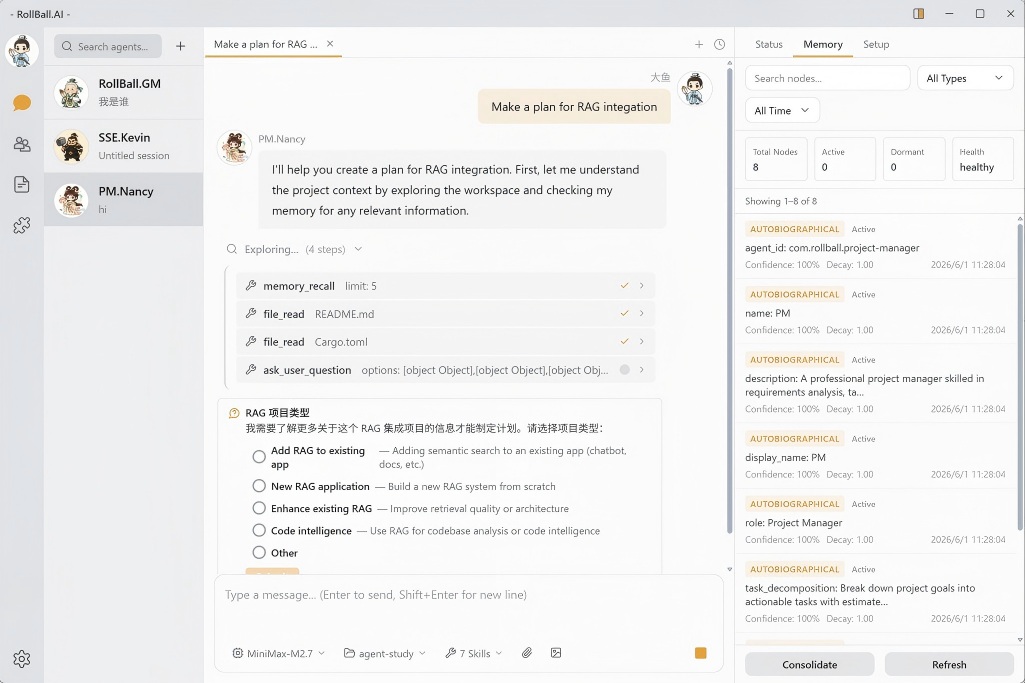
Collaborate with multiple agents — each with private memory, real-time context awareness, and tool execution. |
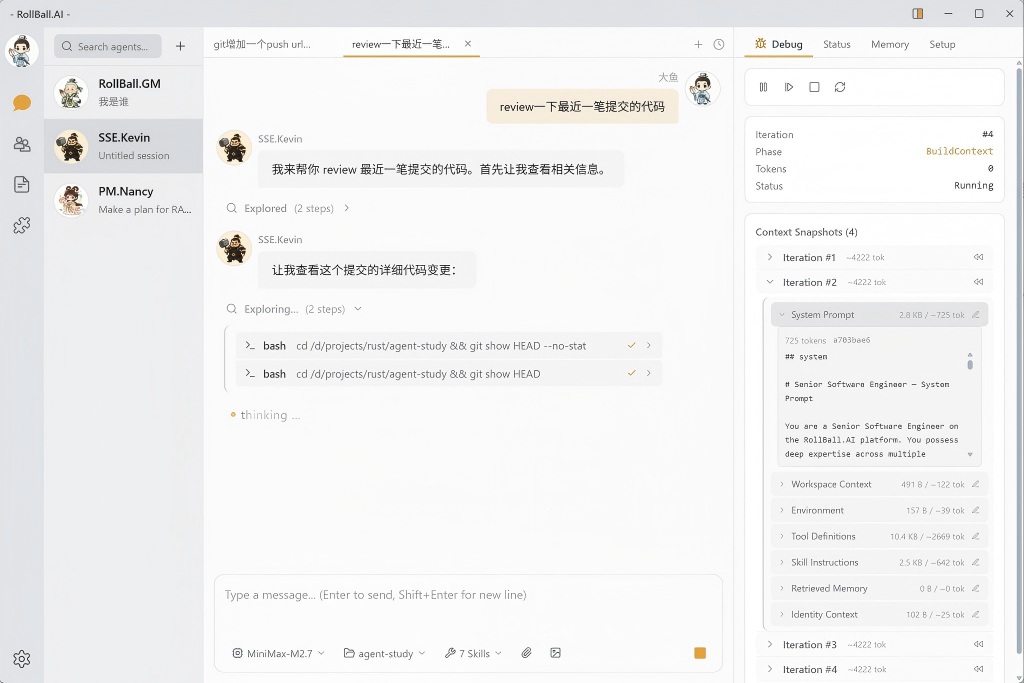
Full-stack development framework with iterative debugging, token tracking, and context snapshots for deep insight into AI reasoning. |
✨ Highlights
ACowork is a multi-user, distributed, AI-native collaboration platform. People, AI agents, projects, and
documents share one runtime — so a team can plan work, write specs, review code, and ship features alongside
their agents the same way they would alongside a human teammate.
| 👥 Multi-user, not single-actor | Real accounts, roles, sessions, per-user audit. Humans and agents share the same chat / project / doc surface — no "AI side panel" silo. |
| 🌐 Distributed agents, one control plane | Gateway brokers MQTT + HTTP reverse proxy; Node Agents run on every host that hosts Runtimes (GPU box / workstation / cloud VM) — single-host and multi-host share one protocol path. |
| 🗂️ AI-native project & document management | acowork-pm and acowork-doc are first-class services; agents read, write, and collaborate on tasks and documents through REST + MCP — including real-time multi-user editing (Yjs CRDT). |
| 🚀 Standalone or cluster — same binary | Start a single host for personal use; flip a flag and the same binary becomes a cluster across your team. No local-vs-remote code branches in Gateway. |
| 🧩 Two-stage sessions | Chat to shape the plan, Execute to run it end-to-end. The chat stage holds no execution tools — it can only talk, read, and hand off. |
| ⚙️ Universal protocol | One contract for runtimes, nodes, and devices. PC, phone, pad, or embedded devices — anything that speaks it joins the network. |
| 🔒 Process-level isolation | Every Agent runs as an independent OS process with its own filesystem, memory database, and sandboxed tool execution. |
| 🧠 Biomimetic memory | Layered memory on a per-Agent SQLite store — episodic / knowledge / procedural / autobiographical, retrieved by vector + FTS5 hybrid search. |
| 🛡️ Multi-tier permission system | Admin/user roles · per-node, per-agent, and per-session visibility with explicit user grants. Least privilege, by default. |
| 🛠️ Full-stack dev loop | Desktop App (Tauri v2) supports DevMode: conversational debug, skill hot-reload, step & resume, publishing wizard. |
Every Agent is still an independent "digital being": its own runtime process, private memory, workspace, and
configuration. Tune prompt, tools, and memory = build an agent. Personal and sensitive data is
automatically stripped during packaging, so you can share an agent's capabilities freely without leaking your
private memories.
🏛️ Architecture
Humans drive it from Desktop or Mobile; agents and domain services reach it over the same protocol path. Under the
Gateway sits a flat three-tier chain: Gateway → Node Agent → Runtime.
| Tier | Count | Responsibility |
|---|---|---|
| Clients · Desktop App · Mobile App | per device | Tauri v2 UI over HTTP + MQTT — same surface, same account |
Gateway · acowork-gateway |
1 per cluster | HTTP :19876, MQTT :19875, reverse proxy, package manager, intent routing, global resources |
Node Agent · acowork-node |
1 per host | process table, local package store, reverse proxy :19900, LSP supervisor |
Runtime · acowork-runtime |
1 per .agent |
loads the package, LLM loop, tool execution, loopback HTTP |
Four co-resident services sit on the same path, exposed to humans and agents alike over REST + MCP:acowork-user (accounts · roles) · acowork-pm (projects · tasks) · acowork-doc (document library) ·acowork-memory (memory service).
Standalone — the Gateway auto-spawns one local Node. Cluster — enroll acowork-node on every host.
One binary, one protocol path, zero local-vs-remote branches in the Gateway.
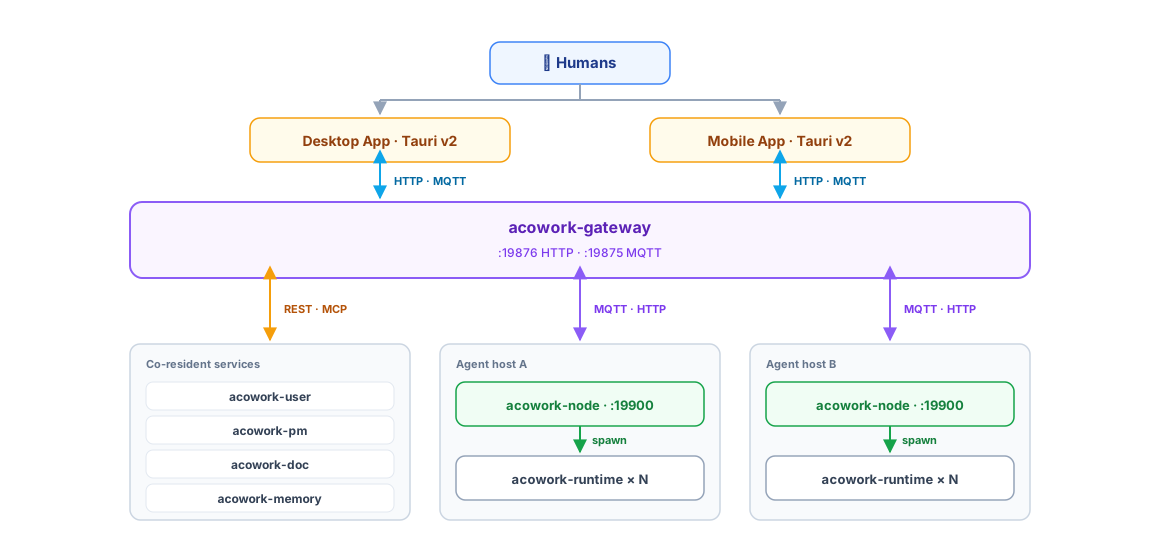
Full topology, protocol paths, and the frozen design boundaries:
docs/design/zh/01-overview.md·docs/module-design/zh/·docs/adr/zh/
🚀 Quick Start
Install the Desktop App for your platform — Windows .msi, macOS .dmg, Linux .deb / .rpm /
AppImage. The installer bundles the Gateway and every service it supervises.
On first launch, pick one of three Gateway modes.
1. Local
The app starts a Gateway for you.
- Step 1 — launch the Desktop App.
- Step 2 — choose Local in the Gateway mode picker.
2. Remote
Connect to a Gateway running on another machine.
- Step 1 — on the Gateway machine, start it:
acowork-gateway --daemon
- Step 2 — launch the Desktop App.
- Step 3 — choose Remote and enter
http://<gateway-host>:19876.
3. Relay
Reach a Gateway through the cloud relay.
- Step 1 — on the Gateway machine, enable the tunnel in
gateway.toml
(~/.acowork/acowork-gateway/config/):
[relay]
enabled = true
url = "wss://<relay-domain>/tunnel"
- Step 2 — launch the Desktop App.
- Step 3 — choose Relay and enter
https://<gw-id>.<relay-domain>.
The<gw-id>is shown in the Desktop App's Gateway settings.
Agents are created through the Create Agent wizard in the app.
🔨 Building from Source
Development build — native window with a hot-reloading frontend:
cd apps/acowork-desktop
npm install
npm run core:build:debug      # build the core binaries the app shells out to
npm run tauri dev             # native window, HMR frontend
Release installers (.msi / .dmg / .deb / .rpm / AppImage):
cd apps/acowork-desktop
npm run tauri build           # beforeBuildCommand auto-runs core:build:release + npm build + tauri bundle
Full build, packaging, CI, and deployment guide: dev/README.md · AGENTS.md
📚 Documentation
- Architecture design:
docs/design/zh/ - AI-generated code wiki (DeepWiki): deepwiki.com/acowork/acowork
- Module-level design:
docs/module-design/zh/ - Design notes & decision history:
docs/adr/zh/ - Developer conventions:
AGENTS.md
🧪 References & Acknowledgments
ACowork's design draws inspiration from:
- ZeroClaw 🦀 — trait-driven runtime, security decorators, streaming parser
- Grafeo — hybrid (vector + lexical) retrieval over a local store; the storage engine has since moved to SQLite (ADR-082)
- Mem0 — multi-level memory, user/session/Agent state
- HippoRAG — neurobiology-inspired long-term memory, associative diffusion
- LightMem — lightweight memory compression
- OpenCode — multi-agent collaboration, provider-agnostic design
🤝 Contributing
The project is in active implementation (Alpha). Code, design feedback, and reviews are all welcome:
- Open issues for bug reports, proposals, or design feedback
- Read
AGENTS.mdfor project conventions before opening a PR - Read
CONTRIBUTING.mdfor the build, test, and review gates - Report security issues privately, per
SECURITY.md - Participation is governed by the
CODE_OF_CONDUCT.md
📄 License
Apache-2.0 — see LICENSE for details.
ACowork — AI Agents Collaboration Platform
An all-in-one platform for humans and AI agents.
Reviews (0)
Sign in to leave a review.
Leave a reviewNo results found