Julius
Health Uyari
- License — License: MIT
- Description — Repository has a description
- Active repo — Last push 0 days ago
- Low visibility — Only 5 GitHub stars
Code Basarisiz
- rm -rf — Recursive force deletion command in .agents/skills/app-creator/scripts/create_app.py
- fs module — File system access in .agents/skills/draw-your-font/engine/src/cli.js
Permissions Gecti
- Permissions — No dangerous permissions requested
Bu listing icin henuz AI raporu yok.
Autonomous AI Agent & Multi-Modal System Copilot — Tactile TypeScript TUI, Direct 550B Streaming API, Sandboxed Canvas
Julius

Autonomous AI Agent & Multi-Modal System Copilot
Tactile TypeScript TUI · Direct 550B Streaming API · Sandboxed Interactive Canvas · Multi-Tier Memory






What is Julius?
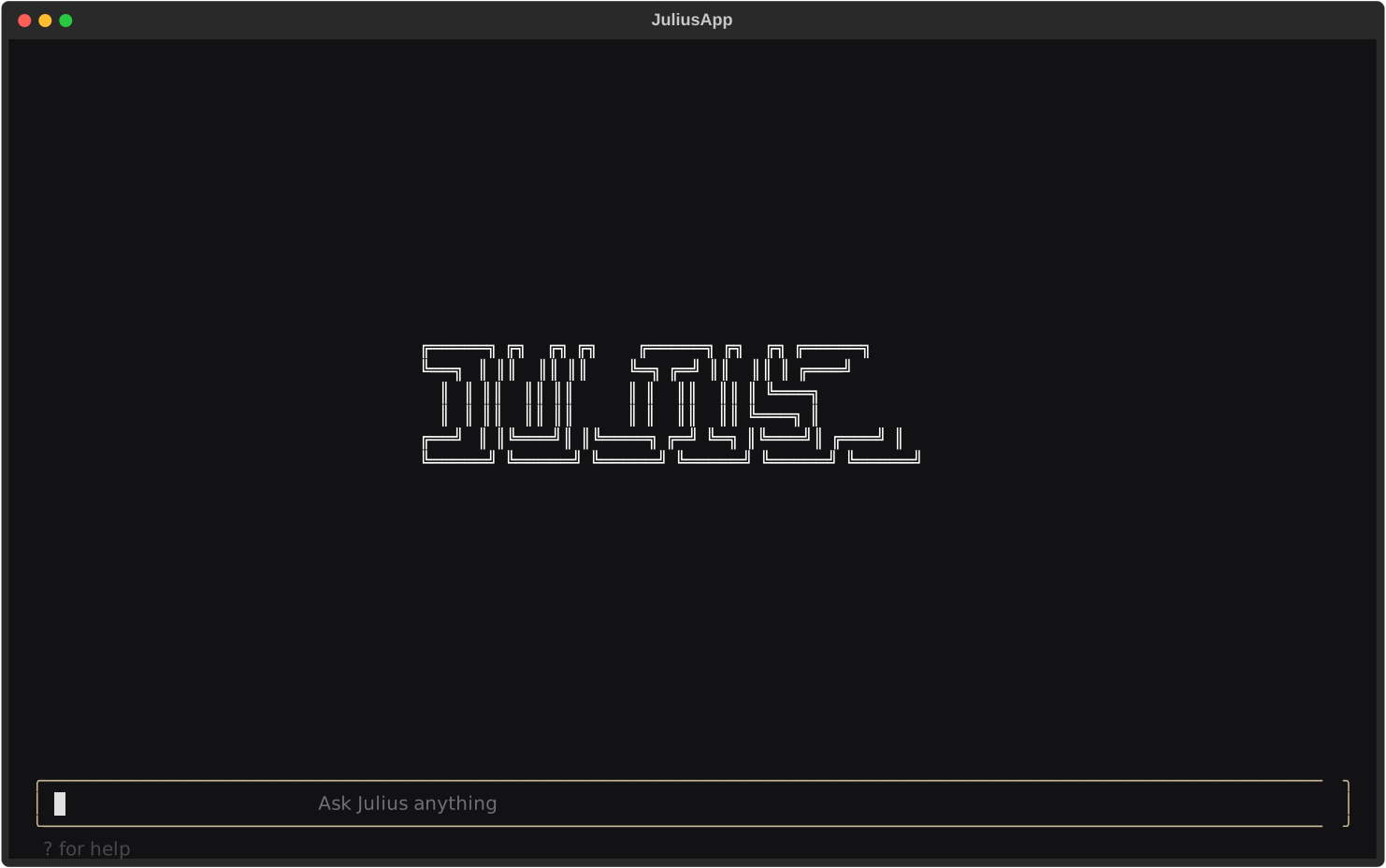
Julius is an open-source autonomous AI system and coding agent designed to combine deep reasoning models with a tactile, fluid developer experience.
Unlike conventional CLI chat wrappers, Julius features a high-performance TypeScript terminal interface (TUI) built on Ink and React, renders live sandboxed HTML/JS widgets inline for data telemetry and visual controls, maintains a 6-tier hierarchical memory engine, and operates 100% on direct streaming APIs (featuring free 550B model inference via NVIDIA Build NIM out-of-the-box).
Key Features & Tech Stack
Key Features
- Direct Streaming API Architecture: Pure HTTP streaming inference with sub-millisecond response latency. Runs on NVIDIA Build NIM 550B (
nvidia/nemotron-3-ultra-550b-a55b) with built-in sliding-window rate limiting (40 RPM, 1.5s pacing, exponential 429 backoff). Fully supports local Ollama endpoints and cloud providers (Anthropic Claude, OpenAI, DeepSeek, Gemini). - Tactile TypeScript TUI: Clean, modern terminal user interface (
src/tui_ts/) built on React and Ink. Features formatted markdown, syntax highlighting, quiet collapsible thinking indicators, and strict cursor standard compliance (arrow pointer and solid block cursor). - Sandboxed Interactive Widget Canvas: Inline HTML/CSS/JavaScript canvas adhering to the Julius design token system for real-time telemetry dashboards, interactive charts, and live git diff viewers.
- 6-Tier Hierarchical Memory & PKB: Comprehensive memory management including session working memory, episodic reflections, failure recovery ledgers, vector similarity embeddings, and an AST Tree-sitter Project Knowledge Base (PKB).
- Autonomous Tooling Suite: Deep OS tool execution (filesystem operations, bash/powershell command execution, web research, search grounding with SearXNG).
- Multi-Platform Support: Engineered from the ground up for seamless operation across Linux, macOS, and Windows.
Tech Stack
- Frontend & TUI: TypeScript, React, Ink, Chalk, Node.js (v18+)
- Core Engine & Backend: Python 3.11+, AsyncIO, Pydantic, HTTPX, SQLite3
- Inference Providers: Direct HTTP REST APIs (NVIDIA Build NIM, Ollama, Anthropic, OpenAI, DeepSeek)
- Web & Tooling: Playwright (reserved exclusively for browser navigation & web transport)
- Security & Sandboxing: Cryptographic hash audit ledgers and strict allowlist execution boundaries
Architecture & Folder Structure
Julius/
├── .github/
│   └── workflows/              # GitHub Actions CI matrices (Linux, macOS, Windows)
├── assets/
│   ├── branding/               # Brand logos, vector badges, and icon sets
│   ├── fonts/                  # Custom Julius typography and variable web fonts
│   └── media/                  # Official TUI screenshots and showcase visuals
├── apps/
│   ├── ios/                    # Julius iOS companion client
│   └── web/                    # Tactile Web Interface (Julius_Web_Interface)
├── config/                     # Default agent configurations and security policies
├── docs/                       # Architectural specifications and design system tokens
├── frontend/                   # Local dashboard and UI components
├── scripts/                    # Supply chain license audits, verification gates, and tooling
├── src/                        # Core agent source code
│   ├── arch_discovery/         # AST code analysis & model discovery pipeline
│   ├── browser/                # Sandboxed browser navigation tooling
│   ├── cli/                    # CLI presenter, spinners, and command dispatch
│   ├── integrations/           # WhatsApp, Spotify, and system integrations
│   ├── memory/                 # 6-tier hierarchical memory & session stores
│   ├── pkb/                    # Project Knowledge Base AST symbol graph
│   ├── providers/              # Direct API LLM connectors (NVIDIA, Ollama, Cloud)
│   ├── security/               # Cryptographic audit ledger & safety guardrails
│   ├── tools/                  # Autonomous tool implementations (fs, bash, web)
│   ├── tui_ts/                 # High-performance TypeScript/Ink terminal interface
│   └── widgets/                # Dynamic sandboxed interactive HTML/JS canvas
├── tests/                      # Unified automated test suite
│   ├── adversarial/            # Security hardening and policy bypass verification
│   ├── music/                  # Audio streaming and FLAC import tests
│   ├── platform/               # OS-specific adapters and terminal compatibility
│   └── whatsapp/               # Messaging protocol and router tests
├── .env.example                # Example environment configuration with placeholders
├── CONTRIBUTING.md             # Contributor guidelines and workflow
├── LICENSE                     # MIT License
├── install.sh                  # Native installer for Linux, macOS, and WSL
├── install.ps1                 # Native Windows PowerShell installer
├── pyproject.toml              # Standardized package metadata and pytest configuration
├── requirements.txt            # Python dependencies
└── julius.py                   # Primary agent launcher
Step-by-Step Quick Start Guide (For Beginners)
1. Clone the Repository
git clone https://github.com/adavidjulius/Julius.git
cd Julius
2. Run the Native One-Line Installer
macOS & Linuxbash install.sh
.\install.ps1
Alternatively, install via the universal Python script:
python install.py
How to Get, Save, and Test the API Key
Julius uses NVIDIA Build NIM by default for 550B parameter model reasoning.
Step 1: Obtain your Free NVIDIA NIM API Key
- Go to NVIDIA Build NIM Portal.
- Sign in with your NVIDIA developer account (or create one for free).
- Search for
nemotron-3-ultra-550bor click Get API Key. - Generate and copy your personal API key (starts with
nvapi-).
Step 2: Configure Environment Variables
Copy the template configuration file:
# Linux / macOS
cp .env.example .env

# Windows (PowerShell)
Copy-Item .env.example .env
Open .env in any text editor and paste your API key:
# Primary LLM API Key (NVIDIA NIM Free 550B)
NVIDIA_API_KEY=nvapi-YOUR_ACTUAL_KEY_HERE
Step 3: Test and Launch
Verify your setup and test connectivity:
# Verify CLI help and provider registration:
python julius.py --help

# Launch interactive autonomous agent:
python julius.py
Project Status & Long-Term Roadmap
[!IMPORTANT]
Project Status: On Hold / Work in Progress (WIP)
Julius is an active pre-release open-source project. While the core engine, provider routing, security boundaries, and test suites are robust and verified, several advanced systems are awaiting active implementation.
Long-Term Architectural Milestones
- Autonomous Multi-Agent Swarm Orchestration: Distributed hierarchical task decomposition, consensus voting among specialized agents, and dynamic fault-tolerant replanning.
- Sandboxed WebAssembly / MicroVM Runtime: Zero-trust ephemeral sandbox execution for untrusted shell commands and dynamic scripts across Linux, macOS, and Windows.
- Local SLM Multimodal Perception: Low-latency on-device vision and duplex audio streaming using quantized small language models (Llama 3.2 Vision, Whisper, Kokoro TTS) without third-party cloud latency.
- Decentralized Knowledge Mesh & AST Semantic Memory: Peer-to-peer encrypted knowledge base synchronization, vector memory sharding, and real-time syntax-tree indexing.
- Cross-Platform Tactile Interface Ecosystem: Unified tactile design system across macOS, Linux, Windows, iOS companion PWA, and Rockchip P200 embedded Julius OS.
- Extensible Open Plugin & MCP Marketplace: Dynamic capability discovery, sandboxed tool plugins, and community agent skills via Model Context Protocol.
Join the Community & Contribute!
Open source thrives when developers build together! Whether you are:
- A TypeScript / React engineer passionate about terminal UX and design systems
- A Python Systems developer interested in autonomous loops and sandboxing
- An AI / ML researcher building multi-agent swarms and local SLM inference
- A Technical Writer who wants to improve documentation, examples, and guides
We would love your contributions!
- Read our Contributing Guide for code standards and testing protocols.
- Check open discussions and pick up items from our roadmap.
- Submit a Pull Request and let's build the future of autonomous engineering copilots together!
License
This project is licensed under the MIT License — see the LICENSE file for details.
Yorumlar (0)
Yorum birakmak icin giris yap.
Yorum birakSonuc bulunamadi