cortex
Health Warn
- License — License: MIT
- Description — Repository has a description
- Active repo — Last push 0 days ago
- Low visibility — Only 5 GitHub stars
Code Warn
- fs module — File system access in .github/workflows/ci.yml
Permissions Pass
- Permissions — No dangerous permissions requested
This tool provides a local-first, persistent memory system for AI coding assistants. It allows different tools like Claude Code, Cursor, and Codex to share context and memory across sessions, eliminating the need to repeatedly explain your preferences.
Security Assessment
Overall Risk: Low. The daemon operates exclusively on localhost, meaning your data and prompts never leave your machine. There are no hardcoded secrets, and the repository does not request any dangerous permissions. The only flag is standard file system access occurring within the CI/CD pipelines, which is a completely normal and expected part of automated testing and building. No dangerous shell command executions were detected in the core application logic.
Quality Assessment
The project is under very active development, with the most recent code pushed just today. It uses the permissive MIT license and features a comprehensive, well-documented README. However, it currently has very low community visibility. With only 5 GitHub stars, the tool is essentially in its early stages. This means it has not been widely peer-reviewed by the broader developer community, so you may encounter undocumented bugs or behavioral quirks.
Verdict
Safe to use, but keep in mind that it is an early-stage project with minimal community testing.
Persistent shared memory and context compression for AI coding agents. Local-first Rust daemon with HTTP, MCP, and a desktop control center.

Cortex
Private local memory for your AI tools.
Install once. Your tools stop starting from scratch.





Download · Connect your tools · What's new · Roadmap





🔒 Private by default: localhost only, data never leaves your machine
🔗 One memory, every tool: HTTP and MCP, same brain, no per-tool silos
📊 Prove it works: token savings, recall quality, and Monte Carlo projections
 ❌ Without Cortex
Session 1 → explain preferences |
✅ With Cortex
Session 1 → store once |




|
Save decisions, lessons, preferences. Conflict detection is automatic. |
Hybrid keyword + semantic search. In-process ONNX embeddings, no external service. |
Compiled identity + delta capsule. ~300 tokens served instead of ~15,000 raw. |
Memory tools are easy to pitch and hard to trust. Cortex starts to matter when the savings stop looking theoretical.
|
📊 Analytics 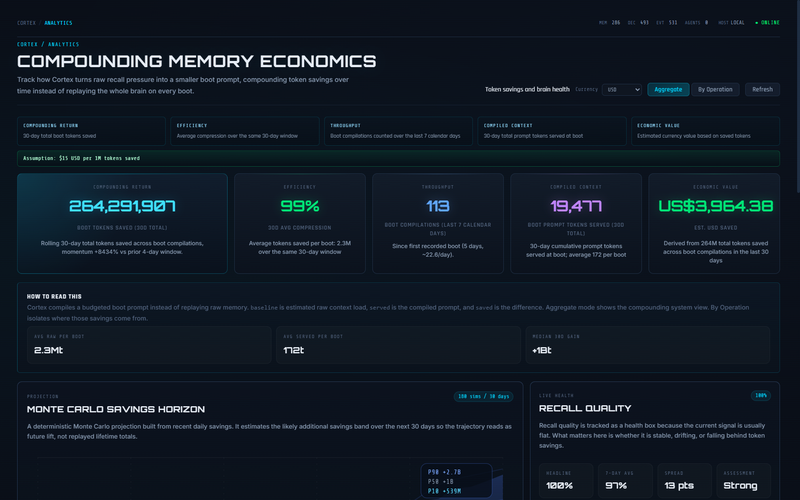
Savings, compression, and activity heatmaps |
📈 Monte Carlo 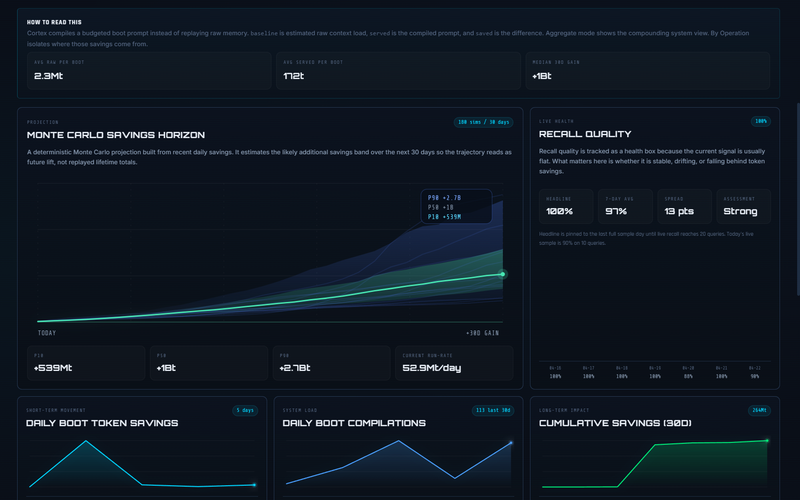
30-day projection with confidence bands |
|
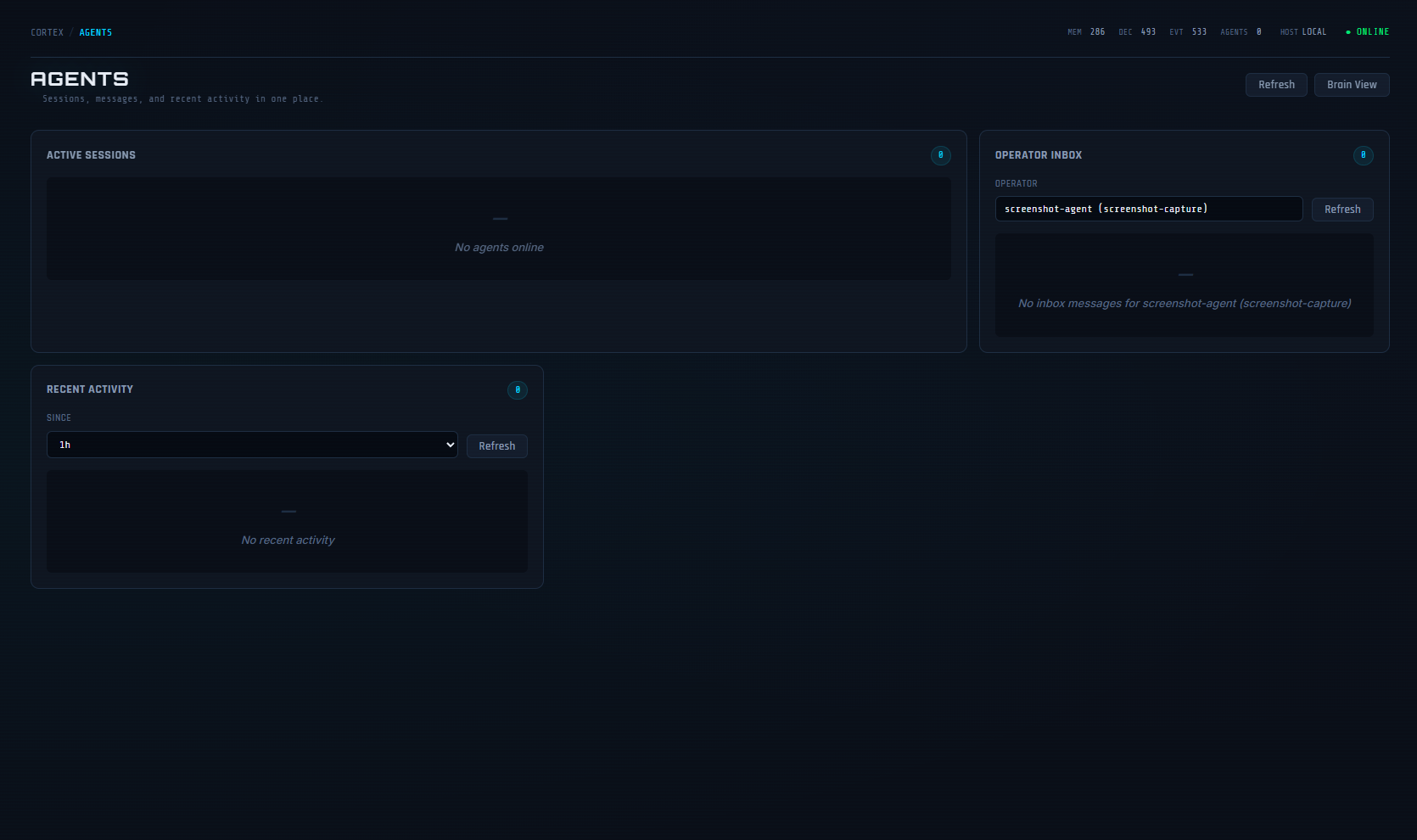
🤖 Agents 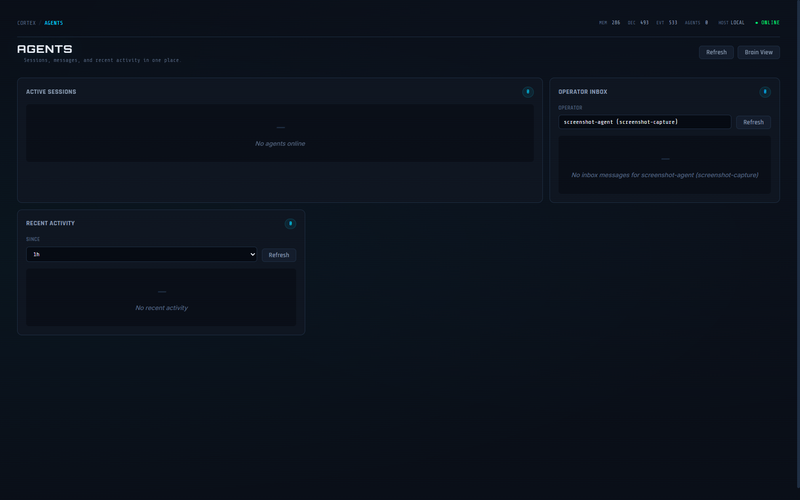
Live sessions, inbox, deduped by identity |
🎛️ Overview 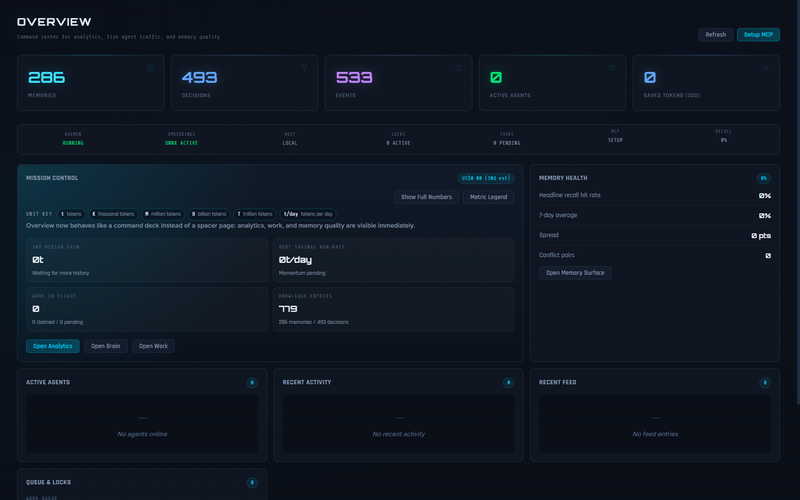
Memory counts, health, and navigation |
Measured against a 20-query ground-truth dataset on every release via the cortex-http-base adapter. A fully helper-free cortex-http-pure adapter lands in v0.6.0 to establish the canonical core baseline.
| v0.4.1 | v0.5.0 | Δ | |
|---|---|---|---|
| Precision | 55.2% | 87.5% | 📈 +32.3% |
| MRR | 69.2% | 95.0% | 📈 +25.8% |
| Top-1 hit | 90.0% | 90.0% | — |
| Avg query tokens | n/a | 48.4 | — |
Raw v0.5.0 JSON
Note: cortex-http-base ("raw") adapter retains partial adapter-layer helpers and is deprecated for new quality claims. The helper-free cortex-http-pure adapter ships in v0.6.0 as the canonical measurement floor -- every v0.6.0+ recall-quality claim is measured through it, enforced by 5 CI purity gates. See benchmarking/README.md. Reranking production-ships in v0.6.0 Phase 2; query expansion (HyDE) targeted for v0.7.0.
349 commits since v0.4.1. Full details in CHANGELOG.md.
Retrieval
- Reciprocal rank fusion: query-adaptive keyword/semantic weighting
- Crystal family recall: collapsed members cut token cost, preserve context
- Synonym-expanded keywords across all retrieval paths
- FTS tokenizer upgrade and BM25 tuning
- Entity-alignment boost, co-occurrence expansion
Reliability
- Schema migration framework with upgrade regression tests
- DB integrity gate, rolling backups, crash-safe WAL
- Storage pressure governor with event-pressure controls
- Persistent savings rollups for long-window analytics
- DB footprint: 720 MB → 386 MB in a real install
Agent intelligence
- Feedback telemetry: record outcomes, track reliability over time
- Recall explainability: see why results ranked the way they did
- Conflict detection: AGREES / CONTRADICTS / REFINES / UNRELATED
- Client permissions: read / write / admin gates per agent
Security
- Localhost exempt from auth-failure lockout
- Non-loopback binds require TLS
- API key masking on non-interactive stdout
- Remote targets need explicit token (no silent auto-load)
- Team-mode destructive ops require admin + rated auth
Cortex tracks active agent sessions when clients identify themselves through cortex_boot or GET /boot?agent=NAME.
|
|
Multi-agent, one brain
Claude Code, Codex, Cursor, and custom scripts can all be connected simultaneously. Each tracks its own session while sharing the same memory. |
| Tool | Connection | Setup |
|---|---|---|
| Claude Code | MCP (plugin) or desktop app | Plugin: claude plugin install cortex@cortex-marketplace |
| Codex | MCP | codex mcp add cortex -- cortex.exe mcp --agent codex |
| Cursor | MCP | Point MCP server at cortex mcp --agent cursor |
| Factory Droid | MCP | cortex mcp --agent droid |
| Aider | CLI / HTTP | cortex boot --agent aider |
| Custom tools | HTTP | Three endpoints: /boot, /recall, /store |
| Local LLMs | HTTP / MCP | Same protocol, any runtime |
Full setup guide: Info/connecting.md
Desktop app (Control Center)
Download from the release page. The Control Center manages daemon lifecycle for you.
| Platform | Desktop installer | Daemon archive |
|---|---|---|
| Windows | .exe (NSIS installer) |
.zip |
| macOS | .dmg |
.tar.gz |
| Linux | .AppImage / .deb |
.tar.gz |
From source
git clone https://github.com/AdityaVG13/cortex.git
cd cortex/daemon-rs
cargo build --release
Claude Code plugin
claude plugin marketplace add AdityaVG13/cortex
claude plugin install cortex@cortex-marketplace
The plugin handles daemon startup, health checks, and MCP bridging automatically.
Cortex enforces a single-daemon invariant: only one daemon process runs at a time.
| Mode | How it works |
|---|---|
| Desktop app | Control Center owns the daemon. Restart and monitor from the app. |
| CLI | cortex serve starts the daemon. Exits cleanly if one is already running. |
| Plugin | cortex plugin ensure-daemon attaches to an existing daemon or starts one. |
Default bind: 127.0.0.1:7437. Non-loopback binds require TLS. Auth token at ~/.cortex/cortex.token.
If using the Control Center, manage the daemon from there. Do not run a second cortex serve alongside it.
After installing, verify everything works:
# Start the daemon (skip if using Control Center)
cortex serve &

# Health check (no auth required)
curl http://localhost:7437/health

# Boot test
TOKEN=$(cat ~/.cortex/cortex.token)
curl -H "Authorization: Bearer $TOKEN" \
     -H "X-Cortex-Request: true" \
     "http://localhost:7437/boot?agent=smoke-test"

# Store and recall round-trip
curl -X POST http://localhost:7437/store \
     -H "Content-Type: application/json" \
     -H "Authorization: Bearer $TOKEN" \
     -H "X-Cortex-Request: true" \
     -d '{"decision": "smoke test", "context": "verifying install"}'

curl -H "Authorization: Bearer $TOKEN" \
     -H "X-Cortex-Request: true" \
     "http://localhost:7437/recall?q=smoke+test"
# Daemon unit tests
cargo test --manifest-path daemon-rs/Cargo.toml

# Desktop test suite
npm --prefix desktop/cortex-control-center test

# Lifecycle smoke test
npm --prefix desktop/cortex-control-center run verify:lifecycle:dev

# Security audit
npm audit --omit=dev --audit-level=high
cargo audit
| Document | Covers |
|---|---|
| Connecting | Setup, MCP, HTTP, auth, troubleshooting |
| MCP Tools | All 28 MCP tool definitions and parameters |
| Research | Papers, inspirations, adaptation notes |
| Roadmap | What shipped, what's planned, and why |
| Security | Threat model, auth rules, vulnerability reporting |
| Team mode | Shared-server setup for engineering teams |
| Contributing | Development setup and PR guidelines |
| Command | Description |
|---|---|
cortex serve |
Start the daemon |
cortex --help |
Full command reference |
cortex doctor |
Run diagnostics |
cortex paths --json |
Show file and port paths |
cortex plugin ensure-daemon |
Ensure daemon health (plugin mode) |
cortex plugin mcp |
MCP stdio bridge to HTTP API |
cortex setup --team |
Initialize team mode and generate API keys |
cortex export |
Export data (json or sql) |
cortex import |
Import from a previous export |
cortex admin rollback --session-id <id> |
Soft-delete a session's memory writes (dry-run default; --apply to persist) |
Cortex defaults to localhost-only access with bearer-token auth.
Full threat model, auth rules, and vulnerability reporting: Info/security-rules.md
The daemon binary is ~30 MB. The SQLite database grows with usage. A real install with 286 memories and 493 decisions uses ~386 MB after compaction. The ONNX embedding model (~50 MB) downloads on first run. 🤖 Can multiple agents write to Cortex at the same time?
Yes. SQLite WAL mode handles concurrent reads and serialized writes. Each agent maintains its own session while sharing the same memory. Conflict detection handles contradictions automatically. 🔒 Does Cortex send any data externally?
No. In solo mode, Cortex runs entirely on localhost. No telemetry, no phone-home, no cloud sync. Team mode sends data only to the configured team server over your network. 🔄 What happens if the daemon crashes mid-session?
The MCP proxy detects daemon death and restarts automatically (bounded to 3 attempts with backoff). SQLite WAL mode ensures no data corruption. Sessions survive transient crashes. 🧹 How do I reset Cortex to a clean state?
Delete
~/.cortex/cortex.db and restart the daemon. A new empty database and auth token are generated. Settings and model files are preserved.
Built by
☕ Support Cortex · Research · Connecting · Security · Contributing · Code of Conduct · Changelog · MIT License
Reviews (0)
Sign in to leave a review.
Leave a reviewNo results found