agentbeacon
Health Uyari
- License — License: Apache-2.0
- Description — Repository has a description
- Active repo — Last push 0 days ago
- Low visibility — Only 5 GitHub stars
Code Gecti
- Code scan — Scanned 12 files during light audit, no dangerous patterns found
Permissions Gecti
- Permissions — No dangerous permissions requested
AgentBeacon is a multi-agent orchestrator for AI coding tools. It coordinates autonomous AI agents working on your codebase and funnels their progress into a centralized queue, requiring human intervention only for structured decisions.
Security Assessment
The automated code scan found no dangerous patterns, hardcoded secrets, or requests for dangerous permissions. However, as an orchestrator for AI coding tools, this software inherently interacts with your local file system and executes shell commands via the underlying agent SDKs (like Claude and Copilot). It also exposes a local web server (localhost:9456) and requires network access to manage AI operations. Because it acts as a control plane for automated code generation and command execution, it handles sensitive data. Overall risk is rated as Medium.
Quality Assessment
The project is licensed under the permissive Apache-2.0 and is currently active, with its last push occurring today. However, it suffers from very low community visibility, having only 5 GitHub stars. This means it has not yet undergone widespread peer review or battle-testing by the broader developer community. Trust should be placed primarily in the active developer rather than community consensus at this early stage.
Verdict
Use with caution: the code appears clean and actively maintained, but its low community adoption and inherent ability to execute commands via third-party AI SDKs warrant careful supervision during use.
Multi-agent orchestrator for AI coding tools

Stop babysitting AI. Start delegating.
How It Works · Why It Works · Quick Start · Apache 2.0
The Problem
If you use AI coding agents, you've probably got several running right now across different terminals, working on different features, and each needing attention at unpredictable times. The coordination is all on you: context-switching between terminals, copying output between tools, trying not to drop threads across multiple workstreams.
Most multi-agent tools either leave coordination entirely to you (fancy session multiplexers) or take it away entirely (opaque orchestration where you hope for the best).
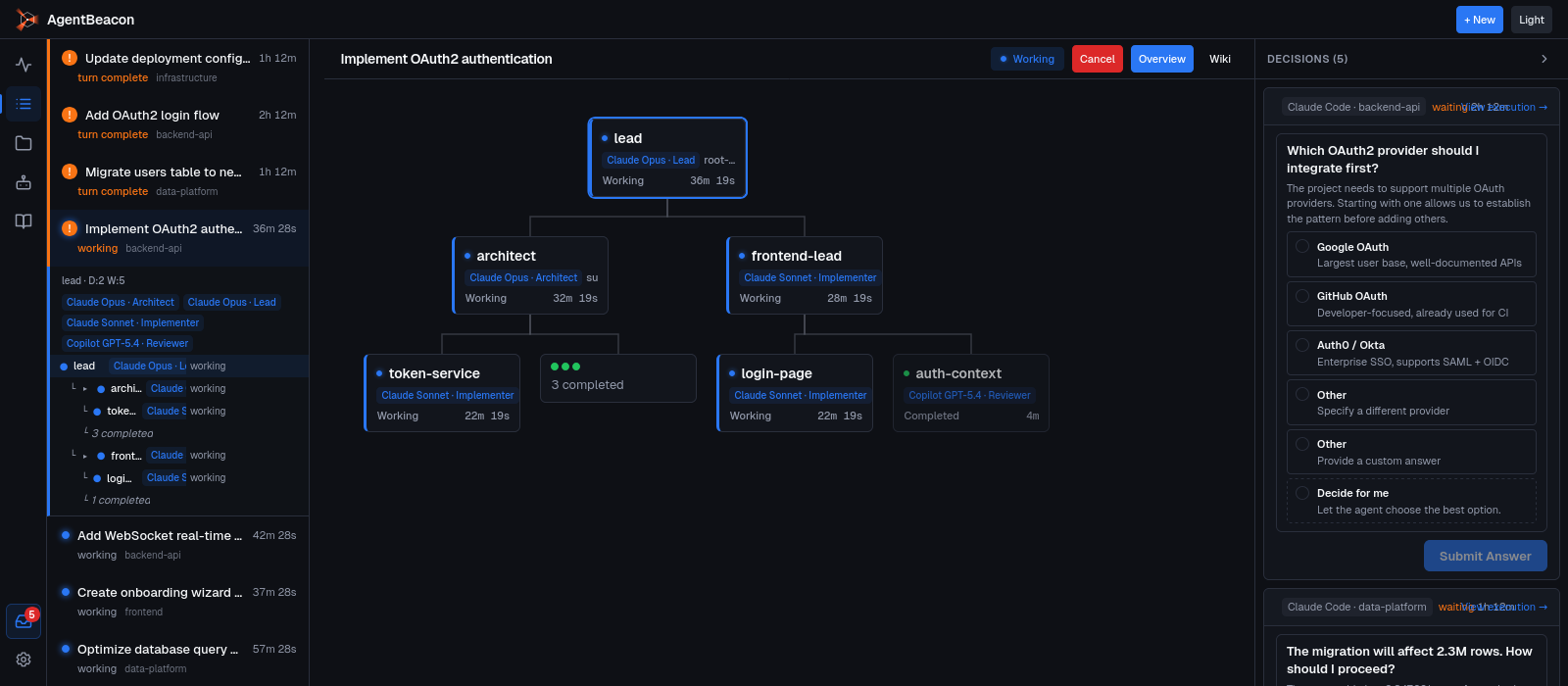
AgentBeacon is a decision operations center that combines the best of both. Agent teams iterate and review each other's work autonomously. You work through a single queue of structured choices across all your running features instead of babysitting terminals. Every detail is logged, so you can dig in to the individual tool call level when you need to. Either way, you ship software you can actually stand behind, at a pace that wasn't possible before.
What AgentBeacon Does
AgentBeacon coordinates teams of AI agents working on your codebase and surfaces only the decisions that need a human. You assign a feature to a lead agent, it delegates to implementers and reviewers, manages iteration loops, and presents you with a queue of structured questions.
The interaction model is closer to triaging an inbox than monitoring a terminal:
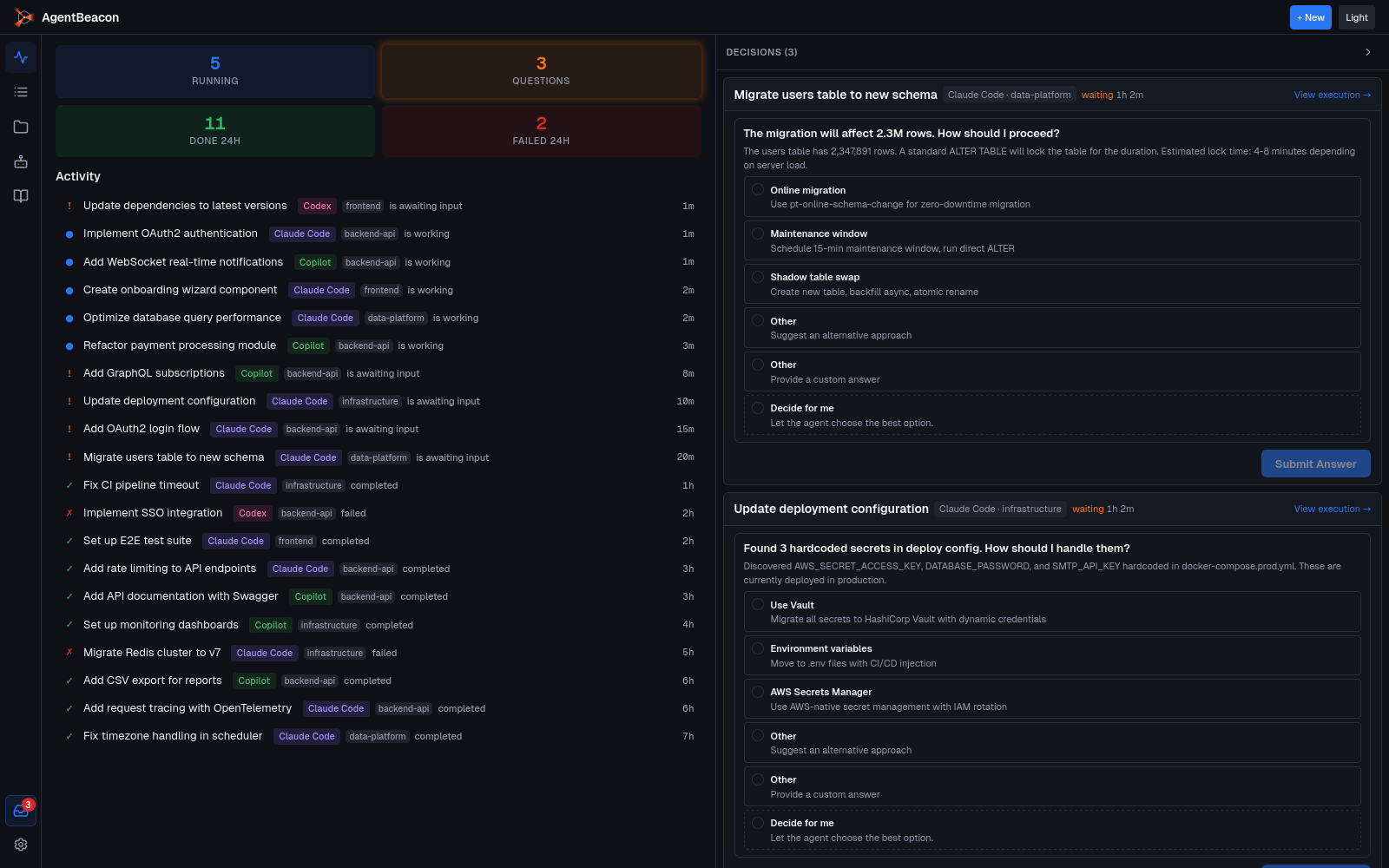
- Open the app, see 3 pending decisions across your running features
- Answer them in 90 seconds
- Glance at the activity feed for progress
- Get back to your own work
One engineer, multiple features in flight, decisions as the main touchpoint.
Quick Start
Platform: Linux (x86_64 and aarch64). macOS support coming soon.
Install via pip, npm, or build from source:
# Python (pick one)
uv tool install agentbeacon        # recommended
pipx install agentbeacon
pip install --user agentbeacon

# npm
npm install -g agentbeacon
Then install the agent SDK dependencies and start:
agentbeacon --setup          # install Claude + Copilot SDK dependencies
agentbeacon                  # start AgentBeacon
# Open http://localhost:9456
git clone https://github.com/adrq/agentbeacon.git
cd agentbeacon
make all
make run
# Open http://localhost:9456
Requires Rust toolchain and Node.js 20+.
Prerequisites:
- Node.js 20+ (for agent SDK dependencies)
- At least one coding agent CLI installed: Claude Code, Codex CLI (coming soon), Copilot CLI, OpenCode (coming soon), or any ACP-compatible agent
- An API key or subscription for the corresponding provider
Note: AgentBeacon orchestrates coding agents you already have installed — it doesn't bundle or replace them.
How It Works
1. Configure agent teams. Define agents with different providers and roles — a Claude-based implementer, a GPT-based reviewer, a lead that coordinates them. Different models have different blind spots; cross-model review catches what any single model misses.
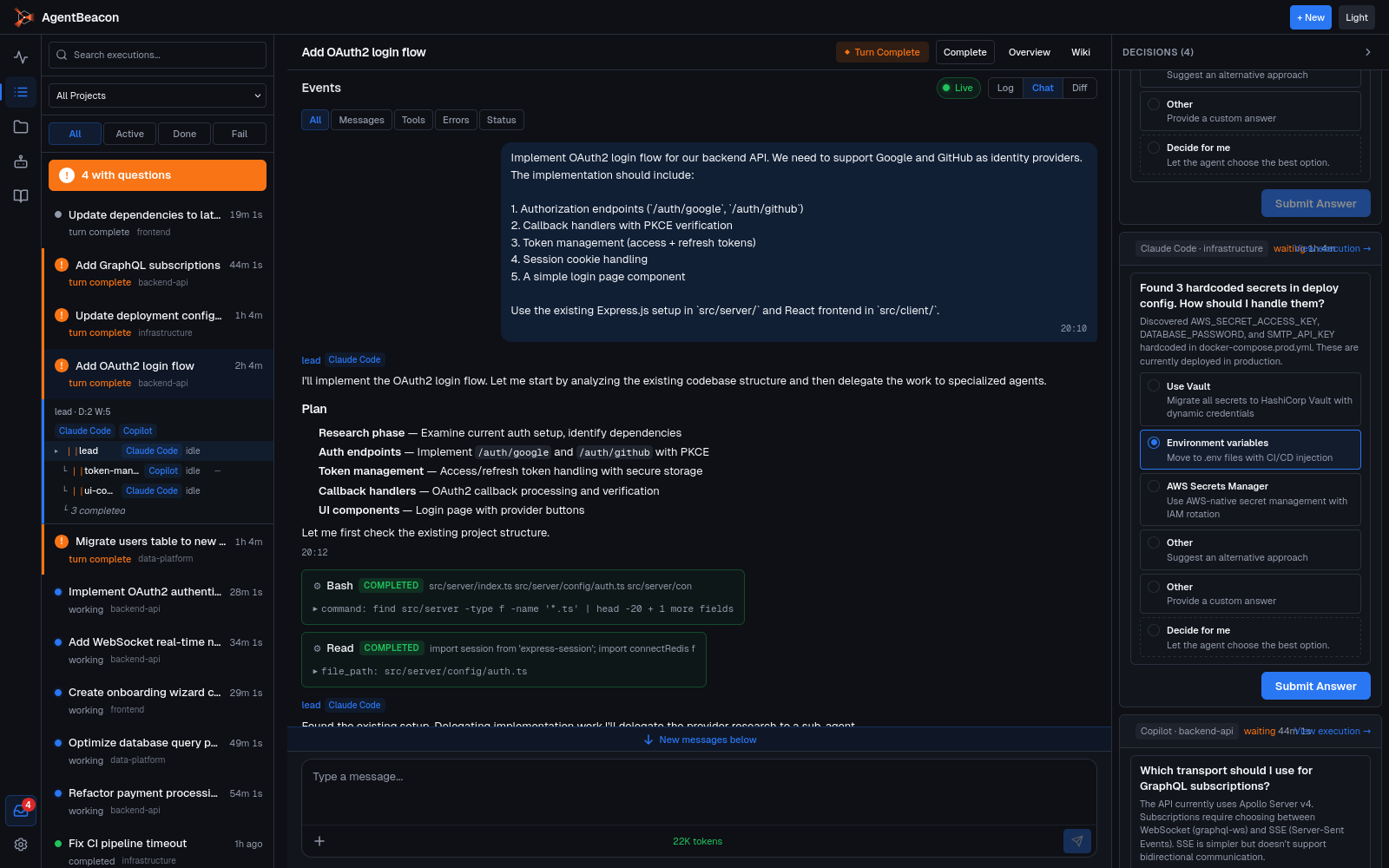
2. Start an execution. Give it a task: "Add rate limiting to the /api/users endpoint." The lead agent breaks the work down and delegates to its team.
3. Answer decisions from the queue. When the team hits a genuine ambiguity — architecture choice, library preference, scope clarification — the lead surfaces a structured question. You pick an option and the team continues.
4. Review converged output. After agents iterate and converge, review the result. Each execution maintains a full decision log so you can trace why things were built the way they were.
Why It Works This Way
Decision queue as the interface. Agents surface structured questions with labeled options — pick one, write your own, or let the agent decide. Each level in the hierarchy absorbs what it can and only escalates genuine ambiguities upward. Your decision volume stays manageable as the hierarchy deepens. Intermediate agents handle the routine calls so you don't have to.
Shared knowledge layer. Every project gets a wiki that any agent can read and write. One agent discovers a codebase convention and writes it down. Another agent, even in a different session days later, finds it through search. This is persistent memory across agents and sessions without bloating context windows. Versioned, full-text searchable, and subscribable so you can watch pages that matter to you.
Agents talk to each other, not just to you. Any agent can message any other agent in the hierarchy directly. Two agents negotiate an API contract. A reviewer messages the implementer about a concern. The authority tree governs lifecycle and accountability; communication is open. No copy-paste between terminals, no human relay.
Protocol-native, self-hosted, provider-agnostic. Native integrations for Claude Code, Codex CLI, GitHub Copilot, and OpenCode, with ACP support for any compatible agent. Built on MCP for tool integration and A2A for agent interop. No proprietary protocols. Your code, your machine, your API keys.
Two primitives, any scale. The entire coordination model is two operations: delegate and release — create and destroy. When agents hit genuine ambiguity, they surface structured questions to a decision queue. From 3 agents to 100+. Research shows LLM performance degrades with tool count, so the surface is deliberately small. The same primitives work at every level of the hierarchy, whether that's two agents or twenty.
Designed for future models. The same two primitives work whether you're delegating a single endpoint or an entire product. As models improve, the scope of what you can delegate grows, and the architecture is deliberately not the bottleneck. Today you operate as a tech lead making per-feature decisions. As the ceiling rises, the same system scales with it.
Status
Early release. Core coordination loop works end-to-end: create executions, delegate to multi-agent teams, answer structured questions, review results with full decision and code change logs.
Contributing
Contributions welcome. See AGENTS.md for development setup and coding conventions.
make test-all      # Run Rust + Python integration + E2E tests
make pre-commit    # Run pre-commit hooks
License
Yorumlar (0)
Yorum birakmak icin giris yap.
Yorum birakSonuc bulunamadi