codex-mobile
Health Uyari
- License — License: MIT
- Description — Repository has a description
- Active repo — Last push 0 days ago
- Low visibility — Only 6 GitHub stars
Code Gecti
- Code scan — Scanned 10 files during light audit, no dangerous patterns found
Permissions Gecti
- Permissions — No dangerous permissions requested
Security Assessment: Risk: Medium. The tool executes local shell commands and interacts with a backend process inside Termux. Notably, the current design requires root permissions (though a light code scan found no dangerous patterns or hardcoded secrets). It acts as a wrapper, communicating via local sockets, and routes AI requests to either local device models or external cloud APIs like OpenAI.
Quality Assessment: The project is very new and has low visibility (6 GitHub stars), making community trust minimal. However, the developer maintains it actively with recent pushes, continuous integration (Android CI), Dependabot, and clear documentation. It is cleanly licensed under the permissive MIT license.
Verdict: Use with caution—the reliance on root access inherently increases your device's attack surface, so it should only be installed by advanced users on dedicated hardware.
把 Termux 里的真实本地 Codex 运行时做成 Android 手机上的触摸优先体验。
Codex Mobile




Codex Mobile turns a local Termux-based Codex backend into a touch-first Android product instead of a terminal-first workflow.
It is a mobile-first shell for a real local Codex runtime, not a fake chat wrapper and not a terminal screenshot in an app.
中文说明见 README.zh-CN.md。
Quick links: Project brief · Setup · Roadmap · Contributing · Security
🌍 Ecosystem Impact (OpenAI Codex Program)
Codex Mobile brings the power of local AI development models directly to Android. By bridging a robust Termux runtime with a native mobile-first touch UI, this project allows developers to maintain long-lived Codex sessions, run real AI coding operations, and review generated code directly on their phones. It significantly lowers the barrier for experimenting with and deploying local language models in mobile environments.
Why This Exists
The terminal workflow is powerful, but it is not a good mobile product. Codex Mobile is an attempt to make local AI coding usable on a real Android phone without pretending the terminal is the final UI.
The project is focused on:
- chat-first mobile interaction
- thread recovery after reconnects or backgrounding
- local backend lifecycle management
- exposing model, reasoning, and permission controls without raw terminal UX
What Makes It Different
- it connects to a real local Codex backend inside Termux instead of proxying to a fake mobile chat shell
- it is designed around thread recovery, reconnect handling, and long-session resilience on an actual phone
- it treats backend lifecycle and keepalive hardening as part of the product, not just an install note
- it is being shaped by daily use on a real device, so the tradeoffs are practical rather than hypothetical
Current Status
Codex Mobile is an active prototype with real daily use behind it.
- Android app built with Jetpack Compose
- local backend runtime inside Termux
- root-assisted backend startup and keepalive hardening
- current UI is Chinese-first while the documentation is being expanded
- rooted Android is required today
This repository is the app project itself. It is not a one-click exported phone image.
Screenshots
| Attachment Sheet | History | Settings |
|---|---|---|
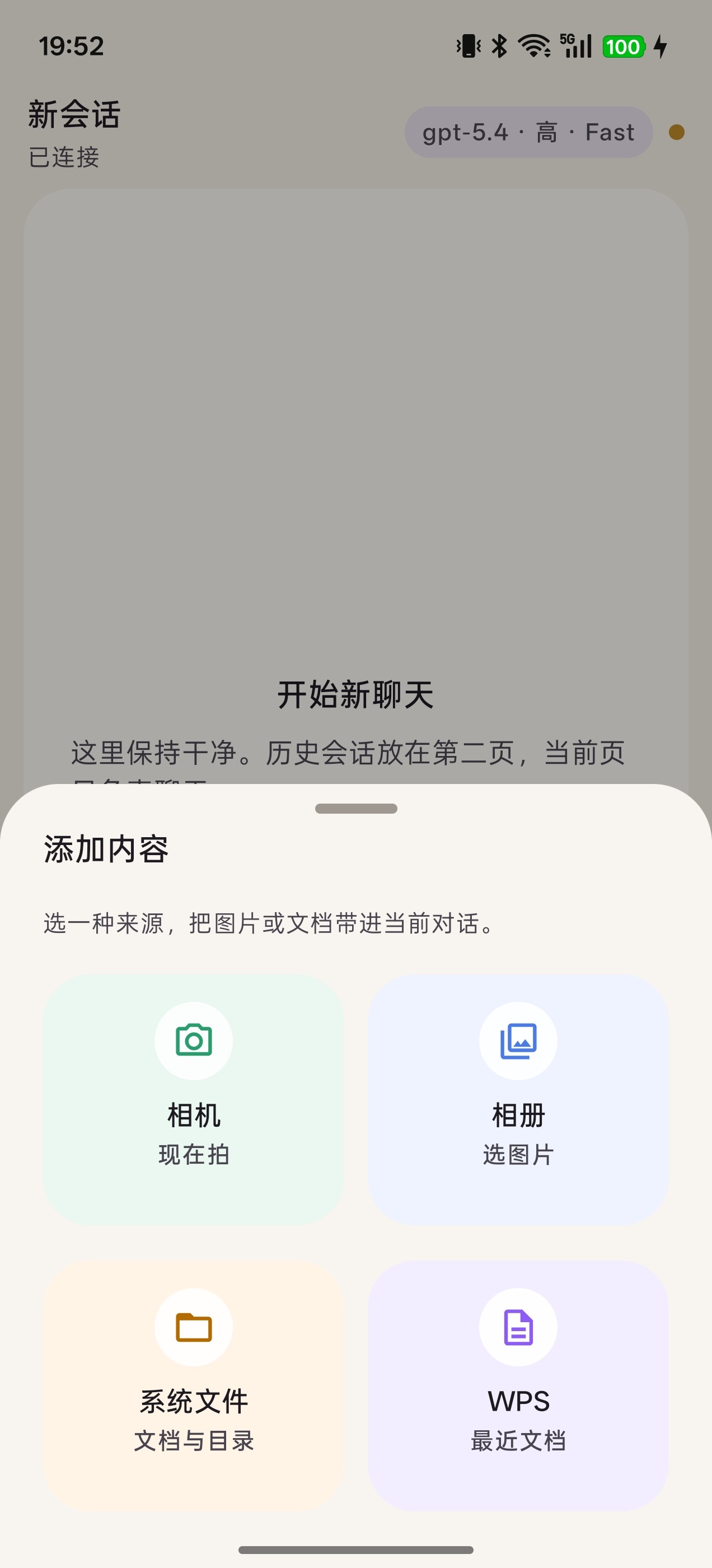 |
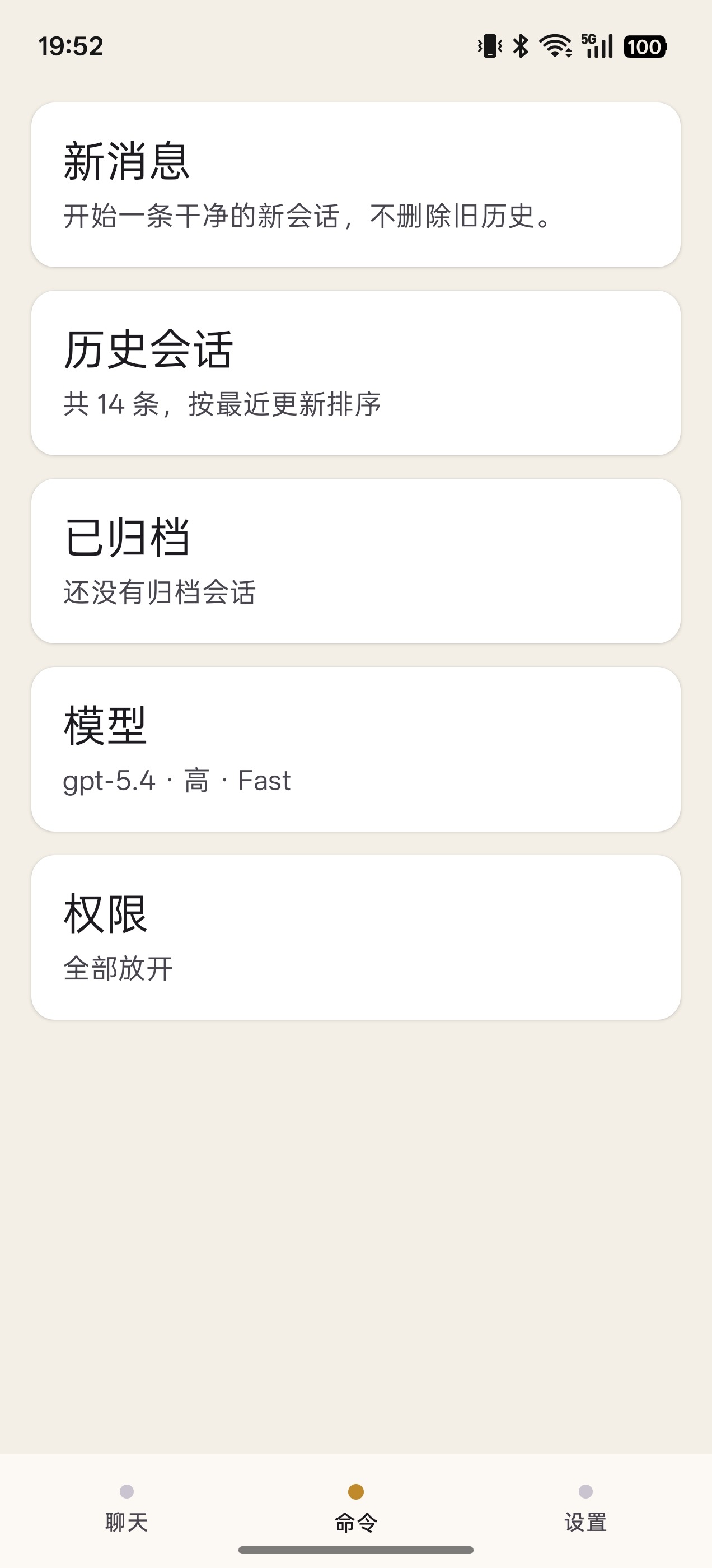 |
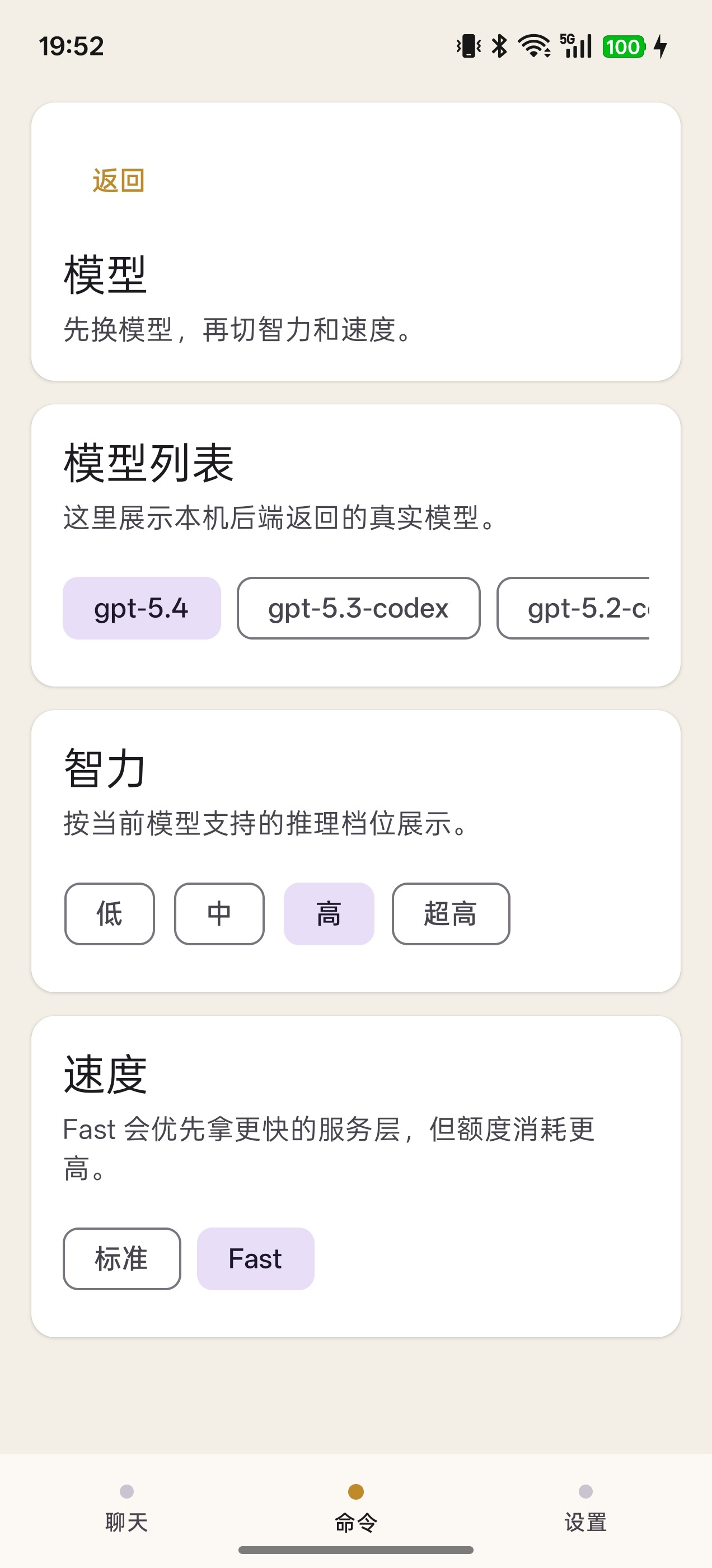 |
Current Features
- auto-start and reconnect to the local Codex backend
- mobile chat UI for real Codex threads
- history, archive, restore, rename, and delete flows
- model switching, reasoning level switching, permission modes, and Fast mode
- document attachment extraction for supported formats
- long-thread recovery improvements for unstable mobile/runtime conditions
Architecture
graph TD
    A[Codex Mobile App<br>Jetpack Compose UI] -->|Local Socket / IPC| B(Termux Runtime Shell)
    B -->|Background Hardening| B
    B <-->|Executes Models| C{Codex CLI / LLM Core}
    C -->|Local Processing| D[(On-Device Models)]
    C -->|API Requests| E[(OpenAI API / Cloud)]

    style A fill:#0A7EA4,stroke:#fff,stroke-width:2px,color:#fff
    style B fill:#3DDC84,stroke:#fff,stroke-width:2px,color:#fff
    style C fill:#333,stroke:#fff,stroke-width:2px,color:#fff
Repository Health
- Android CI runs on pull requests and on pushes to
main - issue templates and a pull request template are included for repeatable maintenance
- dependency updates are configured through Dependabot
- a basic security policy and maintainer ownership file are included
Compatibility And Setup
Current expected environment:
- Android 9+ device
- Termux installed on-device
- community Codex CLI package inside Termux
- local authentication already completed in Termux
- root access for the current backend lifecycle design
Quick start and environment notes live in docs/setup.md.
This project is best evaluated as "an Android product shell around a local coding runtime", not as a general-purpose Android app that can run without environment assumptions.
Development
Build channels:
legacyDebugkeeps package compatibility with the working phone install lineossDebuguses the publicio.github.aeewws.codexmobileapplication id for open-source distribution
Local development commands:
./gradlew testLegacyDebugUnitTest testOssDebugUnitTest
./gradlew assembleLegacyDebug
./gradlew assembleOssDebug
The repository also includes a GitHub Actions workflow that builds both debug channels on pushes and pull requests.
Project Scope
This repository intentionally excludes private and device-specific runtime data.
Not included here:
- Termux auth files
- local Codex session history
- runtime backup archives
- device-specific proxy or root configuration
- private debugging artifacts
Limitations
- the UI is currently Chinese-first
- backend behavior depends on the installed Termux Codex package version
- Android- and root-specific setup is still part of the runtime story
- image input has been validated at the backend layer but is not yet exposed in the main UI
- reconnect and long-thread stability are still being hardened
Open Source Direction
Immediate repository priorities are tracked in docs/roadmap.md.
If you want to contribute, start with CONTRIBUTING.md.
Notes
This project is not affiliated with OpenAI or Termux. It currently targets a community-packaged Codex CLI runtime inside Termux.
License
This project is released under the MIT License.
Yorumlar (0)
Yorum birakmak icin giris yap.
Yorum birakSonuc bulunamadi