agent-gateway
Health Uyari
- License — License: Apache-2.0
- Description — Repository has a description
- Active repo — Last push 0 days ago
- Low visibility — Only 6 GitHub stars
Code Gecti
- Code scan — Scanned 12 files during light audit, no dangerous patterns found
Permissions Gecti
- Permissions — No dangerous permissions requested
Bu listing icin henuz AI raporu yok.
The control layer for agentic AI. A protocol-aware proxy that applies identity, policy, trust and payment controls to A2A, MCP and DIDComm traffic between callers and agents.

Affinidi Trust Fabric - Agent Gateway
The control layer for agentic AI.




Agent Gateway is an intercepting proxy for AI agents. It sits between callers and the
agents it manages, and applies identity verification, policy evaluation, trust-registry
lookups, and payment controls to traffic in both directions.
It is protocol-aware rather than a generic network proxy: it speaks A2A, MCP, and
DIDComm natively, so it can read and act on agent traffic instead of just forwarding it.
Agent Gateway is part of the Affinidi Trust Fabric, alongside Agent Stream, which governs
the calls agents make to model providers.
[!IMPORTANT]
Project status: Agent Gateway is under active development. Interfaces and stored
configuration may change between minor releases. Evaluate its security, privacy,
availability, and regulatory properties before production use.
Why use it
- No changes to your agent code. Point the caller at the gateway's URL instead of the
destination. Controls that answer the caller, such as a payment challenge or a consent
prompt, need the caller to handle that response. - One place to enforce access. Identity, policy, and rate limits live in the gateway
rather than being rebuilt in every agent and every backend. - Agent identity that survives a trust boundary. Agents get verifiable decentralised
identifiers, so a partner organisation can check who is calling and what vouches for
them. - Credentials stay out of agents. The gateway can inject API keys and tokens on the
way out, so an agent does not need to hold the credential for the service it calls. - Visibility into what agents actually did. Every request produces metrics and logs,
and traces when OpenTelemetry is configured. A policy denial is logged with its reason
and the policy version that made it. - Evidence for an auditor. When enabled, an audit log records policy decisions, trust
checks, and delegated credential use, each policy decision tied to the exact policy
version that made it. On Transit Point calls, policy decisions also travel inside a
presentation signed by the gateway. - Payment controls for metered services. x402 and MPP settlement, so an agent can pay
for what it calls under limits you set.
docs/CAPABILITIES.md describes every capability in detail.
How it works
Say agent A calls MCP server B. Without the gateway, A needs its own network path to B,
which for a SaaS product or a public MCP server means direct internet access, and A holds
whatever credential B requires.
With the gateway, A calls a listener on the gateway instead, and the gateway forwards to
B. A only needs to reach the gateway. With nothing else configured, the gateway forwards
the traffic, which now passes through a point you control. Neither
A nor B needs a code change.
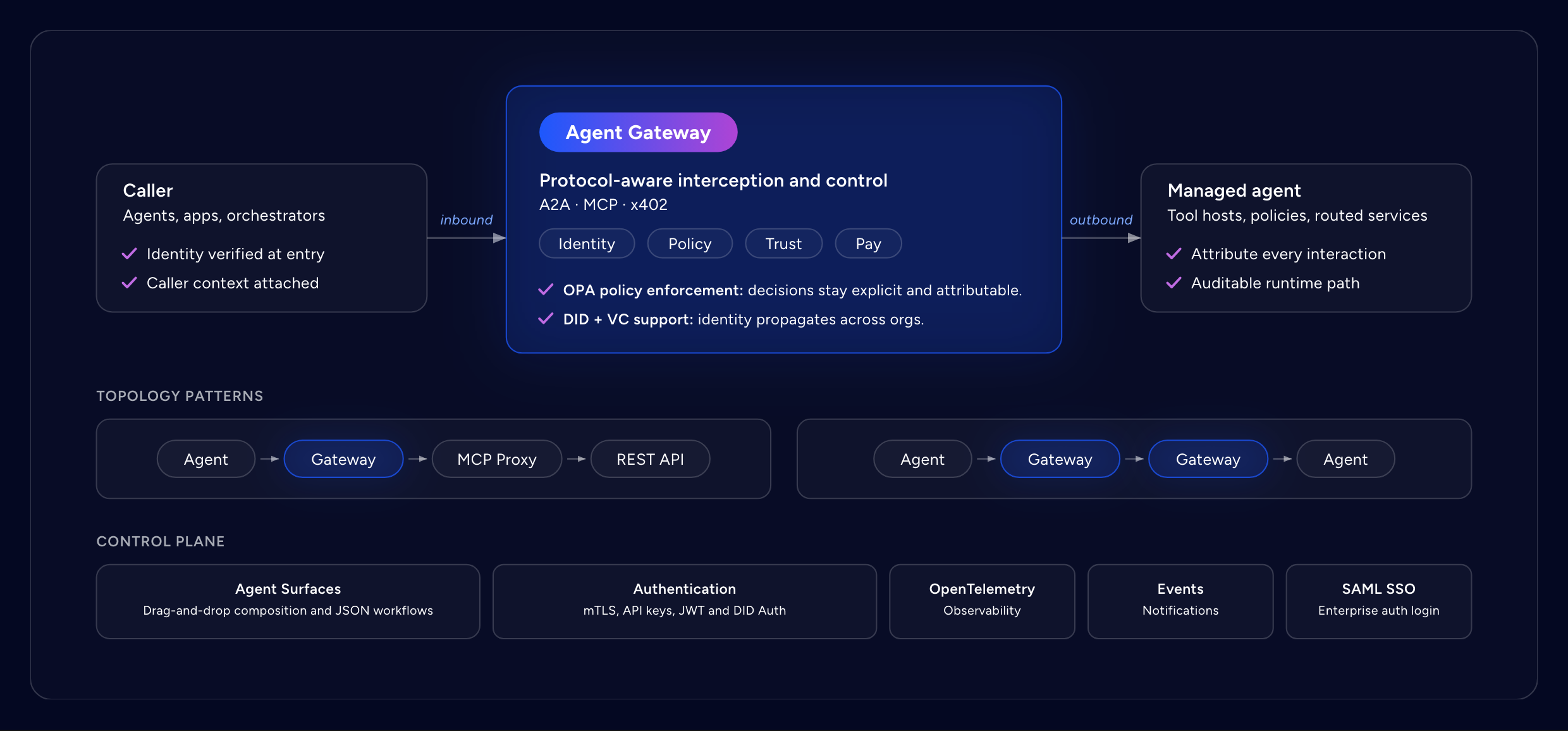
From there you add controls without touching either side: inject the credential for B,
require a policy to pass, check a trust registry, rate limit, or record the exchange.
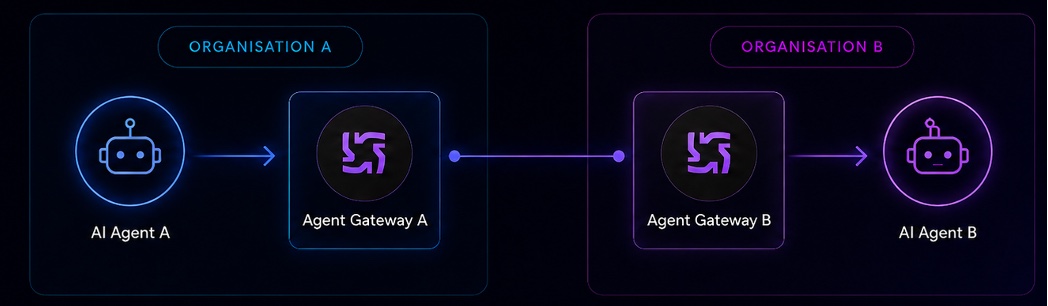
Two gateways can also be connected, so a call can cross an organisational boundary and
the agent's identity still means something on the other side. That path runs over DIDComm
v2.1 through a mediator.
Moving parts
flowchart LR
    Caller([Caller]) --> AP[Access Point]
    AP --> Target[Target]
    Target --> Agent([Managed agent])
    Agent --> TP[Transit Point]
    TP --> Service([External service])
    Target -. DIDComm fabric .-> Peer([Peer Gateway])
An Agent Surface is the configuration and runtime unit for one managed agent. Its
Access Point receives inbound traffic, its Target identifies the managed agent's
endpoint, and optional Transit Points control the traffic that agent initiates. Afabric:// Target routes to another gateway, with each gateway keeping its own trust
boundary.
What it looks like
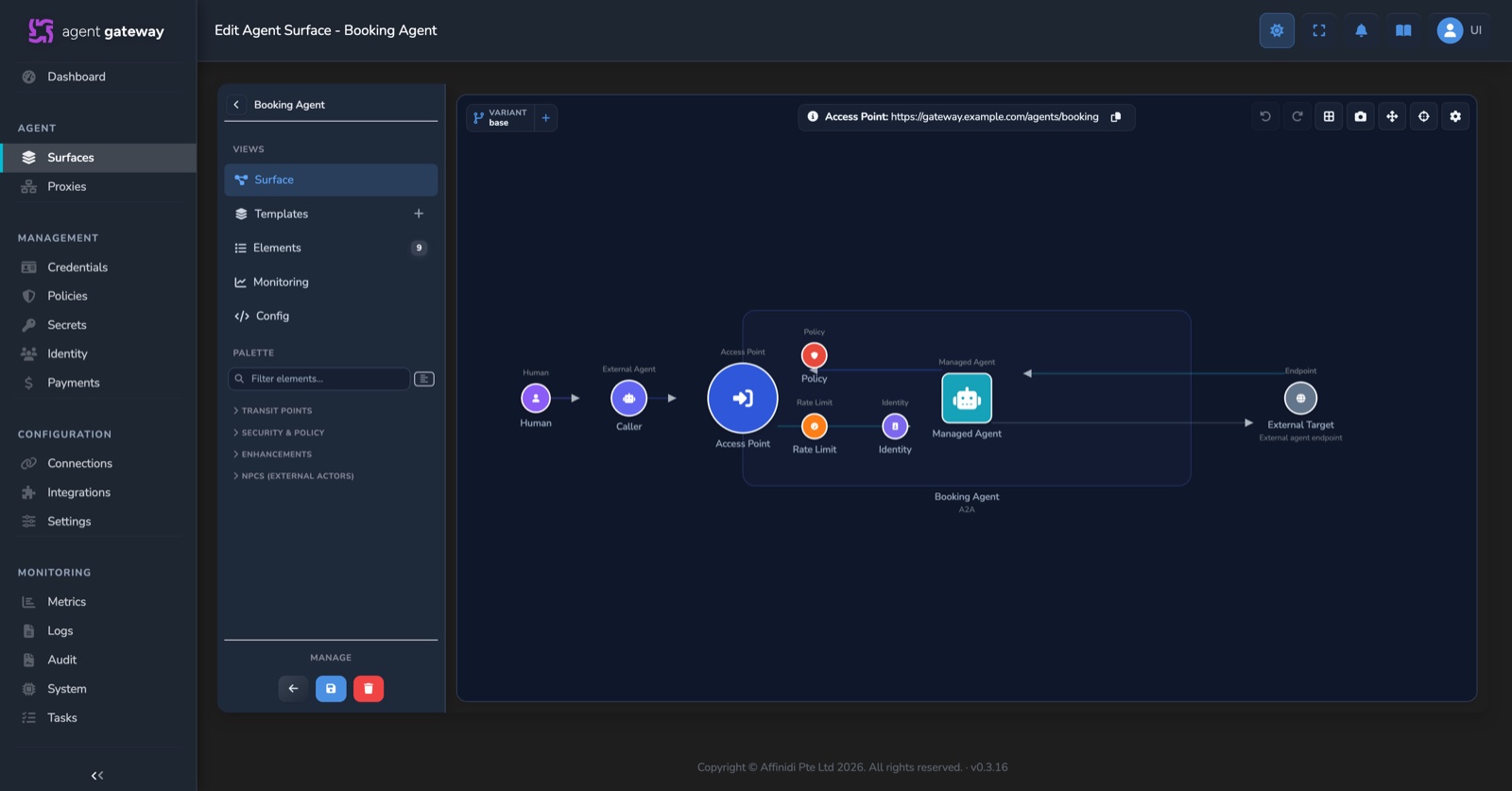
Everything is configured and watched from a web dashboard served by the gateway itself.
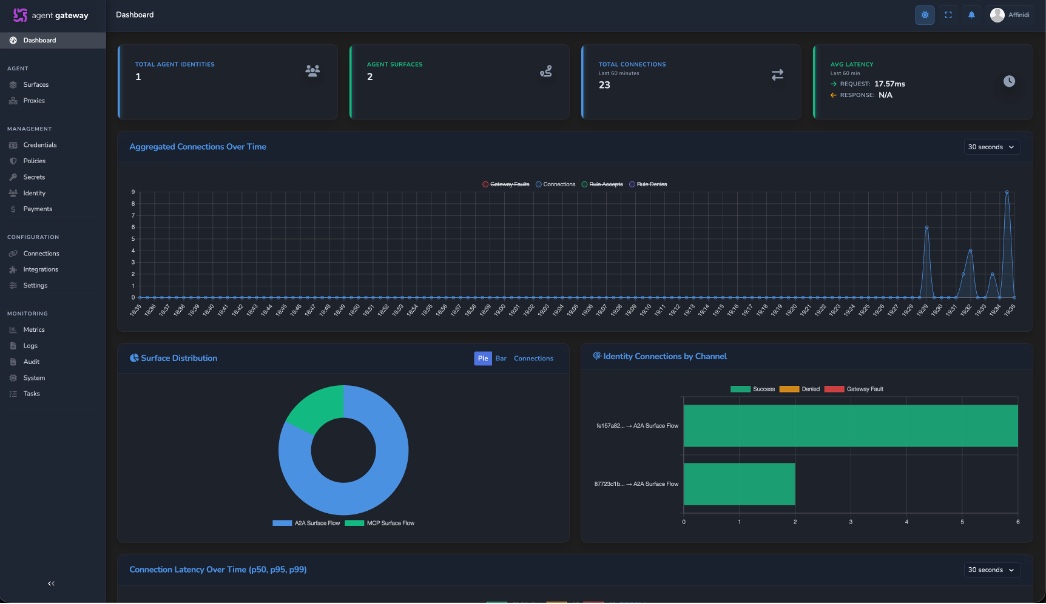
Each surface is built on a canvas by dragging in elements such as caller context,
identity, policy, and credential delegation. The same surface can be edited as JSON, and we plan to
provide a CLI and SDK for automating it.
Quickstart
Deploy an appliance
Follow the hosted Agent Gateway Quickstart
to deploy an appliance, create your first surface, add access controls, and monitor
traffic.
Build from source
The primary local path uses macOS with Homebrew. Install Git, Rust 1.95.0 or newer,
Node.js with npm, and a WebAuthn-capable browser and authenticator, then run:
git clone https://github.com/affinidi-ai/agent-gateway.git
cd agent-gateway
make install-deps
make run-debug
Complete passkey registration in the browser window opened by the run script. It uses the
WebAuthn origin generated in envs/local/config/gateway.json. Then check the local HTTPS
backend:
curl -k https://localhost:8443/api/v1/health
curl -k https://localhost:8443/api/v1/alive
docs/development/GETTING_STARTED.md covers the
full source-build path, including Linux setup, expected responses, reset, and
troubleshooting.
What is in this repository
One Rust binary, agent-gateway, built from src/, plus a React dashboard served
from the same process and built from www/default/. About 270,000 lines
of Rust across 54 top-level modules. No database and no sidecar: state lives in an in-memory cache
backed by JSON files on disk.
ARCHITECTURE.md maps the system to the source tree.
Documentation
Everything needed to understand and build this repository is in it. The hosted
documentation adds procedures for deploying and operating an appliance. Where the two
differ, repository documentation describes this source revision exactly.
| Goal | Documentation |
|---|---|
| Learn what Agent Gateway can do | docs/CAPABILITIES.md |
| Understand how the system works and where the code is | ARCHITECTURE.md |
| Build and run this source locally | docs/development/GETTING_STARTED.md |
| Develop, debug, and test | docs/development/DEVELOPMENT.md |
| Configure an appliance | docs/CONFIGURATION_REFERENCE.md |
| Inspect revision-specific internals | docs/README.md |
| Contribute a change | CONTRIBUTING.md |
| Deploy and operate a hosted appliance | Hosted product documentation |
Protocol status
| Protocol | Status in this source revision |
|---|---|
A2A 1.0 |
Active |
A2A 0.3 |
Accepted while a2a_legacy_compatibility is on, the default |
MCP 2024-11-05 |
Active |
MCP 2026-07-28 |
Active on endpoints set to dual; legacy and unset endpoints reject it |
| DIDComm v2.1 | Available for Fabric transport |
| TRQP | Available for Trust Check |
| x402 and MPP | Available when configured |
| AP2 | Experimental and disabled by default |
Use the hosted protocol documentation
for integration guidance. docs/PROTOCOLS.md records the exact
limitations and compatibility behaviour of this source revision.
Built on open standards
Agent Gateway uses open standards so that identity and trust work across organisational
and cloud boundaries, not only inside one deployment.
| Area | Standards |
|---|---|
| Agent protocols | A2A, MCP, AP2, x402 |
| Identity | W3C Decentralised Identifiers, with did:webvh, did:web, did:peer, and did:key |
| Credentials | W3C Verifiable Credentials and Verifiable Presentations |
| Messaging | DIDComm v2.1, including Out Of Band invitations |
| Trust registries | Trust Registry Query Protocol v2, with an open-source registry in affinidi-trust-registry-rs |
| Delegation | OAuth 2.0 three-legged flows, RFC 8693 token exchange |
The Affinidi technology stack adheres to open standards from the W3C, the Decentralized
Identity Foundation, the Linux Foundation, and the EU Digital Identity (EUDI) programme.
Affinidi has also donated open-source implementations to some of these bodies, among
them didwebvh-rs, the did:webvh
library Agent Gateway itself uses, now hosted by the Decentralized Identity Foundation.
Contributing and support
Contributions are welcome. Read CONTRIBUTING.md for the
discuss-first workflow, required checks, tests, and changelog fragments. Participation is
governed by the Code of Conduct.
For usage questions, use the Affinidi support form.
For reproducible technical problems or feature requests, search or open a
GitHub issue.
To report a security vulnerability, follow the private disclosure process inSECURITY.md.
License
Licensed under the Apache License 2.0. See LICENSE.
Yorumlar (0)
Yorum birakmak icin giris yap.
Yorum birakSonuc bulunamadi