plandb
Health Gecti
- License — License: Apache-2.0
- Description — Repository has a description
- Active repo — Last push 0 days ago
- Community trust — 12 GitHub stars
Code Basarisiz
- rm -rf — Recursive force deletion command in examples/build-docs-site-claude.sh
- rm -rf — Recursive force deletion command in examples/build-docs-site-codex.sh
- rm -rf — Recursive force deletion command in examples/build-docs-site-gemini.sh
- rm -rf — Recursive force deletion command in examples/build-mini-gpt-claude.sh
Permissions Gecti
- Permissions — No dangerous permissions requested
Bu listing icin henuz AI raporu yok.
The issue tracker your AI agents are missing. Think Linear or Jira — but for your agents.
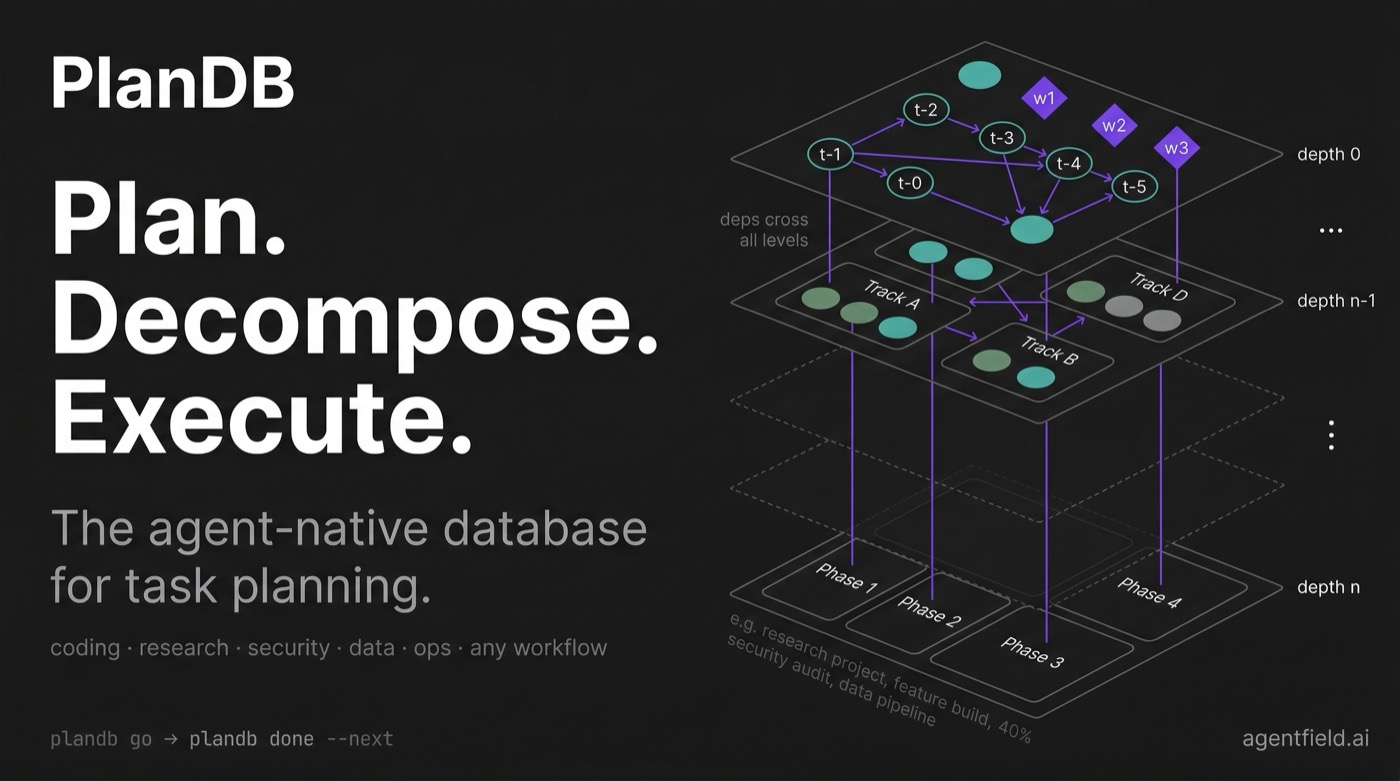
PlanDB
The issue tracker your AI agents are missing.
Linear and Jira were built for humans planning at human speed. Your agents decompose tasks mid-flight, parallelize across branches, and pivot entire subtrees when an approach fails — they need infrastructure that keeps up.
PlanDB is that infrastructure. Local-first, single binary, SQLite-backed. No cloud, no accounts, no setup.



Install · Demo · Architecture · Examples
Your agents have no issue tracker. No dependencies. No sprints. No idea what to work on next. They start coding before the schema exists, duplicate each other's work, and forget everything between sessions.
PlanDB gives them one — like giving every agent their own Linear workspace, except it's a single binary that runs anywhere.
Install
One command. Your agents start using it immediately — no config, no copy-paste, no prompt engineering.
curl -fsSL https://raw.githubusercontent.com/Agent-Field/plandb/main/install.sh | bash
The installer downloads the binary and auto-configures your agents with full planning instructions. Supports Claude Code, Cursor, Codex, Gemini CLI, OpenCode, Windsurf, and Aider. Re-run anytime to update — it's idempotent.
More install optionscurl -fsSL .../install.sh | bash -s -- --all # Silent: configure all detected frameworks
curl -fsSL .../install.sh | bash -s -- --binary-only # Just the binary, no framework config
# From source
cargo install --path .
# Custom prompts for other frameworks
plandb prompt --for cli # Shell agents (Codex, Aider)
plandb prompt --for mcp # MCP agents (Claude Code, Cursor, Windsurf)
plandb prompt --for http # HTTP agents (custom, webhooks)
What Gets Installed
| Framework | What's configured | How it works |
|---|---|---|
| Claude Code | Rules file (~/.claude/rules/plandb.md) + Skill (~/.claude/skills/plandb/) |
Always-on rules make agents plan automatically. The /plandb skill adds a structured 6-phase workflow with command gotchas and anti-patterns. |
| Cursor | Manual (instructions printed) | Paste into Cursor Settings → General → Rules for AI |
| Codex | ~/.codex/AGENTS.override.md |
Appended to agent instructions |
| Gemini CLI | ~/.gemini/GEMINI.md |
Appended to agent instructions |
| Others | Framework-specific config files | Aider, OpenCode, Windsurf — appended to their instruction files |
Try It Now
After installing, open your AI agent and paste one of these prompts:
Claude Code (uses the /plandb skill for structured planning):
/plandb Build a CLI todo app in Python with add, list, complete, and delete commands.
Store todos in a local JSON file. Include tests.
Any agent (Codex, Gemini CLI, Cursor, etc.):
Use plandb to plan and build a CLI todo app in Python with add, list, complete,
and delete commands. Store todos in a local JSON file. Include tests.
Watch the terminal — the agent will decompose the task into a dependency graph, parallelize independent work, and track progress with plandb go / plandb done --next automatically.
Why PlanDB
Compound graph, not a flat task list. Most tools give you a list or a tree. PlanDB is a compound graph — tasks contain subtasks to any depth (like folders), and dependencies connect tasks across those boundaries (like symlinks). Your "Build API" subtask inside Backend can directly depend on "Define Schema" inside Database. One
splitturns a stuck task into three parallel subtasks. One--depwires them into the right execution order. That's why agents using PlanDB naturally parallelize — the graph tells them exactly what's independent.Plans that adapt mid-flight. Agents don't know the full plan upfront. PlanDB expects that.
splita task when it turns out harder than expected.inserta step you missed between two existing tasks — dependencies rewire automatically.pivotan entire subtree when an approach fails. The plan is a living hypothesis, not a static spec.Knowledge that finds you. Record discoveries, blockers, and decisions with
plandb contextas you work. When an agent claims a related task days later, that context surfaces automatically via BM25 — no one searched for it, no one remembered to pass it along. Knowledge compounds across agents and sessions.
- Atomic multi-agent claiming.
plandb gouses atomic operations — two agents cannot claim the same task. No locks, no races, no duplicate work. - Critical path analysis.
plandb critical-pathshows the longest dependency chain.plandb bottlenecksshows what blocks the most downstream work. Focus where it matters. - Pre/post conditions.
--pre "schema must exist"and--post "all tests pass"attach conditions agents see when claiming and completing tasks. - BM25 search across everything. Tasks, descriptions, context entries, notes — all searchable with
plandb search. - Zero infrastructure. Single binary. SQLite. No Docker, no cloud, no config files. Works offline.
- Three interfaces. CLI for shell agents. MCP server for Claude Code / Cursor / Windsurf. HTTP API for custom agents and dashboards.
- Export/import patterns. Save a decomposition as YAML, reuse it across projects.
plandb export/plandb import. - Live terminal dashboard.
plandb watchfor a real-time view that refreshes as tasks complete.
See It Work
plandb init "auth-system"
plandb add "Design schema" --as schema --kind research \
  --description "Define user/session tables, auth flows, token format"
plandb add "Build API" --as api --kind code --dep t-schema \
  --description "Implement endpoints: register, login, refresh, logout"
plandb add "Write tests" --as tests --kind test --dep t-schema \
  --description "Integration tests for all auth endpoints"
plandb add "Deploy" --as deploy --kind shell --dep t-api --dep t-tests \
  --description "Docker build, push, deploy to staging"

plandb go            # claims "Design schema" (only task with no blockers)
plandb done --next   # completes it → "Build API" and "Write tests" both become ready
Two tasks ready = two agents work in parallel. Atomic claiming prevents conflicts.
In the Wild: 6 Tasks Became 20
We gave one Claude Code instance one sentence: "Build a GPT from scratch in Rust, then train it to do tool calling."
No human intervention. PlanDB planned the entire thing. The agent built a 3,769-line transformer in pure Rust (zero ML frameworks), then ran 7 RL experiments. The plan evolved from 6 to 20 tasks — splitting when work proved complex, parallelizing independent experiments, pivoting when REINFORCE collapsed:
graph LR
  design --> sft
  sft --> reinforce & dpo & custom & sft-v2 & sft-v3 & reject
  reinforce & dpo & custom & sft-v2 & sft-v3 & reject --> compare
  compare --> final
| Method | Format Acc | Tool Acc | Composite |
|---|---|---|---|
| Rejection Sampling | 71.3% | 70.0% | 0.601 |
| SFT Baseline | 66.3% | 63.8% | 0.577 |
| DPO | 65.0% | 62.5% | 0.570 |
| REINFORCE | 0.0% | 0.0% | 0.090 |
Pre-trained weights included: cd experiments/mini-gpt-rust && cargo run --release -- --demo
More in
experiments/— docs sites built autonomously by Codex, Claude Code, and Gemini CLI.
Under the Hood
PlanDB uses a compound graph — two orthogonal structures composed:
- Containment (hierarchy): tasks contain subtasks, recursively, to any depth
- Dependencies (flow): edges between tasks at ANY level, crossing containment boundaries
graph LR
  subgraph Backend
    DB --> API
  end
  subgraph Frontend
    UI
  end
  API --> UI
  DB -.-> UI
A backend subtask can depend on a frontend task directly. Composites auto-complete when children finish. plandb use t-backend zooms into a subtree for scoped work.
| You use | Your agents get | Why it matters |
|---|---|---|
| Issues | plandb add --description "..." |
Work items with full specs, not just prompts |
| Dependencies | --dep t-schema |
Right execution order, automatically |
| Sprint board | plandb status --detail |
See what's blocked, ready, running, done |
| Assignment | plandb go |
Atomic claiming — no two agents grab the same work |
| Sub-issues | plandb split --into "A, B, C" |
Recursive decomposition to any depth |
| Comments | plandb context --kind discovery |
Knowledge persists across sessions and agents |
| Triage | plandb critical-path |
Prioritize the bottleneck, not just the next task |
| Search | plandb search "query" |
BM25 across everything the project has learned |
| Pre/post conditions | --pre "..." --post "..." |
Conditions agents see on claim and completion |
| Retrospective | Context auto-surfaces via plandb go |
Agent B gets what Agent A discovered — automatically |
Interfaces
| Command | For | |
|---|---|---|
| CLI | plandb <command> |
Claude Code, Codex, Gemini, any shell agent |
| MCP | plandb mcp |
Claude Code, Cursor, Windsurf |
| HTTP | plandb serve --port 8484 |
Custom agents, webhooks, dashboards |
Part of AgentField
PlanDB is the task planning layer for AgentField — the open-source AI backend for building and running AI agents. SWE-AF uses PlanDB internally to coordinate parallel agent workstreams.
Architecture Docs · Examples · CLI Reference: plandb --help
License
Apache License 2.0
Yorumlar (0)
Yorum birakmak icin giris yap.
Yorum birakSonuc bulunamadi