mcp-server-fuzzer
Health Gecti
- License — License: MIT
- Description — Repository has a description
- Active repo — Last push 0 days ago
- Community trust — 34 GitHub stars
Code Basarisiz
- rm -rf — Recursive force deletion command in .github/workflows/publish.yml
Permissions Gecti
- Permissions — No dangerous permissions requested
This is a CLI-based fuzzing tool designed to test Model Context Protocol (MCP) servers. It sends aggressive, malformed inputs to target servers to help developers uncover bugs and verify schema conformance.
Security Assessment
Because of its core function as a fuzzer, the tool inherently makes network requests to interact with external servers. It does not request dangerous system permissions, and no hardcoded secrets were found. However, the automated scans flagged a recursive force deletion command (`rm -rf`) inside a GitHub Actions workflow file (`publish.yml`). While this is extremely common in publishing scripts to clean up CI environments, you should always verify that such commands do not pose a supply chain risk. Overall risk is rated as Medium due to the tool's network activity and CI script behavior.
Quality Assessment
The project is actively maintained, with repository activity as recent as today. It is released under the standard MIT license, allowing for widespread use and modification. The project has garnered 34 GitHub stars, indicating a small but real level of community trust and adoption.
Verdict
Use with caution—while the project is active and well-structured, users should review the CI workflows and ensure they are comfortable with the tool's aggressive network fuzzing before deploying it in sensitive environments.
A generic mcp server fuzzer
MCP Server Fuzzer

A comprehensive super-aggressive CLI-based fuzzing tool for MCP servers
Multi-protocol support • Two-phase fuzzing • Built-in safety • Rich reporting • async runtime and async fuzzing of mcp tools



Documentation • Quick Start • Examples • Configuration

What is MCP Server Fuzzer?
MCP Server Fuzzer is a comprehensive fuzzing tool designed specifically for testing Model Context Protocol (MCP) servers. It supports both tool argument fuzzing and protocol type fuzzing across multiple transport protocols.
Key Promise
If your server conforms to the MCP schema, this tool will fuzz it effectively and safely.
Why Choose MCP Server Fuzzer?
- Safety First: Built-in safety system prevents dangerous operations
- High Performance: Asynchronous execution with configurable concurrency
- Beautiful Output: Rich, colorized terminal output with detailed reporting
- Flexible Configuration: CLI args, YAML configs, environment variables
- Comprehensive Reporting: Multiple output formats (JSON, CSV, HTML, Markdown)
- Production Ready: PATH shims, sandbox defaults, and CI-friendly controls
- Intelligent Testing: Hypothesis-based data generation with custom strategies
- More Than Conformance: Goes beyond the checks in modelcontextprotocol/conformance with fuzzing, reporting, and safety tooling
Fuzzing Paradigms
MCP Server Fuzzer combines:
- Grammar/protocol-based fuzzing (schema-driven MCP request generation)
- Black-box fuzzing (no instrumentation; feedback from responses/spec checks)
It does not use instrumentation-based fuzzing (no coverage or binary/source instrumentation).
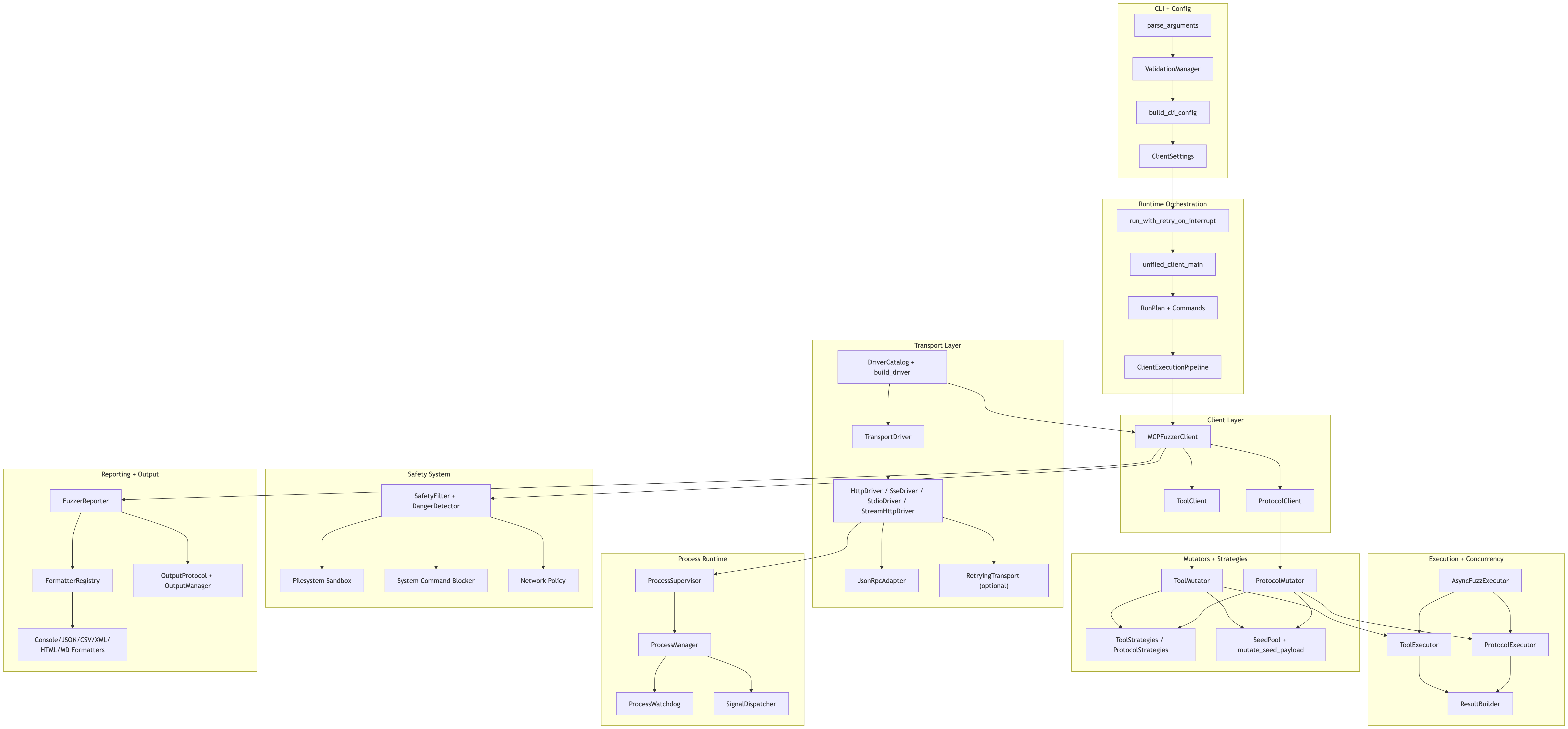
Basic Fuzzer Flow
Extensibility for Contributors
MCP Server Fuzzer is designed for easy extension while keeping CLI usage simple:
- Custom Transports: Add support for new protocols via config or self-registration (see docs/transport/custom-transports.md).
- Pluggable Safety: Swap safety providers for custom filtering rules.
- Injectable Components: Advanced users can inject custom clients/reporters for testing or plugins.
The modularity improvements (dependency injection, registries) make it maintainer-friendly without complicating the core CLI experience.
Quick Start
Installation
Requires Python 3.10+ (editable installs from source also need a modern pip).
# Install from PyPI
pip install mcp-fuzzer

# Or install from source (includes MCP spec submodule)
git clone --recursive https://github.com/Agent-Hellboy/mcp-server-fuzzer.git
cd mcp-server-fuzzer
# If you already cloned without submodules, run:
git submodule update --init --recursive
pip install -e .
Docker Installation
The easiest way to use MCP Server Fuzzer is via Docker:
# Build the Docker image
docker build -t mcp-fuzzer:latest .

# Or pull the published image
# docker pull princekrroshan01/mcp-fuzzer:latest
The container ships with mcp-fuzzer as the entrypoint, so you pass CLI args
after the image name. Use /output for reports and mount any server/config
inputs you need.
# Show CLI help
docker run --rm mcp-fuzzer:latest --help

# Example: store reports on the host
docker run --rm -v $(pwd)/reports:/output mcp-fuzzer:latest \
  --mode tools --protocol http --endpoint http://localhost:8000 \
  --output-dir /output
Required mounts (stdio/config workflows):
/output: writeable reports directory/servers: read-only server code/executables for stdio/config: read-only config directory
Basic Usage
- Set up your MCP server (HTTP, SSE, or Stdio)
- Run basic fuzzing:
Using Docker:
# Fuzz HTTP server (container acts as client)
docker run --rm -it --network host \
  -v $(pwd)/reports:/output \
  mcp-fuzzer:latest \
  --mode tools --protocol http --endpoint http://localhost:8000

# Fuzz stdio server (server runs in containerized environment)
docker run --rm -it \
  -v $(pwd)/servers:/servers:ro \
  -v $(pwd)/reports:/output \
  mcp-fuzzer:latest \
  --mode tools --protocol stdio --endpoint "node /servers/my-server.js stdio"
Using Local Installation:
# Fuzz tools on an HTTP server
mcp-fuzzer --mode tools --protocol http --endpoint http://localhost:8000

# Fuzz protocol types on an SSE server
mcp-fuzzer --mode protocol --protocol-type InitializeRequest --protocol sse --endpoint http://localhost:8000/sse
Advanced Usage
# Two-phase fuzzing (realistic + aggressive)
mcp-fuzzer --mode all --phase both --protocol http --endpoint http://localhost:8000

# With safety system enabled
mcp-fuzzer --mode tools --enable-safety-system --safety-report

# Export results to multiple formats
mcp-fuzzer --mode tools --export-csv results.csv --export-html results.html

# Use configuration file
mcp-fuzzer --config my-config.yaml
Examples
HTTP Server Fuzzing
# Basic HTTP fuzzing
mcp-fuzzer --mode tools --protocol http --endpoint http://localhost:8000 --runs 50

# With authentication
mcp-fuzzer --mode tools --protocol http --endpoint https://api.example.com \
           --auth-config auth.json --runs 100
SSE Server Fuzzing
# SSE protocol fuzzing
mcp-fuzzer --mode protocol --protocol-type InitializeRequest --protocol sse --endpoint http://localhost:8080/sse \
           --runs-per-type 25 --verbose
Stdio Server Fuzzing
Using Docker (Recommended for Isolation):
# Server runs in containerized environment for safety
docker run --rm -it \
  -v $(pwd)/servers:/servers:ro \
  -v $(pwd)/reports:/output \
  mcp-fuzzer:latest \
  --mode tools --protocol stdio --endpoint "python /servers/my_server.py" \
  --enable-safety-system --fs-root /tmp/safe \
  --output-dir /output

# Using docker-compose (easier configuration)
docker-compose run --rm fuzzer \
  --mode tools --protocol stdio --endpoint "node /servers/my-server.js stdio" \
  --runs 50 --output-dir /output
Using Local Installation:
# Local server testing
mcp-fuzzer --mode tools --protocol stdio --endpoint "python my_server.py" \
           --enable-safety-system --fs-root /tmp/safe
Configuration File Usage
# config.yaml
mode: tools
protocol: stdio
endpoint: "python dev_server.py"
runs: 10
phase: realistic

# Optional output configuration
output:
  directory: "reports"
  format: "json"
  types:
    - "fuzzing_results"
    - "safety_summary"
mcp-fuzzer --config config.yaml
Docker Usage
MCP Server Fuzzer can be run in a Docker container, providing isolation and easy deployment. This is especially useful for:
- Stdio Servers: Run servers in a containerized environment for better isolation and safety
- HTTP/SSE Servers: Container acts as the MCP client (server can run anywhere)
- CI/CD Pipelines: Consistent testing environment across different systems
Quick Start with Docker
# Build the image
docker build -t mcp-fuzzer:latest .

# Fuzz HTTP server (server can be on host or remote)
docker run --rm -it --network host \
  -v $(pwd)/reports:/output \
  mcp-fuzzer:latest \
  --mode tools --protocol http --endpoint http://localhost:8000 --output-dir /output

# Fuzz stdio server (server code mounted from host)
docker run --rm -it \
  -v $(pwd)/servers:/servers:ro \
  -v $(pwd)/reports:/output \
  mcp-fuzzer:latest \
  --mode tools --protocol stdio --endpoint "python /servers/my_server.py" --output-dir /output
Docker Releases
Docker images are published automatically on every GitHub Release (tagged v*)
via CI. The published image is:
docker pull princekrroshan01/mcp-fuzzer:latest
Note: The runtime image includes curl and ca-certificates so stdio servers can fetch HTTPS resources (e.g., schemas, tokens, metadata) without bundling extra tools. If your servers never make outbound HTTPS calls, you can remove them.
Using Docker Compose
For easier configuration and management, use docker-compose.yml:
# Set environment variables (optional)
export SERVER_PATH=./servers
export CONFIG_PATH=./examples/config
export MCP_SPEC_SCHEMA_VERSION=2025-06-18

# Run fuzzing (stdio server)
docker-compose run --rm fuzzer \
  --mode tools \
  --protocol stdio \
  --endpoint "node /servers/my-server.js stdio" \
  --runs 50 \
  --output-dir /output

# For HTTP servers (macOS/Windows - uses host.docker.internal)
docker-compose run --rm fuzzer \
  --mode tools \
  --protocol http \
  --endpoint http://host.docker.internal:8000 \
  --runs 50 \
  --output-dir /output

# For HTTP servers on Linux (use host network)
docker-compose -f docker-compose.host-network.yml run --rm fuzzer \
  --mode tools \
  --protocol http \
  --endpoint http://localhost:8000 \
  --runs 50 \
  --output-dir /output

# Production-style (no TTY/stdin)
docker-compose -f docker-compose.prod.yml run --rm fuzzer \
  --mode tools \
  --protocol stdio \
  --endpoint "node /servers/my-server.js stdio" \
  --runs 50 \
  --output-dir /output
Docker Volume Mounts
/output: Mount your reports directory here (e.g.,-v $(pwd)/reports:/output)/servers: Mount server code/executables for stdio servers (read-only recommended)/config: Mount custom configuration files if needed
Network Configuration
- HTTP/SSE Servers: Network access required. Linux: prefer
--network hostsolocalhostworks. Docker Desktop (macOS/Windows): usehost.docker.internalsince host networking is limited. If neither works, use the host IP. - Stdio Servers: No network needed - server runs as subprocess in container
Example: Fuzzing a Node.js Stdio Server
# 1. Prepare your server
mkdir -p servers
cp my-mcp-server.js servers/

# 2. Run fuzzer in Docker
docker run --rm -it \
  -v $(pwd)/servers:/servers:ro \
  -v $(pwd)/reports:/output \
  mcp-fuzzer:latest \
  --mode all \
  --protocol stdio \
  --endpoint "node /servers/my-mcp-server.js stdio" \
  --runs 100 \
  --enable-safety-system \
  --output-dir /output \
  --export-json /output/results.json
Example: Fuzzing an HTTP Server
# Server runs on host at localhost:8000
# Container connects to it as client

docker run --rm -it --network host \
  -v $(pwd)/reports:/output \
  mcp-fuzzer:latest \
  --mode tools \
  --protocol http \
  --endpoint http://localhost:8000 \
  --runs 50 \
  --output-dir /output
Security Considerations
- The Docker container runs as non-root user (UID 1000) for improved security
- Stdio servers run in isolated container environment
- Use read-only mounts (
:ro) for server code when possible - Reports are written to mounted volume, not inside container
Configuration
Configuration Methods (in order of precedence)
- Command-line arguments (highest precedence)
- Configuration files (YAML)
- Environment variables (lowest precedence)
Environment Variables
# Core settings
export MCP_FUZZER_TIMEOUT=60.0
export MCP_FUZZER_LOG_LEVEL=DEBUG

# Safety settings
export MCP_FUZZER_SAFETY_ENABLED=true
export MCP_FUZZER_FS_ROOT=/tmp/safe

# Authentication
export MCP_API_KEY="your-api-key"
export MCP_USERNAME="your-username"
export MCP_PASSWORD="your-password"
Performance Tuning
# High concurrency for fast networks
mcp-fuzzer --process-max-concurrency 20 --watchdog-check-interval 0.5

# Conservative settings for slow/unreliable servers
mcp-fuzzer --timeout 120 --process-retry-count 5 --process-retry-delay 2.0
Key Features
| Feature | Description |
|---|---|
| Two-Phase Fuzzing | Realistic testing + aggressive security testing |
| Multi-Protocol Support | HTTP, SSE, Stdio, and StreamableHTTP transports |
| Built-in Safety | Pattern-based filtering, sandboxing, and PATH shims |
| Intelligent Testing | Hypothesis-based data generation with custom strategies |
| Rich Reporting | Detailed output with exception tracking and safety reports |
| Multiple Output Formats | JSON, CSV, HTML, Markdown, and XML export options |
| Flexible Configuration | CLI args, YAML configs, environment variables |
| Asynchronous Execution | Efficient concurrent fuzzing with configurable limits |
| Comprehensive Monitoring | Process watchdog, timeout handling, and resource management |
| Authentication Support | API keys, basic auth, OAuth, and custom providers |
| Performance Metrics | Built-in benchmarking and performance analysis |
| Schema Validation | Automatic MCP protocol compliance checking |
Performance
- Concurrent Operations: Up to 20 simultaneous fuzzing tasks
- Memory Efficient: Streaming responses and configurable resource limits
- Fast Execution: Optimized async I/O and connection pooling
- Scalable: Configurable timeouts and retry mechanisms
Architecture
The system is built with a modular architecture:
- CLI Layer: User interface and argument handling
- Transport Layer: Protocol abstraction (HTTP/SSE/Stdio)
- Fuzzing Engine: Test orchestration and execution
- Strategy System: Data generation (realistic + aggressive)
- Safety System: Core filter + SystemBlocker PATH shim; safe mock responses
- Runtime: Fully async ProcessManager + ProcessWatchdog
- Authentication: Multiple auth provider support
- Reporting: FuzzerReporter, Console/JSON/Text formatters, SafetyReporter
Runtime Watchdog Overview
The watchdog supervises processes registered through ProcessManager, combining hang detection, signal dispatch, and registry-driven cleanup. For a deeper dive into lifecycle events, custom signal strategies, and registry wiring, see the runtime management guide.
Understanding the Design Patterns
For developers (beginners to intermediate) who want to understand the design patterns used throughout the codebase, please refer to our comprehensive Design Pattern Review. This document provides:
- Module-by-module pattern analysis
- Design pattern fit scores and recommendations
- Modularity observations and improvement suggestions
- Complete pattern map for every module in the codebase
This is especially helpful if you're:
- Learning about design patterns in real-world applications
- Planning to contribute to the project
- Wanting to understand the architectural decisions
- Looking for areas to improve or extend
Troubleshooting
Common Issues
Connection Timeout
# Increase timeout for slow servers
mcp-fuzzer --timeout 120 --endpoint http://slow-server.com
Authentication Errors
# Check auth configuration
mcp-fuzzer --check-env
mcp-fuzzer --validate-config config.yaml
Memory Issues
# Reduce concurrency for memory-constrained environments
mcp-fuzzer --process-max-concurrency 2 --runs 25
Permission Errors
# Run with appropriate permissions or use safety system
mcp-fuzzer --enable-safety-system --fs-root /tmp/safe
Debug Mode
# Enable verbose logging
mcp-fuzzer --verbose --log-level DEBUG

# Check environment
mcp-fuzzer --check-env
Community & Support
- Documentation: Full Documentation
- Issues: GitHub Issues
- Discussions: GitHub Discussions
Contributing
We welcome contributions! Please see our Contributing Guide for details.
Quick Start for Contributors:
git clone --recursive https://github.com/Agent-Hellboy/mcp-server-fuzzer.git
cd mcp-server-fuzzer
# If you already cloned without submodules, run:
git submodule update --init --recursive
pip install -e .[dev]
pytest tests/
License
This project is licensed under the MIT License - see the LICENSE file for details.
Disclaimer
This tool is designed for testing and security research purposes only.
- Always use in controlled environments
- Ensure you have explicit permission to test target systems
- The safety system provides protection but should not be relied upon as the sole security measure
- Use at your own risk
Funding & Support
If you find this project helpful, please consider supporting its development:

Ways to support:
- ⭐ Star the repository - helps others discover the project
- 🐛 Report issues - help improve the tool
- 💡 Suggest features - contribute ideas for new functionality
- 💰 Sponsor on GitHub - directly support ongoing development
- 📖 Share the documentation - help others learn about MCP fuzzing
Your support helps maintain and improve this tool for the MCP community!
Made with love for the MCP community
Yorumlar (0)
Yorum birakmak icin giris yap.
Yorum birakSonuc bulunamadi