agent-memory
Health Warn
- License — License: NOASSERTION
- Description — Repository has a description
- Active repo — Last push 0 days ago
- Low visibility — Only 5 GitHub stars
Code Pass
- Code scan — Scanned 12 files during light audit, no dangerous patterns found
Permissions Pass
- Permissions — No dangerous permissions requested
No AI report is available for this listing yet.
Evidence-backed memory for AI agents. Traceable facts, time-aware recall, and reliable recovery. Zero-dependency Python core with SQLite, PostgreSQL, MCP & LangGraph.
Agent Memory
Remember what changed. Keep the evidence.
Traceable, correctable memory for AI agents.
Start with Python + SQLite. Add PostgreSQL, MCP, and LangGraph when you need them.





简体中文 · Quickstart · Architecture · Examples · Integrations · Docs
Agent Memory gives your agent current facts, evidence, and a history of what changed. It records where a statement came from, when it applies, and whether it can be used in the current scope. Your host receives a bounded MemoryBundle for its next model call.
The basic memory loop runs locally with zero third-party runtime dependencies—no model key, vector database, or background service required. Extraction, integrations, and workers are opt-in.
Alpha · v0.1.0. Try the local examples below. Supported slices and remaining acceptance work are documented in capability status.
Memory changes. The evidence stays connected.
| A real memory problem | What your agent can do |
|---|---|
| “I moved from Hangzhou to Shanghai.” | Record the change and its effective time. Keep the earlier history. If Shanghai's evidence is erased, return unknown after the move while preserving the independent evidence that Hangzhou ended. Run it → |
| “Use Chinese for Project A, except on holidays.” | Preserve the project condition and the exception. Return a qualified language preference when applicable, or context_unknown when the trusted context is missing. Run it → |
| “Forget this source—even after restoring a backup.” | Replay an authoritative deletion log over an isolated old database copy. Keep unrelated sources while preventing erased content from returning. Run it → |
These examples use explicit host policies and deterministic adapters. They demonstrate inspectable behavior without a model API key. Source identity, time, and permission remain attached as memory is corrected, combined, retrieved, or erased.
Quickstart
Install
Requires Python 3.13+. Install from this repository into a virtual environment. On macOS or Linux:
git clone https://github.com/agent-memory-lab/agent-memory.git
cd agent-memory
python3.13 -m venv .venv
source .venv/bin/activate
python -m pip install -e .
git clone https://github.com/agent-memory-lab/agent-memory.git
cd agent-memory
py -3.13 -m venv .venv
.\.venv\Scripts\python.exe -m pip install -e .
.\.venv\Scripts\python.exe demo.py
Create demo.py from the example below before running the last command. This uses the virtual environment's interpreter directly; activation is optional.
On macOS or Linux, ./setup.sh creates a development environment; ./setup.sh --all also installs the optional packages. Select an interpreter with PYTHON_BIN=/path/to/python3.13 ./setup.sh.
Remember → recall → inspect the source
Save this as demo.py, then run python demo.py:
import asyncio
from agent_memory import AgentMemory, MemoryScope


async def main():
    # Your application supplies identity and scope.
    scope = MemoryScope(tenant_id="demo", user_id="alice", agent_id="assistant")
    async with AgentMemory.local("memory.sqlite3", scope=scope) as memory:
        await memory.remember(
            "I prefer concise answers.",
            event_type="user.message",
            actor="user",
            idempotency_key="alice-answer-style-1",
            claims=({
                "key": "answer.style",
                "value": "concise",
                "text": "Alice prefers concise answers.",
                "scope": "user",
                "confidence": 0.98,
            },),
        )
        bundle = await memory.recall("How should I answer Alice?", token_budget=600)
        for claim in bundle.current_state:
            print(f"{claim.key}: {claim.value}")
            print("source event:", claim.provenance.source_event_ids[0])


asyncio.run(main())
Output on a fresh database:
answer.style: concise
source event: <event-id>
The event ID is generated at runtime. Rerunning the same input with the same idempotency key returns the same source event; changing that input requires a new key.
This example supplies the structured claim from host code. It demonstrates persistence and recall; automatic extraction is a separate, optional path. confidence is an input score, not a guarantee of truth. The returned bundle contains memory context for your host to assemble into a model request; it does not call an LLM.
From source evidence to usable knowledge
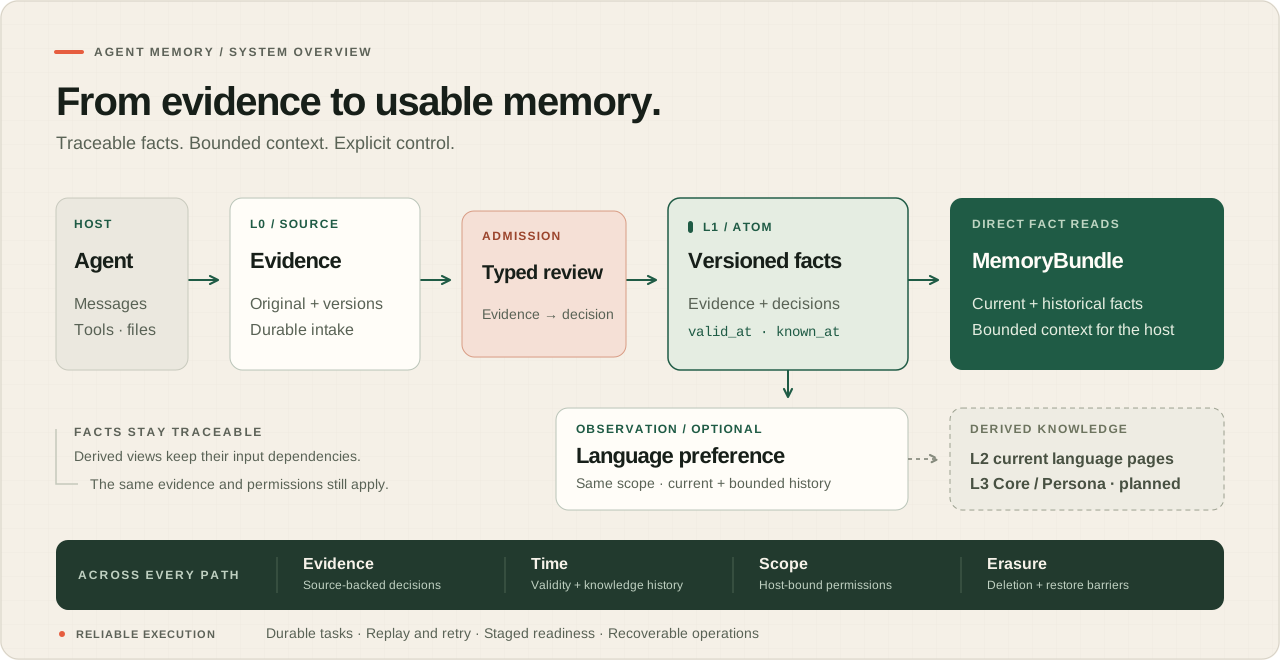
The v6.1 design separates the source, the accepted interpretation, and the views built from it:
| Component | Responsibility | Available scope |
|---|---|---|
| L0 · Source evidence | Preserve captured content, source identity, revisions, and processing requests | Durable receive, deduplication, explicit source revisions, and replay |
| L1 · Atomic memory | Decide what can be used, with evidence, conditions, and time | Typed admission; accepted, pending, or contested outcomes; supported corrections and dual-time queries |
| Observation · Derived views | Organize a facet across sources and rebuild when its inputs change | Same-scope language templates, bounded historical reads, current non-conditional parent views, and versioned host permissions |
| L2 · Scenario | Organize versioned scenario pages and blocks | Current language-scenario/1 pages support full rebuild from fixed same-scope, non-conditional language parents; general scenario templates remain planned |
| L3 · Core / Persona | Organize explicit long-term preferences and carefully evaluated patterns | Planned under the unified contract; inferred profiles require separate acceptance |
Observation is a derived building block that can support L2 or L3. L1 also feeds retrieval directly. A summary's position in this structure never increases the authority of its evidence.
- Two clocks:
valid_atasks when a fact applies;known_atasks what the system knew at that point. - Reliable work: sources, tasks, publication receipts, and index coverage have explicit transaction boundaries and recovery behavior.
- Controlled delivery: the host supplies identity and permissions; retrieval and derived reads enforce their supported scope and current erasure guards.
- Bounded context:
MemoryBundlecarries relevant memory and citations within item, character, and token estimates configured by the host.
See Atom admission, bitemporal memory, and code architecture for contracts and module boundaries.
Examples
Run these from the repository root. Core means python -m pip install -e .; + SDK adds python -m pip install -e packages/python-sdk. All examples below run locally without a model key.
| Try this | What to inspect | Install |
|---|---|---|
| Basic memory | A saved preference, current state, and source citations | Core |
| Contribution correction | A move, independent termination evidence, and safe erasure | Core |
| Conditional language | Project conditions, exceptions, and qualified Observation output | + SDK |
| Host-controlled views | Versioned query definitions, expiring host permissions, and read-only delivery | + SDK |
| Batched publication | Partial publication, closure, and complete index coverage | + SDK |
| Backup deletion replay | Recover an old backup without restoring erased evidence | Core |
python examples/contribution_memory.py
October 2: ['Hangzhou']
October 6: unknown
| Example | What to inspect | Install |
|---|---|---|
| Durable memory | Persist sources and processing requests, then publish L1 | + SDK |
| Contextual facts | Field evidence, conditions, and supported time ranges | Core |
| Derived parent views | Fixed current parent versions, transitive access and revocation | + SDK |
| Versioned L2 page | Full rebuild, stable block identities and guarded current page readiness | + SDK |
| Current Observation | Build and read a current language facet | + SDK |
| Offline deletion sync | Clean a participating SDK outbox before new delivery | + SDK |
| L1 readiness | Wait for a fixed set of requests; cancel a deleted offline sequence | + SDK |
| Reprocessing readiness | Track an explicit interpretation replacement | + SDK |
| Local index readiness | Separate publication from candidate locator visibility | + SDK |
| Index repair and rollover | Repair a gap and switch to a rebuilt index stream | + SDK |
| Resource refresh | Coalesce work while preserving fixed completion targets | Core |
| Plugin contracts | Implement and validate a plugin lifecycle | Core |
The capture integration recipe shows how to connect lifecycle hooks, a host provider, authenticated context, and a queue. It requires the Python SDK and host setup.
Integrations
Start with the core and install the integration packages you need:
| Package | Purpose | Local installation |
|---|---|---|
agent-memory |
Domain contracts, SQLite runtime, retrieval, plugin loading | python -m pip install -e . |
Python SDK · agent-memory-sdk |
Embedded/remote facade and durable host outbox | python -m pip install -e packages/python-sdk |
MCP server · agent-memory-mcp |
stdio and Streamable HTTP transport | python -m pip install -e packages/mcp-server |
| LangGraph | Lifecycle adapter | python -m pip install -e packages/langgraph |
| PostgreSQL | PostgreSQL provider and optional vector support | python -m pip install -e packages/postgres |
| Evolution | Evaluated Procedure candidates and promotion | python -m pip install -e packages/evolution |
For a local MCP host, install the MCP package above and start a scope-bound stdio server:
agent-memory-mcp --transport stdio --database memory.sqlite3 \
  --tenant-id demo --user-id alice --agent-id assistant --session-id session-1
For remote HTTP, use the authenticated gateway contract. Identity comes from trusted host configuration or verified authentication.
The public boundary is MemoryProvider. Optional packages use lazy discovery; importing the core does not load database drivers, framework runtimes, or ML libraries. Plugin Protocol v1 adds manifests, capability negotiation, lifecycle health, resource limits, and stable errors. See the plugin example and architecture guide.
Capability status and roadmap
The current documented delivery baseline is stage 15: bounded current language L2 pages of the v6.1 architecture plan. The software package is v0.1.0 / Alpha; architecture, protocol, and package versions are tracked separately.
| Capability | Current implementation | Evidence |
|---|---|---|
| Reliable L0 → L1 | Host outbox, atomic receive/publish, source revisions, explicit reprocessing, same-slot corrections, and dual-time fact reads | Delivery chain · Contribution lifecycle |
| Recovery and readiness | Fixed processing targets, bounded waiting, batch closure, local candidate indexing, explicit repair, and stream rollover | Index recovery · Batched publication |
| Erasure and backup replay | Participating outbox deletion sync and controlled offline replay using an independently held authoritative checkpoint | Deletion sync · Backup replay |
| Current Observation | Same-scope language facets, complete input dependencies, invalidation, full rebuild, and conditional language templates | Lifecycle · Conditions |
| Historical Observation | Frozen language snapshots/context, independent known/valid time, certified coverage and current permission/erasure checks | History |
| Derived parent inputs | Fixed current language revisions, complete processing lineage, guarded delivery and transitive physical erasure | Stage 14C |
| Query and host permissions | Versioned current queries, expiring local authority, source-grant binding, and checks before final delivery | Stage 14A |
| Current language L2 pages | Typed Scenario/Page/Block versions, stable block identities, atomic full rebuild, fixed readiness targets, guarded delivery, and transitive erasure | Stage 15 |
| Retrieval and feedback foundations | Scoped, bounded recall; optional lexical/hybrid candidates; outcome-linked Episode/Procedure and gated Evolution components | Architecture · Feedback |
Observation remains limited to documented language templates. Published-point and certified-interval history preserve frozen policies/context and current access checks; gaps are rejected. Current locale-parents/1 views bind fixed parent revisions and transitive processing permissions. Current language-scenario/1 pages combine 1–4 non-conditional language Observation parents in the same exact scope, with compatible subject, purpose, and authority.
Conditional/historical parents, pages as parents, historical pages, delta updates, general scenario templates, cross-scope composition, remote ACL synchronization, and L3 remain disabled or planned. The bounded page delivery does not complete the full L2/L3 lifecycle. L1's existing bitemporal queries remain independently available; l1_decided means processing completed, not that a fact is true.
Validation records include SQLite and real PostgreSQL contracts, cross-connection races, process-kill recovery, and backup replay. The stage 12 full-suite report is an older baseline; stage 13 and stage 14 A/B.3/C record targeted and affected regression runs. Stage 15 records a full repository/package run and build/install verification, with independent evidence. Each report applies to its recorded code baseline; counts are not cumulative. Production acceptance, real-domain extraction quality, and full M0/M1/M2 milestone acceptance remain open.
Next in the implementation plan:
- Qualified current parents and pages: the stage 16 plan defines compatible host routing and qualification contracts that preserve conditions and exceptions; it is not yet implemented or accepted.
- Further composition: historical parents/pages and broader templates need their own frozen-input contracts and acceptance; cross-scope composition remains disabled.
- Incremental views and L3: delta is deferred pending evidence of benefit and a versioned patch contract; inferred profiles require independent stability, counterexample, and quality acceptance.
- Real-world validation: domain gold, model input and delivery controls, dispatch budgets, and reproducible quality/cost comparisons.
Advanced retrieval and optional read-only Reflect remain on the task ledger. Remote deployments use the security policy and threat model; external caches, remote ACL systems, and provider-held copies need their own integration contracts.
Documentation
| You want to… | Start here |
|---|---|
| Understand the design | v6.1 architecture · Module boundaries |
| Admit or extract facts | Atom admission · Automatic extraction |
| Read facts across time | Bitemporal memory |
| Build a controlled language view | Observation lifecycle · Conditional view · Query and permissions |
| Read historical views or compose current pages | Bounded history · Parent inputs · Current L2 pages |
| Connect feedback and evolution | Feedback contract · Evolution package |
| Deploy and recover | Single-host deployment · Recovery operations |
| Inspect evaluation evidence | Evaluation methodology · Resource baseline |
| Follow or contribute to development | Plan · Tasks · Next steps |
Contributing
Useful contributions include a reproducible edge case, an integration adapter, or a well-annotated evaluation scenario. Start with the task ledger and CONTRIBUTING.md.
./setup.sh --all
source .venv/bin/activate
python -m pytest -q
Integration and live PostgreSQL tests have additional setup; see CI. Preserve the small default footprint, host-owned scope, and traceable evidence.
Open an issue with a reproducible example, or report security vulnerabilities privately through SECURITY.md.
License
Reviews (0)
Sign in to leave a review.
Leave a reviewNo results found