mnemiq
Health Pass
- License — License: Apache-2.0
- Description — Repository has a description
- Active repo — Last push 0 days ago
- Community trust — 41 GitHub stars
Code Pass
- Code scan — Scanned 12 files during light audit, no dangerous patterns found
Permissions Pass
- Permissions — No dangerous permissions requested
No AI report is available for this listing yet.
Open-source text-to-SQL engine you tune and measure on your own database
mnemiq
Text-to-SQL you can tune to your database. /NEM-ik/ — the "m" is silent, as in mnemonic.
An open-source engine that answers natural-language questions over your database, built so that
every stage between the question and the SQL is a setting you can read, change, and measure.
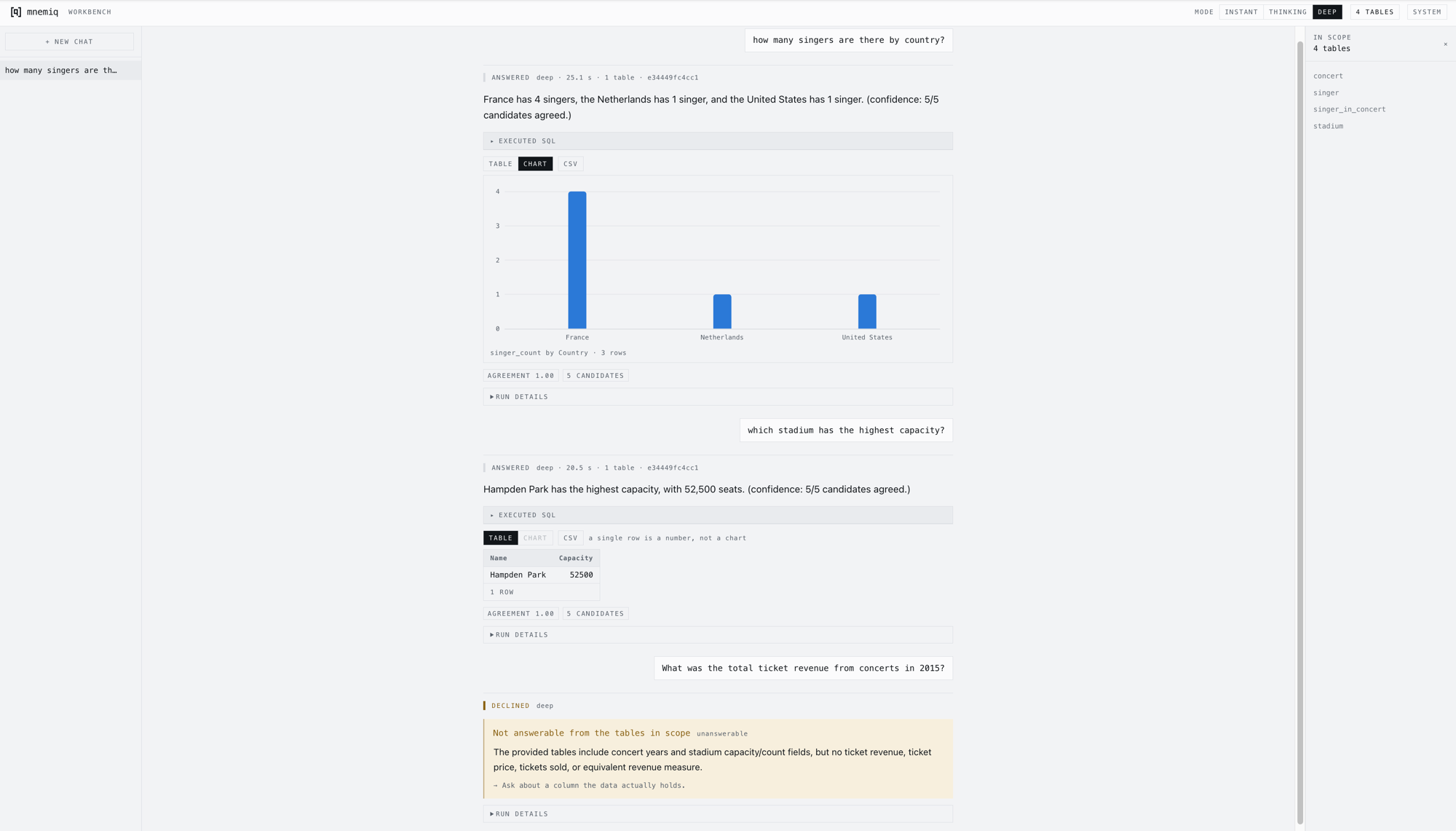
Two answers and a refusal. The third question asks for revenue the database does not hold, and the
engine says so — naming the columns it would have needed — instead of returning a number that looks
right. That distinction is the whole design.
Read more · Launch article ·
Technical report (PDF) ·
Paper (PDF) ·
beacon — the grader and results tracker
Why mnemiq exists
Every text-to-SQL product has an accuracy number. Almost none of them were measured on a database
that looks like yours.
A system can do well on a benchmark and then struggle on your warehouse because the schema is
larger, the naming is different, the business definitions live in people's heads, or the
configuration that suited the benchmark simply doesn't suit your data. When it underperforms, a
closed system gives you no way to find out why, and nothing to change.
So the question worth asking isn't how accurate is it. It's:
How well will this work on my database — and what can I change if it doesn't?
mnemiq is built to make both halves answerable. It is Apache-2.0, runs inside your own environment
on models you choose, and exposes the major parts of the pipeline as settings rather than
internals. No accuracy number applies to your database until you have run it on your database;
mnemiq is the engine and the evaluation harness for doing that.
How it works
mnemiq separates writing SQL from deciding to run it. A model proposes a query. A deterministic
layer then rules on it before anything touches the database. The query has to be read-only, may
only reference objects the caller is allowed to see, has to compile in the source's own SQL
dialect, and has to survive an EXPLAIN. Fail any of those and you get a refusal with a stated
reason rather than a plausible number.
Two properties fall out of that ordering. Permissions apply before schema retrieval, so the model
is never shown a table the caller may not see — naming it is useless rather than refused. And every
answer carries a trace: the SQL that ran, the tables it touched, the enrichment version behind it.
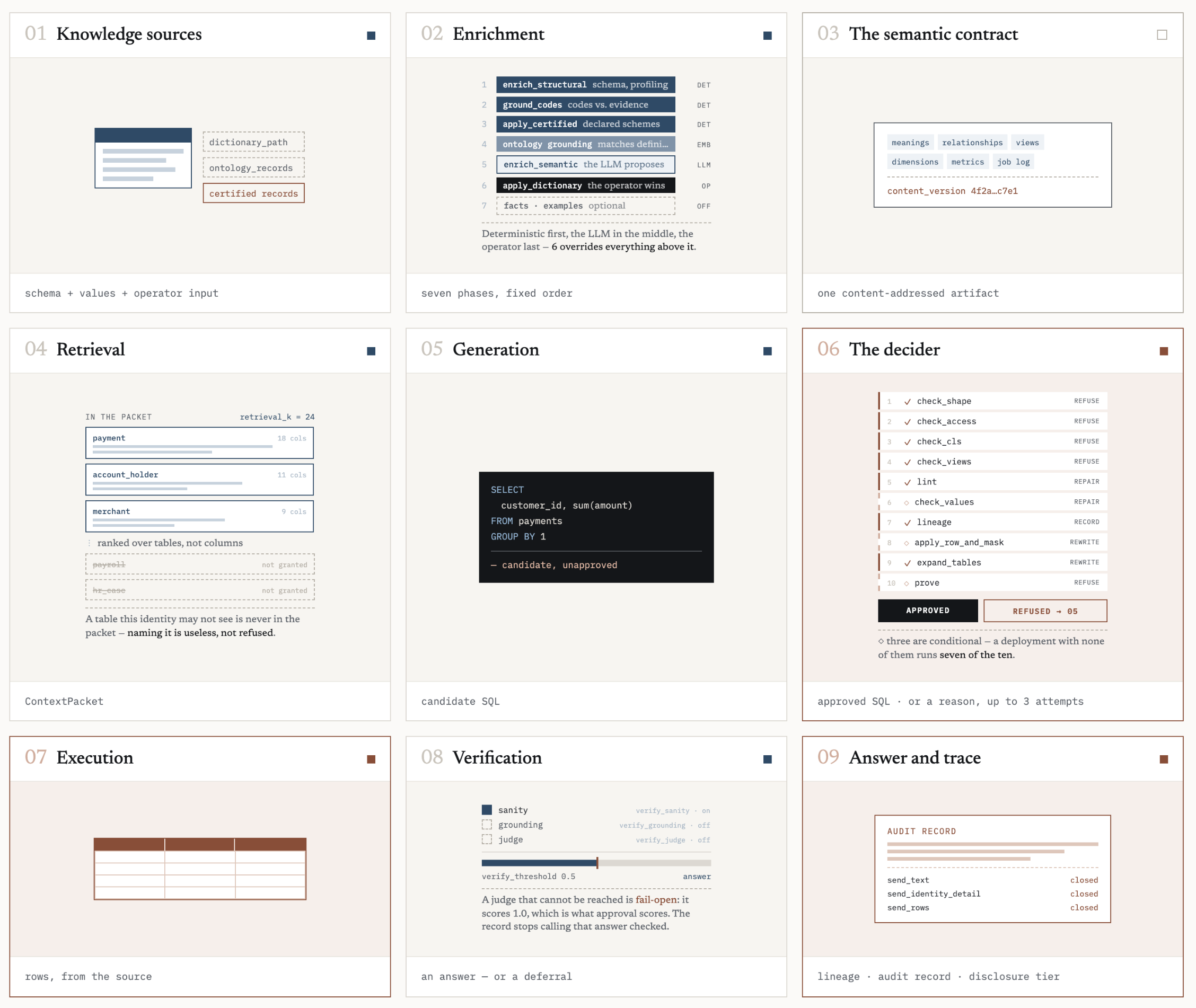
Read the diagram left to right, top to bottom. The stages in red are the ones that can stop an
answer: the decider refuses or repairs, execution runs under policy, and verification can defer.
The model appears once, at stage 05, and everything around it is deterministic.
The pipeline is settings, not internals
The parts people usually can't reach are the parts mnemiq puts in your hands:
- Which model writes the SQL — hosted or local, one candidate or several.
- How much schema context is retrieved, and how it is ranked.
- How much semantic enrichment is built, and whether a human certifies it.
- How aggressively the system refuses — the verifier and its threshold.
- What the decider enforces, including row and column policy applied to the query tree rather
than requested of the model.
Each of those is a dial with a cost on the other side, which is why they are dials and not
defaults. More context is not free. More compute is not automatically better. The right setting
depends on your data, and the point of the harness is that you can find out rather than guess.
The semantic layer has tiers
Before any question is asked, mnemiq can inspect the database and build context around the schema:
- Tier 0 — tables and columns only.
- Tier 1 — adds structural information: primary and foreign keys, profiling, value
distributions. - Tier 2 — adds meaning an LLM proposes: table and column descriptions, grain, glossary terms,
coded-value meanings.
Enrichment is a multiplier on meaning that isn't already in the schema. Where column names already
say what they hold, richer cards add length without adding signal. Where three columns are all
called revenue by three different teams, the meaning is in a person, not the schema — and that is
exactly what a certified definition captures. For production use, definitions can be reviewed and
certified by a named owner, and the operator's dictionary overrides everything the model proposed.
Codes are grounded or left bare, never guessed. E11 or NC-17 take their meaning from the data
itself, from a standard code system (TTL/SKOS/OWL), or from a hand-written dictionary, with the
source recorded. No evidence, no meaning. See docs/grounding.md.
Measure it on your own database
The evaluation harness is part of the engine, not a separate research project. It runs a question
set against a configuration, grades results by the data returned rather than by string-matching the
SQL, and reports right, refused, and wrong as three separate numbers — because a system can buy
accuracy by answering less often, and a single figure hides that.
A useful first pass, on your data:
- Take one meaningful slice of your schema, not the whole warehouse.
- Write 20–30 questions people actually ask, and tag each one: answerable from column names,
needs a definition, should be refused. - Run it with enrichment on and off, a local model and a hosted one, the verifier at two
thresholds. - Read the result by tag. The tags are the diagnosis: if the definition-band questions fail while
the schema-band questions pass, you have a glossary problem and documentation will pay for
itself. If both already pass, you were about to spend a quarter on something worth very little.
The same harness runs the public benchmarks (BIRD mini-dev, Spider 1.0, Spider 2.0-lite) and the
warehouse comparison scripts under scripts/, so the setup you use on your data is the setup the
published numbers came from.
Grading itself lives in beacon, a separate
Apache-2.0 repository: the grader that decides what counts as correct, and the tracker that holds
every run behind the published figures. Keeping it out of the engine is deliberate — a system
should not mark its own homework, and the same grader scores mnemiq, Snowflake Cortex Analyst and
Databricks Genie in the comparison. Per-question results are published there, so a number in the
launch article can be traced to the SQL and the rows that produced it.
Quickstart
Runs on a clean clone with no database of your own and no Docker. The seed step writes a small
SQLite database plus its source manifest and access policy under demo/.
uv sync
uv run python scripts/seed_demo.py

export MNEMIQ_LLM_BASE_URL=...  MNEMIQ_LLM_API_KEY=...  MNEMIQ_LLM_MODEL=...
export MNEMIQ_SOURCES_PATH=demo/sources.json
export MNEMIQ_AUTHZ_PATH=demo/authz.json
export MNEMIQ_STORE_PATH=demo/store.duckdb

uv run mnemiq enrich      # profile + describe the schema  (~30 s on the demo's 4 tables)
uv run mnemiq build       # index it for retrieval          (~2 s)
uv run mnemiq ask "how many customers are there by country?" --roles analyst
uv sync pulls about 230 MB of dependencies on a first run — DuckDB, PyArrow and the OpenAI
client are the bulk of it — so give it a minute on a normal connection. It is near-instant on any
subsequent checkout, since uv caches wheels globally.
mnemiq enrich is the only slow step: it profiles every column and makes one LLM pass over the
schema, so expect roughly 30 seconds for the demo's four tables and longer in proportion to
your own. It prints nothing until each table completes — it is working, not hung. The result is
cached, so you pay it once per schema rather than per question.
Two more worth trying, because they show the parts that aren't the model:
uv run mnemiq ask "how many enterprise customers are there?" --roles analyst
uv run mnemiq ask "what was our total revenue last quarter?"   --roles analyst
The first joins through a lookup table to resolve a coded column — segment_cd holds A/B/C
and nothing in the name says "enterprise". The second is refused: the demo schema has no price or
revenue column, and the engine says so instead of returning a number.
Access is fail-closed. A role is required — pass --roles analyst, or export MNEMIQ_ROLES=analyst alongside the other settings above. Without a role the engine grants nothing
and defers, which is the correct behaviour and the first thing people mistake for a bug. No policy,
no grants, no snapshot — no data.
Which LLM endpoints work
Any OpenAI-compatible /v1 endpoint. mnemiq talks to MNEMIQ_LLM_BASE_URL through the
standard OpenAI client, so vLLM, Ollama, llama.cpp's server, LM Studio, vendor gateways and the
hosted APIs all work — set the base URL, a key (any non-empty string for local servers that
ignore it) and a model name. Nothing about the engine assumes a hosted provider, which is what
"runs inside your perimeter" means in practice: point it at a local server and no schema, no
question and no row ever leaves your network. Embeddings follow the same setting, or their own
via MNEMIQ_EMBED_*.
Use it from a browser (workbench)
cd workbench && pnpm install && pnpm build
uv run mnemiq serve --http     # http://127.0.0.1:8080
One process serves both the workbench and the HTTP API — POST /v1/ask (JSON), POST /v1/chat
(SSE, AG-UI event vocabulary), GET /v1/schema. Every
answer shows the SQL that produced it and the tables it read; a question the data cannot support
comes back as a stated reason, not a guess — that is the interface pictured at the top of this
file. See workbench/README.md.
Use it from an AI agent (MCP)
uv run mnemiq serve exposes two read-only, access-scoped tools over stdio — db_read(question)
(answer + SQL + trace) and get_schema(). Point any MCP client at it:
{ "mcpServers": { "mnemiq": { "command": "mnemiq", "args": ["serve"] } } }
MCP initialization and tool discovery work before database setup is complete. The runtime is
loaded on the first tool call; configure the source and LLM, then run mnemiq enrich andmnemiq build before querying. Missing setup is returned as a tool error while the MCP
connection stays open. With a uv sync installation, launch from the repository usinguv run mnemiq serve so the command uses the project's environment.
Sources
Postgres, SQLite, DuckDB, Oracle, Snowflake and Databricks, with DuckDB as the universal executor.
The semantic model (mnemiq-contract) is open, and dbt-semantic-interfaces import/export ships
with it.
Deploying against Oracle
The Oracle read plane refuses writes, but that refusal is partly a property of your deployment
rather than of the engine: a SELECT can reach an AUTONOMOUS_TRANSACTION function through a
view, and restricting the caller does not close it, because a view resolves its references with the
view owner's rights. Pointing the read plane at a database that is open read-only does close it,
measured, and mnemiq reports at boot whether you are in that deployment or resting on the engine's
gate alone. See docs/oracle-deployment.md before connecting a
production source.
What's commercial
The engine is Apache-2.0 and always will be — enrichment included. Nothing here is a
time-limited or feature-gated build, and no capability is stubbed out pending a licence key.
Specifically open, because these are the parts people assume are held back: the enrichment
pipeline including the LLM pass and coded-value grounding (src/mnemiq/enrichment/), the verifier
and its judge (src/mnemiq/verify/), the access checks (src/mnemiq/authz/, src/mnemiq/sql/),
the result grader (src/mnemiq/eval/grade.py), and the benchmark harness that produced the
published numbers (scripts/).
Commercial are two things that sit around the engine rather than inside it: Verity, a managed
grading and drift service, and the Agentic Fabriq control plane — identity, vaulted
credentials, per-group grants and audit across many sources. Both talk to the engine through the
open contract (mnemiq-contract), so a self-hosted deployment is not a degraded one; it is the
same read path without a managed service in front of it.
Read the code rather than taking this on trust — that is the point of shipping it.
Known weaknesses
Filed as open issues rather than left to be discovered, because they are readable in the source
either way. Contributions and arguments welcome.
All four this list opened with are now closed. The default mode is judged
(#3) — that issue read Settings.verify, which
governs the eval door and not Runtime.ask, and concluded a fresh install ran unverified. It did
not: the product path resolves each mode's own verify level, and the deterministic sanity layer
has always run in all three. What was missing was the LLM judge, which now runs in thinking as
well as deep. An unreachable judge withholds the answer instead of passing it
(#2), lineage stopped reportingunconfirmed-function-identity on ordinary queries
(#5), and the CLI honours MNEMIQ_ROLES like
every other surface (#4).
Contributing
Issues and pull requests are welcome. Fork, branch, and open a PR against main.
uv sync --extra dev --extra ontology --extra oracle
uv run pytest -m "not integration and not live_llm"
git config core.hooksPath .githooks     # optional: runs the same checks before each commit
What repo-guard checks, and what a green tick means. It blocks credential shapes and
hardcoded /Users/<name> machine paths — both run in CI on every push and pull request, and both
are what your PR has to pass. It also blocks a private list of proprietary names, and that one runs
only on the maintainer's machine: enforcing it in CI would publish the list it protects, since a
flagged word in a public log tells every reader that word is on the blocklist. Your clone has no
such list and does not need one — you cannot leak names you have never seen.
The hook reads that setting from .env, so copy .env.example before installing it: the copy
ships REPO_GUARD_NAME_PATTERNS=off, which is how you say this machine holds no list, and the
hook then runs the two checks that matter to you. With no .env at all it stops and asks, rather
than guess whether a missing list means "contributor" or "maintainer whose config broke".
Status
v0.1: the full read path — enrichment, retrieval, the decider, execution, trace — evaluated on
ACME, BIRD mini-dev, Spider 1.0 and Spider 2.0-lite, with a local-model program alongside. Tiered
modes (instant / thinking / deep), row- and column-level security, the governed write path,
cross-source federation and multi-replica deployment are built and wired behind the same
interfaces. Next: additional source adapters, the self-maintaining loops, and hardening the write
plane against a production source.
Reviews (0)
Sign in to leave a review.
Leave a reviewNo results found