MOAA
Health Uyari
- License — License: MIT
- Description — Repository has a description
- Active repo — Last push 0 days ago
- Low visibility — Only 5 GitHub stars
Code Gecti
- Code scan — Scanned 12 files during light audit, no dangerous patterns found
Permissions Gecti
- Permissions — No dangerous permissions requested
Bu listing icin henuz AI raporu yok.
MOAA: Mother of All Agents. One-command Claude Code setup: Specialist Council, Agent Arena with forging, War Room parallel teams with a live app, Allies (hand tasks to Codex, Gemini, Kimi, DeepSeek), Strata layered long-term memory, plugins, skills, MCP servers
MOAA: Mother of All Agents



Agents compete in an arena; the winners join a 60-role council that cross-checks your answers.
MOAA turns Claude Code into a team. A Specialist Council of 60 role agents, each with its own model and effort
level, works a problem in parallel and checks the results against each other before you see an answer. In the
Agent Arena, agents compete and a blind judge scores them, and agents that keep winning are forged into
permanent council members.
Try it in Claude Code
/plugin marketplace add ahmadhammoud56/MOAA
/plugin install moaa-core@moaa
Restart Claude Code, then:
/specialist-council:specialist-council  Is 221 prime? Factor it.
/agent-arena-mode:judge --quick -- Write fib(n) with fib(1)=fib(2)=1 and give fib(20).
moaa-core installs the council, the arena and moaa-catalog. For the whole setup (about 90 pinned third-party
plugins, standalone skills and MCP servers), use the installer:
git clone https://github.com/ahmadhammoud56/MOAA.git && cd MOAA
./install.sh              # macOS / Linux / Git Bash  (Windows PowerShell: .\install.ps1)
Staying up to date
- Marketplace install: run
python scripts/install.py --auto-updateonce in a clone, or turn it on in/plugin> Marketplaces > moaa > Enable auto-update. Claude Code then refreshes MOAA in the background and saysPlugin updated ... Run /reload-plugins. - Clone install:
python scripts/install.py --updatepulls, reinstalls with your profile and mode, and prints what
changed. - Either way: at session start, moaa-catalog checks GitHub's latest release once a day and tells you when a newer
one is out, with the exact command (silent offline;MOAA_NO_UPDATE_CHECK=1turns it off). To get an e-mail per
release, use Watch > Custom > Releases on the GitHub repository.
New here? The 5-minute guide walks through every part, and /moaa-catalog:moaa-help
answers "what can MOAA do?" from inside Claude Code.
What a council run looks like

A real run, replayed from its transcript and compressed from 44 s. The analyst factors 221 with Fermat's method; a
forged arithmetic checker (an arena agent that scored 97 and 95 in two validated runs) uses trial division; the
coordinator checks that they agree:
221 is not prime. 221 = 13 × 17.
Both workers agree. Check: 13 × 17 = 221, and 15² − 2² = 221. 13 and 17 are prime.
That loop is what MOAA is built around:
 task ──► Specialist Council (60 roles, per-role model + effort) ──► verified answer
            ▲                                      │
            │ forge (≥2 validated runs, every      ▼
            │ score ≥ 85, spread ≤ 10)      Agent Arena (8 modes, judge + validator)
            └──────────── library of winning agents ◄─┘
An arena run, replayed from its transcript: three contestants work in parallel, a blind judge scores them and a
fresh validator checks the winner (real run, 233 s, compressed):

What's inside
| Plugin | What it does |
|---|---|
| Specialist Council | 60 role agents (debugger, statistician, security reviewer, FEM specialist, …) with per-role model and effort presets (MODELS.md). Split, ensemble or hybrid teams, one integrated and verified result. |
| Agent Arena | Eight modes: judge, tournament, league, swarm, cascade, red team, evolution and synthesis. Every judged result goes to a local library; proven agents are forged into the council. |
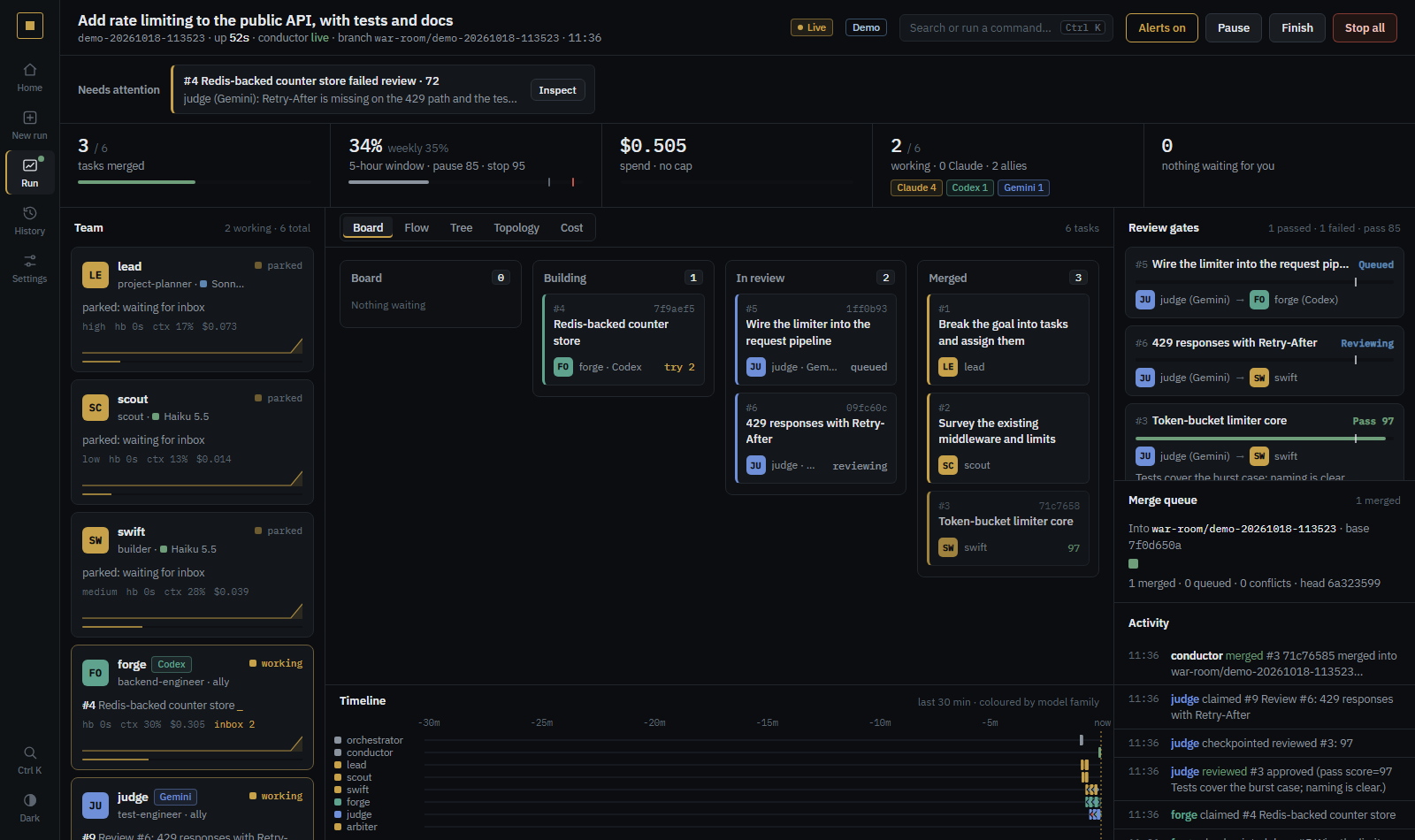
| War Room | Several real Claude Code sessions on one big job, with a task board, review gates on a different model, a merge queue and a live local app. Zero-token demo: python plugins/war-room/warroom.py demo. |
| Allies | Hands bounded tasks to Codex, Gemini, OpenCode (free zero-retention models, no sign-in), Kimi, DeepSeek or a local OmniRoute gateway, each on its own account. Read-only by default; writes land on their own branch. |
| Team | People on separate Claude accounts work on one git repository together: a board on its own branch with task claims (never twice, even in a push race), path locks, dependencies, handoffs, messages and a decision log; each session is briefed on its tasks and new messages. No credential or usage sharing. |
| Strata | Layered long-term memory in local SQLite (raw sessions, notes, project scenes, your profile), recalled at session start. Project RAG over each project's files, virtual context (evicted turns recalled after handoffs and compactions), context handoff near a full context window or when a silent canary shows Claude losing its instructions, a second-brain vault (quick capture, daily notes, weekly distill into linked pages, Obsidian-friendly), a Karpathy-style LLM Wiki (/strata:wiki) and a findings graph with a grounding check (/strata:graph). |
| prompt-refiner | Turns every prompt into a clear brief before Claude works on it, asks about ambiguous points with concrete options (or lets a brainstorming skill ask, never both), and hands the brief to every subagent. |
| moaa-core | The one-line install (council, arena, catalog), plus a guard that steers long inline python -c into a script file and /moaa-core:project-docs, which audits a project for AGENTS.md, ARCHITECTURE.md, PRD and the rest of the agent doc set. |
| moaa-catalog | Skills on demand: big skill packs stay installed but disabled, a prompt hook names the one skill a task needs, and a daily check tells you when a MOAA update is out. |
| More skills | /specialist-council:long-task (brief, progress file, evidence review, resume), /agent-arena-mode:karpathy-loop (keep only changes that move a number), /agent-arena-mode:effort-trial, /agent-arena-mode:fold-trial (one loop vs a council), /agent-arena-mode:harness-league (Claude Code vs the allies), and Anthropic's automation recommender. |
Always on, no commands
Nine things run on their own once installed, and each has an off switch:
- Prompt to brief (prompt-refiner): Claude rewrites each new request as a brief (goal, deliverables, constraints,
acceptance checks), asks about anything material with 2-4 options, saves the brief to.briefs/, and gives
subagents the brief instead of your raw words. Short replies, slash commands and already-detailed prompts pass
straight through. Off:py plugins/prompt-refiner/refiner.py off, or start a prompt withraw:. - No more compacting (strata): at about 85% of the context window Claude stops at a safe point, writes
HANDOFF.mdandCONTEXT.mdto.claude/handoff/, and tells you to open a new chat in the project; the new chat
picks the work up with your first message (hidden app sessions in the folder leave it alone). If a conversation is compacted anyway, a snapshot is written first. Off:py plugins/strata/strata.py handoff off;handoff threshold 90moves the trigger. - Virtual context (strata): what leaves the context window stays recallable. Every turn, tool results included,
is stored before a compaction and when a new chat takes a handoff; later prompts get back the evicted turns that
match them. A chat that continues a chain of handoffs, or one long compacted chat (handoff mode compact), behaves
as if the window had no end. Off:py plugins/strata/strata.py handoff recall off. - Project RAG (strata): each project's docs, code, notebooks and PDFs are indexed locally (SQLite full-text
search, refreshed in the background at session start). When a request clearly matches passages in the project,
the best few are added with theirpath:lines; chit-chat and unrelated requests get nothing. Off:py plugins/strata/rag.py off. - Context canary (strata): Claude ends each reply with an invisible line (
[//]: # (strata:ok)). Two long replies
in a row without it, once the context is 30% full, mean Claude is losing its instructions, so the handoff starts
early. Off:py plugins/strata/strata.py canary off. - Second brain (strata):
strata.py capture "idea"drops a note into a vault (default~/code/brain, a local git
repo you create withstrata.py vault init); every chat adds a line to that day's note;/strata:wiki distill
files the week's notes into linked pages you can open in Obsidian, and project RAG searches them too. Strata never
commits or pushes the vault. Off:py plugins/strata/strata.py vault off. - Inline-Python guard (moaa-core): a long or multi-line
python -cgets a note to use a script file instead (it
never blocks). Off:MOAA_GUARD=offorguard.py off. - The right skill (moaa-catalog): a prompt that clearly needs a skill gets it named, from enabled or disabled packs.
- Update notices (moaa-catalog): once a day at session start, a newer MOAA release is announced with the
command to get it. While a ruflo plugin is enabled, the globalrufloCLI is checked every 3 hours (at session
start and on prompts, so long sessions too) and installed or updated in a hidden background process, with its
native modules built; ruflo's hooks otherwise runnpx ruflo@lateston every tool call, which on Windows flashes
a console window. Off:MOAA_RUFLO_UPDATE=off.
What it costs
- Council: every finished worker's tokens go to a local ledger;
council.py costand the end of each council
answer show them. A run is usually two or three workers. - Measured, not assumed: on short tasks with fixed answer keys, Sonnet and Opus alone already scored 100%, and
the council matched them at 2.5–6× the cost and 3.5–7× the time (benchmark).
So the council now answers small checkable tasks with one worker and keeps the team for ambiguous, long or
high-stakes work. - War Room: far more than subagents. A measured three-worker Haiku/Sonnet run processed 3–4M tokens, mostly
cache reads. It has a usage guard and a spend cap; use it for jobs with several independent streams of work. - Context: every enabled plugin's skills are listed in every request.
install.py --reportshows what yours
cost, and--mode leanor--prunetrims it (details).
Security, in short
The installer adds deny rules that keep Claude's file tools away from secrets: .env files, keys.env (allies' keys), ~/.ssh, ~/.aws/credentials and *.pem. They do not cover scripts run through Bash, so keep secrets out of the repository too.
MOAA installs third-party plugins, and some of them run hooks with your user permissions. Every third-party plugin
is pinned to a tested commit, but pinning is not an audit. Your settings.json is backed up and merged, never
overwritten, and --uninstall reverses every change the installer recorded. War Room launches nothing without your
confirmation and denies push, publish and delete to its workers. Read SECURITY.md before --full,
and use --dry-run to preview every command.
Requirements
- Claude Code 2.1.296 or newer, logged in. The council pins
claude-*-5-5andclaude-fable-5-1model IDs. - git, Python 3.10+, and Node 20+ (for
npx). - Windows: if marketplace clones fail with
Filename too long, rungit config --global core.longpaths trueonce.
Documentation
- Getting started: a 5-minute walkthrough.
- Guide: War Room, Allies, Strata, using the arena and forging, profiles, context cost, install
options, the marketplace, tests and maintenance. - Plugin list: all 100 plugins in the
moaamarketplace. - MODELS.md: each agent's model and effort. CHANGELOG.md: release notes.
- ARCHITECTURE.md: how the plugins, hooks and data fit together. AGENTS.md: rules for
AI agents (Claude Code, Codex, Gemini, OpenCode) working on this repository.
Author and licence
MOAA is created and maintained by Ahmad Hammoud (@ahmadhammoud56). The
Specialist Council and the Agent Arena are original work; everything else is credited in NOTICE and
THIRD_PARTY.md. To cite MOAA, use CITATION.cff.
MOAA's own code is released under the MIT licence. Vendored third-party plugins and skills keep their own
licences (MIT and Apache-2.0, listed in NOTICE). Plugins installed from other marketplaces are fetched from
their authors and are not redistributed here.
Yorumlar (0)
Yorum birakmak icin giris yap.
Yorum birakSonuc bulunamadi