deutsch-dna
Health Uyari
- License — License: MIT
- Description — Repository has a description
- Active repo — Last push 0 days ago
- Low visibility — Only 5 GitHub stars
Code Gecti
- Code scan — Scanned 12 files during light audit, no dangerous patterns found
Permissions Gecti
- Permissions — No dangerous permissions requested
Bu listing icin henuz AI raporu yok.
DeutschDNA: a German tutor skill for Claude Code and Codex that remembers your mistakes and the hints that helped.
DeutschDNA
A German tutor that remembers your mistakes.
It runs inside Claude Code and Codex. Every mistake is filed under its root cause and comes back in a new sentence until it stops. Your history stays on your own machine, and there is no extra API key.




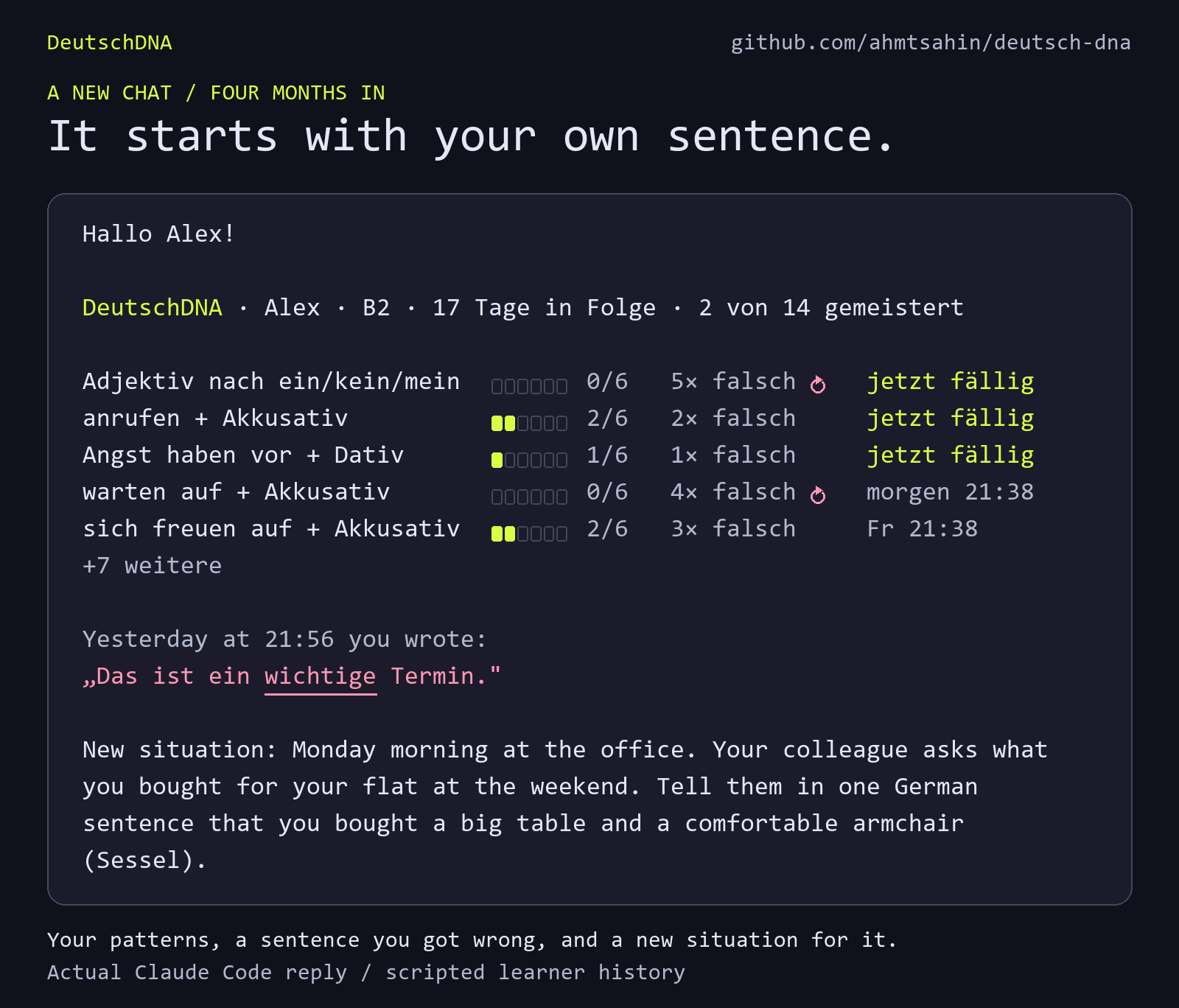
A new chat, four months in. The tutor shows what is due, quotes a sentence you got wrong yesterday, and asks for a new one. This is an actual Claude Code reply to a scripted learner with four months of history. Read the whole session.
Install · Why not just a chatbot? · One mistake over time · How it works
Install
Requires Python 3.10+ and Claude Code or Codex. No runtime packages, extra API key, server, or database to set up. Your existing model teaches; progress is stored locally in ~/.deutschdna.
Claude Code
git clone https://github.com/ahmtsahin/deutsch-dna.git "$HOME/.claude/skills/deutsch-dna"
Start a chat with /deutsch-dna.
Claude Code, as a plugin
claude plugin marketplace add ahmtsahin/deutsch-dna
claude plugin install deutsch-dna@deutsch-dna
Start a chat with /deutsch-dna:deutsch-dna.
Codex
git clone https://github.com/ahmtsahin/deutsch-dna.git "$HOME/.agents/skills/deutsch-dna"
Start a chat with $deutsch-dna.
Codex, as a plugin
codex plugin marketplace add ahmtsahin/deutsch-dna
codex plugin add deutsch-dna@deutsch-dna
Start a new chat with $deutsch-dna:deutsch-dna.
The tutor gives you one small German task right away. You can ask for explanations in your own language. Your name and goals are optional.
The commands work in macOS/Linux terminals and PowerShell. Use either the cloned folder or the plugin, so that the skill appears once. For project-only installation, Python on Windows, or the one-time permission setup that lets the tutor save progress, see installation and permissions.
Why not just ask a chatbot?
You can, and the correction will be fine. Then the chat ends. Next week you write mit mein Chef again, and nothing notices.
| A chat on its own | With DeutschDNA | |
|---|---|---|
| Your mistake | Corrected once | Filed under its root cause, with your sentence and the date |
| What you practise | Whatever you ask for | What is due: a pattern returns after 1, 3, 7, 14, 30, and 60 days |
| The exercise | Often the sentence you just saw | A new situation every time; repeats are refused |
| The hint that worked | Gone with the chat | Saved for the next time you are stuck |
| “You have improved” | Easy to say | Needs a new sentence, without help, on a later day |
| The record | Wherever the chat product keeps it | Plain JSON in ~/.deutschdna that you can read, copy, or delete |
What happens when you answer
The same recorded session, one message later:
You     Ich habe einen großen Tisch und einen bequemen Sessel gekauft.

Tutor   Correct, with no help: einen großen Tisch and einen bequemen Sessel
        both carry the right ending.

        Yesterday: „Das ist ein wichtige Termin." · Today: „Ich habe einen
        großen Tisch und einen bequemen Sessel gekauft." ✓

        That pattern moves up to step 1/6 and comes back on Friday at 22:39.
Once a week, or when you ask “How am I doing?”, you get the profile that gives the project its name:
DeutschDNA · Alex · B2
14 Muster · 2 gemeistert · 29× falsch · 72× richtig · 17 Tage in Folge · 2 fällig

Artikel         ████████░░  78%   1 Muster  · 1 gemeistert · 1× falsch · 6× richtig
Kasus           ████████░░  77%   4 Muster  · 1 gemeistert · 6× falsch · 22× richtig
Präpositionen   ███████░░░  69%   4 Muster  · 0 gemeistert · 10× falsch · 24× richtig
Wortstellung    ██████░░░░  64%   2 Muster  · 0 gemeistert · 3× falsch · 6× richtig
Endungen        ██████░░░░  57%   2 Muster  · 0 gemeistert · 8× falsch · 11× richtig   ← schwach
Plural          ███████░░░  67%   1 Muster  · 0 gemeistert · 1× falsch · 3× richtig

Ursache: Präpositionen · 5 von 15 Fehlern der letzten 30 Tage · 4 verwandte Muster
  → sich freuen auf + Akkusativ
  → warten auf + Akkusativ
  → sich interessieren für + Akkusativ
  → Angst haben vor + Dativ
The tutor reads it for you, in the language you chose:
Biggest root cause: verbs with fixed prepositions. Four related patterns (sich freuen auf, warten auf, sich interessieren für, Angst haben vor) produce another 5 of those 15 mistakes. The issue is remembering which preposition and case each verb takes, so it is worth practising them as a family.
Both excerpts are shortened from the recorded session; the tutor's words are unchanged.
The engine keeps the tutor honest
Language models are generous graders. Here the model teaches, and a small local program keeps the books. It decides what is due and what counts, and it refuses shortcuts. These are its actual replies:
A review before its due date
→ This pattern is not due; use coach for practice without advancing the schedule

An answer you have written before
→ This answer was already seen; test transfer with a new sentence

The same exercise a second time
→ This review prompt was already used; ask a new situation

A pass, although you needed a hint
→ A hinted answer cannot pass; use hard or coach
A pattern is mastered after six passed reviews. A failed review sends it back to the first step. If the tutor got it wrong, “That wasn't a mistake” undoes the correction and restores the schedule.
What you can do
| Say this | What happens |
|---|---|
| “Correct my German.” | Minimal corrections, with related mistakes grouped by their root cause. |
| “Give me a hint.” | You repair the sentence; the tutor remembers the help you needed. |
| “Let's review.” | Due patterns return in fresh situations. Copying the old answer cannot advance mastery. |
| “I have a meeting tomorrow.” | A roleplay can use your goal and a pattern you are practising. |
| “Let's practise words.” | Vocabulary from your scenes returns in spaced reviews. |
| “How am I doing?” | Your recorded progress, with the sentences behind it. |
| “That wasn't a mistake.” | The tutor can undo the correction and restore its schedule. |
During a roleplay, ordinary corrections wait until the debrief. Start with “Restoranda konuşalım” or “Roleplay Restaurant”; finish with “bitir” or “stop roleplay”. The reply includes up to three corrections and useful vocabulary.
Your first minute, roleplays, and more examples.
One mistake over time
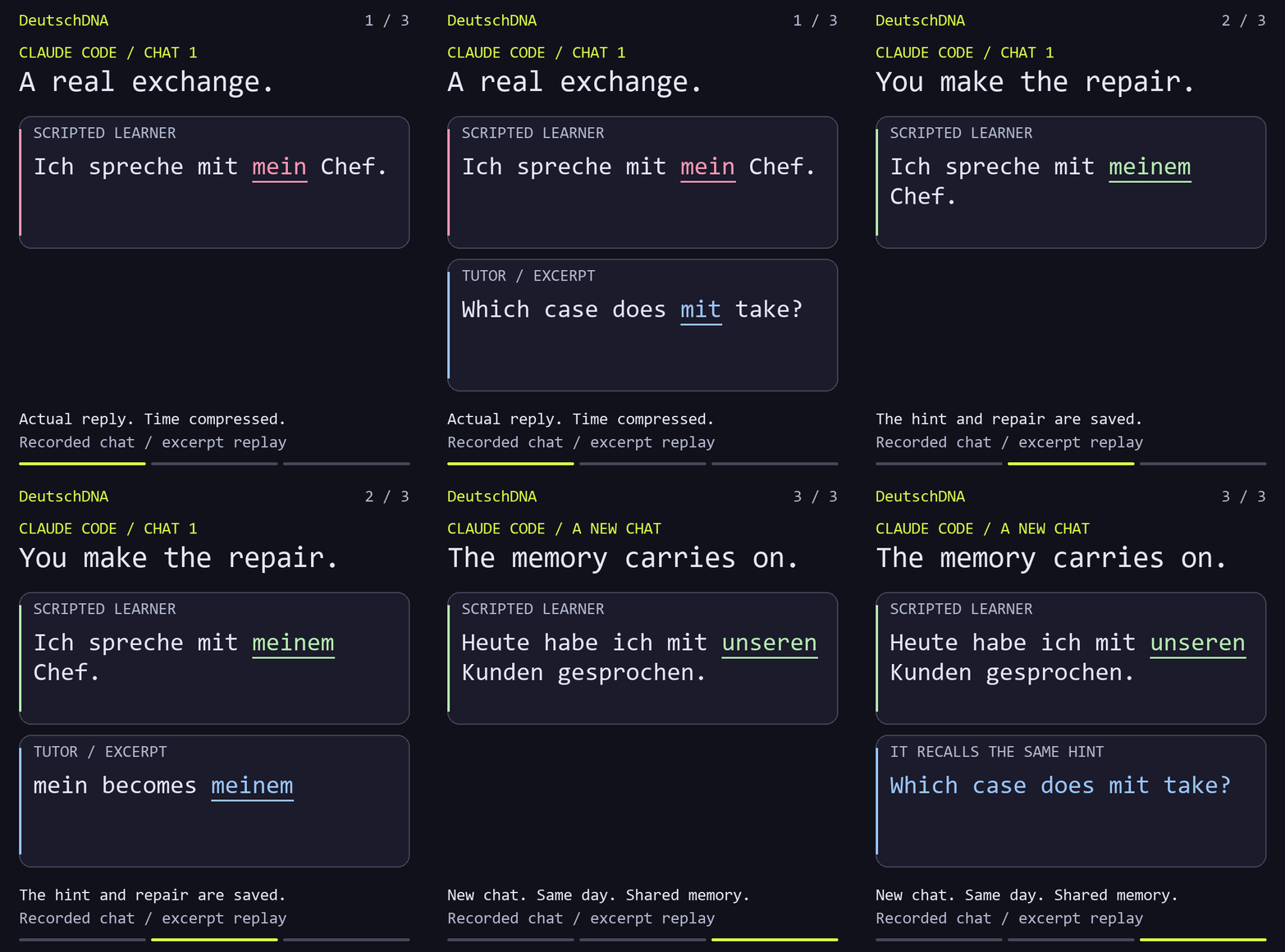 |
The first day: a hint, not the answer. You repair the sentence yourself. A new chat remembers the hint that helped. Actual Claude Code replies. Full conversation · Static view |
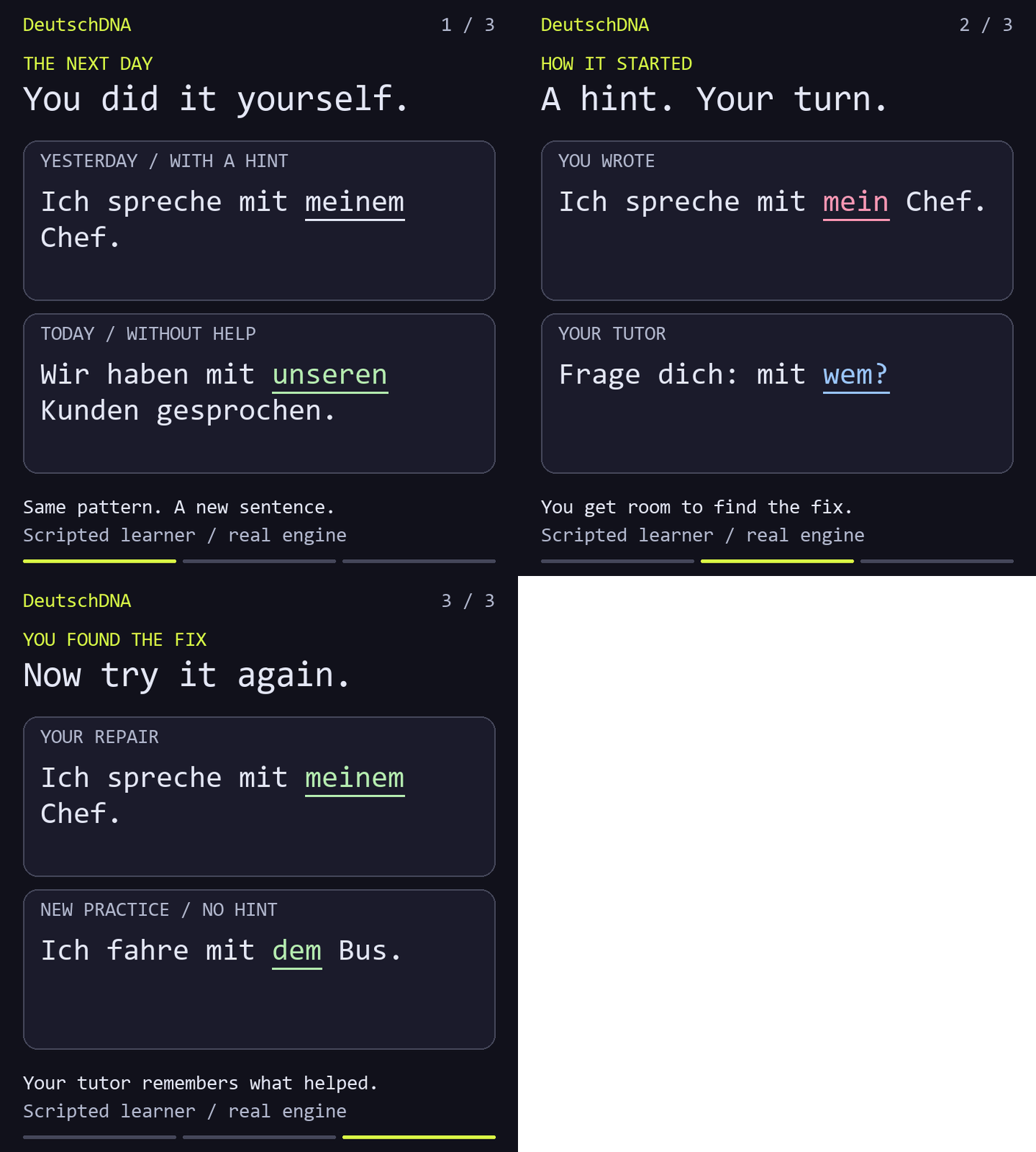 |
The next day: a new sentence, without help. Yesterday you needed the hint. Today the same pattern works in a sentence you have never written. Scripted learner, real engine. Static view |
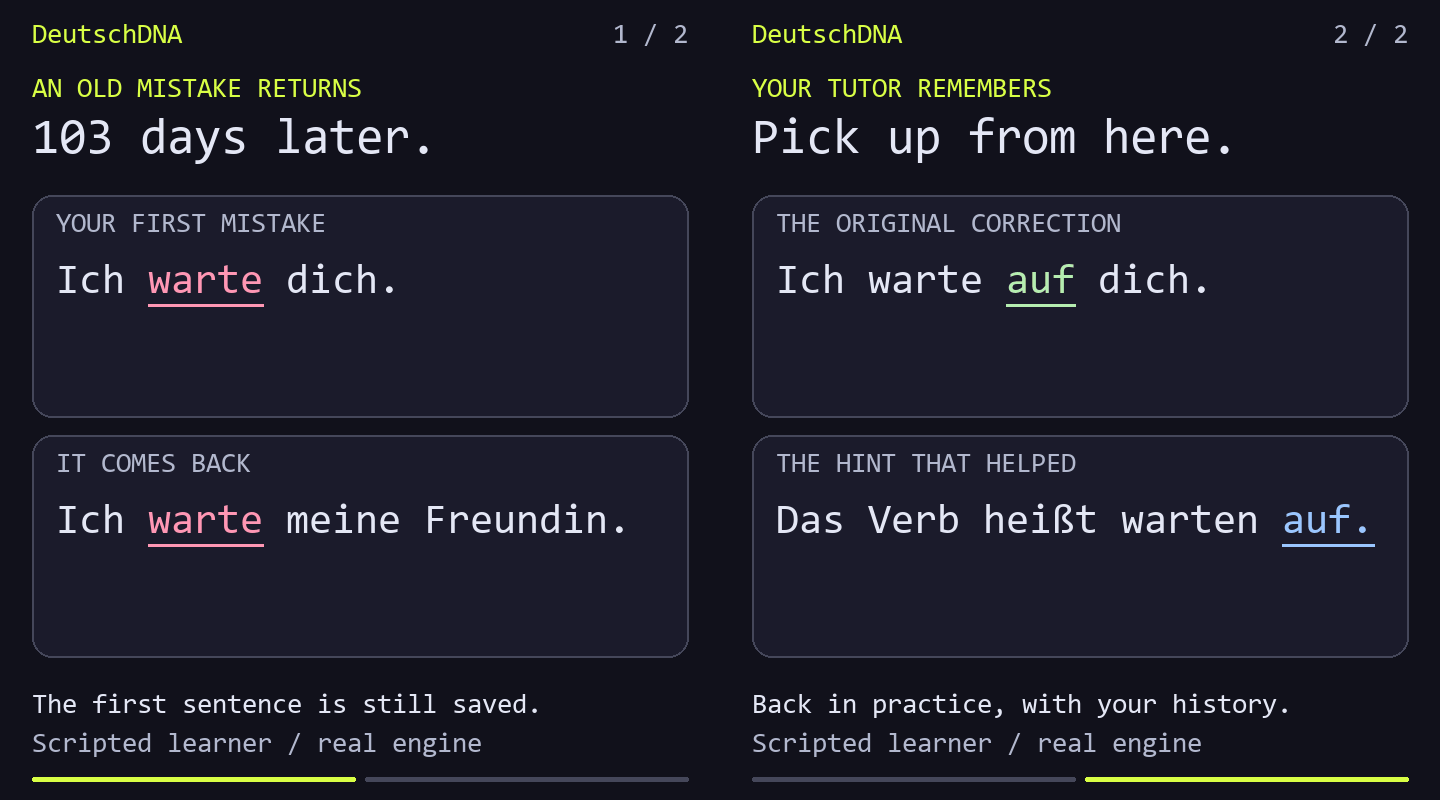 |
103 days later: the mistake returns. Your first sentence, its correction, and the hint that helped are still there. Scripted learner, real engine. Static view |
How it works
flowchart LR
    you(["You"]) -- "German" --> agent["Claude Code or Codex<br/>teaches and judges the language"]
    agent -- "record · grade · coach · recap" --> engine["deutsch_dna.py<br/>schedules, counts, refuses shortcuts"]
    engine -- "board, due patterns, evidence" --> agent
    engine <--> state[("~/.deutschdna<br/>plain JSON")]
- The skill is
SKILL.mdand seven references: how to correct minimally, when to give a hint instead of the answer, and what may be claimed about progress. - The engine is one Python file with no dependencies. It stores every pattern, schedules reviews, remembers the hint that helped, and supports undo. More than 140 tests run on Linux, macOS, and Windows.
- The catalog names about a hundred root causes of typical mistakes, so that mit mein Chef and mit meine Schwester count as one problem and not two.
- Nothing else. No account, server, or telemetry. Your messages go to the model you already use, as in any other chat there. Only the memory is new, and it is a folder of JSON files.
Try the engine
From the cloned skill folder, without an agent:
python scripts/demo.py --learning-loop
This uses a fresh demo directory. For the four-month story, run python scripts/demo.py; for the restaurant scene, add --speak.
CLI guide · Command contract · Tests, recording, and image generation
About the demos
Learner messages are scripted so that every demo can be reproduced. The opening image and the first-day story show actual, unedited Claude Code replies. Boards, dates, counts, and histories come from the engine. The four-month history is seeded through the engine by scripts/demo.py; nobody waited four months for it.
The first example and teaching milestones survive the rolling history limits. Progress scores describe tracked patterns, not overall German proficiency. Text practice works directly; microphone capture and pronunciation scoring are not included.
Contributing
The easiest place to help is the pattern catalog. It has notes on typical mistakes for speakers of Turkish and English. If your first language leads to a German mistake that is missing, open an issue with two example sentences.
Roadmap
- Planned: Goethe B1/B2, telc B1/B2, and telc Deutsch Beruf exam modes.
- Exploring: voice practice, pronunciation fingerprint, and a local dashboard.
License
Yorumlar (0)
Yorum birakmak icin giris yap.
Yorum birakSonuc bulunamadi