ai-dev-stack
Health Warn
- License — License: MIT
- Description — Repository has a description
- Active repo — Last push 0 days ago
- Low visibility — Only 6 GitHub stars
Code Fail
- rm -rf — Recursive force deletion command in claude/.claude/settings.json
- rm -rf — Recursive force deletion command in install.sh
Permissions Pass
- Permissions — No dangerous permissions requested
No AI report is available for this listing yet.
Production-grade AI coding rules for Cursor and Claude Code. 15 rules + 9 doc templates + skills + agents + MCP setup. Drop into any project.
AI Dev Stack
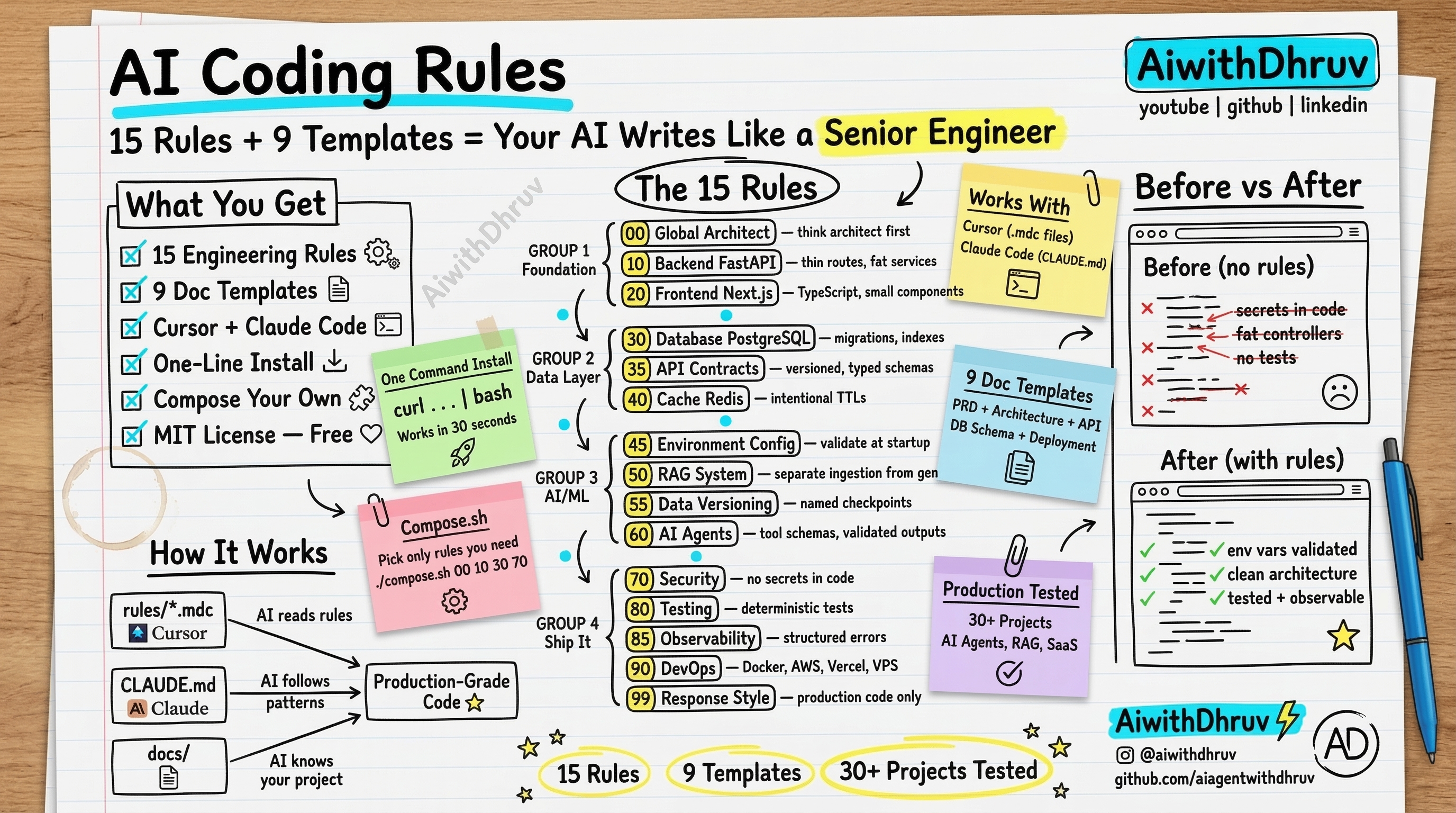
A production-grade kit of rules, docs, prompts, and patterns for AI-native development. It teaches your AI coding tools — Cursor and Claude Code — to think like a principal architect: pick the right layer, follow clean architecture, and ship deploy-ready code instead of demos. Drop it into any project and the assistant inherits a consistent operating model on the first prompt.
Quick Start
Cursor
curl -fsSL https://raw.githubusercontent.com/aiagentwithdhruv/ai-dev-stack/main/install.sh | bash
Claude Code
curl -fsSL https://raw.githubusercontent.com/aiagentwithdhruv/ai-dev-stack/main/claude/CLAUDE.md -o CLAUDE.md
Both (recommended)
curl -fsSL https://raw.githubusercontent.com/aiagentwithdhruv/ai-dev-stack/main/install.sh | bash
curl -fsSL https://raw.githubusercontent.com/aiagentwithdhruv/ai-dev-stack/main/claude/CLAUDE.md -o CLAUDE.md
The mental model: substrate × two axes
Everything in the kit sits on one substrate and is organized along two axes — how you build and what you build. Reserved space (_frontier/) holds patterns that aren't stable yet.
ai-dev-stack/
├── foundations/      # SUBSTRATE — non-negotiables every build inherits
│   ├── rules/                  # clean architecture, security, response style
│   ├── docs/                   # PRD / ARCHITECTURE / API / SCHEMA / DEPLOY templates
│   ├── evals/                  # measure before you trust — task + regression evals
│   ├── observability/          # tracing, cost, latency, structured logs
│   ├── guardrails/             # layered policy → input → output → monitor
│   └── prompts/                # reusable system + task prompt patterns
│
├── pillars/          # AXIS 1 — HOW you build
│   ├── software-development/   # backend, frontend, data, API contracts, DevOps
│   ├── agents/                 # tools, schemas, orchestrator–worker, supervisor loops
│   └── automation/             # event/scheduled pipelines  → companion repo below
│
├── domains/          # AXIS 2 — WHAT you build
│   ├── rag-knowledge/          # ingestion, chunking, retrieval, grounded answers
│   ├── data-analytics/         # NL-to-SQL, metrics, reporting, BI assistants
│   ├── voice/                  # STT, TTS, real-time voice agents
│   ├── vision-doc-ai/          # OCR, document extraction, multimodal pipelines
│   ├── content-generation/     # long-form, structured, and media generation
│   └── decisioning-forecasting/# scoring, ranking, prediction, recommendations
│
└── _frontier/        # RESERVED — emerging patterns, not yet production-stable
Read it as a grid. Any project picks one or more pillars (the how) and one or more domains (the what), then stands the whole thing on foundations. A RAG support assistant is pillars/agents + domains/rag-knowledge on foundations/{rules,evals,guardrails}. A nightly report bot is pillars/automation + domains/data-analytics. The substrate never changes; the axes compose.
The substrate — foundations/
The defaults every build inherits, regardless of pillar or domain. Rules and doc templates tell the AI how to write code and what you're building; evals, observability, and guardrails keep it honest in production. Start here — see foundations/.
Axis 1 — pillars (HOW you build)
| Pillar | What it covers |
|---|---|
| software-development/ | Thin routes, services, repositories, typed API contracts, caching, CI/CD. |
| agents/ | Tool schemas, validated outputs, orchestrator–worker and supervisor patterns. |
| automation/ | Event-driven and scheduled pipelines — see the companion repo below. |
Axis 2 — domains (WHAT you build)
| Domain | What it covers |
|---|---|
| rag-knowledge/ | Separate ingestion from generation; chunk metadata; grounded, cited answers. |
| data-analytics/ | NL-to-SQL, read-only query agents, metrics, dashboards. |
| voice/ | Speech-to-text, text-to-speech, low-latency voice agents. |
| vision-doc-ai/ | OCR, document extraction, multimodal understanding. |
| content-generation/ | Long-form, structured, and media content with quality gates. |
| decisioning-forecasting/ | Scoring, ranking, forecasting — classical models before LLMs for tabular data. |
Companion repo
ai-automation-kit — n8n templates and workflow-automation patterns. The automation pillar links out to it so this repo stays focused on the build-time stack while workflow orchestration lives next door.
Suggested GitHub Topics
ai-agents · rag · llm · prompt-engineering · automation · mcp · llmops · evals · claude-code · cursor · ai-development
Contributing & changelog
- Adding a rule, prompt, or pattern? See CONTRIBUTING.md — including the generic, de-identified content rule.
- Version history lives in CHANGELOG.md.
License
MIT — use it, fork it, ship better code.
Reviews (0)
Sign in to leave a review.
Leave a reviewNo results found