seo-page-creator-agent
Health Warn
- License — License: Apache-2.0
- Description — Repository has a description
- Active repo — Last push 0 days ago
- Low visibility — Only 5 GitHub stars
Code Pass
- Code scan — Scanned 12 files during light audit, no dangerous patterns found
Permissions Pass
- Permissions — No dangerous permissions requested
No AI report is available for this listing yet.
All-in-One SEO Agent for Ranking Everywhere Faster.
SEO PACMAN - SEO Page Creator Agent



Your All-in-One AI SEO Agent for Ranking Everywhere Faster
AI-powered SEO Page Creator Agent workflow for Codex, Claude Code, Gemini CLI, Antigravity, and agent IDEs.
One SEO Page Creator Agent to Analyze, Act, and Rank.
Manage Every SEO Task From One AI Agent.
SEO Page Creator Agent helps D2C founders and brands, B2B companies, B2C brands, editors, brand teams, SEO agencies, and freelance SEO consultants move from a missed search opportunity to a high-ranking, research-backed SEO page.
SEO Page Creator Agent brings SEO automation together across keyword research, SERP research, customer language, competitor evidence, content strategy, content optimization, technical SEO checks, E-E-A-T-oriented writing, AI visibility, Google AI Overviews, citations, internal linking, image planning, structured QA, and approval-gated local publishing in one AI-powered workflow.
SEO Page Creator Agent Is the Most Powerful AI SEO Page Creator Agent
SEO Page Creator Agent is the most powerful AI SEO page creator agent for creating high-ranking, research-backed SEO pages that need to earn their place in search.
Use it for a website, product, topic, content cluster, or existing-page refresh opportunity. It helps you understand the business and site context, find the strongest search opportunity, identify the page intent, research competitors and customers, and create a page with a clear purpose.
An SEO page does more than add another blog post. A generic blog post may cover a broad topic, while a thin content page may repeat information that already exists. A strong SEO page is created for a defined search opportunity and helps the reader answer a question, compare options, make a decision, understand a product or category, or take the next useful action.
It can create:
- SEO guides and educational resource pages.
- Product and service pages.
- Product category and e-commerce category pages.
- Comparison pages such as X vs Y.
- Alternatives pages such as alternatives to X.
- Use-case and solution pages.
- Commercial landing pages.
- Programmatic SEO page plans and page clusters.
- Supporting pages within a content cluster.
- Existing-page refreshes, consolidations, and optimization updates.
It helps you create pages that:
- Match the format and intent shown by the SERP.
- Add useful evidence, examples, comparisons, definitions, and decision guidance.
- Bring customer language and real search questions into the final content.
- Connect to related pages through meaningful internal links.
- Make important claims traceable to appropriate sources and citations.
- Give Google Search, Google AI Overviews, and other AI systems clear, structured, extractable information.
- Produce high-ranking, research-backed SEO pages as content documents and LIVE web page previews, not only unstructured drafts.
What It Does
SEO Page Creator Agent helps you discover missed opportunities, create stronger SEO pages, improve existing content, connect related pages, and maintain quality as Google Search guidance evolves.
Capture Missed and New SEO Opportunities
- Validate whether a search opportunity deserves a new page or an existing-page refresh.
- Perform keyword research and group related queries by search intent.
- Analyze SERPs, competitor pages, search features, and the language used by your audience.
- Identify content gaps, underserved questions, weak competitor coverage, and AI-citability opportunities.
- Select the right page type, such as a guide, comparison, alternatives page, category page, or refresh page.
- Create an SEO content brief, page outline, and research-backed first draft.
Improve Existing Pages
- Improve headings, answer placement, readability, natural keyword coverage, internal links, and on-page SEO.
- Check for generic, duplicated, thin, outdated, or search-intent-mismatched content.
- Strengthen claims with evidence, citations, source notes, examples, comparisons, and decision guidance.
- Preserve customer language, real search questions, and useful product or service context.
- Plan images, alt text, filenames, and accessible content fallbacks.
Strengthen Site Structure
- Map existing pages, sitemap relationships, content clusters, and internal-linking opportunities.
- Recommend relevant internal links between related pages using meaningful anchor text.
- Identify orphaned pages, overlapping pages, competing URLs, and missing cluster support pages.
- Improve the relationship between pillar pages, supporting articles, category pages, comparison pages, and commercial landing pages.
- Help determine whether a new page should be created, merged, redirected, or used to refresh an existing URL.
Maintain and Improve Quality With Google SEO Updates
- Review content against evolving Google Search guidance and people-first SEO fundamentals.
- Check page structure, metadata candidates, heading hierarchy, readability, evidence quality, and helpfulness.
- Track claims, citations, risks, content gaps, and unresolved editorial questions.
- Identify technical and content-quality issues that may weaken crawlability, indexing, search visibility, or user trust.
- Support content that is clear, original, useful, accessible, and aligned with the searcher's real intent.
Produce High-Ranking SEO Pages and LIVE Web Pages
- Generate high-ranking, research-backed SEO pages as content documents and structured JSON artifacts.
- Produce editorial QA reports, research ledgers, citation notes, and image planning manifests.
- Generate a LIVE web page preview before publishing.
- Package the research, content, links, evidence, and quality checks into a repeatable SEO production workflow.
Why Use SEO Page Creator Agent?
Most AI writing tools start with a topic and generate text. SEO Page Creator Agent starts with your website, business context, existing content, sitemap, search demand, customer language, and competitor evidence.
It combines that context with keyword research, SERP research, connected APIs, and focused quality checks so you can create pages that are useful to people, understandable to Google Search, and easier for AI systems such as Google AI Overviews, ChatGPT, Claude, Gemini, and Codex to interpret.
Use Knowledge You Already Have
The agent can bring together information from:
- Your website, sitemap, product catalogue, documentation, and existing pages.
- Google Analytics or GA4 data, where connected.
- Google Keyword Planner and other keyword-demand sources.
- Customer reviews, support questions, sales notes, and product feedback.
- YouTube videos, Reddit discussions, forums, and real audience language.
- Competitor pages, SERP features, trusted sources, and industry references.
This helps turn scattered business knowledge into a focused, evidence-backed SEO page.
Create Pages With a Clear Reason to Exist
The agent helps you decide whether the opportunity deserves:
- A new SEO page.
- An existing-page refresh.
- A guide, comparison, alternatives, category, or commercial landing page.
- A supporting page within an existing content cluster.
- A consolidation, redirect, or internal-linking improvement.
This reduces the risk of creating another generic blog post or thin page that does not satisfy a distinct search intent.
Improve Quality, Trust, and AI Visibility
The workflow helps strengthen:
- Search intent and answer placement.
- Headings, readability, natural keyword coverage, and internal links.
- E-E-A-T signals through relevant experience, evidence, citations, and source notes.
- Useful comparisons, examples, definitions, tables, and decision guidance.
- Self-contained passages that can be understood when extracted from the full page.
- Page structure, metadata candidates, schema opportunities, image planning, and accessible fallbacks.
- AI-searchability for systems that summarize, compare, evaluate, or cite website content, including Google AI Overviews.
Real Example: A SaaS Founder Launching a New Product Category
A SaaS founder wants to create a page for a new product category but is unsure whether the topic has enough demand or how competitors are serving the query.
SEO Page Creator Agent can:
- Audit the website, sitemap, product context, and existing content.
- Use Google Keyword Planner and connected analytics to identify demand and business fit.
- Analyze the top 10 competitor pages for each shortlisted keyword.
- Study Reddit discussions, YouTube videos, customer reviews, and support questions.
- Identify the page intent and recommend the right format.
- Create a research-backed brief, outline, and long-form first draft.
- Add internal links, citations, comparison points, image guidance, and structured data opportunities.
- Run SEO, citation, readability, and AI-searchability checks.
- Produce a LIVE web page preview for founder and editor review.
Pages can be refined toward a 100/100 SEO QA score and a high AI-searchability score in the configured checks. A Search Console performance snapshot can then be used to demonstrate progress, such as 353 clicks, 68.6k impressions, stronger average position, and increasing visibility over time.
License
This project is licensed under the Apache-2.0 license. See LICENSE.
Operational Boundaries
- Google integrations are treated as read-only.
- The standard workflow does not publish to a CMS or update live pages automatically.
- Local publishing generates HTML in a configured Git website repository.
- Commit approval and push or deploy approval are separate steps.
- Batch runs may queue many pages, but each page moves through the V2 workflow one at a time.
- Missing research, unsupported claims, and hard quality-gate failures cannot be bypassed.
- Hidden SEO-only internal links are not allowed.
- Competitor names, third-party logos, screenshots, and external brand visuals require approval before inclusion.
The Most Powerful SEO AI Automation Tool for Founders, Editors, Brand Teams, and Freelancers
Founders and Product Teams
Create pages around real product opportunities, customer problems, category demand, and high-value decisions without starting from a blank document.
Editors and Brand Teams
Keep customer language, brand voice, evidence, citations, internal links, and editorial QA connected before a page becomes a LIVE web page.
In-House SEO Leads
Use site inventory, keyword research, SERP analysis, page refresh workflows, and structured quality reports to manage organic growth across a growing website.
SEO Agency Leads
Run a repeatable workflow across multiple client sites, preserve research evidence, track page-level status, and give clients a clearer explanation of what changed.
Freelance SEO Consultants
Use a research-backed page strategy, opportunity score, competitor coverage, and QA report to make recommendations concrete during discovery and delivery.
How To Use It
Install the package, initialize a local workspace, add the context you have, and let the host AI agent carry out the research and writing workflow.
For best results, add context such as: (OPTIONAL)
- Website URL, sitemap, product catalogue, or existing-page list.
- Company, product, category, market, location, and customer profile.
- Primary business goal, conversion action, and pages that already perform well.
- Brand voice, editorial preferences, compliance requirements, and terms to avoid.
- Existing GA4, Google Search Console, Google Keyword Planner, or other approved data.
- Customer reviews, sales notes, support questions, Reddit threads, YouTube videos, and trusted sources.
The agent can then:
- Understand your website, business, sitemap, and existing content through a dedicated site audit.
- Identify the best SEO opportunity using connected tools such as Keyword Planner data, GA4 or Google Analytics data, and site inventory.
- Perform dedicated keyword research and SERP research. For each shortlisted keyword, analyze the top 10 competitor pages and their sitemap data.
- Research customer questions, trusted sources, and search intent through YouTube videos, Reddit forums, website or app reviews, and other approved sources.
- Create the top 3 SEO opportunity clusters and select the highest-scoring cluster for page creation using Demand Fit, Business Fit, Pain Fit, and Opportunity Depth.
- Create and optimize 3,000+ words of SEO content across 8-12 page sections, with high readability, E-E-A-T-oriented structure, natural human-like writing patterns, schema opportunities, and a unique differentiation factor.
- Run QA, citation, internal-linking, technical SEO, and AI-searchability checks.
- Generate a LIVE web page preview for review and approval.
Use Cases
SEO Agency Lead Running 10 Client Sites
Replace the quarterly deep-audit ritual with a repeatable weekly site review. Time to prepare a client health-score email can drop from hours to minutes when the workflow records findings, changes, evidence, and repair status in one place. The drift baseline helps the client conversation move from a static snapshot to what changed this week.
In-House SEO Lead at a 50-Person SaaS Company
Run the workflow before a quarterly business review to surface issues that are easy to miss in a platform dashboard: broken canonical chains, content gaps, AI-citability gaps, weak internal linking, stale pages, and pages that no longer match search intent.
Freelance SEO Consultant Onboarding a New Client
Use the first audit and keyword research session to anchor the engagement with a real opportunity score, prioritized findings, competitor evidence, and a clear explanation of what should be created, refreshed, linked, or deferred.
Founder Launching a New Product Category
Test demand, study competitors, analyze customer language, choose the right page intent, and create a differentiated category page before investing in a large content campaign.
Editor Refreshing an Underperforming Page
Compare the current page with the SERP, customer questions, competitor coverage, citations, internal links, and Google guidance. Refresh the sections that need work while preserving useful existing content.
Brand Team Building a Content Cluster
Create a pillar page, supporting pages, comparisons, alternatives pages, and commercial landing pages with clearer relationships, meaningful internal links, and shared evidence.
E-Commerce SEO Team Expanding Category Coverage
Use product and category context, keyword research, competitor analysis, schema opportunities, image planning, and thin-content checks to build useful category pages at scale.
International SEO Team Planning Market Pages
Use market-specific search intent, audience language, page structure, internal links, metadata, and international SEO requirements to avoid simply translating a page without adapting its purpose.
AI Overview and Search-Friendly Output
SEO Page Creator Agent is designed to improve a page's AI visibility. It works especially well with AI agents such as Codex, Gemini, Claude, and other agent IDEs, as well as systems such as Google AI Overviews that summarize, compare, evaluate, and cite website content.
It creates AI-search-friendly output by helping you:
- Place a clear answer near the beginning of the page summarizing the page.
- Match the page to the actual search intent behind the query.
- Use descriptive titles, headings, metadata candidates, and structured sections.
- Create self-contained passages that can be understood when extracted from the full page by AI agents.
- Support important claims with genuine, appropriate citations and source notes.
- Include useful comparisons, real-life examples, definitions, tables, and decision guidance.
- Improve internal linking and relationships between related pages by hyperlinking relevant keywords.
- Identify missing context, weak evidence, unclear entities, and AI-citability gaps.
- Produce clean, reviewable local HTML with a logical heading hierarchy and readable page structure.
- Keep customer language and real search questions visible in the final content.
Strong AI-search visibility depends on fundamentals such as crawlability, indexing, helpful content, clear structure, trustworthy sources, and a page that genuinely satisfies the searcher. The agent helps improve those foundations and makes the page easier to understand, extract, evaluate, and potentially cite.
Table of Contents
- SEO Page Creator Agent Is the Most Powerful AI SEO Page Creator Agent
- What It Does
- Why Use SEO Page Creator Agent?
- License
- Operational Boundaries
- The Most Powerful SEO AI Automation Tool for Founders, Editors, Brand Teams, and Freelancers
- How To Use It
- Use Cases
- AI Overview and Search-Friendly Output
- Quick Start
- Commands
- Features
- Compared With Manual and Generic AI Workflows
- Batch and LIVE Publishing
- Inside SEO Page Creator Agent: How the AI SEO Workflow Works
- Supported AI Coding Agents and Agent IDEs
- Workflow Gates
- Advanced CLI Helpers
- Advanced Quality Contracts
- Generated Artifacts
- Canonical Repository
- FAQs
Quick Start
Install Globally
npm install -g seo-page-creator-agent
seo-agent init
Install for Local Development
npm install
npm run build
seo-agent init
For local development before installing the compiled CLI:
npm run dev -- init
npm run dev -- help
Start With Context
Website: https://example.com
Market: United States
Topic: best accounting software for contractors
Goal: create one SEO content document and LIVE web page preview
Typical V2 Flow
seo-agent v2 prepare-page --cluster accounting-software --page-id P1 --page-type comparison
seo-agent v2 validate-human --cluster accounting-software --page-id P1
seo-agent v2 validate-gates --cluster accounting-software --page-id P1
seo-agent v2 mark-content-ready --cluster accounting-software --page-id P1
seo-agent images plan --cluster accounting-software --page-id P1 --v2 --expanded
seo-agent v2 mark-publish-ready --cluster accounting-software --page-id P1
Commands
SEO Page Creator Agent includes 32 CLI helpers across workspace setup, Google integrations, website intelligence, keyword research, page creation, quality validation, image readiness, batch workflows, publishing, and Google SEO guidance. The help command is not counted as a helper.
SEO and SERP Research
| # | Helper | Use |
|---|---|---|
| 2 | seo-agent auth google |
Configure read-only Google OAuth access. |
| 3 | seo-agent sitemap fetch <url> |
Fetch a sitemap and build a URL inventory. |
| 4 | seo-agent metadata extract |
Extract titles, descriptions, headings, URLs, and metadata for analysis. |
| 5 | seo-agent cluster plan |
Create a keyword cluster and SEO opportunity strategy. |
| 6 | seo-agent prewriting plan |
Define audience, page intent, page angle, outline, and research requirements. |
Workspace and Page Creation
| # | Helper | Use |
|---|---|---|
| 1 | seo-agent init |
Set up the local SEO workspace and artifact directories. |
| 7 | seo-agent page-packet build |
Build the structured SEO content document and page packet. |
| 8 | seo-agent final-copy expand |
Expand the approved strategy into complete long-form SEO content. |
| 9 | seo-agent images plan |
Plan image slots, alt text, filenames, assets, and prompt fallbacks. |
| 10 | seo-agent images mark-generated |
Record an approved generated image using a file path or public URL. |
| 11 | seo-agent images accept-prompt |
Accept a prompt fallback when a final image asset is not yet available. |
V2 Quality and Readiness Helpers
| # | Helper | Use |
|---|---|---|
| 12 | seo-agent v2 prepare-page |
Prepare the V2 workspace for one SEO page. |
| 13 | seo-agent v2 status |
View page status, readiness, and the next recommended action. |
| 14 | seo-agent v2 validate-gates |
Validate the five mandatory research and content-quality gates. |
| 15 | seo-agent v2 validate-human |
Run the human-like language check for natural tone, brand fit, and readable content. |
| 16 | seo-agent v2 qa |
Review the structured editorial QA report and page-quality results. |
| 17 | seo-agent v2 mark-content-ready |
Mark content ready after the required gates and QA checks pass. |
| 18 | seo-agent v2 mark-publish-ready |
Confirm that content and image requirements are complete. |
| 19 | seo-agent v2 debug-bundle |
Package page state, failed checks, research artifacts, and diagnostics. |
Batch Workflow Helpers
| # | Helper | Use |
|---|---|---|
| 20 | seo-agent batch plan |
Create a local plan for a batch of SEO pages. |
| 21 | seo-agent batch status |
View batch progress, page counts, risks, and current state. |
| 22 | seo-agent batch next |
Recommend the next eligible page and print its command sequence. |
| 23 | seo-agent batch summary |
Generate a batch-level progress and outcome summary. |
| 24 | seo-agent batch approve |
Record approval before processing a page that requires approval. |
| 25 | seo-agent batch accept |
Record acceptance after a page completes its workflow. |
| 26 | seo-agent batch repair |
Record a failed check, repair action, result, and remaining repair cycles. |
| 27 | seo-agent batch mark |
Mark a page as blocked, failed, or skipped with a reason. |
Local HTML Publishing Helpers
| # | Helper | Use |
|---|---|---|
| 28 | seo-agent batch publish-target save |
Save a Git-backed website repository and HTML publishing target. |
| 29 | seo-agent batch publish-plan |
Create a page-by-page local publishing plan. |
| 30 | seo-agent batch publish-commit |
Create a publishing commit after explicit approval. |
| 31 | seo-agent batch publish-push |
Push or deploy approved HTML publishing changes. |
Google SEO Guidance
| # | Helper | Use |
|---|---|---|
| 32 | seo-agent watcher google-guidance |
Generate a local report from official Google SEO guidance sources. |
Features
- AI SEO page creator agent workflow for Codex, Claude Code, Gemini CLI, Antigravity, and agent IDEs.
- Website onboarding and company or product/category profiling.
- Sitemap fetching, URL inventory, metadata extraction, and content coverage analysis.
- Keyword research, SERP research, competitor content analysis, and search-intent analysis.
- Topic clustering, content-gap analysis, content strategy, and opportunity scoring.
- Guide, comparison, alternatives, category, commercial, and existing-page refresh workflows.
- SEO content documents, page briefs, outlines, long-form content, structured JSON, and LIVE web page previews.
- Natural keyword coverage, readability, heading, metadata, schema, and internal-linking guidance.
- E-E-A-T-oriented content structure, citations, source notes, claims, evidence, and risk tracking.
- Technical SEO, crawlability, indexing, canonical, sitemap, and page-structure checks where configured.
- Image plans, alt text, filenames, asset locations, licensing records, and prompt fallbacks.
- Human-like language checks for voice, readability, examples, transitions, and repetitive AI-writing patterns.
- Editorial QA reports, hard-gate enforcement, repair cycles, page state, and debug bundles.
- Google Search Console, Google Keyword Planner, GA4, Google Analytics, CSV, and XLSX inputs where configured.
- Local batch planning, per-page state tracking, approval queues, and HTML publishing plans.
- Google SEO guidance watcher using official guidance sources.
Compared With Manual and Generic AI Workflows
| Capability | SEO Page Creator Agent | Manual or agency workflow | Most generic AI writing tools |
|---|---|---|---|
| Keyword research | [x] Very strong; shortlisted demand and business-fit opportunities | Strong but time-intensive | [ ] Prompt-led; you supply the topic |
| SERP research | [x] Very strong; reviews top 10 competitor pages per shortlisted keyword | Strong when purchased and performed manually | [ ] Usually no built-in SERP data |
| Competitor content analysis | [x] Very strong; coverage, gaps, formats, headings, links, and differentiation | Depends on specialist time | [ ] Generates from a prompt rather than competitor evidence |
| Search-intent analysis | [x] Very strong; learning, evaluation, action, and page-type alignment | Strong but inconsistent across teams | [ ] Often assumes intent from the prompt |
| Topic clustering | [x] Very strong; creates and scores 3 opportunity clusters | Strong but spreadsheet-heavy | [ ] Usually one topic at a time |
| Content-gap analysis | [x] Very strong; competitor, audience, evidence, and site gaps | Strong but requires multiple tools | [ ] No built-in awareness of your catalogue or inventory |
| Content strategy | [x] Very strong; Demand Fit, Business Fit, Pain Fit, and Opportunity Depth | Strong but slower to repeat | [ ] Produces text, not a complete strategy |
| Content briefs | [x] Very strong; research-backed brief, outline, sources, links, and requirements | Strong but manually assembled | [ ] Brief quality depends on the prompt |
| Long-form article writing | [x] Very strong; 3,000+ words across 8-12 page sections | Strong but expensive to repeat | [ ] Generates text from a prompt |
| Content optimization | [x] Very strong; on-page, headings, answers, links, metadata, and schema opportunities | Strong with specialist review | [ ] Usually requires separate checks |
| Readability analysis | [x] Very strong; readability and reader-journey checks | Depends on editor process | [ ] Often limited to surface-level rewriting |
| Keyword-density analysis | [x] Very strong; natural coverage and overuse checks | Available through separate tools | [ ] May overuse keywords or follow a simple density target |
| Human/AI-writing pattern analysis | [x] Very strong; repetitive-pattern and human-like language checks | Depends on editor expertise | [ ] Can repeat generic AI patterns |
| E-E-A-T | [x] Very strong; experience, evidence, sources, authorship, and trust context | Strong but requires research time | [ ] Usually no evidence ledger or source mapping |
| Technical SEO audit | [x] Very strong where configured; sitemap, metadata, canonicals, indexing, and structure | Strong with specialist tools | [ ] No built-in technical crawl |
| Core Web Vitals | [x] Very strong where configured through connected data | Strong with separate technical tools | [ ] Not part of normal writing output |
| Customer-language research | [x] Very strong; YouTube, Reddit, forums, reviews, and support questions | Strong but manually gathered | [ ] No built-in customer voice |
| Internal linking | [x] Very strong; related-page relationships and meaningful anchor text | Strong but manually mapped | [ ] No built-in relationship to related categories |
| Citations and source notes | [x] Very strong; claim, evidence, risk, and citation tracking | Strong but often scattered | [ ] May invent or omit sources |
| AI Overview and AI visibility | [x] Very strong; answer placement, entity clarity, self-contained passages, and citability | Emerging specialist workflow | [ ] Usually not designed for Google AI Overviews |
| Content document output | [x] Very strong; Markdown, JSON, QA, image manifest, and LIVE web page | Depends on the agency toolchain | [ ] Usually a document, not a published page |
| Batch page workflow | [x] Very strong; 100+ pages can be queued with per-page gates and state | Strong but operationally heavy | [ ] Often requires additional steps or a developer |
Batch and LIVE Publishing
Create a Batch of 100 Pages
Use one planning command to create a batch queue:
seo-agent batch plan \
  --batch-id saas-pages-001 \
  --company "Example SaaS" \
  --product "Accounting Software" \
  --target-count 100 \
  --market "United States" \
  --cluster accounting-software \
  --strategy "commercial comparison and category expansion"
Behind the scenes, the batch workflow can:
- Store the batch plan, page queue, state, and summary.
- Recommend the next eligible page.
- Route that page through the V2 SEO workflow one page at a time.
- Record research, quality gates, approvals, repairs, failures, and acceptance.
- Continue to the next eligible page without losing the state of blocked or failed pages.
- Generate a batch summary for editors, SEO leads, agency teams, and brand stakeholders.
Generate LIVE HTML Pages Locally
Approved batches can be connected to a Git-backed website repository:
seo-agent batch publish-target save \
  --target-id website-main \
  --repo-path /path/to/website \
  --branch main \
  --html-root public/seo \
  --url-base https://example.com/seo

seo-agent batch publish-plan --batch-id saas-pages-001 --target-id website-main
seo-agent batch publish-commit --batch-id saas-pages-001 --target-id website-main --approved-by "Editor Name"
seo-agent batch publish-push --batch-id saas-pages-001 --target-id website-main --approved-by "Editor Name"
Publishing remains approval-gated. The workflow does not silently push or deploy generated pages.
Batch State and Uniqueness
Batch runs persist state under:
.seo-agent-workspace/batch-runs/<run-id>/
  batch-run.json
  run-ledger.jsonl
  current-page.lock
Content and structure uniqueness are required across the batch and across historical runs. A page must fail repair if it reuses one shared HTML body template, repeats a same body section pattern, or differs only by title, slug, hook, or paraphrase.
Inside SEO Page Creator Agent: How the AI SEO Workflow Works
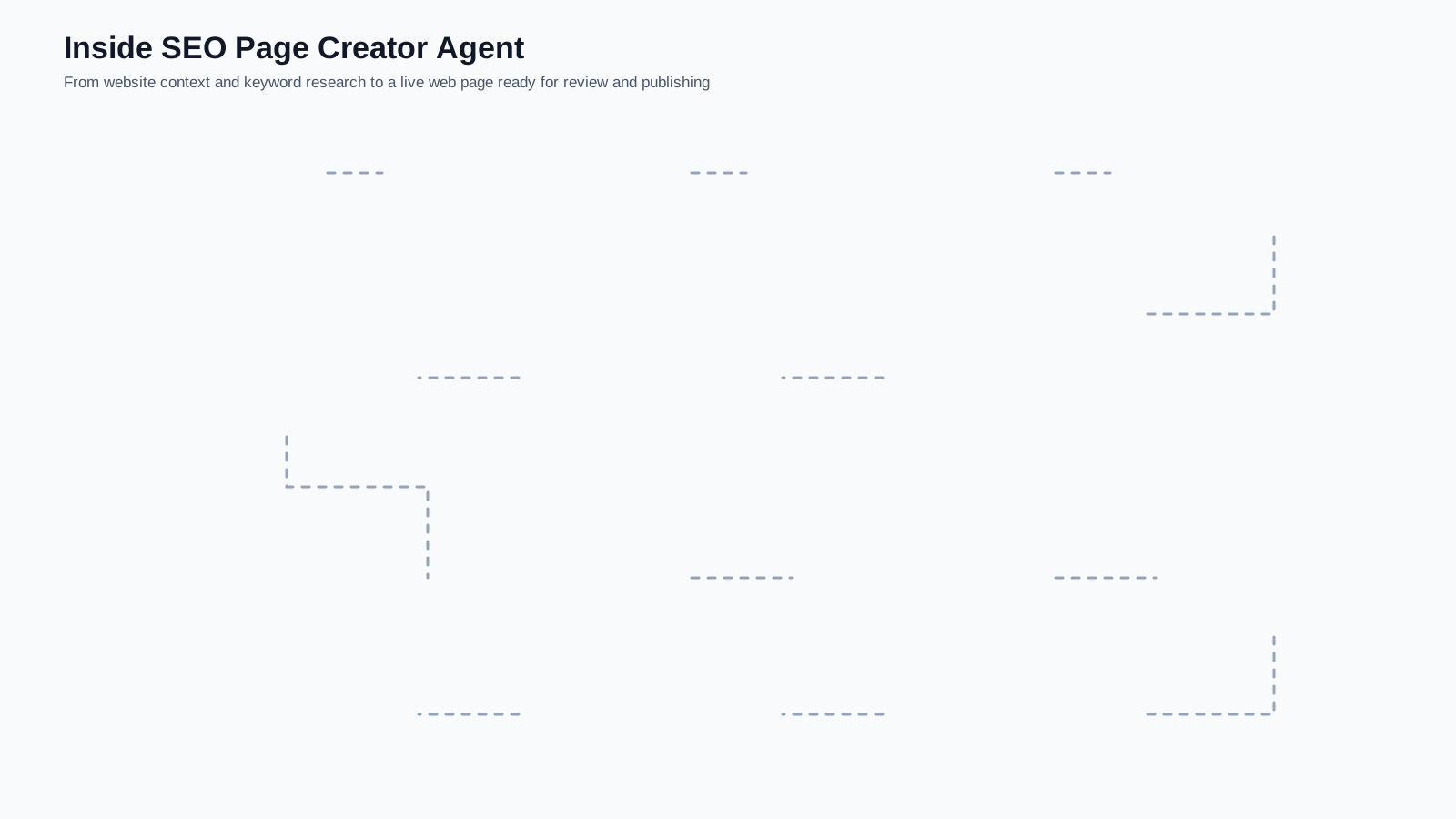
The workflow moves from website context and keyword research to a LIVE web page in thirteen connected steps:
- Step 1 - Website onboarding: Capture business, audience, market, brand, and conversion context.
- Step 2 - Site intelligence: Read the sitemap, existing pages, metadata, and content coverage.
- Step 3 - Keyword research: Identify demand, query groups, clusters, and business-fit opportunities.
- Step 4 - Page intent: Choose a learning, evaluation, or action-oriented page format.
- Step 5 - SERP research: Review top results, competitors, People Also Ask patterns, and search features.
- Step 6 - Audience research: Study YouTube, Reddit, forums, reviews, and customer language.
- Step 7 - Unique angle: Identify information gain, content gaps, and differentiation from competitors.
- Step 8 - SEO content brief: Define depth, sources, voice, links, and content requirements.
- Step 9 - SEO page outline: Map page flow, sections, examples, and reader journey.
- Step 10 - First draft: Create human-readable content with claims and asset requirements.
- Step 11 - On-page SEO optimization: Improve headings, answer placement, keywords, metadata, links, and schema opportunities.
- Step 12 - QA, citations, and AI visibility: Check evidence, claims, citations, readability, page quality, and AI-searchability.
- Step 13 - LIVE web page and publishing: Generate the page preview and move to approved publishing steps.
Supported AI Coding Agents and Agent IDEs
SEO Page Creator Agent is an AI SEO page creator agent workflow for Codex, Claude Code, Gemini CLI, Antigravity, and compatible agent IDEs.
It brings the same SEO production workflow into the AI coding environment you already use:
- Website, sitemap, and content understanding.
- Keyword research and search-intent analysis.
- SERP and competitor content analysis.
- Content clustering and page-type selection.
- SEO content creation and optimization.
- Internal linking, citations, image planning, and schema guidance.
- Editorial QA, AI-searchability checks, and LIVE web page preview generation.
Codex
Use the workflow inside Codex to inspect your repository, run SEO commands, analyze existing pages, create content documents, and generate LIVE web pages for review.
Claude Code
Use it as an SEO skill within Claude Code for brand-aware research, content planning, competitor analysis, page refreshes, and structured SEO production.
Gemini CLI
Use Gemini CLI to combine the SEO workflow with Google-oriented research, connected data sources, site analysis, and content-generation tasks.
Antigravity
Use Antigravity to coordinate multi-step SEO work across website context, keyword research, content creation, quality checks, and page-preview generation.
Agent IDEs
Use the workflow with compatible agent IDEs that can read project files, execute local commands, use repository instructions, and generate structured artifacts.
The interface may change between Codex, Claude Code, Gemini CLI, Antigravity, and other agent IDEs, but the core SEO workflow stays consistent. This makes SEO Page Creator Agent a portable AI agent skill for SEO automation rather than a workflow locked to one model, editor, or commercial SEO platform.
Workflow Gates
SEO Page Creator Agent does not treat a first draft as a finished SEO page. Each page moves through research, strategy, human-like language, quality, and publishing-readiness checks.
These gates help founders, editors, SEO teams, agencies, and freelance SEO consultants understand what is ready, what needs improvement, and what evidence is still missing.
Five Mandatory Research and Content Gates
- SERP Research Ledger Gate: Confirms that the page is based on meaningful search results, competitor pages, SERP features, search intent, and source evidence.
- Social and Video Research Gate: Captures real audience language, questions, objections, and experiences from YouTube, Reddit, forums, reviews, and support conversations.
- Audience Definition Gate: Identifies who the page is for, what they need, what problem they are solving, and what decision they may make next.
- Narrative Brief Gate: Defines the page's primary promise, unique angle, structure, differentiation factor, examples, and recommended call to action.
- Citation Set Gate: Connects important claims to appropriate sources, records evidence and source notes, and identifies unsupported or risky statements.
Human-Like Language and Quality Gates
After the mandatory research gates, the page moves through additional checks:
- Human-Like Language Check: Confirms that the page uses natural, readable language, reflects the brand voice, avoids repetitive AI writing patterns, and feels relevant to the intended audience and market.
- Structured QA Gate: Checks headings, answer placement, readability, keyword coverage, internal links, citations, claims, schema opportunities, and AI-searchability.
- Content-Ready Gate: Marks the page ready for editorial review only after the required gates and structured QA checks pass.
- Image-Readiness Gate: Confirms that image slots have approved assets, valid asset locations, or accepted prompt-based fallbacks.
- Publish-Ready Gate: Confirms that the content and image requirements are complete before an approved local publishing workflow begins.
What Happens When a Gate Fails?
The agent records the missing evidence, failed check, content risk, or required repair. It does not silently treat an incomplete page as ready.
Hard failures such as missing research or unsupported claims must be resolved before the page can move forward. Advisory recommendations can be reviewed and overridden when an editor has a clear reason.
V2.1 Workflow Coverage
The deeper V2.1 workflow covers the full path from opportunity discovery to on-page SEO:
- Category Discovery: Infer the SEO cluster from website, business, SERP, competitor, and audience-language evidence.
- Step 0A: Define the topic, search problem, and natural problem-language.
- Step 0B: Freeze the target keyword, query cluster, and page scope.
- Step 1: Define the page's job.
- Step 2: Validate search intent and expected depth.
- Step 3: Choose the page type and internal content format.
- Step 4: Define the next reader action.
- Step 5: Analyze SERP and competitors.
- Step 6: Research the topic deeply.
- Step 7: Define the unique angle and information gain.
- Step 8: Create the SEO content brief.
- Step 9: Build the outline.
- Step 10: Write the first draft.
- Step 11: Optimize on-page SEO.
Each major gate creates structured JSON and Markdown artifacts with hashes, verdicts, blockers, warnings, repair logs, and must-carry-forward requirements.
Advanced CLI Helpers
The CLI provides focused helpers for site intelligence, keyword research, page planning, content creation, validation, image readiness, batch operations, and Google SEO guidance. See the complete 32-helper command list.
Use these helpers when you want to inspect, prepare, validate, debug, or publish SEO work in a repeatable local workflow.
Useful lower-level commands include:
seo-agent category init --site https://example.com --company "Example" --market India
seo-agent category validate --run-id <run-id>
seo-agent cluster plan --auto-discover --run-id <run-id> --company "Example"
seo-agent v2 prepare-page --cluster <cluster-slug> --page-id P1 --page-type guide
seo-agent v2 validate-depth --cluster <cluster-slug> --page-id P1
seo-agent v2 qa --cluster <cluster-slug> --page-id P1
When a V2 workspace exists, the host adapter fills final-copy-draft.json with evidence-backed prose before final expansion. The editor-facing deliverables remain the final page packet, editorial QA report, and image manifest.
Advanced Quality Contracts
SEO Page Creator Agent uses structured quality contracts to keep research, writing, citations, QA, images, and page readiness connected.
These contracts help ensure that a page is not treated as complete simply because an AI agent produced readable text.
Research Contracts
Each page can maintain structured artifacts for:
- SERP research and competitor analysis.
- Social, video, Reddit, forum, and customer-language research.
- Audience definition and search-intent context.
- Narrative brief, page angle, differentiation, and decision guidance.
- Citation sets, evidence, source notes, and claim mapping.
Content Contracts
The workflow also tracks:
- Page type, primary keyword, secondary keywords, and content cluster.
- Required sections, claims, examples, transitions, and internal links.
- Human-like language, brand voice, readability, and non-generic writing patterns.
- Page refresh scope, changed sections, affected claims, and update rationale.
- Section-level version history and editorial decisions.
QA and Readiness Contracts
Before a page can advance, the workflow checks:
- Required artifacts and schema versions.
- Machine validation results.
- Host-agent judgment checks.
- Blocking issues and advisory recommendations.
- Editorial QA JSON and readable QA reports.
- Image slots, asset locations, licensing approval, and prompt fallbacks.
- Content-ready and publish-ready state requirements.
How Enforcement Works
- Machine checks validate structure, required fields, schemas, counts, links, and artifact relationships.
- Judgment checks evaluate research quality, audience fit, narrative strength, evidence, and content usefulness.
- Blocking issues must be fixed before the page can move forward.
- Advisory recommendations can be reviewed or overridden with editorial reasoning.
- Missing research, unsupported claims, and required artifacts cannot be bypassed.
A page can be marked content_ready only after the mandatory research gates, human-like language checks, expanded page packet, and structured QA report pass.
A page can be marked publish_ready only after the content is ready and required image assets or approved fallbacks are complete.
Intent-Aware Page Structure
SEO Page Creator Agent includes an Intent-Aware Page Structure contract. Page sections must carry page-specific sectionIntent and evidenceBudget expectations instead of relying on one fixed body template.
The pre-draft-quality-brief.json artifact checks publish-worthiness before prose is written. It includes the SERP Superiority Gate and the Research-Derived Structure Gate. The research-derived structure plan is stored as researchDerivedStructurePlan, and final copy must include structurePlanDeliveryProof.
For competitive pages, the SERP Superiority Gate expects primary keyword top 5 SERP pages, a secondary keyword or long-tail top 3 SERP set, the top 4 intent dimensions, at least 1 required superiority component, and 5 differentiated visible improvements. Final prose must include superiorityProof, whyThisDeservesToRank, and traceable sourceRefs.
Opportunity selection prioritizes unfocused and long-tail search opportunities where the page can add real information gain. The agent should use SERP, PAA, Reddit/forum/video, AI Overview, audience-language, and competitor-gap research to avoid generic page structures and shallow copy.
Generated Artifacts
Artifacts are written under .seo-agent-workspace/ unless another workspace is configured:
.seo-agent-workspace/clusters/<category-slug>/strategy.json
.seo-agent-workspace/clusters/<category-slug>/strategy.md
.seo-agent-workspace/clusters/<category-slug>/prewriting/<page-id>/strategy.json
.seo-agent-workspace/clusters/<category-slug>/prewriting/<page-id>/strategy.md
.seo-agent-workspace/page-packets/<category-slug>/<page-id>/page-packet.json
.seo-agent-workspace/page-packets/<category-slug>/<page-id>/page-packet.md
.seo-agent-workspace/page-packets/<category-slug>/<page-id>/page-packet.expanded.json
.seo-agent-workspace/page-packets/<category-slug>/<page-id>/page-packet.expanded.md
.seo-agent-workspace/page-packets/<category-slug>/<page-id>/image-manifest.json
.seo-agent-workspace/page-packets/<category-slug>/<page-id>/image-prompts.md
.seo-agent-workspace/v2/page-packets/<category-slug>/<page-id>/page-state.json
.seo-agent-workspace/v2/page-packets/<category-slug>/<page-id>/serp-research-ledger.json
.seo-agent-workspace/v2/page-packets/<category-slug>/<page-id>/social-video-research.json
.seo-agent-workspace/v2/page-packets/<category-slug>/<page-id>/audience-definition.json
.seo-agent-workspace/v2/page-packets/<category-slug>/<page-id>/narrative-brief.json
.seo-agent-workspace/v2/page-packets/<category-slug>/<page-id>/citation-set.json
.seo-agent-workspace/v2/page-packets/<category-slug>/<page-id>/editorial-qa-report.md
.seo-agent-workspace/v2/page-packets/<category-slug>/<page-id>/editorial-qa-report.json
.seo-agent-workspace/v2/page-packets/<category-slug>/<page-id>/debug-bundle.md
.seo-agent-workspace/watcher-reports/google-guidance-YYYY-MM-DD.md
.seo-agent-workspace/watcher-state/google-guidance-state.json
Private company data is stored outside the public repository in .seo-agent-workspace/. This folder is ignored by git by default.
Canonical Repository
The canonical source for SEO Page Creator Agent is:
github.com/aiapplications001-art/seo-page-creator-agent
Use this repository for the latest:
- SEO agent workflow instructions.
- Codex, Claude Code, Gemini CLI, and agent IDE adapters.
- CLI commands and quality contracts.
- Keyword research, SERP research, content optimization, and page-generation workflows.
- V2 validation, batch processing, image readiness, and local HTML publishing helpers.
- README updates, issue tracking, releases, and contribution history.
Forks, mirrors, generated copies, and local replicas may not contain the latest workflow, command, or quality-contract changes.
FAQs
What is SEO Page Creator Agent?
SEO Page Creator Agent is an AI SEO page creator agent and SEO automation workflow for keyword research, SERP analysis, content creation, content optimization, technical SEO checks, and AI-search-friendly page production.
What can it create?
It can create guides, comparison pages, alternatives pages, product category pages, commercial landing pages, page refreshes, content briefs, keyword clusters, SEO content documents, structured JSON artifacts, QA reports, image plans, and LIVE web page previews.
How is it different from a generic AI writing tool?
Generic AI writing tools usually generate text from a prompt. SEO Page Creator Agent can understand your website, sitemap, products, existing content, search demand, competitors, customer language, internal links, citations, and page intent before creating the content.
Does it perform keyword research?
Yes. It can support keyword research, search-intent analysis, SERP research, competitor content analysis, topic clustering, content-gap analysis, and opportunity scoring.
It outperforms competitors like SEOmachine & Claude SEO across keyword research, SERP analysis and competitor data analysis.
Can it improve existing pages?
Yes. It can identify outdated, thin, duplicated, generic, poorly structured, or search-intent-mismatched content and recommend page refreshes, consolidation, internal links, citations, and on-page SEO improvements.
Does it support Google AI Overviews and AI search?
The workflow is designed to improve AI visibility by creating clear answers, self-contained passages, useful comparisons, structured sections, trustworthy citations, and content that is easier for Google AI Overviews and other AI systems to understand, summarize, compare, and potentially cite.
Which AI coding agents does it support?
It is designed for Codex, Claude Code, Gemini CLI, Antigravity, and compatible agent IDEs.
Can it use Google APIs and other data sources?
Yes, where configured. It can work with read-only Google integrations, Google Search Console, Google Keyword Planner data, GA4 or Google Analytics data, sitemaps, YouTube, Reddit, customer reviews, forums, and other approved sources.
Does it publish directly to a CMS?
The standard workflow produces content documents and LIVE web page previews for review. Local HTML publishing is available through an explicit, approval-gated Git workflow. CMS updates, pushes, and deployments require separate approval.
Can it create many pages at once?
Yes. SEO Page Creator Agent can plan and queue a batch of 100 or more SEO pages using a single command.
Each page is still processed individually through keyword research, SERP research, page-intent selection, content creation, quality gates, image readiness, and publishing approval. The batch runner also tracks page status, approvals, repairs, failures, blocked pages, acceptance, and local HTML publishing.
None of the AI SEO agents other than SEO Page Creator Agent can perform batch page SEO research and creation.
Who is it for?
It is built for founders, editors, brand teams, in-house SEO leads, SEO agencies, freelance SEO consultants, content strategists, and teams using AI coding agents to create or improve SEO pages.
What does the final output include?
Depending on the workflow, outputs can include a keyword strategy, SERP research, content brief, page outline, SEO content document, structured JSON, citations, internal-link recommendations, editorial QA report, image manifest, and LIVE web page preview.
Reviews (0)
Sign in to leave a review.
Leave a reviewNo results found