qwen38-strix-halo-harness
Health Pass
- License — License: MIT
- Description — Repository has a description
- Active repo — Last push 0 days ago
- Community trust — 26 GitHub stars
Code Fail
- rm -rf — Recursive force deletion command in bench/check-fixes.sh
- process.env — Environment variable access in bench/check-fixes.sh
- fs module — File system access in bench/check-fixes.sh
- rm -rf — Recursive force deletion command in bench/guard-canary.py
- network request — Outbound network request in bench/guard-canary.py
- process.env — Environment variable access in extensions/auto-guard.ts
- network request — Outbound network request in extensions/auto-guard.ts
- exec() — Shell command execution in extensions/ling-tiny-commit.ts
- os.homedir — User home directory access in extensions/ling-tiny-commit.ts
- process.env — Environment variable access in extensions/ling-tiny-commit.ts
- network request — Outbound network request in extensions/ling-tiny-commit.ts
Permissions Pass
- Permissions — No dangerous permissions requested
No AI report is available for this listing yet.
Local AI coding agent harness for AMD Strix Halo (Ryzen AI Max+ 395): Qwen3.8 125B on the iGPU, NPU side-jobs, crash recovery, logged benchmarks. Works with any OpenAI-compatible engine; cloud optional.
Local AI Coding Agent Harness for AMD Strix Halo (Ryzen AI Max+ 395)
Qwen3.8 125B on the Radeon 8060S iGPU, four small models on the NPU, cloud optional — a
self-hosted pi coding-agent harness built on llama.cpp.




What you get •
The stack •
Evidence •
Install •
Model files •
Quick Start •
The NPU •
Crash recovery •
Upgrading halogen •
Documentation •
License
A coding-agent harness for the AMD Strix Halo (Ryzen AI Max+ 395 / gfx1151): the
pi coding agent driving Qwen3.8 Flash-Next (125B) on
the iGPU, with the NPU running the small side jobs (prompt-injection screening, fast routing
decisions, embedding dedup) and a llama.cpp sidecar writing commits and compaction summaries.
One-command setup, crash recovery that survives a killed server, and the 262k ctx window the
engine is capable of.
Built and measured on Strix Halo, but not locked to it: the pi extensions (commit, compaction,
crash recovery, semantic search) work against any OpenAI-compatible engine, so NVIDIA or Apple
users can swap in their own — see engines.
The NPU tools and setup.sh --halogen are Strix Halo only.
It runs with no API key and no outbound calls by default, and switching to a cloud model mid
session is a supported shape rather than a fallback: the NPU tools and the whole sidecar suite
stay on-device either way, so screening, search and compaction never follow your code off the box
— the hybrid, measured.
The model was never the hard part. This repo is everything around the model: the launch
scripts, the extension suite, the allocator pre-flight, the speed tooling, and the measured
numbers behind every claim. Every benchmark here is logged — see
BENCHMARKS.md and the
local vs cloud head-to-head, seven runs of one real
debugging task rated against verified ground truth.
[!TIP]
Just want the agent running?./setup.sh --halogen auto, then./start.sh ~/my-project.
The two things you must supply are docker and the
model files (~124 GB, local). Everything else is optional, and./setup.sh --doctortells you what is live.
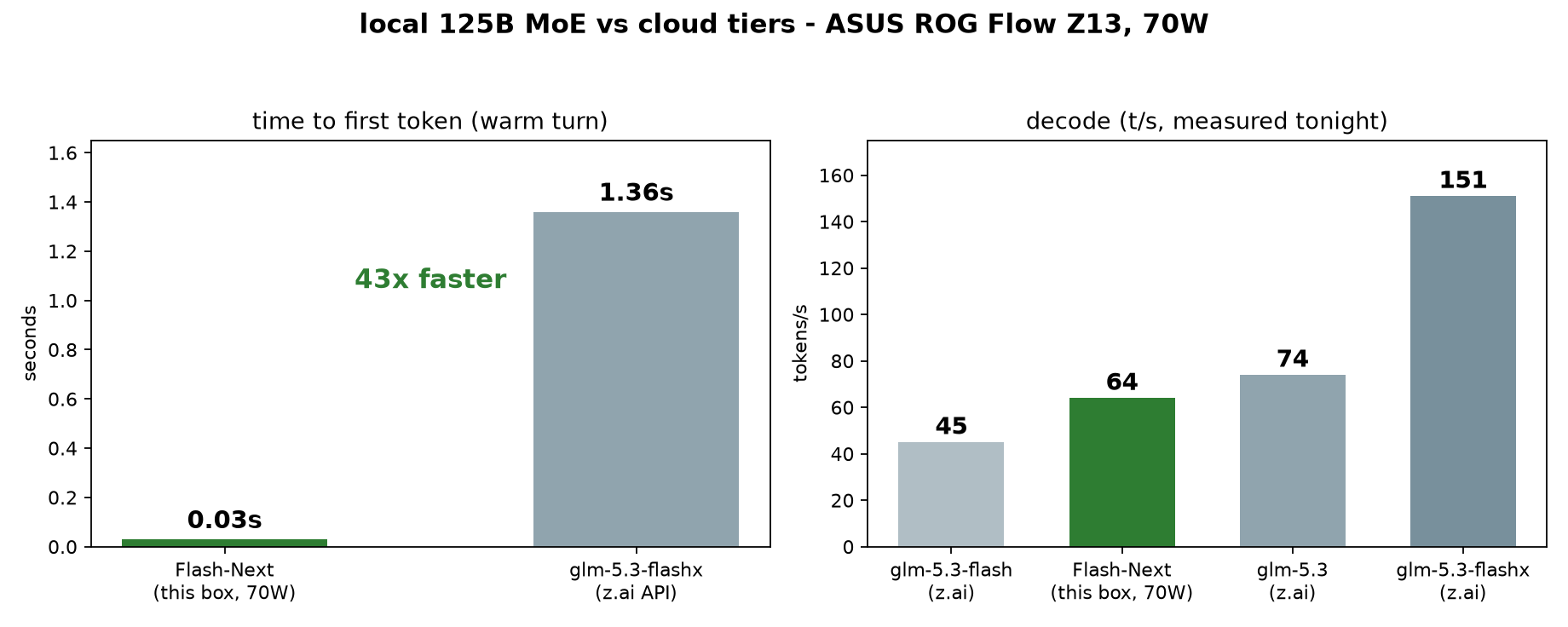
Measured on an ASUS ROG Flow Z13 (Ryzen AI Max+ 395, Radeon 8060S, 128 GB) at 70 W sustained.
What you get
- One-command setup —
./setup.shis idempotent: extensions, providers, sidecar download,
keep-alive units, halogen launch, memory check. It touches nothing you configured yourself and
probes every piece instead of trusting it — the NPU guard answers a real/v1/moderations
probe, the vision tower showsenabled: trueon/health, and the smoke test checks its own
file artifact rather than the model's report. - Crash recovery —
progress-trackercheckpoints task and partial state; relaunch and say
"continue". Verified across six scenarios, includingkill -9at response 1, server death
mid-task, and 15-deep compaction chains. - NPU side jobs — the
npu-retrievalextension shipstriage(a constrained routing
decision with per-option probabilities in ~120 ms) anddedup_scan(near-duplicate files by
embedding similarity);auto-guardscreens every prompt on the guard model as a fail-open
tripwire (42 % recall / 0 % false positives on the 30-prompt canary — not a security boundary).
See The NPU. - Semantic code search — the pinned semble MCP server
(search+find_related), wired intomcp.jsonby setup. A/B on 18 ground-truth queries
against the NPU RAG pipeline it replaced: 17/18 vs 13/18 top-3 hits, 2-3x faster queries, ~40x
faster indexing. It needs no NPU and indexes any local path or remote git URL, on first query. - Sidecar suite off the main context —
ling-tiny-compaction(non-blocking, thinking off,
10/10 rule retention on the canary),ling-tiny-commit,ling-tiny-branch-summary,ling-tiny-repomap. Diffs and transcripts never touch halogen's prompt cache, so a side call
can never evict your session prefix. - Speed tooling —
scripts/halogen-top.sh(live prefill/decode dashboard) andscripts/session-audit.sh --perf(per-session throughput from the server logs). bench/andconfig/—harness-ab.sh(baseline vs kill+resume A/B, one command),report-accuracy.py(grades every file:line claim in a report against the tree), theguard-canary.py/compaction-retention.pycanaries,check-sidecar.sh+check-fixes.sh
(offline regression checks), plusmodels.json.exampleand the compaction snippet. Two
numbers there must be understood, not copied:reserveTokensis per-model, and on halogenmaxTokensmust stay <= 8192 or the server 400s past ~32.7k ctx.- Also shipped —
harness-tune(/tunelive knobs),turn-timer,subagent/
(worker/scout/reviewer/planner, session-model inheritance),/gauntletand/speedtest
prompt templates, and opt-in voice (./setup.sh --voice: privateer-speak
on a local Lemonade server — whisper STT 0.43 s, kokoro TTS 0.3 s, both on CPU). Two pi packages
are installed bysetup.shwhen missing — ponytail
and rpiv-ask-user-question (the structuredask_user_questiontool) — they live in~/.pi/agent/settings.json, not in this repo. Measured
no-ops were deleted; receipts inextensions/README.md.
The stack
One box, four model servers (five with voice), three pieces of silicon:
- halogen (
:8731, iGPU) — Qwen3.8 Flash-Next 125B from a local checkpoint: the agent's main
model, 262,144 ctx x 4 slots, prompt cache on. - NPU sidecars (
:8731, NPU) — four 0.6-0.8B models on the same server: guard, decider,
embedder (the reranker is no longer launched). Detailed in The NPU. - ling3.0-tiny (
:8090, iGPU, llama.cpp) — the sidecar for commit messages, compaction
summaries and repo maps. - semble (child process, CPU) — semantic code search over
uvx; no model server. - Lemonade (
:13305, CPU, opt-in--voice) — whisper STT and kokoro TTS.
Flow: every prompt is screened by the NPU guard before the main model sees it; the main model
generates on the iGPU with its prompt cache warm; side jobs that need a judgement in
milliseconds (is this injection, which of these three is it, which files are near-duplicates) go
to the NPU instead of the 125B model; sidecars read diffs and transcripts directly so they never
evict the cached prefix; and search runs on CPU against an index built at first query. Halogen is
the only engine setup.sh provisions — what breaks on another engine is
measured, too.
Halogen vs gufo (the best engines for Strix Halo)
The engine is swappable. The harness is a pi setup plus extensions that talk to an
OpenAI-compatible endpoint, so on other hardware (NVIDIA, Apple Silicon, plain CPU) use any
server that fits it: llama.cpp (CUDA/Metal builds), vLLM, Ollama, LM Studio, MLX, or gufo where
it supports your GPU. Point models.json at it (example) and skip--halogen. Only the Strix Halo numbers below are measured here; nothing on NVIDIA or Apple was
tested. What you lose off halogen is the NPU tooling (list).
On Strix Halo, halogen and gufo are the two best options:
gufo (MIT) is the open alternative to closed-source halogen.
Matched A/B on this box, same session and client, fabric clock held:
| halogen 0.18.1 (default) | gufo 0.12.0 | |
|---|---|---|
| decode, 20-prompt battery (median) | 62 t/s | 40 t/s |
| decode, 4k to 131k context | 45-50 t/s | 29-32 t/s |
| cold prefill, 131k prompt | 79 s | 94 s |
| warm cache replay | 0.01-0.05 s | ~0.1 s |
| NPU tools (guard, triage, dedup) | yes | no |
| license | closed | MIT |
Halogen stays the default (fastest, NPU tools); gufo is the open (MIT) pick. To run it, stop halogen first (they share
one memory heap), then server/start-gufo-flashnext.sh (UD-Q4_K_XL + MTP, :8080). Full
numbers and the NPU-prefill fork status: ENGINES.md.
Evidence
| Local vs cloud: TTFT and decode by tier |
Wall-clock per run, seven runs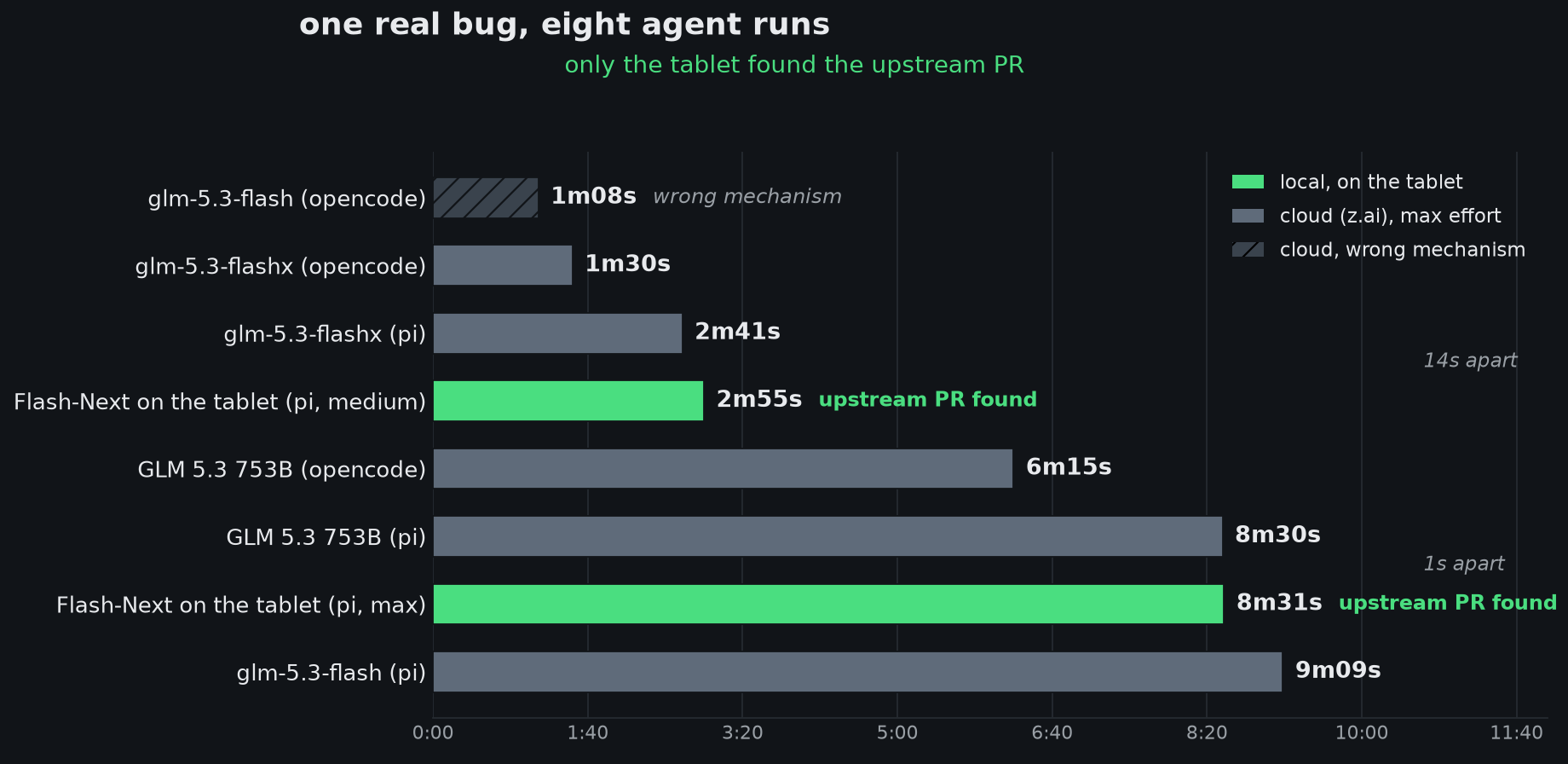 |
halogen 0.16.2 to 0.17.1: NPU latency 4000ms to 130ms, decode 44 to 64 tok/s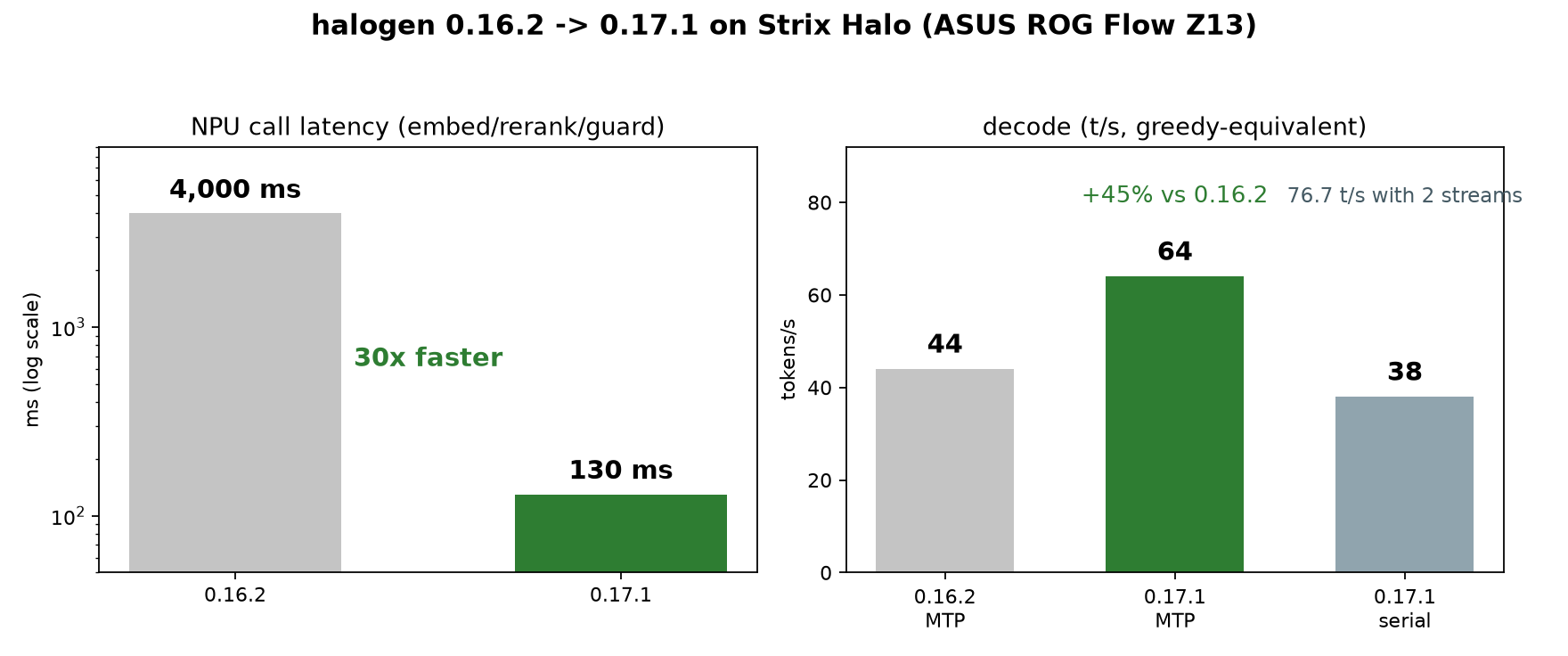 |
Every number in this README logged in docs/BENCHMARKS.md |
Install
# one-time install: extensions, providers, sidecar, pi defaults
./setup.sh

# launch halogen from your local checkpoint (zero downloads)
./setup.sh --halogen auto

# status check any time, ends with a live model ping
./setup.sh --doctor
--halogen auto finds *.hgn in ., /models, ~/models, ~/Downloads, or pass a path
explicitly; restart later with ./start-halogen.sh (written on first launch); --no-halogen
installs pi without container management (laptop pi against your own providers, or against a
remote Strix Halo appliance via baseUrl + PI_NPU_BASE). Other flags: --voice,--halogen-upgrade [tag], --uninstall. Prerequisites: docker (setup will not sudo-install it),
pi (setup installs it via npm if missing), uvx from uv for semantic
search, and an IOMMU-enabled gfx1151 box for the NPU driver. The launch is pinned to local files
(no HALOGEN_DOWNLOAD), so the engine makes no outbound connections.
[!NOTE]
Do not clone the whole model repo — it carries ~190 GB of optional variants and the minimum
set is ~124 GB../setup.sh --halogen autooffers to fetch exactly the right files and resumes
where it stopped if interrupted.
Plain pi also works after setup: startup defaults point at halogen, and existing overrides are
never touched.
Model files
From huggingface.co/peonist-ai/halogen-qwen3.8-flash-next,
plus four separate NPU repos:
| file | size | why |
|---|---|---|
qwen38-flash-next-v2.hgn |
66.7 GB | the main checkpoint (MTP drafter head included) |
qwen38-flash-next-ngram.hgn |
51.2 GB | required — the checkpoint's weight lookup table (read through the page cache; not an n-gram drafter despite the name) |
qwen38-flash-next-vision.hgn |
0.9 GB | vision tower — image input is enabled by default |
tokenizer/ |
small | chat template the engine loads |
npu/decider-0.8b/ |
2.3 GB | triage — constrained decisions (55 ms warm, ~1.6 s to wake) |
npu/qwen3-embedding-0.6b/ |
848 MB | dedup_scan embeddings |
npu/qwen3guard-gen-0.6b/ |
787 MB | injection screening (auto-guard) |
npu/qwen3-reranker-0.6b/ |
821 MB | optional file now — dropped from the default HALOGEN_NPU_MODELS (v1.4): nothing calls /v1/rerank; keep it only if you re-add reranking yourself |
One directory (e.g. ~/models/halogen-qwen3.8-flash-next/), NPU models in a lowercase npu/
subdirectory; the launcher mounts it read-only at /models inside the container, so the engine
reads its NPU models from /models/npu/.
pip install -U "huggingface_hub[cli]"   # provides the hf command
hf download peonist-ai/halogen-qwen3.8-flash-next \
  qwen38-flash-next-v2.hgn qwen38-flash-next-ngram.hgn qwen38-flash-next-vision.hgn tokenizer/ \
  --local-dir ~/models/halogen-qwen3.8-flash-next
for n in decider-0.8b qwen3-embedding-0.6b qwen3guard-gen-0.6b qwen3-reranker-0.6b; do
  hf download peonist-ai/halogen-npu-$n --local-dir ~/models/halogen-qwen3.8-flash-next/npu/$n
done
Skip the rest (w4b.hgn, ht43.hgn, MTP.hgn, w4b.overlay*.hgn, qwen3.5-2b) — the
checkpoint carries its own draft head. Upstream also ships an optional smaller/faster ht43.hgn
checkpoint; the default stays v2 — pass its path explicitly to use it. First cold boot pins the
47.7 GiB lookup table from disk, so a few minutes of startup is normal.
Quick Start
# daily driver: heals any dead server, then opens the pi TUI
./start.sh ~/my-project
In the session: read/edit/bash as usual, mcp__semble__search for "where is X implemented",commit for a sidecar-written message, triage when a decision is a one-word call, and /tune
to change compaction headroom, output budget, temperature or ubatch mid-session. Codebase search
needs no setup — semble indexes on first query.
The default launch is halogen's native max (262,144 ctx x 4 slots) behind an allocator
pre-flight gate; if order-9 pages are low it recovers or fails in seconds with the exact fix
command. Context knobs, the vm-compact.timer and the small-context opt-out are in
Operations.
Live stats
# live dashboard in a second terminal: busy state, queue, KV pool, per-request prefill/decode t/s, cache
./scripts/halogen-top.sh          # optional refresh interval in seconds (default 1); piped = one log line per request

# after a session: halogen version vs pin, sidecar rejections, cache-broken prefills, errors
./scripts/session-audit.sh        # newest session by default; add --perf for its prefill/decode throughput, --harness for sidecar/NPU work
Halogen only updates its counters when a request finishes, so the dashboard shows per-request
rates, not a mid-stream ticker. Leave halogen-top.sh running if you want --perf to diff/metrics over a session — it records every scrape to ~/.local/state/halogen-top/history.csv.
Point it at a remote box with HALOGEN_URL=http://host:8731. Details in
Operations.
The NPU
The NPU is not where the big model runs. It runs four small models whose whole job is to answer,
in 0.1-1 s, questions the 125B model would take 5-90 s on — and without touching the main model's
prompt cache. halogen exposes them on the same :8731 server.
| model | how it is called | used by | what it does | measured |
|---|---|---|---|---|
decider-0.8b |
/v1/chat/completions with a json_schema enum + logprobs |
triage |
picks one of 2-5 options, returns per-option probabilities | 55 ms warm, ~1.6 s cold (first call after idle, measured 10-14), 78 % on 18 binary prompts |
qwen3-embedding-0.6b |
/v1/embeddings |
dedup_scan |
embeds files for near-duplicate detection | 70 ms/query, 38 files in 8.4 s; low traffic (2 runs logged) and loads on first use, so it costs nothing resident |
qwen3guard-gen-0.6b |
/v1/moderations |
auto-guard, every prompt |
flags prompt injection | 207 ms p50 / 285 p95, 42 % recall, 0 % fp — re-verified 10-14 by bench/guard-canary.py |
qwen3-reranker-0.6b |
/v1/rerank |
nothing since v1.1 | ranked the retired NPU search | out of the default launch as of 10-14: 0 calls in the event log |
[!NOTE]
The NPU does not do codebase search. It used to — an embedding + rerank RAG pipeline — and
that moved to the semble MCP server in v1.1 (17/18 vs 13/18 top-3, 2-3x faster queries). What
the NPU still owns is everything the big model is too slow or too expensive for: per-prompt
screening, one-shot routing decisions, and embedding sweeps over thousands of files.
Everything on it is optional and every extension degrades quietly: with no halogen server,auto-guard fails open, triage and dedup_scan return an error string, and the agent keeps
working — search, commit messages and compaction never needed the NPU.
# which NPU models the server has configured vs actually loaded (they load on first use)
curl -s localhost:8731/health | python3 -c "import json,sys;print(json.load(sys.stdin)['npu'])"

# the default set is already trimmed (reranker out); override to go smaller still
HALOGEN_NPU_MODELS=decider-0.8b,qwen3guard-gen-0.6b ./start-halogen.sh
[!WARNING]
GPU + NPU at the same time is only safe with the GPU fabric clock held (halogen NPU docs) —
without it, concurrent GPU and NPU work can hang the device or corrupt output../setup.sh --doctorprobes it and prints the one-time host-side install for thehalogen-fabric-clockunit when it is not held. The container holds the clock while it runs;
the gap is any NPU call made with no container up.
Crash recovery
pi dies, you kill it, the server dies mid-task — doesn't matter. Relaunch ./start.sh in the
same directory and say "continue": progress-tracker wrote a checkpoint (task + partial state)
and the fresh session picks it up. Verified across six scenarios, including kill -9 at
response 1, server death mid-task, and 15-deep compaction chains (reliable to ~8-10 compactions;
deeper chains deserve a re-orientation pass).
Known limits, measured and documented: one pi task per repo (concurrent sessions race on the
checkpoint — set PI_PROGRESS_FILE per task for parallel work), and a stale checkpoint from a
previous task is data, not instructions: rm PROGRESS.md when switching tasks.
Upgrading halogen
The image tag is pinned in server/start-halogen.sh (HALOGEN_IMAGE_TAG, default the version
this harness was last validated on). One command does it safely:
./setup.sh --halogen-upgrade          # default: latest
./setup.sh --halogen-upgrade 0.18.0   # or a specific tag
It pulls the image, refreshes the NPU model files (new images can need new NPU device files — 0.18
added the embedding u10.elf), restarts, then runs the acceptance battery: health + version
match, prompt cache on, NPU probes < 1 s, guard smoke, MTP decode > 30 t/s, and a pi -p smoke.
Only then does the pin move; any failed check restores the previous NPU files and restarts on the
previous pin automatically. Read the changelog first — tool-calling, schema, cache and
log-routing behavior have all changed between releases.
Uninstall
./setup.sh --uninstall
Removes everything the installer provisioned — extensions, templates, skills, theme, pi defaults,
the two providers (only where they still match what setup set) and the systemd units — after
backing all of it up to ~/pi-harness-uninstall-backup-*.tar.gz. Deliberately left alone:
your own model entries, mcp.json, the sidecar GGUF (the reclaim command is printed), the halogen
container and your checkpoint files.
Documentation
- BENCHMARKS.md — measured numbers: decode/prefill, NPU latencies, canary
results, and every claim in this README with its logged run. - Local vs cloud model comparison — seven runs, one
real debugging task, answers rated against verified ground truth. - Engines — the two stacks, halogen vs gufo 0.12, what breaks on a non-halogen engine, sidecar
isolation, and running a cloud model with the local NPU tools. - llama.cpp path — the full-control engine: engine build, GGUFs and
drafters, GPU-memory boot args, pi wiring. - Operations — context size and fragmentation, watching prefill/decode,
troubleshooting table. - extensions/README.md — per-extension notes and the measured value
table. - CHANGELOG.md — release history, including what was removed after testing.
Posts
- Qwen3.8-27B on Strix Halo at 31 t/s decode, the full stack guide (r/LocalLLaMA)
- Running a local coding agent on Strix Halo with pi + llama.cpp (r/StrixHalo)
- Qwen3.8-Flash-Next on Strix Halo: 40 t/s sustained decode (r/StrixHalo)
- Neon Ladder: a playtest-graded benchmark for local LLM stacks (r/LocalLLaMA)
Companion repo: neon-ladder — the playtest-graded
benchmark this stack was validated on. Benchmark protocol questions live there; harness questions
live here.
License
Reviews (0)
Sign in to leave a review.
Leave a reviewNo results found