clauderabbit
Health Warn
- License — License: MIT
- Description — Repository has a description
- Active repo — Last push 0 days ago
- Low visibility — Only 5 GitHub stars
Code Warn
- process.env — Environment variable access in app/.well-known/oauth-authorization-server/route.ts
- process.env — Environment variable access in app/.well-known/oauth-protected-resource/mcp/route.ts
- process.env — Environment variable access in app/[owner]/[repo]/page.tsx
- process.env — Environment variable access in app/api/export/markdown/route.ts
- process.env — Environment variable access in app/api/export/pdf/route.ts
- process.env — Environment variable access in app/api/ops/smoke/route.ts
Permissions Pass
- Permissions — No dangerous permissions requested
No AI report is available for this listing yet.
ClaudeRabbit is a free, open-source security product protecting the open-source community from malware. We clone any public GitHub repo into an isolated sandbox, run it, and return one honest safety score.
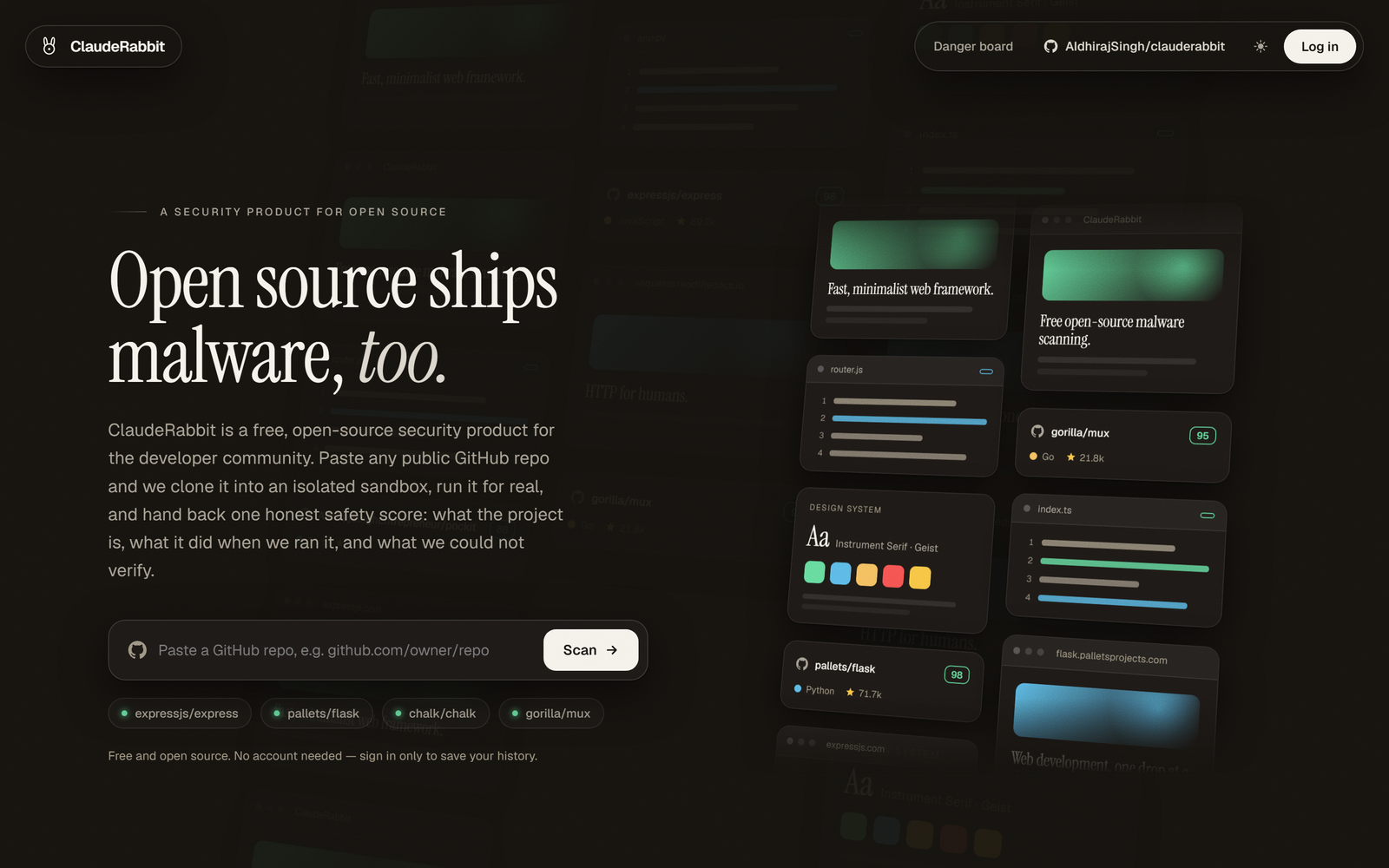
Open source ships malware, too.
Free, open-source malware scanning that doesn't just read a repo. It runs it, in a disposable sandbox, and shows you exactly what it does.



Scan a repo → · CLI · MCP server · How it works · Contributing
The problem
More than 454,600 new malicious open-source packages appeared in 2025, up 75% in a single
year, and over 99% of them landed on npm. The attacks that matter carry no CVE at all: the
dominant pattern is install-time execution, code that runs the moment you npm install or clone
and run, harvesting GitHub tokens, cloud credentials, SSH keys, and wallets before a build even
finishes. Self-replicating worms (Shai-Hulud and its 2026 descendants) republish themselves
through every developer they touch. A favorite delivery method is a fake recruiter's "take-home"
repo. Every tool that waits for a disclosed vulnerability is, by construction, looking the wrong way.
And the honest developer's side of it: you clone something, run it, and then wonder if you should
have. Trust ends up decided on a vibe, stars, a clean README, a gut feeling.
Nobody built the obvious tool for that
The behavior that defines modern open-source malware is invisible to anything that only reads
source and guesses at intent, static scanners, package-reputation tools, the existing free
repo-checkers are all structurally blind to it. So ClaudeRabbit doesn't guess. It runs the code.
Paste any public GitHub repo (or an npm package, scanned as its real published tarball, the exact
bytes npm install fetches, not the repo it merely links to, so a malicious install hook injected
only into the published artifact is caught) at clauderabbit.in -
no account needed. Every scan installs and runs the code in a real, disposable sandbox, with a
target of about eight seconds on a small package. If it tries to phone home or steal a credential,
ClaudeRabbit doesn't just block it: a forge inside the sandbox answers with a fake-success
response, so the malware thinks it got away with it, and that is the exact moment it's caught. You
get back one 0-100 safety score: what the project is, what it did when we ran it, and always
what we could not verify. Never a blind "Safe" with nothing behind it. Every report is public
and permanent at /owner/repo (or /npm/<package> for a registry package), shareable, and
embeddable as a trust badge. Each result carries one clearly labelled sponsored message; ads never
gate a scan or a result.
Demo
The 85-second launch film, the threat, the sandbox, and the moment a repo gets caught phoning home.
Click to play, or watch the product live at clauderabbit.in.
A vertical cut of the same film ships for Reels/Shorts. Direct file:
docs/assets/demo.mp4.
Quickstart
On the web, go to clauderabbit.in, paste a GitHub URL (orowner/repo), hit scan. No login required; signing in only saves your scan history.
From the terminal, the CLI (clauderabbit
on npm) scans a repo or npm package before you install or clone it:
npm install -g clauderabbit                          # one-time setup
clauderabbit scan expressjs/express                  # run a real scan
From an AI coding agent, the MCP server exposes one cache-aware scan tool over
stdio so an agent can check a dependency before it ever clones it (also served remotely over
Streamable HTTP at clauderabbit.in/mcp for claude.ai custom connectors). Wire it into Claude
Desktop with clauderabbit mcp install (installed as part of the CLI above).
Both the CLI and the MCP server call the same public scan API the website uses and require a
signed-in ClaudeRabbit account (a real product/access decision, not because the data is sensitive -
report pages stay public either way); the first call opens your browser to sign in once, then stays
silent until you log out. See cli/README.md and
mcp-server/README.md for the full command/tool reference, or
docs/GETTING-STARTED.md for a full beginner's walkthrough (install →
log in → scan → wire up the MCP server → connect claude.ai Custom Connectors → update).
How it works
paste URL -> POST /api/scan (one Vercel function) -> cache check (commit SHA or npm version+integrity)
   hit  -> stored report + replay of its recorded event stream
   miss -> fetch the GitHub or npm tarball into memory, verify it
           -> in parallel:
              (a) static: Semgrep, YARA, GuardDog (offline E2B analysis sandbox), OSV malicious-package
                  lookup on every dependency, in-process heuristics
              (b) reachability graph of code that runs at install or import
              (c) model readers (structured output) on that slice: install surface, flagged code,
                  README versus code
              (d) detonation in a fresh E2B sandbox: a root forge answers every outbound call; the
                  repo installs with every dependency and script (npm scripts on, uv for Python) and
                  runs its entry point as a non-root user on a fast fake clock; forensics recorded;
                  the sandbox is destroyed
           -> deterministic score in code (behaviour outweighs static; unreachable code never lowers it)
           -> the model writes the report -> persist + public /owner/repo
   every stage, timing, forged call, file, process and check streams to the client and to
   Supabase Realtime, and is stored per SHA for replay
Two safety rails, always: (1) no surface ever states a bare "Safe": every verdict shows its
evidence and what was not verified; (2) the sandbox holds no real credentials, every outbound
call is answered by our forge, resources are capped, and a fresh VM is used for every scan and
destroyed after it. Reputation signals (owner history, account age, stars) and code/behaviour
signals (what the code does, what running it revealed) are always kept visibly separate.
Stack
| Layer | Choice |
|---|---|
| Web and scan | Next.js 16 (App Router) on Vercel: homepage SPA, SSR /owner/repo SEO pages, and POST /api/scan, which runs the whole engine (lib/engine/) |
| DB / Auth / Realtime | Supabase (Postgres + RLS, Google + email auth, Realtime broadcast of scan events) |
| Sandbox | E2B: one fresh VM per scan from a pinned template (sandbox/e2b/) |
| Model | OpenAI gpt-6-luna through one adapter (lib/engine/model/); model id in config (CR_MODEL_ID) |
| Scoring | Deterministic formula in code (lib/engine/score.ts); the model supplies evidence and prose, code decides the number |
| Design | Faithful port of the shipped Claude Design spec (design.md) |
Local development
npm install
cp .env.example .env.local   # fill in the Supabase URL + publishable key (public values)
npm run dev                  # http://localhost:2311
npm run lint, npm run typecheck, npm test (engine, a keyless end-to-end scan with a test-only
stand-in model and mock sandbox, and the PGlite migration round trip), npm run test:python (forge)
and npm run build. A CI workflow with the same gates plus gitleaks ships in.github/workflows/ci.yml.disabled (rename to ci.yml to enable).
Secrets (server-side only, never in the client or the repo)
The client holds only public values: NEXT_PUBLIC_SUPABASE_URL,NEXT_PUBLIC_SUPABASE_PUBLISHABLE_KEY, NEXT_PUBLIC_SITE_URL and the optional AdSense IDs. Every
credential is a Vercel server environment variable: OPENAI_API_KEY, E2B_API_KEY,CR_V2_DATABASE_URL (the least-privilege cr_v2_server login, schema v2 only), and the optionalGITHUB_TOKEN and CR_OPERATOR_KEY. Full table:docs/INFRASTRUCTURE.md section 6.
Deploy to Vercel
- Import the repo into Vercel (framework auto-detected: Next.js).
- Set the env vars from
.env.examplein the Vercel project. - Build the E2B template once (
E2B_API_KEY=... npm run template:build) and setCR_E2B_TEMPLATE. - Apply
supabase/migrations/to the database (non-production first,scripts/db-branch-apply.mjs). - Deploy. The key-day checklist is in
docs/runs/2.0-backend.md.
Repo layout
app/                     Next.js routes (SPA home, /[owner]/[repo] + /npm/<pkg> SSR reports, /badge, /mcp,
                         /api/scan, /api/runs/<id>/events, /oauth/token)
components/spa/          the faithful design port (7 screens + shared chrome + state machine)
lib/engine/              the 2.0 scan engine: resolve, archive, reachability, static, OSV, model,
                         sandbox orchestration, forensics, score, ads, events, store
lib/                     report view, types, supabase clients, scan client
sandbox/e2b/             the E2B template, its build script, the in-VM harness and the forge (the moat)
supabase/migrations/     schema + RLS (reverse files in supabase/migrations-down/)
tests/                   engine tests, keyless e2e, fixtures (our own phone-home fixture), labeled set
cli/                     the clauderabbit CLI (scan, mcp install, login/logout)
mcp-server/              MCP server (one cache-aware scan tool over stdio for AI coding tools)
docs/                    north star, UX, INFRASTRUCTURE, COST, 2.0 design, run records
design.md                the shipped Claude Design spec (source of truth for the UI + reports)
Contributing & community
ClaudeRabbit is a public good, and contributions are welcome, see
CONTRIBUTING.md for how to run it locally and open a PR, and our
Code of Conduct. Good starting points are labelledgood first issue.
Questions, ideas, and "is this repo safe?" discussions belong in
GitHub Discussions.
License
MIT © 2026 Adhiraj Singh.
Free and unlimited, no login or ads ever required to scan. The accumulating database of vetted repos
is the real asset, see docs/INFRASTRUCTURE.md for the honest current
state of the (still-open) monetization question.
Reviews (0)
Sign in to leave a review.
Leave a reviewNo results found