AgentLoop
Health Gecti
- License — License: MIT
- Description — Repository has a description
- Active repo — Last push 0 days ago
- Community trust — 10 GitHub stars
Code Basarisiz
- exec() — Shell command execution in bridge.js
- fs.rmSync — Destructive file system operation in bridge.js
- fs module — File system access in bridge.js
- fs module — File system access in replay/data/log-t-bc53c776.json
- fs module — File system access in replay/data/run.json
- network request — Outbound network request in replay/replay.js
- Hardcoded secret — Potential hardcoded credential in replay/replay.js
- exec() — Shell command execution in src/daemon.js
- spawnSync — Synchronous process spawning in src/daemon.js
- fs.rmSync — Destructive file system operation in src/daemon.js
- process.env — Environment variable access in src/daemon.js
- fs module — File system access in src/daemon.js
- process.env — Environment variable access in src/engines.js
- fs module — File system access in src/engines.js
- fs module — File system access in src/mcp-server.js
- exec() — Shell command execution in src/prompts.js
Permissions Gecti
- Permissions — No dangerous permissions requested
Bu listing icin henuz AI raporu yok.
Local Codex orchestration for solo developers running long tasks without babysitting: fresh worker and critic cycles, files as memory, self-improving loops, a live dashboard, and ChatGPT control via MCP.
AgentLoop
Self-improving fresh-context loops for coding work you can watch.
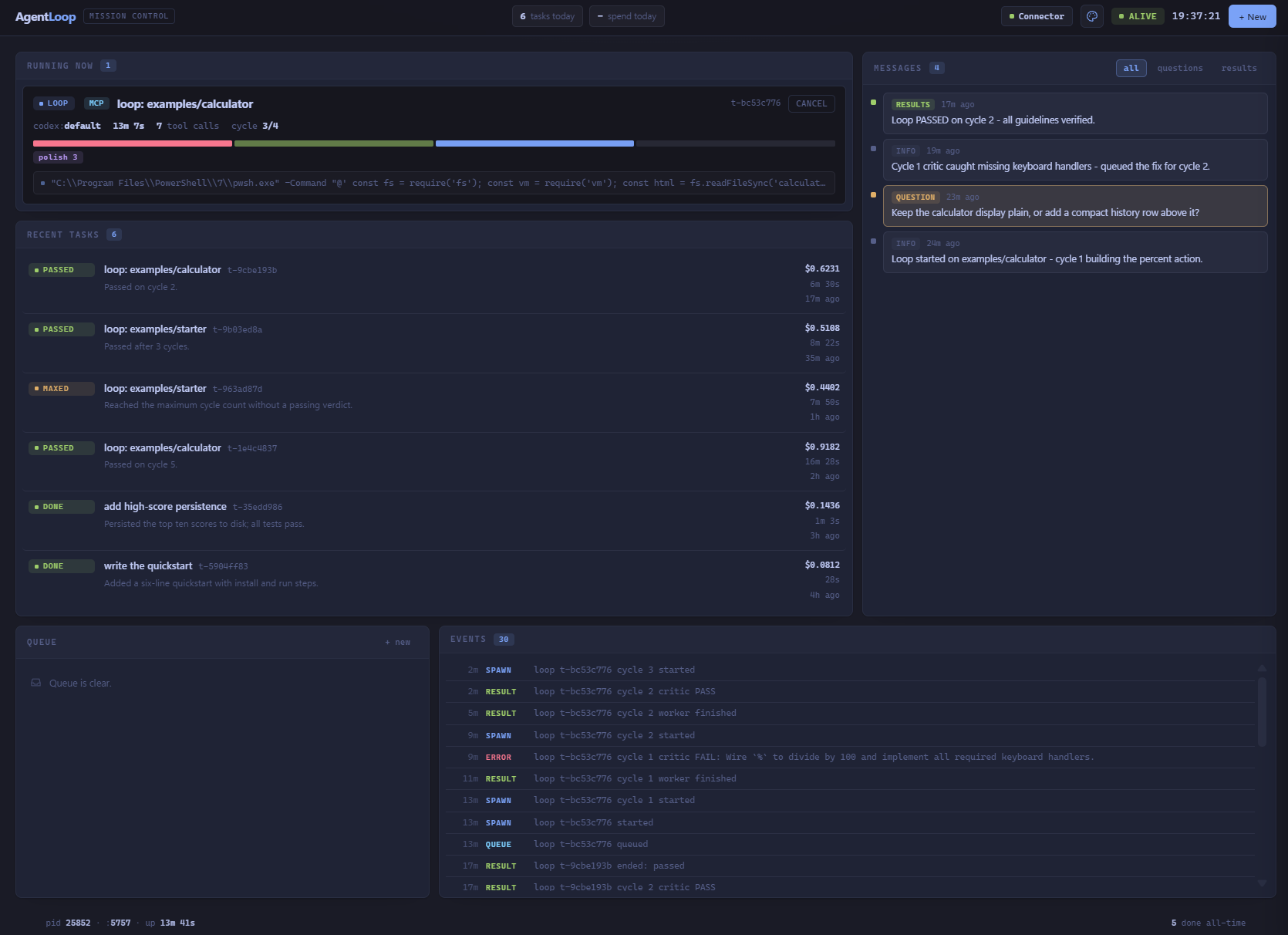
Watch the demo | Try the replay - a real recorded run in the live dashboard
What it is
Plan a goal in Claude or ChatGPT, then let it rip. AgentLoop is a local orchestration daemon for coding agents: each cycle starts a fresh worker, work carries forward in project files, a fresh critic enforces your rubric, and the whole run is watchable on a local dashboard.
Codex CLI and Claude Code both run as engines. Pick one per loop from the dashboard, or per task through the bridge.
AgentLoop is for solo developers who run long agent tasks across multiple projects and cannot supervise every session.
It exists because running coding agents by hand means shuttling plans between a chat and a terminal all day, and quality slips the moment you stop watching.
Your standards live in GUIDELINES.md and the critic enforces them every cycle, so you supervise the work without babysitting it.
Why sequential fresh-context
Long-running chats collect stale assumptions and irrelevant context. That is context rot. AgentLoop starts a new engine process for every worker and critic session, so no prior chat history follows them. The durable context is the project itself plus concrete critic fixes. That keeps a loop bounded, easier to leave unattended, and less likely to spend tokens re-reading an ever-growing conversation.
A loop is intentionally sequential. Independent queued tasks can run up to maxConcurrent, but one loop does not create a parallel swarm that races across the same project.
Claude or ChatGPT -> MCP bridge -> daemon -> worker/critic cycles -> dashboard
How it works
- Dispatch sends one one-shot task to
POST /api/dispatch. Its file moves from pending to running to done, with a transcript and dashboard cancellation. - Loop runs a project cycle by cycle. A worker reads
PLAN.mdandSTATE.md, makes one increment, updates state, and exits. A fresh critic then readsPLAN.md,GUIDELINES.md, the worker output, and the project files. The next worker is a new process. - Polish mode is an optional loop flag: after the first PASS, remaining cycles become polish cycles where the critic re-verifies the guidelines and proposes one improvement per cycle until it verdicts SHIP.
- Critic contract requires the final line to be exactly
VERDICT: PASS,VERDICT: FAIL - <concrete fixes>, orVERDICT: CONTINUE - done: <item>; next: <item>. FAIL becomes injected fix notes for the next worker; CONTINUE records a finished PLAN.md item and starts a fresh worker on the next one; PASS means every unblocked plan item is complete and ends the loop unless polish mode is on. Polish cycles end withVERDICT: IMPROVE - <one improvement>orVERDICT: SHIP.maxCyclesis capped at 1 to 50 and defaults to 3. - Stuck tasks get skipped.
taskRetries(1 to 10, default 3) caps consecutive FAIL cycles per task; at the cap the task is marked blocked, later workers and critics skip it, and the loop endspartialif the rest passes orincompleteif the cycle budget runs out mid-plan. - Auto-checkpoint is on by default for projects inside a git work tree: the daemon makes a local commit after each completed task, on the final pass, and when a task is blocked. The daemon composes every commit message itself and never touches remotes; a dirty tree at loop start is refused so checkpoints stay clean.
- Files are memory.
PLAN.md,STATE.md, andGUIDELINES.mdcarry the goal, progress, and rubric. A loop project needsPLAN.md; missingSTATE.mdandGUIDELINES.mdfiles are seeded automatically. - Messages narrate a run. A connected chat client can post
info,question, orresultsmessages through the bridge. They appear in the dashboard Messages panel. - Engines are pluggable.
src/engines.jsholds one entry per engine: how to find its CLI, what arguments to run it with, and how to read its event stream. The daemon itself is engine-agnostic. SetdefaultEngineinconfig.json, override it per loop in the dashboard, or per task through the bridge. An engine that is not installed is greyed out rather than offered. - Workers start clean and constrained. Codex sessions use workspace-write sandboxing, disable network access inside the sandbox, and route boundary requests through automatic approval review. Claude Code sessions run with
acceptEditsso they never block on a prompt,--safe-modeso a worker ignores your personalCLAUDE.md, hooks, skills, and MCP servers, and web tools disabled. The two are not identical: Codex isolates the network at the sandbox boundary, so a shell command it runs cannot reach out, while a shell command run by Claude Code can.
The daemon is plain Node with no package dependencies. Task state, results, transcripts, events, and messages are stored as JSON or NDJSON files. The dashboard is one local HTML file at http://127.0.0.1:5757.
Multi-task loops
A PLAN.md written as a top-level list is walked one item per worker:
# Calculator

Users report two bugs in `calculator.html`.

1. Fix the arithmetic.
2. Fix the `%` button.
-, *, +, and 1. all count, up to 100 items. Indented lines are detail for the item above them, not items of their own.
Each cycle takes one item. VERDICT: CONTINUE - done: <item>; next: <item> closes that item and starts a fresh worker on the next one. VERDICT: FAIL keeps the same item and injects the critic fixes into the next worker. VERDICT: PASS ends the loop once every unblocked item is complete.
taskRetries caps consecutive FAIL cycles on a single item, 1 to 10, default 3. At the cap that item is marked blocked: later workers take the next item instead, the critic stops grading it, and the loop finishes partial if the rest passes or incomplete if the cycle budget runs out first. Size maxCycles at roughly tasks x retries.
Checkpoints
Auto-checkpoint is on by default for a project inside a git work tree. The daemon commits after each completed item, when an item is blocked, and on the final pass, so every task boundary is a sha you can read, diff, or reset to. The dashboard shows each one on its task chip.
The daemon writes those commit messages itself from the verdict text. Agents never run git, and the daemon never touches a remote: git add -A . then git commit inside the project folder, nothing else.
It needs two things. The project must be a git work tree, otherwise the toggle is forced off and the dashboard reads checkpoints off. And the project tree must be clean when the loop starts, otherwise the loop is refused, so a checkpoint only ever holds work the loop did.
The dashboard
A left rail navigates the page - waiting on you, active run, recent runs, queue, messages, event log - and holds the loop launcher, live daemon status, and a theme picker with fifteen editor themes remembered locally.
- Cycle timeline. The active run shows one card per cycle: verdict, critic summary, duration, and cost. A card working a plan task carries a try tag like
T02 · try 1/3, and a task that hits its retry budget is marked blocked on the card itself. - Task rail. A loop with a parsed
PLAN.mdgets a chip per plan task: done chips show their checkpoint sha, the active chip shows its try count, blocked chips show the spent retry budget. - Waiting on you. Tasks blocked on an answer pin to the top of the page with a rail badge; the block stays hidden while nothing is blocked.
- End states. Recent runs keep loop endings distinct:
passed,partial(passed with blocked tasks),incomplete(cycle budget ran out mid-plan), andmaxed(no passing verdict), plus counts of tasks done and blocked. - Launcher. The loop form takes a project folder, max cycles, task retries, an engine picker that preselects
defaultEngineand disables engines that are not installed, an auto-checkpoint toggle (on by default), and polish mode.
The page polls GET /api/state, a whitelisted read-only payload: optional metrics like cost and duration are omitted when unknown rather than zero-filled, and project paths are reduced to folder basenames, so absolute paths never leave the daemon.
How it was built
AgentLoop started as my own bottleneck. I was the relay between ChatGPT planning the architecture and Codex executing the tasks, shuttling plans and results back and forth across multiple projects, and quality slipped whenever I stepped away. A bare retry loop was not the answer: loops without standards rot their context and never improve. The fix was to move the human judgment into the system itself, so I designed the sequential fresh-context loop, the files-as-memory model, the strict critic verdict contract, and the rubric-as-GUIDELINES pattern to mimic a demanding human in the loop. Codex CLI with GPT-5.6 turned that design into working code: the daemon, filesystem store, loop engine, critic, bridge, and dashboard wiring, roughly one focused session per slice.
The engine layer came later. Nothing in the daemon is tied to one CLI: src/engines.js takes one entry per engine, and Codex CLI and Claude Code both ship today, either one running as worker and critic. Codex is the default.
Independent evaluation
The reproducible query parser evaluation asked for the full repair in one pass. Cycle 1 produced nine passing tests, but a fresh critic found a mixed percent-decoding defect and returned FAIL. Cycle 2 fixed it, added regression coverage, passed 11 tests, and received PASS from a new critic.
Quickstart
Requirements:
- Node.js 18 or newer
- Git
- At least one engine CLI installed and authenticated, found on
PATHor through anenginePathsoverride. Codex CLI (codex) has no version floor; Claude Code (claude) needs 2.1.169 or newer, the release that added the--safe-modeflag it is launched with
Windows:
git clone https://github.com/aiedwardyi/AgentLoop.git
cd AgentLoop
node src\daemon.js
Open http://127.0.0.1:5757. Select + New loop, point Project folder at a folder containing PLAN.md, pick an Engine, then select Start loop. No dependency install is required.
Connect a chat client
This is optional: once connected, you can plan and launch real work on your machine from a chat, without opening a terminal.
In the dashboard, open Connector and select Start.
Expose the local bridge on port 5758. For example:
cloudflared tunnel --url http://127.0.0.1:5758Copy the authenticated connector URL from the Connector popover. Replace the local host with your tunnel host while preserving
/mcp?key=....https://<your-tunnel-host>/mcp?key=<token-from-Connector>Treat this URL as a secret; the token persists in state/mcp-token - delete that file and restart the bridge to rotate it.
Add that URL as a custom connector in Claude or ChatGPT, then describe tasks in plain English.
Claude Code can connect to the local bridge directly, no tunnel needed:
claude mcp add --transport http agentloop "http://127.0.0.1:5758/mcp?key=<token-from-Connector>"
The bridge listens only on 127.0.0.1:5758, uses a token, and exposes agentloop_status, dispatch_task, start_loop, and send_message. dispatch_task and start_loop both take an optional engine.
Try the demo loop
With the daemon running, select + New loop:
- Project folder:
examples/starter - Max cycles:
3 - Engine: whichever you have installed
- Select Start loop
Cycle 1 deliberately implements only the normal input path. The critic reads GUIDELINES.md, rejects the missing hardening and command-line requirements, and emits a FAIL verdict. A later cycle receives those fixes, completes the utility, and passes.
Watch the cycle timeline in Active run and critic verdicts in the Event log. Open the completed task to see its transcript. Messages posted through the bridge appear in Messages.
Configuration
config.json contains the local runtime settings:
| Key | Default | Purpose |
|---|---|---|
dashboardPort |
5757 |
Local dashboard port. |
maxConcurrent |
2 |
Maximum concurrent queued tasks or loops. |
taskTimeoutMin |
45 |
Timeout in minutes for each worker or critic session. |
defaultEngine |
codex |
Engine used when a task or loop does not name one. codex or claude. |
mcpBridge.port |
5758 |
Local MCP bridge port. |
models |
{ "claude": "opus", "codex": "gpt-5.6-terra" } |
Default model per engine. |
enginePaths |
none | Optional absolute path per engine, for a CLI that is not on PATH. |
The shipped config.json includes every key above except the optional enginePaths key.
A model named on the task or loop itself wins over models.
Supported platforms
Windows is the primary path:
node src\daemon.js
macOS and Linux use the equivalent command:
node src/daemon.js
On every platform, install and authenticate at least one engine CLI first. The daemon and bridge bind to loopback addresses, so a tunnel is required for a hosted connector.
Roadmap
Research loops. Cycles that gather sources first, then write against an explicit rubric - reports, docs, briefs.
Two-way messages. The dashboard already receives questions from the chat client; answering from the panel closes the loop.
More engines. Codex CLI and Claude Code ship today. The
src/engines.jsregistry takes one entry per engine, so a third is additive rather than a rewrite.
License
MIT. See LICENSE.
Yorumlar (0)
Yorum birakmak icin giris yap.
Yorum birakSonuc bulunamadi