geo-skills
Health Warn
- License — License: MIT
- Description — Repository has a description
- Active repo — Last push 0 days ago
- Low visibility — Only 5 GitHub stars
Code Fail
- rm -rf — Recursive force deletion command in .github/workflows/sv-001.yml
- network request — Outbound network request in .github/workflows/vs-001.yml
Permissions Pass
- Permissions — No dangerous permissions requested
No AI report is available for this listing yet.
9 open Claude skills for GEO / AEO: check if AI search can read a page, collect and analyze how often AI engines name a brand (with confidence ranges), plus schema parity, AI crawler log checks and migration guards. From the AI Visibility Census.
GEO skills




Your GEO audit says 87 out of 100. Can ChatGPT's crawler even reach the page?
A score cannot tell you. These nine free skills can: they list what blocks a page from AI search, count how often AI engines actually name you, and say when the numbers are too thin to mean anything. For Claude and other AI assistants, and every script also runs on its own from the command line.
Built on the published method of the AI Visibility Census.
Why use this instead of a GEO score
| What a score gives you | What these skills give you |
|---|---|
| One number out of 100 | Findings in order of what blocks you, each with what to do |
| A number nobody has tested against AI answers. We searched nine open-source GEO audit repositories on 10 November 2026 and found no published test | No score. And we are testing in public whether scores go with being named at all, with the result published either way |
| "Up 17 points this month", with no way to tell a real change from chance | "Up 17 points, and that is inside the noise": every rate comes with a 95% range and the number of answers behind it |
Also here, and not common:
- Every tactic is graded by its evidence (tactics/EVIDENCE.md): the platform documents it, a study found it, or nobody has tested it. llms.txt is graded untested, and we say so.
- Crawler visits are verified against the IP ranges the companies publish, so a fake "GPTBot" is not counted.
- Experiments are registered before the data exists, and null results get published.
- Nothing to install beyond Python 3. No account for the checks, and your data stays on your machine. Only the answer collector needs a key, and it is your own.
- Tests run on every change.
What you get is less flattering than a score and more useful: the three things to fix, the count you can defend to a client, and a plain "we can't tell yet" when that is the truth.
When another tool is the better choice: if you want a full SEO suite, client-ready PDF reports or content generation, the larger repositories do far more than this one, and several are very good at it. This repo does one job: honest measurement.
Start here
Check one page, no account and nothing to install beyond Python 3:
git clone https://github.com/aivisibilitycensus/geo-skills
python3 geo-skills/geo-check/scripts/geo_check.py https://example.com/your-page
You get a short list of what stops AI search engines from reading that page, each item with the evidence behind it. Example output. There is no score out of 100, on purpose: whether audit scores go with being named by AI is an open question, and we are testing it in public.
Run it on every deploy
As a GitHub Action (on GitHub Marketplace), with the findings in the job summary:
- uses: aivisibilitycensus/[email protected]
  with:
    urls: |
      https://example.com/
      https://example.com/pricing
The job fails if a page has a blocking finding, such as a noindex that shipped from staging or a robots.txt rule against a search crawler. When nothing blocks, --badge prints a README badge that states the count and the date, not a score:

See it work
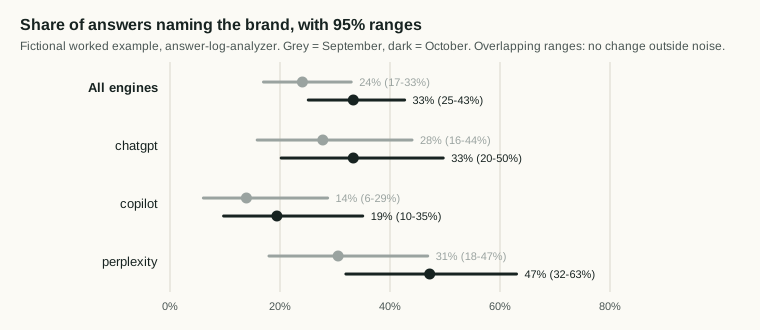
The answer log analyzer on its worked example (a fictional Dublin accounting firm, 108 logged answers a month on three engines):
| Engine | Named, September | Named, October |
|---|---|---|
| chatgpt | 28% (16-44%), n=36 | 33% (20-50%), n=36 |
| copilot | 14% (6-29%), n=36 | 19% (10-35%), n=36 |
| perplexity | 31% (18-47%), n=36 | 47% (32-63%), n=36 |
A nearly 17-point jump on one engine, and the report says it is not outside the noise. That is the point of these skills: counts with ranges, not a score. Full output: answer-log-analyzer/examples/example-report.md.
Skills
| Skill | What it does | Needs |
|---|---|---|
| geo-check | One command: can AI search reach and read this page? Page response, noindex, robots.txt for 11 crawler tokens, text without JavaScript, structured data, firewall hints. Findings in four tiers with evidence grades | A URL |
| question-set-builder | Builds a fixed set of buyer questions with stable IDs, spread across buying intents, for tracking AI visibility | Nothing |
| answer-collector | Runs the question set on ChatGPT, Gemini, Google AI Overviews, AI Mode and Copilot with repeats, and logs every answer and cited URL | Your own DataForSEO or SerpApi key |
| answer-log-analyzer | Reads logged AI answers from repeated runs and reports named, cited, cited-but-someone-else-named and absent, with run-to-run variance and an honest month-on-month comparison | A CSV of answers (from answer-collector, a tracker export or a manual log) |
| schema-parity-checker | Checks that a page's structured data says only what the visible page says: FAQ text, prices, ratings, contact details, dates | A URL or saved HTML |
| geo-migration-guard | Protects AI search visibility through a site migration: baseline, redirect map check, post-launch parity, robots.txt changes for AI crawlers | URL lists and a redirect map |
| ai-crawler-log-check | Analyzes server logs for AI and search crawlers and verifies them against published IP ranges and reverse DNS, so spoofed bots are not counted | Access logs |
| content-shape-checker | Checks whether a draft is built like human writing or generated text (over-explanation, named specifics, scaffold variance, profundity inflation) and quotes every sentence to fix. Also available as a free web tool | A draft with headings |
| geo-experiment-kit | Templates and a readout script for running one-change-at-a-time SEO and GEO experiments with control pages and recorded predictions | Nothing |
Templates
Free spreadsheets in templates/: an SEO report template with AI visibility (95% ranges on every AI rate), a GEO checklist graded by evidence, and an AI Overview CTR loss finder for Search Console data.
Every recommendation carries an evidence grade from tactics/EVIDENCE.md: tested by the Census, published study, platform documentation, vendor claim, or untested.
The scripts are Python 3 and use the standard library only (schema-parity-checker can optionally render pages with Playwright). Each skill with a script has a worked example built from synthetic data, with the real script output, and tests that run on every push.
Install
Claude (claude.ai or the desktop app): zip a skill folder, then in Settings > Capabilities turn on code execution, scroll to Skills, click "Upload skill" and choose the zip. Anthropic's guide has the details.
Claude Code (plugin, all nine skills):
/plugin marketplace add aivisibilitycensus/geo-skills
/plugin install geo-skills@geo-skills
On Claude Code 2.1.275 or later, one step: /plugin install geo-skills --marketplace aivisibilitycensus/geo-skills.
Claude Code (one skill): copy the skill folder into ~/.claude/skills/ (personal) or .claude/skills/ in a project. Copy tactics/ alongside the skills so the evidence links resolve.
Other assistants: each SKILL.md is plain markdown. Paste it into a custom GPT, a Gem or a project's instructions. The scripts run on their own from the command line.
A typical workflow
- Run geo-check on the pages you want named, and fix anything that blocks.
- Build the questions with question-set-builder.
- Collect answers with answer-collector: at least three per question, per engine, per check date.
- Analyze the log with answer-log-analyzer.
- Fix what the data points to, one change at a time, using geo-experiment-kit.
- Check drafts with content-shape-checker before they ship.
- Use schema-parity-checker, ai-crawler-log-check and geo-migration-guard for the deeper technical checks.
Open studies
Run in this repository, registered before the data exists, published whichever way they come out:
- SV-001: do GEO audit scores go with being named by AI? Two open-source scoring scripts against Census100 answer data for 20 project management brands. Registered 10 November 2026.
- VS-001: how often does the Content Shape Checker flag articles written by people?
What the skills send and fetch
Everything runs on your own machine or CI runner. Nothing is sent to the AI Visibility Census, and no skill collects data about you.
- geo-check, schema-parity-checker, geo-migration-guard: request the pages you name, plus that site's robots.txt and redirects. geo-check also sends a few short requests to the same site with AI crawler names in the user agent, to see if a firewall treats them differently (
--no-probeturns that off). schema-parity-checker's optional--renderloads the page in a local Playwright browser. - ai-crawler-log-check: reads the log file you give it, and downloads the IP lists that OpenAI, Google, Microsoft, Anthropic, Apple, Perplexity and Common Crawl publish for their crawlers, to verify each visit.
- answer-collector: sends your questions to DataForSEO or SerpApi with your own key, and only after it prints the number of paid calls and you confirm with
--yes. Answers are saved to local files. - answer-log-analyzer, question-set-builder, content-shape-checker, geo-experiment-kit: work on local files only and make no network requests.
geo-check's --badge prints a shields.io image link for you to paste; the script itself does not contact shields.io.
If it helped, pass it on
This repo grows by people showing other people what it found. Three ways, each under a minute:
- Star it. Stars are how the next person finds it.
- Show your result. Run
geo_check.py --badgeand paste the badge line in your README or site footer when nothing blocks. It states a count and a date, and links back here. - Tell one person who reports GEO numbers to a client. The line that usually lands: "it tells you when a change is inside the noise."
Found a wrong grade, a false finding or a missing check? Open an issue. See CONTRIBUTING.md for the five-minute ways to help.
License
Code is MIT. Skill text, evidence grades, templates, examples and data are CC BY 4.0: reuse them, including commercially, with credit to the AI Visibility Census. LICENSING.md says which files are which.
Feedback
Open an issue, or email [email protected]. If a grade in the evidence file is wrong, send the source.
Reviews (0)
Sign in to leave a review.
Leave a reviewNo results found