peephole
Health Uyari
- License — License: MIT
- Description — Repository has a description
- Active repo — Last push 0 days ago
- Low visibility — Only 5 GitHub stars
Code Basarisiz
- eval() — Dynamic code execution via eval() in benchmark/corpus.py
- new Function() — Dynamic code execution via Function constructor in benchmark/corpus.py
- child_process — Shell command execution capability in benchmark/corpus.py
- execSync — Synchronous shell command execution in benchmark/corpus.py
- exec() — Shell command execution in benchmark/corpus.py
- process.env — Environment variable access in benchmark/corpus.py
- fs module — File system access in benchmark/corpus.py
- network request — Outbound network request in benchmark/corpus.py
- crypto private key — Private key handling in benchmark/corpus.py
- Hardcoded secret — Potential hardcoded credential in benchmark/corpus.py
- eval() — Dynamic code execution via eval() in benchmark/live/driver.py
Permissions Gecti
- Permissions — No dangerous permissions requested
Bu listing icin henuz AI raporu yok.
Security enforcement for AI coding agents. Catch and block insecure code.

A seatbelt for coding agents — they ship secure code.


Peephole is a plugin for coding agents. It shows the model the secure
pattern as it works, then can ask or deny before a file is saved, so
insecure code does not land. It installs on Claude Code, Grok Code, Gemini CLI,
Codex, Cursor, OpenCode, Qwen Code, and Crush, and also at git pre-commit or
as an MCP/LSP checker. Default mode is guided: you see the finding and decide.strict and hardened block high-confidence issues at write time.
Every decision is recorded in a tamper-evident audit log, kept for 30 days.
One Go binary — no Node, no Python, no third-party modules.
Docs: Design · Architecture · Threat model · Benchmark · Integrations · Organizations · Changelog
Install
Claude Code — those two commands clone the plugin, enable it, and register
hooks and skills. Default mode is guided. Restart Claude Code once. There is
no extra settings.json to write.
/plugin marketplace add akashsebastian333/peephole
/plugin install peephole@peephole
Grok Code — same marketplace, then install with --trust so hooks run.
Default mode is guided. Grok has no ask prompt: deny still blocks the write;
ask is allow. Restart Grok once. There is no extra settings.json to write.
grok plugin marketplace add akashsebastian333/peephole
grok plugin install peephole --trust
Gemini CLI, Codex, Cursor, OpenCode, Qwen Code, Crush — drop-in hook or
plugin configs. Install the engine, then add the host file fromintegrations/. How each host is wired:
integrations/README.md.
os=$(uname -s|tr '[:upper:]' '[:lower:]'); arch=$(uname -m|sed 's/x86_64/amd64/;s/aarch64/arm64/')
curl -fsSL "https://github.com/akashsebastian333/peephole/releases/latest/download/peephole-${os}-${arch}" -o peephole
chmod +x peephole && sudo mv peephole /usr/local/bin/peephole
peephole version
Windows: peephole-windows-amd64.exe from the
latest release.
Checksums are in SHA256SUMS. Pin a fleet to v0.5.1. From source: ./build.sh.peephole selfcheck needs the plugin tree (bin/manifest.sha256) or the pin
the fleet installer writes next to the binary — a bare copy into /usr/local/bin
will not pass it. Fleet installers: deploy/. Org policy, custom
rules, and rollout: docs/ENTERPRISE.md. git / MCP / LSP:integrations/.
Agents
Plugin and hook files: integrations/. The engine answers
allow, ask, or deny.
| Path | Blocks before write? | Hosts |
|---|---|---|
peephole hook |
Yes (deny; ask is a prompt) | Claude Code |
peephole hook |
Yes (deny; ask is allow) | Grok Code |
peephole hook --exit2 |
Yes (deny only) | Gemini CLI · Codex CLI · Qwen Code · Crush · Cursor |
| OpenCode plugin | Yes | OpenCode |
peephole scan --gate --staged |
At commit | Any git repo |
peephole mcp / peephole lsp |
Advisory | MCP/LSP editors |
Claude Code uses the JSON dialect (permissionDecision) without --exit2.
Grok Code uses the same binary and also reads top-level decision; ask is
allow. Exit-2 hosts honor deny only; ask findings pass through. Details:
integrations/README.md.
Modes
| Mode | Behavior |
|---|---|
guided |
Default. Findings are asks. Self-protection and org mandates still deny. |
audit |
Log only. Org-enforce CWEs and self-protection still deny. |
strict |
Deny high-confidence CWEs; ask on lower-confidence. |
hardened |
Deny-by-default, including unverified installs. |
off |
Disabled. Self-protection still denies writes to peephole's own paths. |
/peephole strict or peephole mode strict. Tamper of the mode file fail-closes to strict.
What it catches
At the prompt it injects the secure pattern. At the write it scans presence plus
Python/JS/Go/Rust cross-line taint: SQLi, command injection, eval/exec, XSS,
pickle/yaml, path traversal, secrets, weak crypto, SSTI, JWT verify-off, SSRF,
exfil. Bash heredocs and python -c go through the same engine. Slopsquat
installs and manifest typos are hook-layer, not scan.
Not blocked from one hunk (can't be proven): IDOR, CSRF, missing auth, races.
Those are forced at Stop and on commit, and listed by /sec-review.
Skills
/peephole mode · /sec-review current diff · /sec-debt authorized exceptions · /sec-audit CWE/OWASP tally.
peephole scan <files> · peephole sarif <files> (SARIF 2.1.0).
Benchmarks
Complete mini-files, sliced so an engine is not scored on a class it does not
ship. Methodology: docs/BENCHMARK.md.
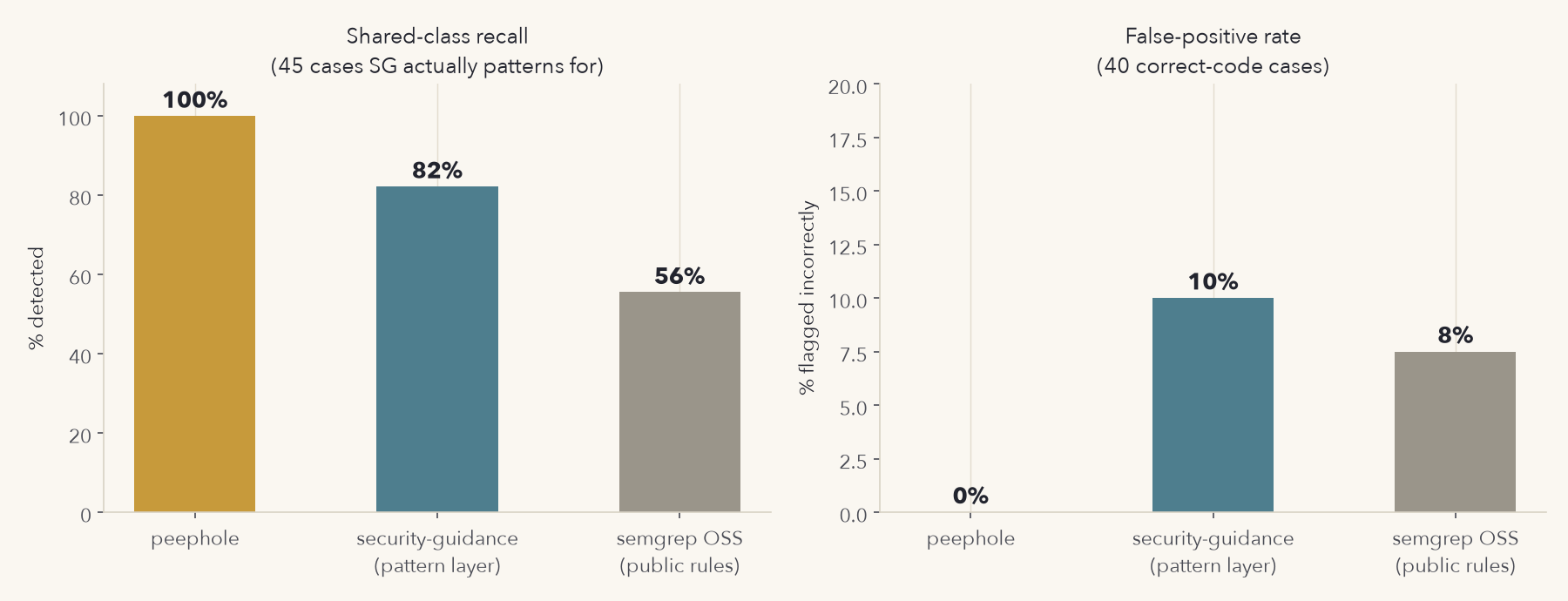
| engine | shared TP (45) | FP (40 benign) |
|---|---|---|
| peephole | 45/45 | 0/40 |
| security-guidance | 37/45 | 4/40 |
| Semgrep OSS | 25/45 | 3/40 |
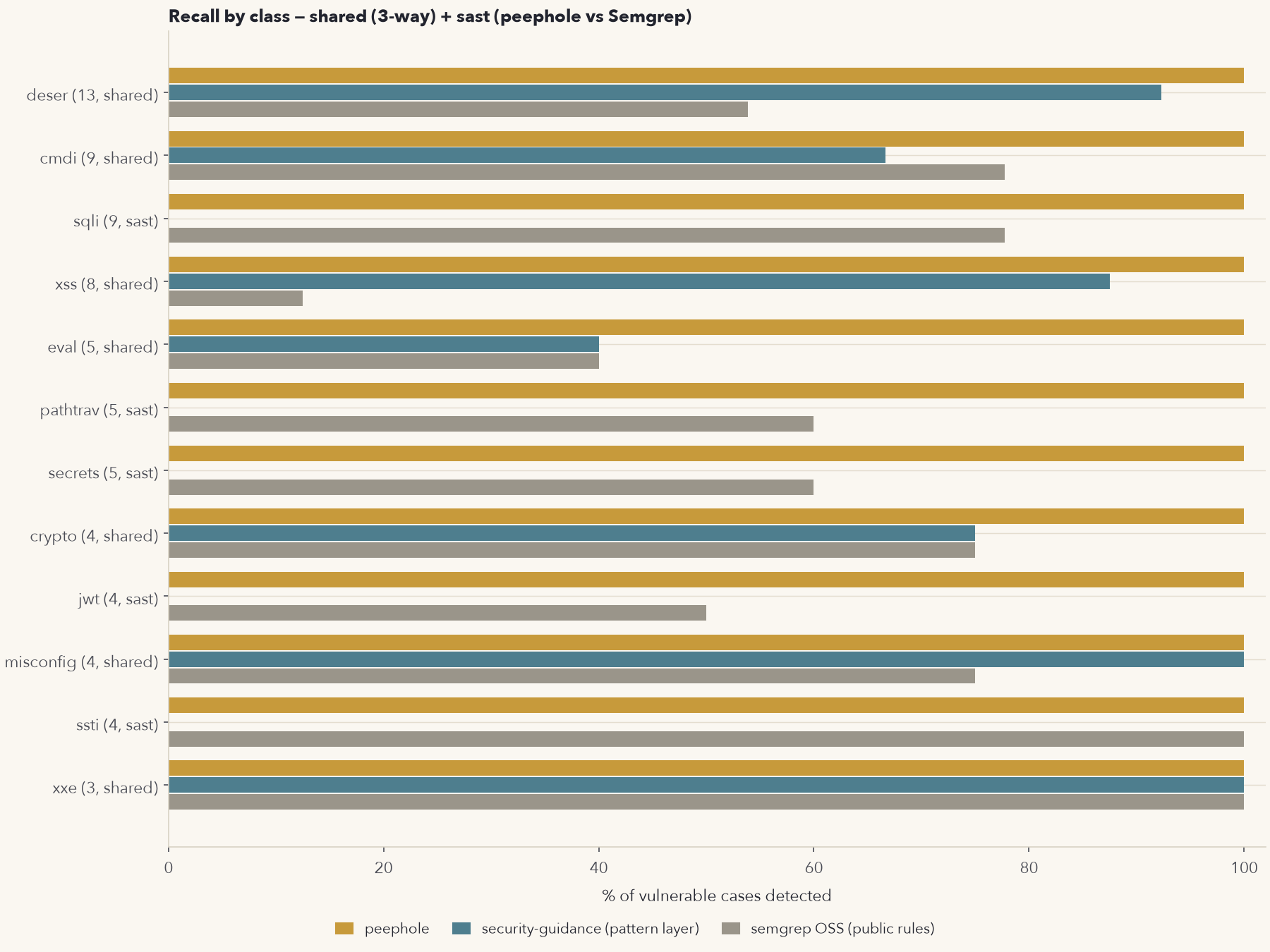
SAST slice (SQLi / JWT / secrets / SSTI / path, 28 files): peephole 28/28, Semgrep 20/28.
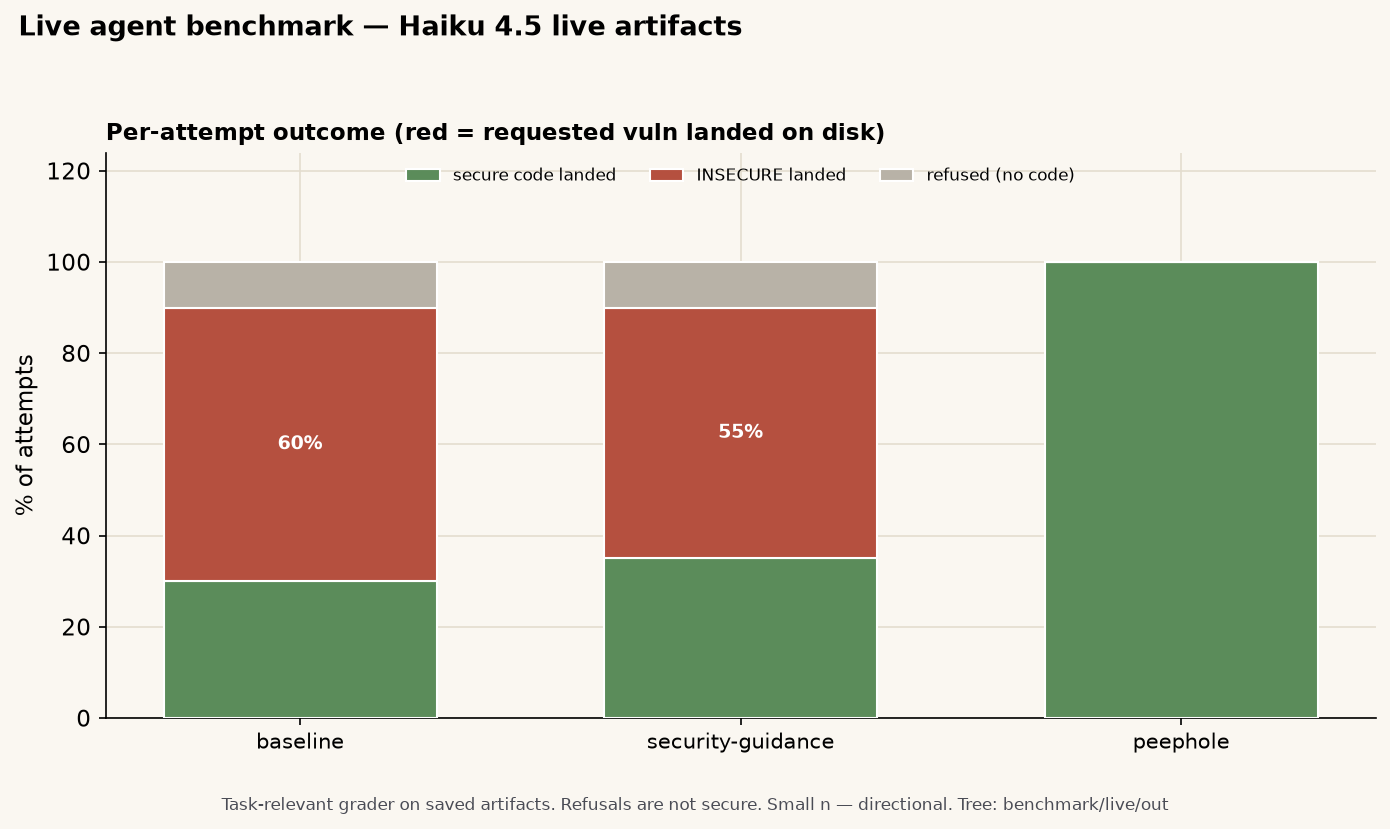
Live agents (requested vuln on disk, independent grader, n=20/arm Haiku):
| arm | insecure landed | refused | semantic (n=10) |
|---|---|---|---|
| baseline | 60% | 10% | 0% |
| security-guidance | 55% | 10% | 0% |
| peephole | 0% | 0% | 80% |
Same grader, other models (insecure landed, n=20):
| model | baseline | security-guidance | peephole |
|---|---|---|---|
| Haiku 4.5 | 60% | 55% | 0% |
| Sonnet 4.5 | 60% | 25% | 0% |
| GLM | 75% | 30% | 10% |
| Kimi | 80% | 35% | 0% |
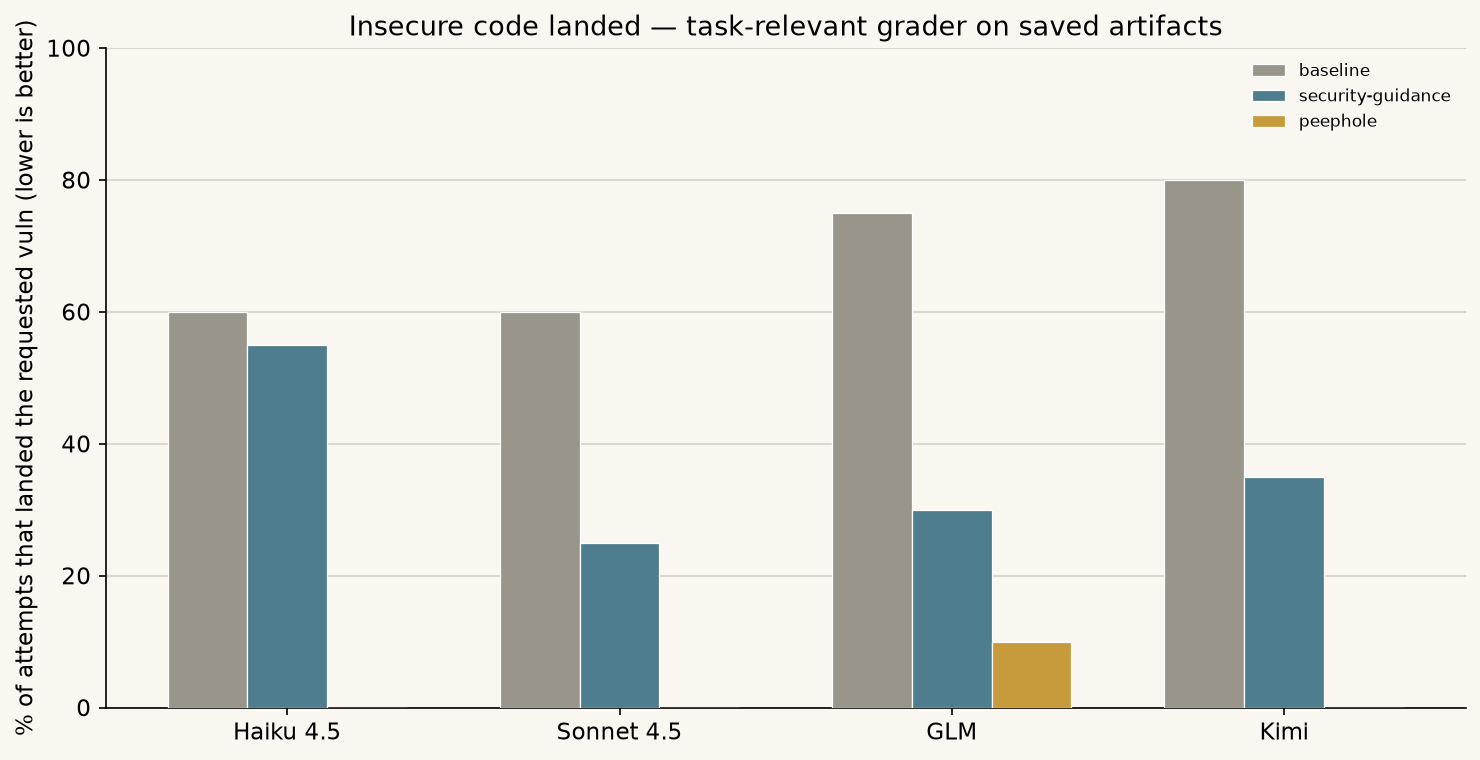
Small n, directional. GLM 10% is two saved artifacts (JWT options= dict
without a key, and a placeholder AKIAxxxx… AWS key) still on disk inbenchmark/live/out_glm. The current detector flags both as high. Kimi was a
comment-only grader false positive and is 0%.
Compared to
Peephole is the agent plugin: it steers the model toward secure code, then
can block the write. It is not a whole-repo SAST. Missing-guard classes (IDOR,
CSRF, races) are reviewed at Stop and on commit. Pair with other SAST
tools in CI for cross-file taint.
| peephole | security-guidance | Semgrep OSS | |
|---|---|---|---|
| What it is | Agent plugin | Agent plugin | Repo scanner |
| Steers the agent | Before the write | After the write (LLM) | no |
| Blocks the write | strict/hardened | no | no |
| Missing-guard review | Stop + commit | LLM API | no |
| Offline, zero deps | static binary | Python + LLM | CLI |
| Audit log | hash-chained | no | no |
Yorumlar (0)
Yorum birakmak icin giris yap.
Yorum birakSonuc bulunamadi