teamclaude
Health Warn
- License — License: MIT
- Description — Repository has a description
- Active repo — Last push 0 days ago
- Low visibility — Only 9 GitHub stars
Code Warn
- network request — Outbound network request in dashboard/src/App.tsx
Permissions Pass
- Permissions — No dangerous permissions requested
This tool provides real-time observability and a structured sprint management workflow for multi-agent Claude Code sessions. It scaffolds a local dashboard to help users monitor task progress, track token costs, and coordinate autonomous AI agents.
Security Assessment
Overall risk: Medium. The tool explicitly manages autonomous AI agents that execute tasks and review code, which inherently involves running local shell commands and modifying your file system. The automated audit flagged an outbound network request in `dashboard/src/App.tsx`, which is expected behavior for the local live dashboard streaming at `localhost:3456`, but users should verify it does not phone home with proprietary code. No hardcoded secrets were found, and the tool does not request dangerous system-wide permissions. However, running autonomous agents on your machine always requires caution, especially if operating on sensitive codebases.
Quality Assessment
The project is very new and has low community visibility, currently sitting at only 9 GitHub stars. Despite the low traction, it is actively maintained, with repository updates pushed as recently as today. It utilizes standard open-source best practices, including a CI workflow and a clear MIT license. Community trust level is currently low due to the project's infancy, meaning users are relying primarily on the creator rather than a broad community consensus.
Verdict
Use with caution due to the inherent risks of running autonomous code-modifying agents and the project's early stage.
Autonomous sprint plugin for Claude Code — real-time visualization of agent teams

TeamClaude
Stop flying blind with AI agent teams.
Real-time observability and structured sprints for Claude Code.


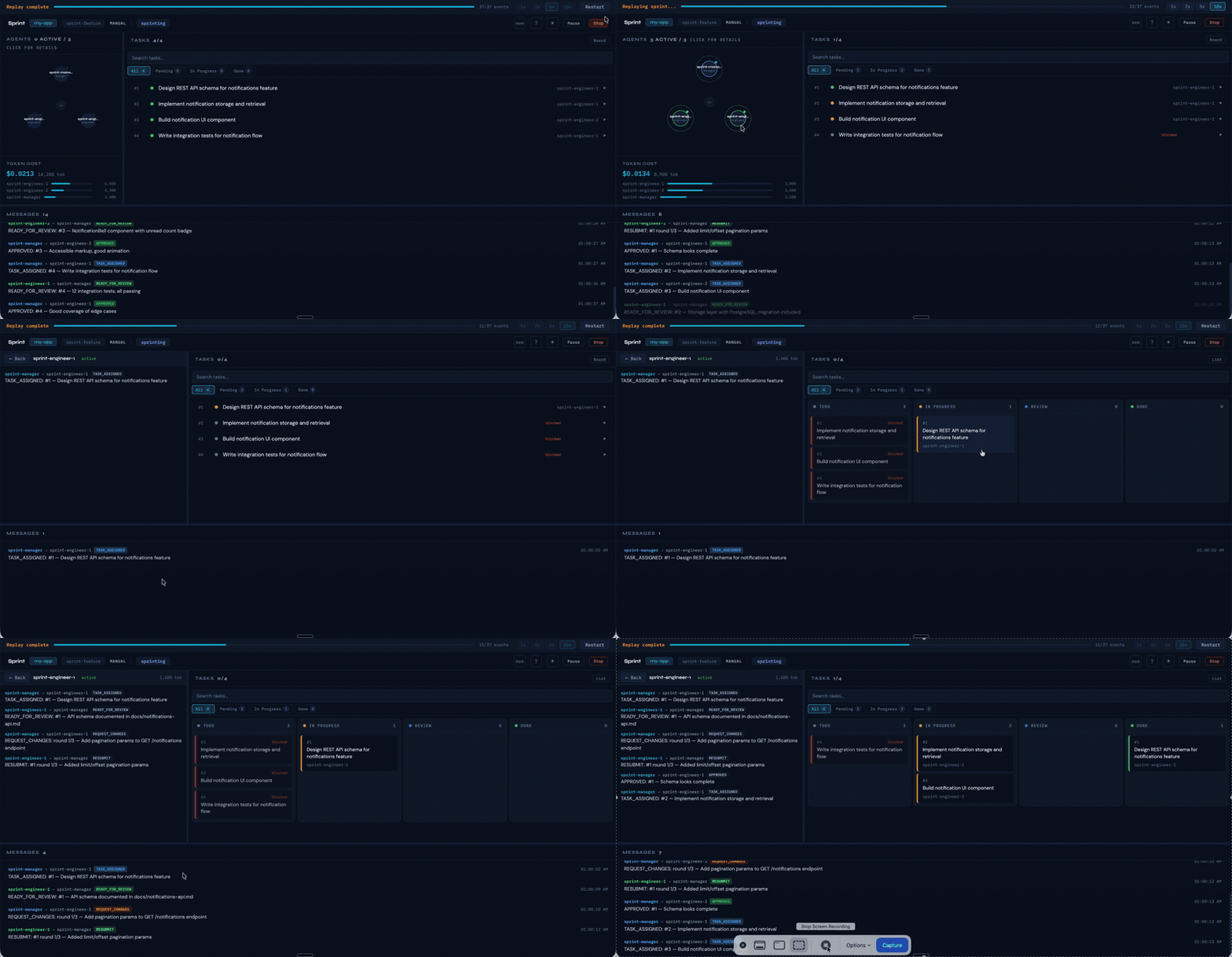
Multi-agent Claude Code sessions are powerful but opaque. You can't see what agents are doing, which tasks are stuck, how much they're costing, or whether the work is actually converging. TeamClaude fixes that with a live dashboard and a manager/engineer sprint workflow that keeps agents on track.
Get started
npx teamclaude init
This enables Agent Teams, scaffolds agents and commands into .claude/, and creates .teamclaude/ for sprint history. Then open Claude Code and type:
/sprint Add user authentication, fix payment bug, refactor database layer
The dashboard opens at http://localhost:3456 and streams everything live.
Prerequisites: Node.js 18+. Optional: tmux for live terminal views of each agent.
When to use TeamClaude
| Good fit | Not a good fit |
|---|---|
| Multi-task sprints (3+ related tasks) | Single quick fixes or one-liners |
| Feature batches with review cycles | Exploratory research or brainstorming |
| Bug-bash sessions across a codebase | Tasks requiring constant human decisions |
| Refactoring with test validation | Projects without tests or type-checking |
| Autonomous overnight/background work | Highly sensitive code needing line-by-line review |
What you get
Live observability dashboard
See what every agent is doing, in real time.
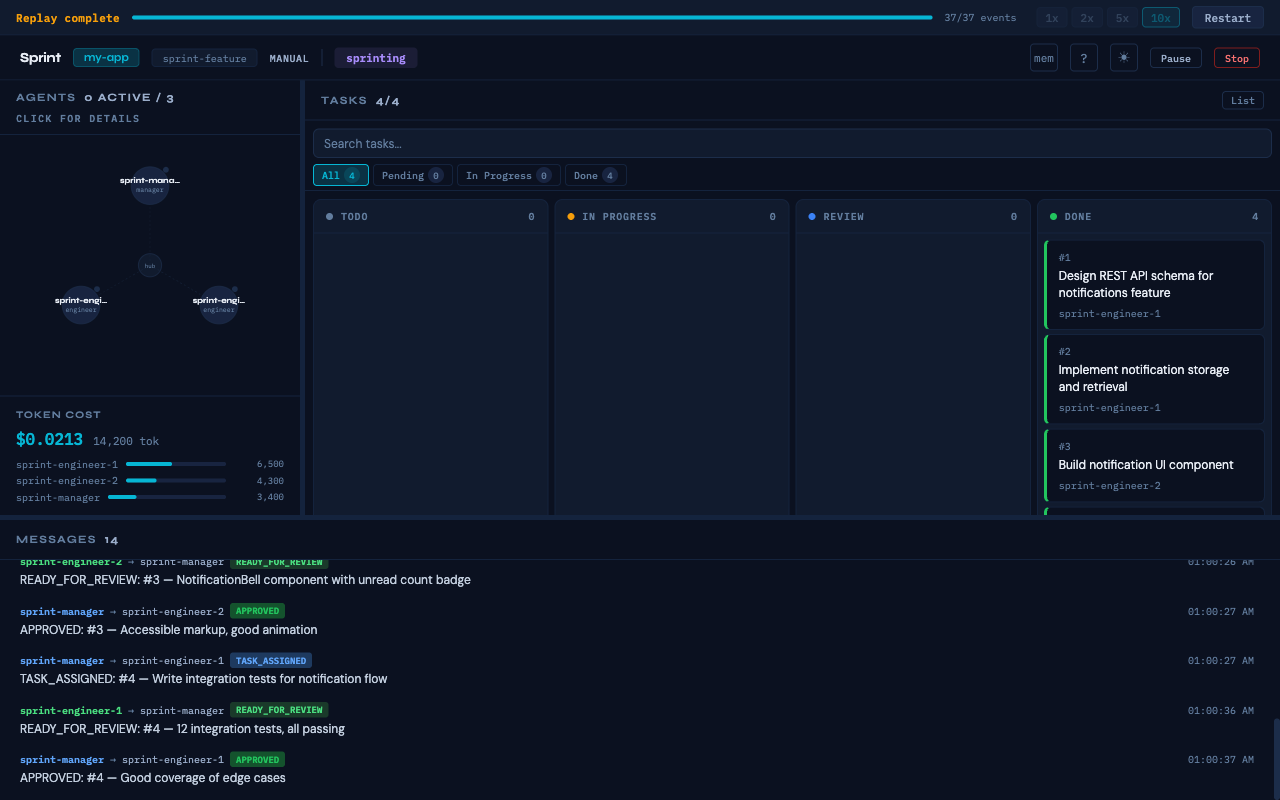
- Agent topology with active/idle status — click any agent to view their live terminal (tmux) or message history
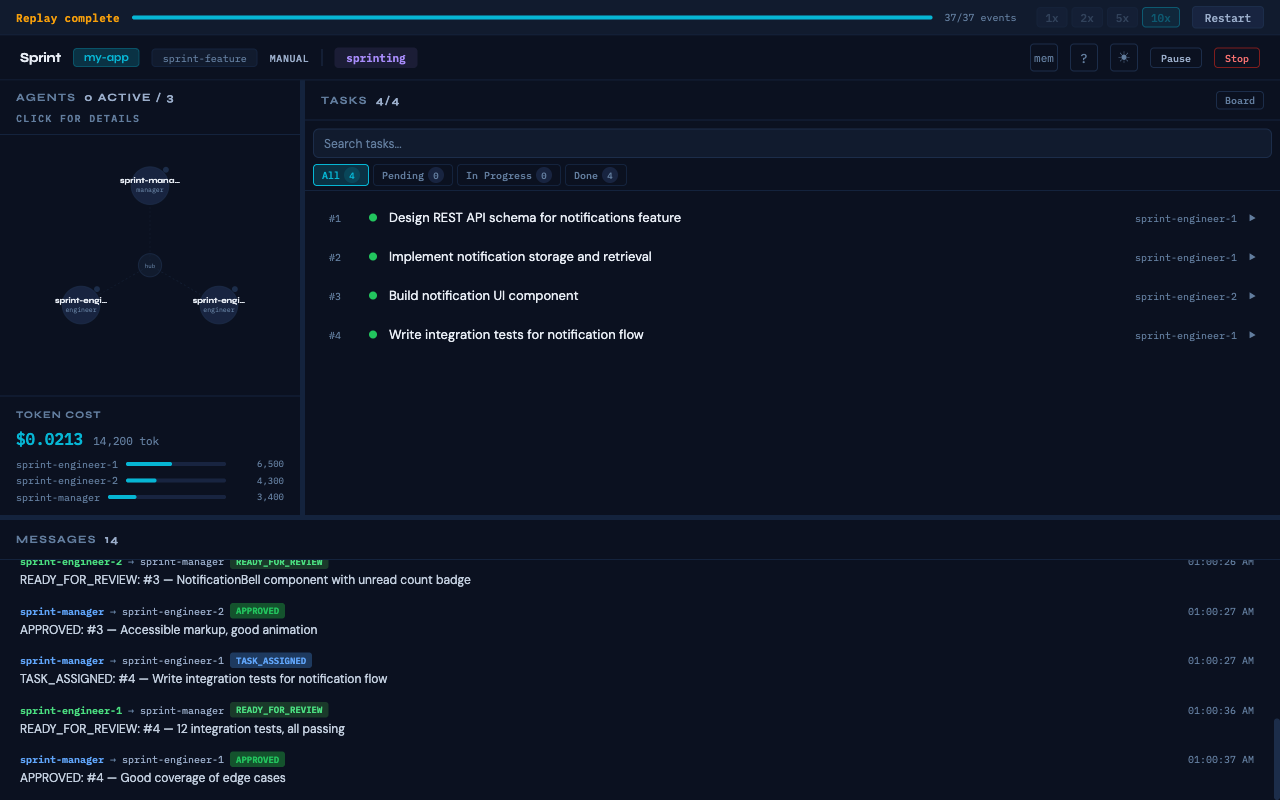
- Task board (list or kanban) with real-time status, protocol tags, and review round tracking
- Message feed showing inter-agent communication (TASK_ASSIGNED, READY_FOR_REVIEW, APPROVED, etc.)
- Token cost tracking per agent with estimated USD cost (model-aware pricing)
Structured sprint workflow
Agents don't just run — they follow a review loop.
- Manager assigns tasks to engineers with context
- Engineer implements and submits for review
- Manager approves or requests changes (max 3 rounds)
- If stuck after 3 rounds, it escalates to you
This prevents the common failure mode: agents running indefinitely without converging.
Sprint analytics and retros
Every sprint generates data.
- Retrospective — auto-generated markdown on sprint stop (summary, task results, team performance, improvement suggestions)
- Sprint history — completion rates, review rounds, velocity trends across cycles
- Sprint replay — re-watch any recorded sprint in the dashboard at adjustable speed
- Git integration — auto-creates sprint branches, generates PR summaries
Cost control
- Token budget — auto-pause when spend exceeds a threshold, with dashboard warnings at 80%
- Human checkpoints — pause before specific tasks for manual review
- Model routing — automatically assigns haiku/sonnet/opus per task based on complexity
Modes
Manual — you define the work
/sprint Add user auth, fix payment bug, refactor DB layer
/sprint path/to/ROADMAP.md
You see the parsed task list and approve before anything starts.
Autonomous — PM agent drives
/sprint
A PM agent analyzes the codebase, creates a roadmap, and hands it to the manager. Runs in continuous cycles until no issues remain.
Configuration
Auto-detects your project tooling from lockfiles and package.json. For explicit control, add .sprint.yml:
agents:
  model: sonnet              # haiku | sonnet | opus
  roles:                     # custom team composition
    - engineer
    - engineer
    - qa

sprint:
  max_review_rounds: 3

budget:
  max_tokens: 100000
  warn_at: 80000

verification:
  type_check: "npm run type-check"
  test: "npm test"

server:
  port: 3456
CLI
npx teamclaude init [--global] [--force]            # Scaffold into .claude/
npx teamclaude init --template <name|list>           # Use a pre-built template
npx teamclaude start [--port N]                      # Start server (default: 3456)
npx teamclaude replay <file.jsonl> [--speed N]       # Replay a recorded sprint
Alternative install
# Claude Code plugin marketplace
claude plugin marketplace add albertnahas/teamclaude
claude plugin install teamclaude@teamclaude

# Standalone server
npx teamclaude start
Agent roles
| Agent | Role |
|---|---|
| sprint-pm | Analyzes codebase, creates roadmaps, validates results. Never writes code. (Autonomous mode only) |
| sprint-manager | Delegates tasks, reviews code, drives sprint to completion. Never writes code. |
| sprint-engineer | Implements features, fixes bugs, writes tests. Submits work for review. |
| sprint-qa | Validates acceptance criteria, runs tests, reports defects. Never writes code. |
| sprint-tech-writer | Updates docs, changelogs, inline comments. Never writes code. |
Custom roles: drop an agents/<role>.md file and reference it in .sprint.yml.
Agents communicate via structured prefixed messages:
| Prefix | Direction | Meaning |
|---|---|---|
TASK_ASSIGNED: |
Manager → Engineer | Task delegated with context |
READY_FOR_REVIEW: |
Engineer → Manager | Work submitted for review |
APPROVED: |
Manager → Engineer | Work accepted, task complete |
REQUEST_CHANGES: |
Manager → Engineer | Feedback with round counter (N/3) |
RESUBMIT: |
Engineer → Manager | Revised work after feedback |
ESCALATE: |
Either → Human | Stuck after 3 rounds |
ROADMAP_READY: |
PM → Manager | Sprint tasks created (autonomous) |
SPRINT_COMPLETE: |
Manager → PM | All tasks done (autonomous) |
ACCEPTANCE: |
PM → Manager | Validation pass/fail (autonomous) |
| Endpoint | Method | Description |
|---|---|---|
/api/state |
GET | Full sprint state snapshot |
/api/launch |
POST | Launch a sprint ({ roadmap, engineers, includePM, cycles }) |
/api/stop |
POST | Stop sprint, record analytics, generate retro + PR summary |
/api/pause |
POST | Toggle pause/resume |
/api/resume |
POST | Resume persisted sprint after server restart |
/api/process-status |
GET | Running process info (PID, startedAt) |
/api/analytics |
GET | Sprint history (?cycle=N&limit=N&format=csv) |
/api/retro |
GET | Last retrospective (?format=json) |
/api/retro/gist |
POST | Publish retro to GitHub Gist |
/api/retro/diff |
GET | Diff two sprints (?a=<id>&b=<id>) |
/api/history |
GET | All sprint history entries |
/api/history/:id/retro |
GET | Retro for a past sprint |
/api/velocity.svg |
GET | Velocity chart SVG (?w=N&h=N) |
/api/plan |
GET | Task dependency analysis + model routing |
/api/task-models |
GET | Model routing per task |
/api/git-status |
GET | Branch status |
/api/checkpoint |
POST | Set human checkpoint ({ taskId }) |
/api/checkpoint/release |
POST | Release pending checkpoint |
/api/templates |
GET | Available sprint templates |
/api/memories |
GET/POST | Agent memory store (?role=X&q=query) |
/api/memories/:id |
DELETE | Delete a memory |
WebSocket events: init, task_updated, message_sent, agent_status, token_usage, checkpoint, cycle_info, paused, escalation, terminal_output, panes_discovered, merge_conflict.
Drop a .js file into .teamclaude/plugins/:
export default {
  name: "notify",
  hooks: {
    onSprintStart(state) { console.log(`Sprint started: ${state.teamName}`); },
    onTaskComplete(task) { console.log(`Task done: ${task.subject}`); },
    onSprintStop(state) { console.log(`Sprint stopped`); },
  },
};
Hooks: onSprintStart, onTaskComplete, onEscalation, onSprintStop. Errors are caught — they never crash the server.
Auto-create issues from tasks and post retros as PR comments:
github:
  repo: "your-org/your-repo"
  pr_number: 42
Set GITHUB_TOKEN in your environment (needs issues:write and pull_requests:write).
~/.claude/teams/<team>/config.json     ──┐
~/.claude/teams/<team>/inboxes/*.json  ──┤  chokidar
~/.claude/tasks/<team>/*.json          ──┘  watches
                                           │
                                     ┌─────▼─────┐
              tmux (panes) ◄────────►│   server   │
              capture-pane           │ HTTP + WS  │
              send-keys              └─────┬──────┘
                                           │
                                     ┌─────▼─────┐
                                     │  browser   │
                                     │ xterm.js   │
                                     └────────────┘
The server watches Claude Code's native Agent Teams filesystem and streams deltas via WebSocket. When tmux is available, it polls panes for terminal output and relays keyboard input. On sprint stop, it records analytics, generates a retrospective, and creates a PR summary.
License
MIT
Reviews (0)
Sign in to leave a review.
Leave a reviewNo results found