Osler
Health Gecti
- License — License: MIT
- Description — Repository has a description
- Active repo — Last push 0 days ago
- Community trust — 10 GitHub stars
Code Basarisiz
- rm -rf — Recursive force deletion command in scripts/package-app.sh
Permissions Gecti
- Permissions — No dangerous permissions requested
Bu listing icin henuz AI raporu yok.
A native Mac canvas for AI agent workflows. Four node types, MCP tools, and local models via Ollama — no account, no cloud, no telemetry.
Osler
Design AI agent workflows on a canvas, on your Mac. Drop nodes, wire them into
a flow, hit Run — the graph executes and every node's output streams in live.
No Docker, no web stack, no account, no subscription, no telemetry. Everything
runs on your machine and everything stays there. With Ollama
it runs without an API key at all.
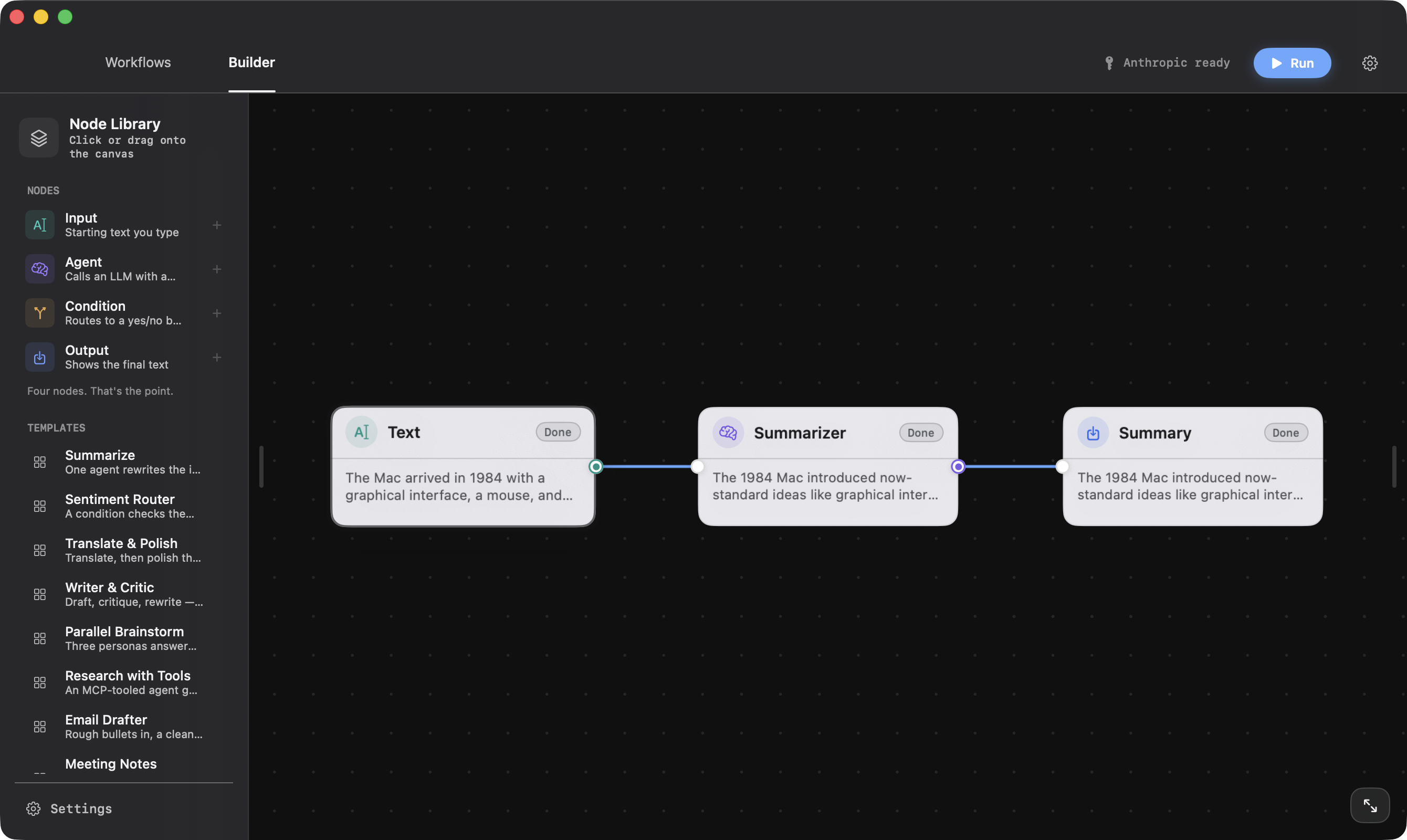
Four node types
That's the point. The whole vocabulary is:
- Input — the starting text.
- Agent — a system prompt and a model. Takes the incoming text, calls the
LLM, streams text out. Can call MCP tools. - Condition — routes to a
yesornobranch, either by keyword or by
asking a model a yes/no question. - Output — shows the final text.
Branches that don't depend on each other run concurrently, several inputs
can fan into one node (they're joined in edge order), and the branch a
condition didn't take is marked skipped rather than silently dropped.
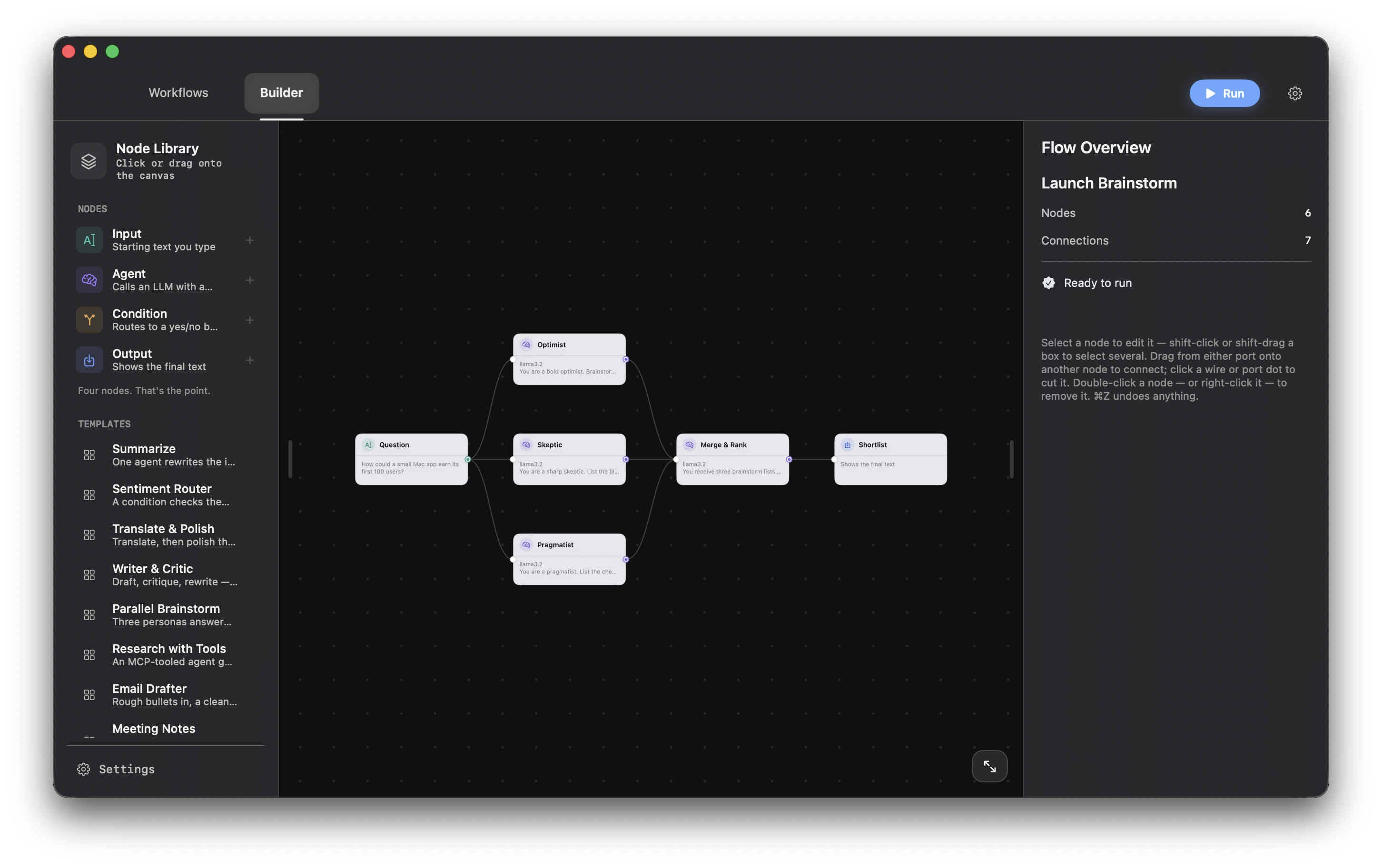
Why so few nodes?
Because the vocabulary is small, not the ceiling. An Agent reaches anything
through MCP tools, {{Node name}} reaches any value upstream, and iteration is
coming as a node that loops inside itself rather than a cycle on the canvas.
Hosted builders solve a different problem — they're infrastructure for
companies shipping products, with evals, tracing and one-click deployment, and
they run that vendor's models. Osler is a Mac app for one person's work. It can
run Claude, GPT and a local model in the same flow, offline if you want, with
no account to make.
Reaching sideways
Text flows along the wires, but a node can also reach a value that isn't wired
into it. Write {{Node name}} in an Agent's system prompt (or a Condition's
question) and it's replaced at run time with that node's output:
Compare the two.
Original: {{Text}}
Translation: {{Translate}}
References may only point upstream — at a node that's guaranteed to have
finished first. Anything else is flagged before the flow runs, so a value can
never race its reader. The inspector lists what's in reach.
Tools, via MCP
An Agent can call tools from MCP servers —
files, web, APIs, anything with a server. Add one in Settings → MCP as a
local command:
npx -y @modelcontextprotocol/server-filesystem ~/Documents
Hit Test to launch it and see its tools, then enable the server on any
Agent node. The agent decides when to call what; each call shows up in the
node's output as it happens.
Today Osler speaks to stdio servers only, and a tool-enabled agent answers turn
by turn instead of streaming live. Tool calls run without an approval step —
an Approval node is next on the roadmap.
Models
Bring your own key, or bring your own machine:
| Provider | Needs a key | Notes |
|---|---|---|
| Anthropic | yes | Messages API, streaming |
| OpenAI | yes | Chat Completions, streaming |
| Ollama | no | Local models, fully offline |
Keys live in the macOS Keychain — never on disk in plain text, never sent
anywhere except the provider you're calling. Ollama needs nothing but a running
server at localhost:11434.
Getting started
Download the latest release
— macOS 14 or newer. Open the .dmg, drag Osler to Applications, then
right-click it and choose Open the first time.
That first-launch warning isn't a problem with the app — it just isn't signed
with a paid Apple developer account. Right-click → Open tells macOS you meant
it, once. (No "Open" in the menu? System Settings → Privacy & Security →
Open Anyway.) After that Osler updates itself, and every update is
signature-verified, so a tampered download is refused.
Or build it
Requirements: Swift 5.9+ (Xcode 15+).
git clone https://github.com/albertofettucini/Osler.git
cd Osler
swift run Osler
And to produce the app bundle itself:
./scripts/package-app.sh --desktop # builds Osler.app and copies it to ~/Desktop
Other targets:
swift test                          # engine tests
swift run osler-cli --demo linear   # headless run (uses Ollama when no key is set)
swift run osler-cli --demo tools    # MCP tool loop against a mock server
swift run osler-cli --demo cycle    # cycle detection, no model needed
Around the canvas
Eight starter templates ship with the app — Summarize, Sentiment Router,
Translate & Polish, Writer & Critic, Parallel Brainstorm, Research with Tools,
Email Drafter, Meeting Notes → Actions. Open one, press Run, take it apart.
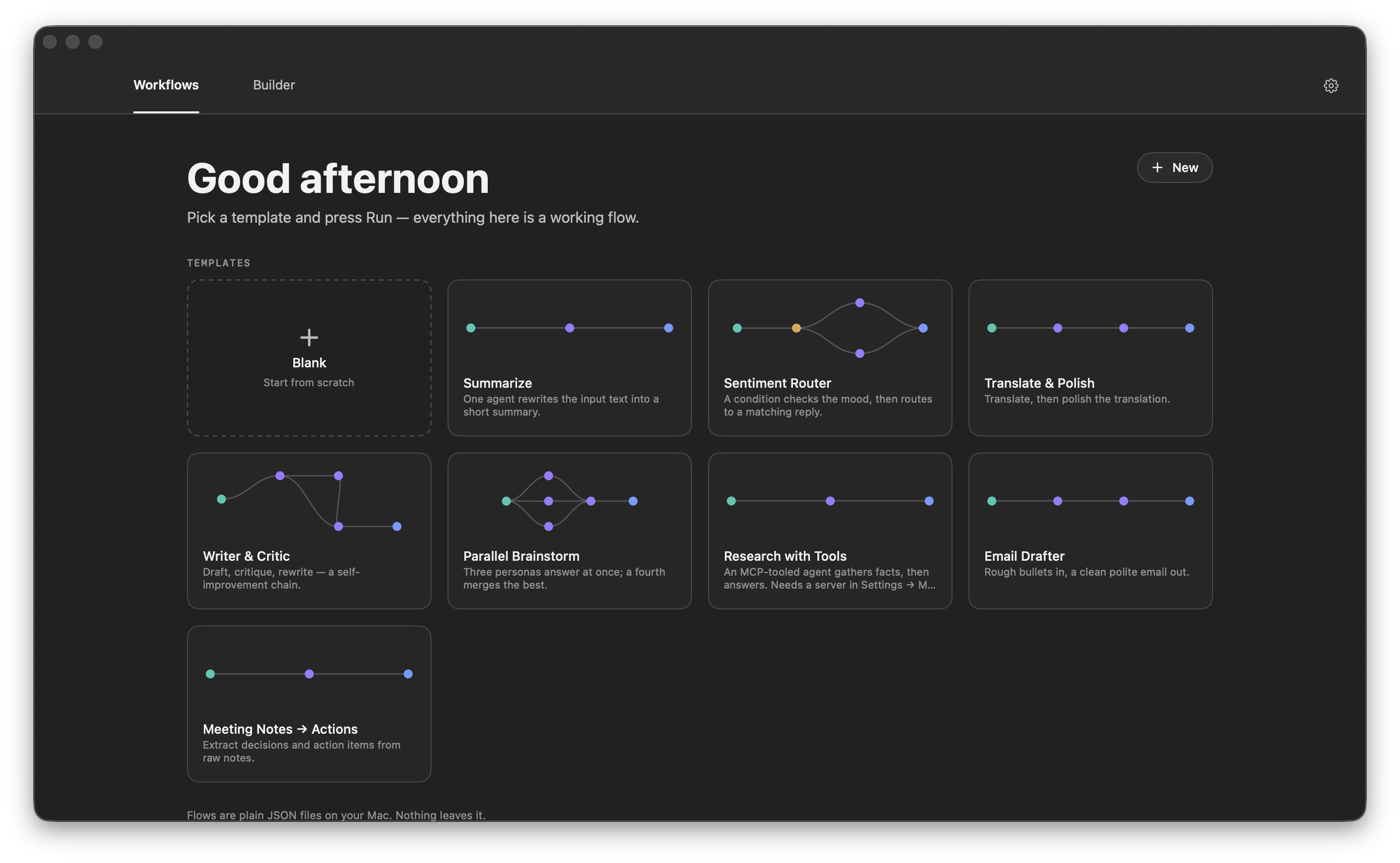
Wiring is two-way: drag from either port onto another node to connect, click a
wire (or a port dot) to cut it. Double-click empty canvas to add a node where
you clicked, or drag one in from the library. Shift-click and shift-drag select
several nodes; ⌘Z undoes anything. ⌘K opens a command palette. Save any flow as
a template and it joins the library.
Flows are plain JSON files (.oslerflow) — readable, diffable, and yours. A
flow saved by a newer version keeps its unknown nodes intact when an older
build opens it.
Appearance follows the system, or you can pin light/dark and pick a background
wash and card tint in Settings.
Architecture
OslerEngine is a headless Swift library with no UI dependency:
FlowGraph/Node/Edge— the Codable graph model.GraphValidator— structural checks and topological ordering, with real
cycle errors instead of hangs.FlowEngine— readiness-based scheduling (independent branches run in
parallel), per-node state as an async event stream, cancellation throughout.LLMProvider— a two-method protocol: stream text, or take one tool-calling
turn. Adding a provider is a single type.MCPClient/MCPToolbox— stdio JSON-RPC, tool discovery, call routing.
Osler is the SwiftUI app — canvas, inspector, run controller — bound to
the engine's event stream. osler-cli runs flows headlessly.
64 tests cover the engine, including a real subprocess round-trip against a
scripted MCP server.
License
MIT — see LICENSE.
Yorumlar (0)
Yorum birakmak icin giris yap.
Yorum birakSonuc bulunamadi