blackbox-datahub
Health Gecti
- License — License: Apache-2.0
- Description — Repository has a description
- Active repo — Last push 0 days ago
- Community trust — 16 GitHub stars
Code Gecti
- Code scan — Scanned 12 files during light audit, no dangerous patterns found
Permissions Gecti
- Permissions — No dangerous permissions requested
Bu listing icin henuz AI raporu yok.
BlackBox, Grand Prize winner of the Build with DataHub Agent Hackathon 2026. Autonomous data incident response with an evidence gate, verified repair, real PRs, and DataHub write-back.
◼ BlackBox — Autonomous Data Incident Response
🏆 BlackBox won the Grand Prize at the Build with DataHub Agent Hackathon in September 2026, out of 600+ projects — DataHub's write-up · Devpost project page
Evidence-gated autonomous recovery for data incidents.
Claude decides what to investigate; deterministic tools decide what is true.
Tell BlackBox what looks wrong. It reads DataHub's context graph, proves the root cause against a machine-enforced evidence gate, repairs the pipeline, executes and verifies the fix against the full invariant suite, opens a real pull request, and writes the resolution back into DataHub.
READ → PROVE → ACT → VERIFY → WRITE







Built for Build with DataHub: The Agent Hackathon · Submitted challenge: Agents That Do Real Work · Also demonstrates: Metadata-Aware Code Generation & Development
The worst data incidents don't crash anything. A payment provider quietly starts reporting amount in cents instead of dollars. Every schema still validates. Every job stays green. The executive revenue dashboard is wrong by 100× — and nobody notices for days.
BlackBox is given one plain-English sentence — "Revenue just jumped roughly 100×. Is this real?" — and takes it from there.
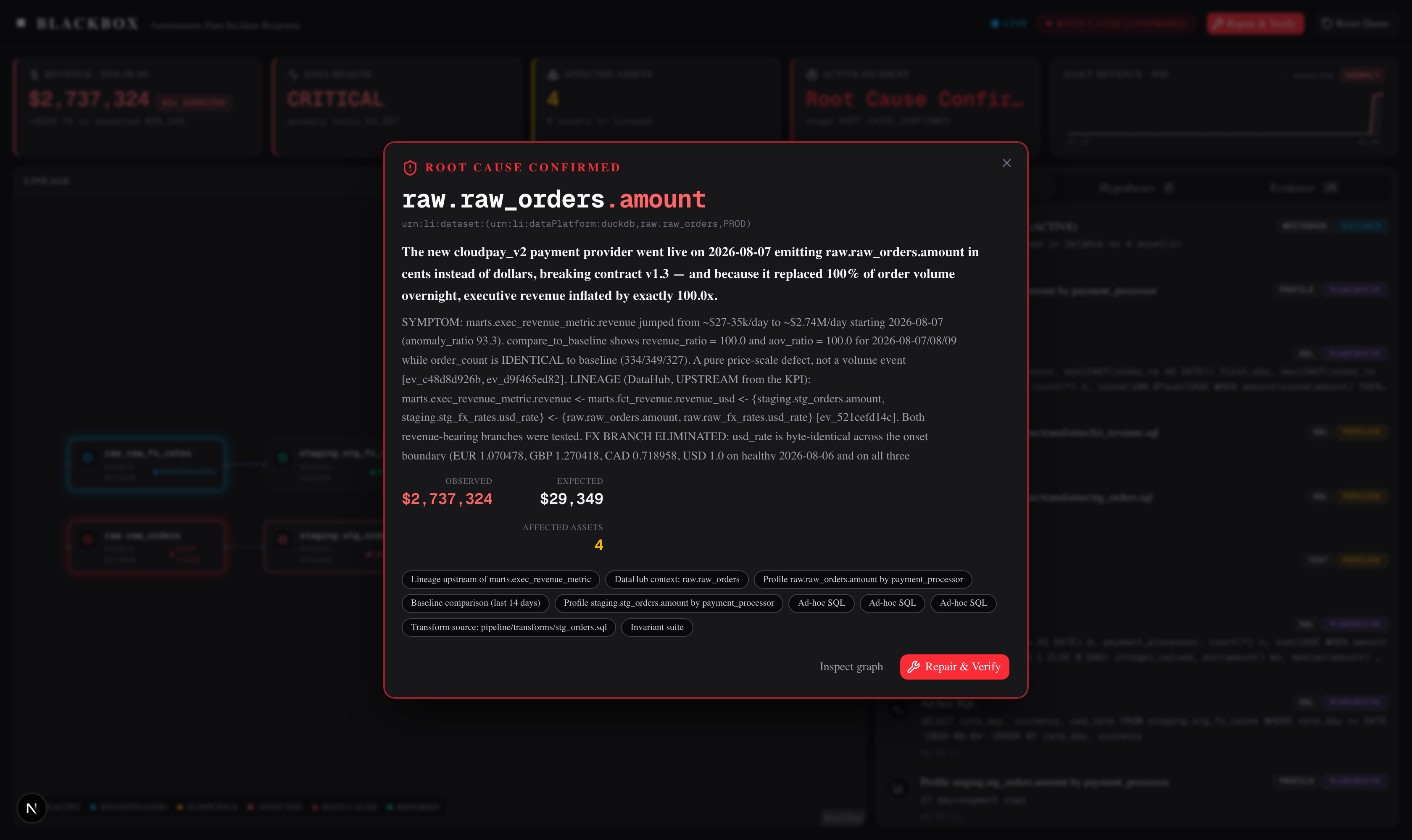
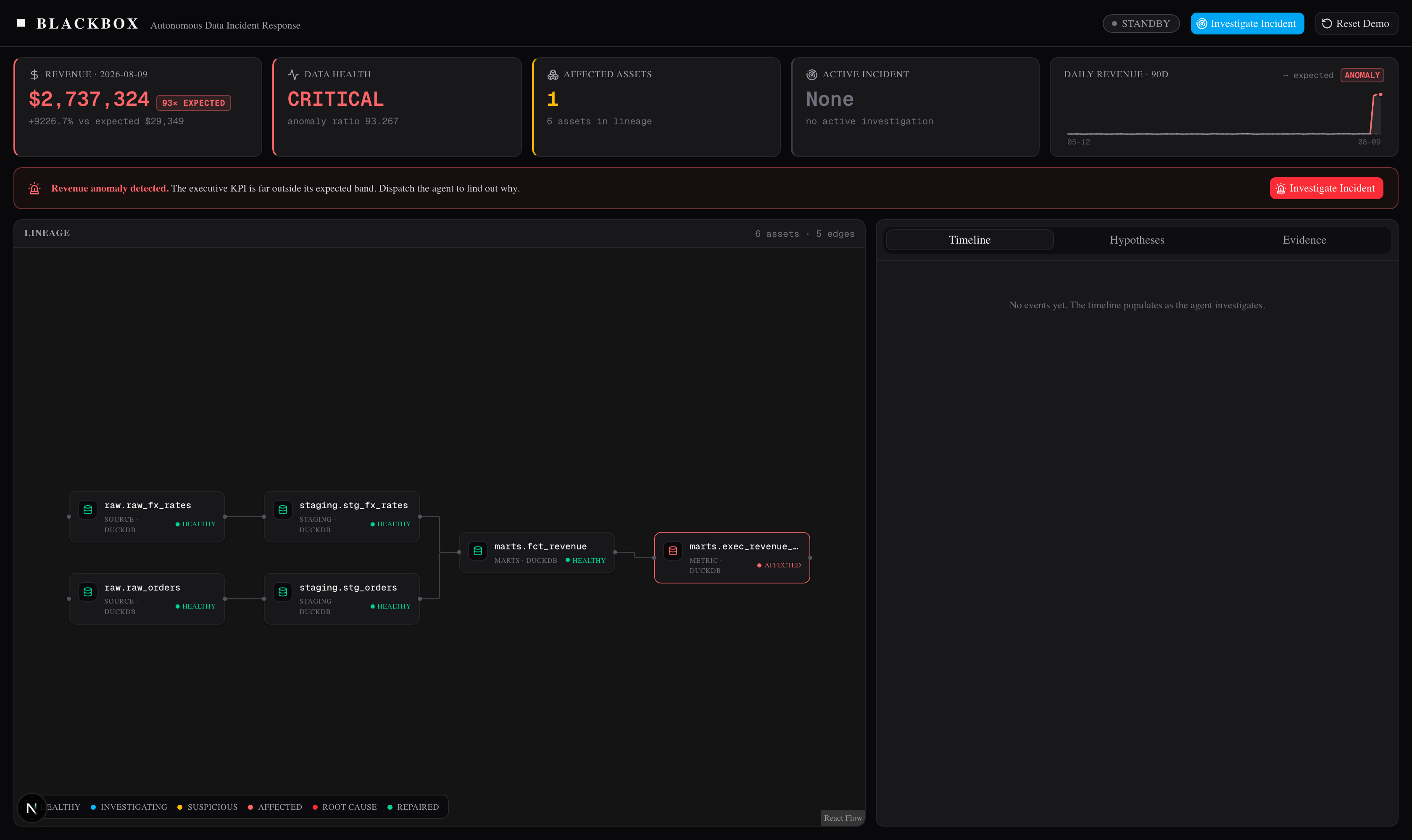
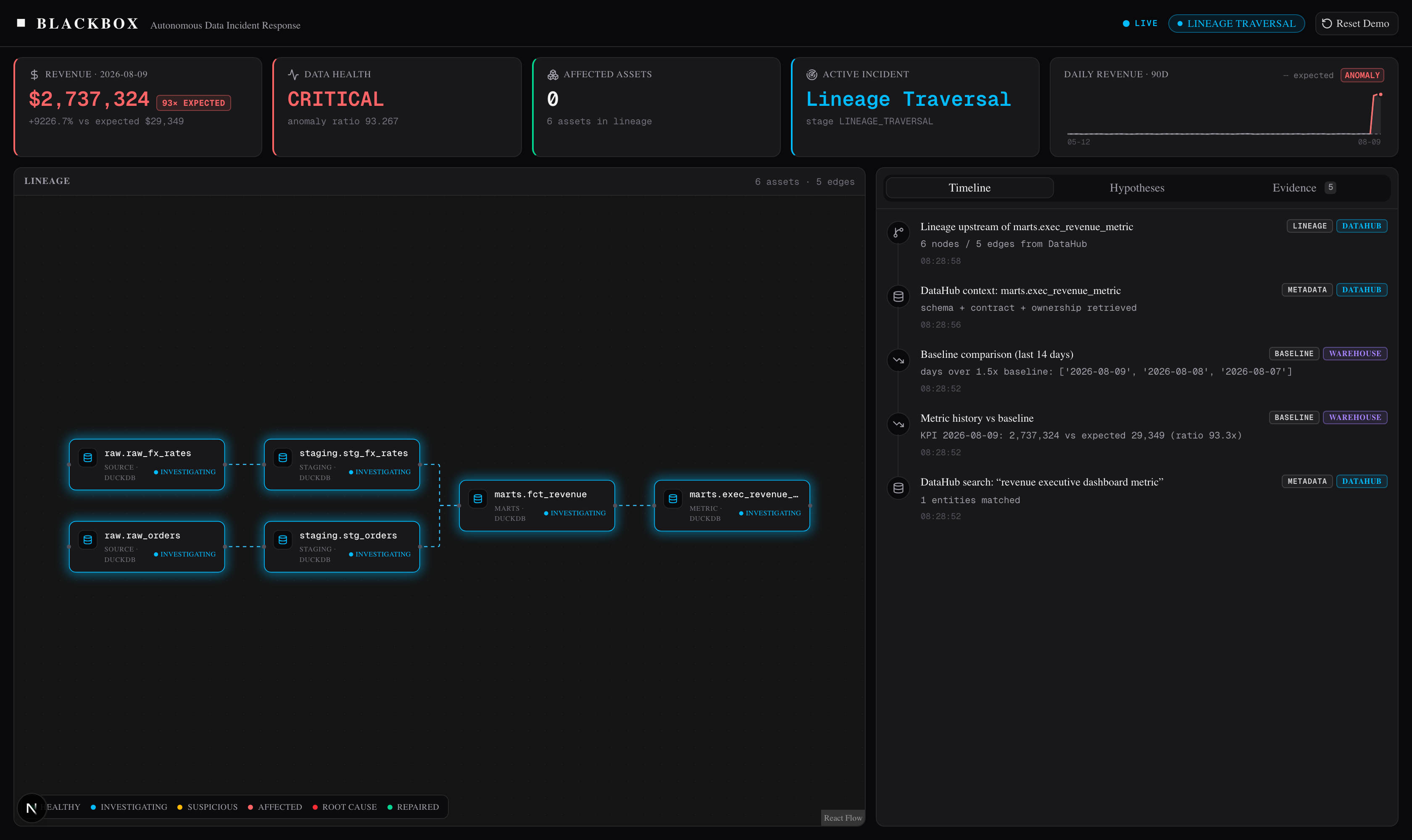
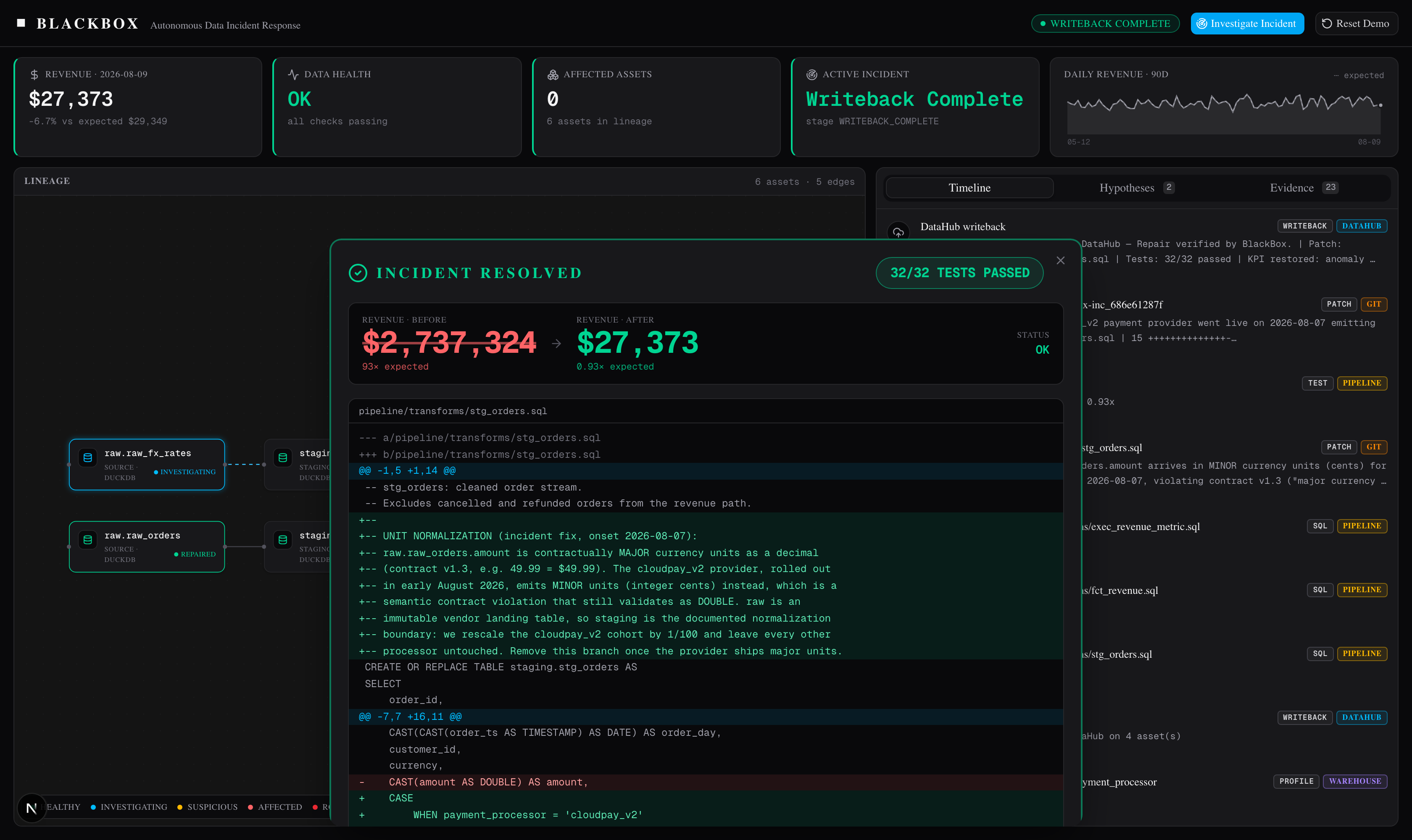
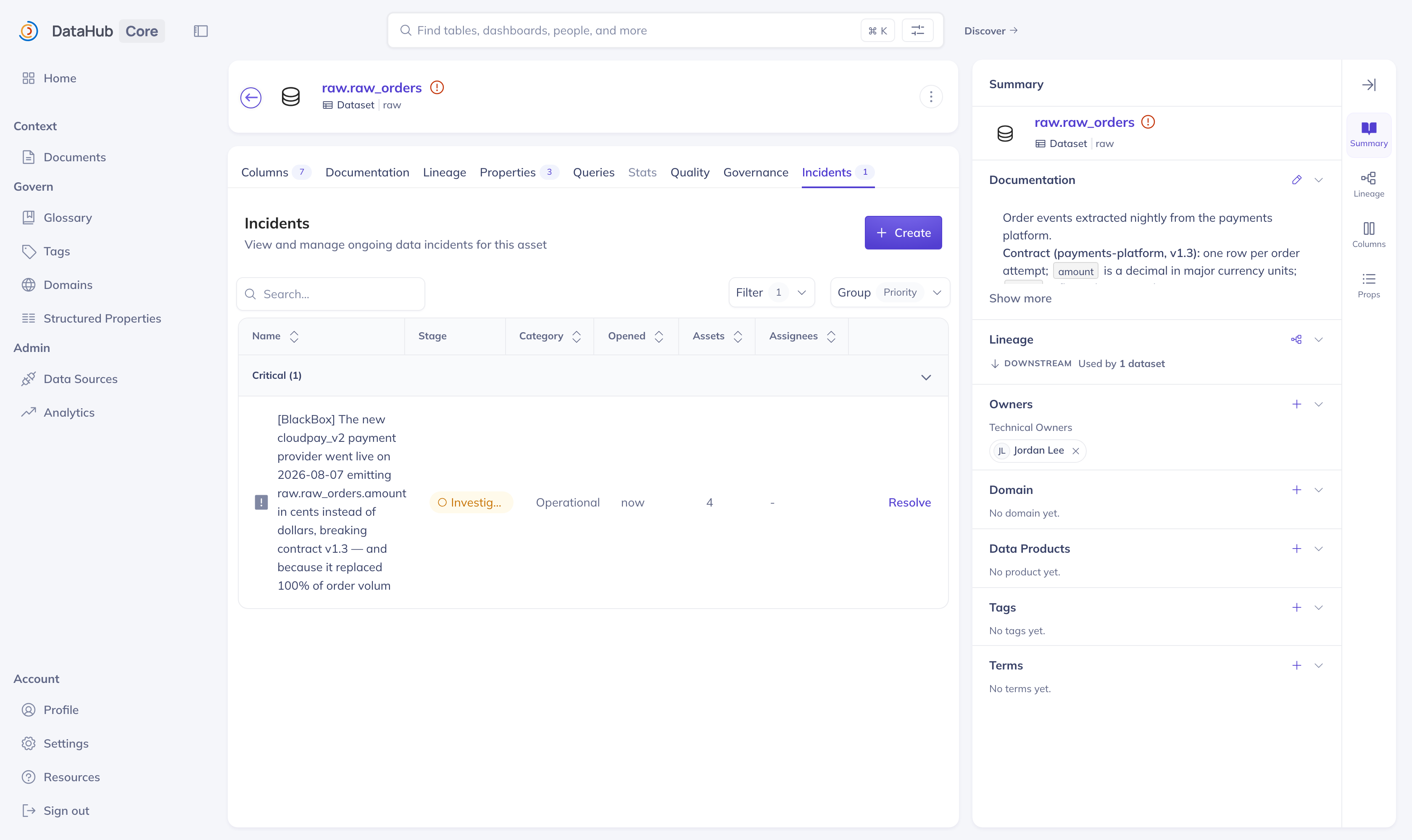
Top: anomalous KPI at 93.3× · live lineage traversal | Bottom: verified repair (32/32, real diff, git branch) · the incident BlackBox raised in DataHub
See it work
One autonomous run, graded on 11 machine-checked criteria — all passed, 13 turns, 24 tool calls, ~180 s:
| Reported symptom | Executive revenue $2,737,324 — 93.3× its expected baseline |
| Root cause found | raw.raw_orders.amount — cloudpay_v2 migration emitting integer cents, violating the documented contract |
| Distractor rejected | stale FX feed eliminated quantitatively (max effect ~1.27×, two orders of magnitude too small) |
| Repair | provider-scoped CASE WHEN normalization in stg_orders.sql, written by the agent |
| Verification | 32/32 invariants green; KPI restored to 0.93×, within 1% of the committed healthy baseline |
| Writeback | DataHub incident RESOLVED / FIXED + docs note + tag → WRITEBACK_COMPLETE |
| Engineering artifact | a real pull request the agent opened itself → |
🔎 The receipt: PR #1 — opened by BlackBox, left open for judges
Not a mock-up and not hand-assembled: an incident run reached
VERIFIED, and the verified-repair path pushedblackbox/fix-inc_17b054bc01and opened that PR. The body is rendered only from recorded evidence — autonomous-authorship and synthetic-fixture disclosures, the blamed DataHub asset and field, the DataHub evidence census, quantitative tables from the cited profiles, the real unified diff, the before/after KPI, and 32/32 invariants. Read it the way you would review any machine-authored change.
Inspect the actual run, no install required: examples/sample-incident/ — unedited incident state, full agent transcript, the real patch, and the agent's final report. Every eval run and its artifacts: evals/results/.
Why trust the agent?
Anyone can get an LLM to say it found a root cause. The design question is what happens when it's wrong — so every way this could produce a confident falsehood has a structural defense that does not depend on the model behaving well.
| Failure mode | Structural defense | Proof |
|---|---|---|
| The model invents a plausible root cause | confirm_root_cause is rejected unless the agent cites DataHub lineage/metadata evidence and quantitative evidence that actually references the blamed asset and field |
tests/test_engine.py · rejection paths unit-tested |
| It declares healthy data broken | NO_INCIDENT is itself evidence-gated; a healthy-fixture control run must not invent an incident |
control_no_incident eval — evals/results/ |
| It makes the headline KPI look right by corrupting history | Repair must pass the entire invariant suite (incl. historical immutability) and land the KPI within 1% of the committed baseline | bad_repair_rejected eval: a naive blanket /100 is caught |
| A prior run leaks the answer via DataHub writeback | Reset scrubs BlackBox-written DataHub state; the eval harness hard-fails on contamination | datahub/reset.py · evals/harness.py |
| The "repair" is merely plausible text | The real transform file is modified, the warehouse is rebuilt, and the diff is computed by difflib from disk |
real patch in examples/sample-incident/repair.patch |
| Remote publication fails | PR creation runs strictly after verification and is non-gating; failure is recorded as evidence | tests/test_repair_pr.py |
The LLM is never the final judge of a fact, a root cause, a repair's correctness, or an evaluation result.
Safety envelope
The model controls investigative strategy. The system controls its authority. Every constraint below is enforced in code, not prompting:
| The agent cannot… | Enforced by |
|---|---|
| Advance a root cause without machine-validated DataHub and quantitative evidence naming the blamed asset/field | tools.py::t_confirm_root_cause · tests |
Mutate the pipeline without explicit human authorization — diagnosis pauses at ROOT_CAUSE_CONFIRMED until an operator presses Repair & Verify |
api.py::start_repair · allow_repair in tools.py |
Touch anything outside pipeline/transforms/*.sql |
repair.py::_resolve_transform — path-resolved allowlist |
| Pass off a repair it did not execute — the patch is written to the real transform and the warehouse is rebuilt | repair.py::verify_repair |
| Leave an unverified repair on disk — abandoned/failed patches are reverted and the warehouse rebuilt | investigator.py::_cleanup_unverified_patch |
| Declare success on a partial fix — requires the complete invariant suite green and the KPI inside the acceptance band | verify_repair: report.failed == 0 and 0.8 ≤ ratio ≤ 1.3 |
Hide a plausible-but-wrong fix — a blanket /100 is caught by historical-immutability invariants |
bad_repair_rejected eval, evals/results/ |
Turn a verified repair into a failure via publication — PR creation runs strictly after VERIFIED and is non-gating |
repair.py::publish_repair_pr · tests |
Push anywhere but blackbox/fix-* on origin |
FIX_BRANCH_PREFIX guard in repair.py |
| Write a resolution to DataHub before it is earned — the incident is raised at proven root cause and only resolved after verification | datahub/writeback.py |
Read-only SQL is additionally sandboxed: filesystem access is disabled at the DuckDB connection level after a security review found read_csv('.env') could slip past a SELECT-prefix guard (warehouse.py, regression test).
Architecture
flowchart TB
    User([On-call engineer]):::human
    UI["Next.js Command Center<br/><i>lineage canvas · evidence timeline</i>"]:::app
    API["FastAPI + SSE<br/><i>incident state machine</i>"]:::app
    LLM["Claude Investigator<br/><i>chooses what to investigate</i>"]:::llm
    GATE{{"Evidence gates<br/><i>machine-checked citations</i>"}}:::gate

    subgraph TOOLS["Deterministic tools — the only source of facts"]
        DH["DataHub client"]:::tool
        WH["DuckDB warehouse<br/><i>profiling · baselines · read-only SQL</i>"]:::tool
        PT["pytest<br/><i>32 pipeline invariants</i>"]:::tool
        GIT["git worktree<br/><i>difflib patch · fix branch</i>"]:::tool
    end

    subgraph ROUTES["Alternative routes to ONE DataHub graph — not independent sources"]
        MCP["① Official MCP Server<br/><i>search · context · lineage hops</i>"]:::route
        ACK["② Agent Context Kit<br/><i>embedded Python, same reads</i>"]:::route
        GQL["③ GraphQL + aspect reads<br/><i>fallback · fineGrainedLineages</i>"]:::route
    end

    HUB[("DataHub OSS v1.7<br/>schemas · contracts · ownership<br/>table + column lineage")]:::hub
    PIPE[["pipeline/transforms/*.sql<br/>DuckDB warehouse"]]:::data

    User -->|"'Revenue jumped 100×. Is this real?'"| UI
    UI <-->|"live state stream"| API
    API --> LLM
    LLM -->|"tool calls"| TOOLS
    TOOLS -->|"EvidenceItems (facts, transport-tagged)"| GATE
    GATE -->|"accepted / rejected"| LLM

    DH --> MCP --> HUB
    DH -.->|"fallback"| ACK --> HUB
    DH -.->|"fallback"| GQL --> HUB
    GQL -.->|"column-level lineage<br/>comes from here, not MCP"| HUB

    WH <--> PIPE
    GIT -->|"applies repair"| PIPE
    PIPE -->|"rebuild"| PT
    PT -->|"32/32 + KPI in range<br/>= verified"| GIT
    GIT -->|"fix branch + commit"| ART[/"Git repair artifact"/]:::out
    ART -.->|"opt-in BLACKBOX_CREATE_PR<br/>post-verification, non-gating"| PR[/"Real GitHub PR"/]:::out
    GATE -->|"root cause proven → ACTIVE incident"| HUB
    PT -->|"resolution + remediation note + tag"| HUB

    API -.->|"optional · BLACKBOX_TRACING<br/>observability only, never correctness"| OTEL(["Phoenix / OpenTelemetry<br/>one incident = one trace"]):::opt

    classDef human fill:#1f2937,stroke:#6b7280,color:#f9fafb
    classDef app fill:#0c4a6e,stroke:#38bdf8,color:#f0f9ff
    classDef llm fill:#4c1d95,stroke:#a78bfa,color:#f5f3ff
    classDef gate fill:#7c2d12,stroke:#fb923c,color:#fff7ed
    classDef tool fill:#064e3b,stroke:#34d399,color:#ecfdf5
    classDef hub fill:#1e3a8a,stroke:#60a5fa,color:#eff6ff
    classDef data fill:#292524,stroke:#a8a29e,color:#fafaf9
    classDef out fill:#713f12,stroke:#facc15,color:#fefce8
    classDef route fill:#134e4a,stroke:#2dd4bf,color:#f0fdfa
    classDef opt fill:#1c1917,stroke:#57534e,color:#a8a29e
Why this architecture matters
The split between the model and the tools is the whole design:
- Claude chooses what to investigate — which branch of the lineage to walk, which cohort to profile, which hypothesis is worth the next query. That is genuinely a judgment problem.
- Deterministic code produces every fact.
EvidenceItems come only from tool execution — DuckDB profiles, DataHub lineage reads, pytest runs, difflib diffs. The model never free-types a number, an edge, or a test result. - Root-cause claims are machine-checked before they're accepted.
confirm_root_causeis rejected unless the agent cites DataHub lineage/metadata evidence and quantitative evidence that actually references the blamed field and asset. An LLM cannot talk its way past this gate — see the evidence-gate unit tests that hold it down. - A generated repair only counts if it executes. The patch is applied to the real transform, the warehouse is rebuilt, and all 32 invariants plus the KPI must pass. A fix that restores the headline number while corrupting history is rejected and the agent iterates — proven by the
bad_repair_rejectedeval. - DataHub is both the map and the memory. Topology, schemas, and the data contracts come from the graph; the incident, root cause, remediation note, and tag go back into it. The next engineer inherits the investigation.
Deep version — state machine, evidence-gating internals, verification loop: docs/ARCHITECTURE.md.
How DataHub is used
| Surface | Used for | Where |
|---|---|---|
Official DataHub MCP Server (uvx mcp-server-datahub) |
the agent's entity discovery, entity context, and lineage BFS — BlackBox is a real MCP client of DataHub's agent surface | datahub/mcp_bridge.py, client.py |
Agent Context Kit (datahub-agent-context) |
the same reads over a native embedded Python path — no subprocess, no stdio hop; second in the transport chain | datahub/context_kit.py |
| GraphQL API | dataset context, schema contracts, fallback lineage | client.py |
Column-level lineage (fineGrainedLineages) |
tracing the KPI to the exact upstream field | client.py (read) · ingest.py (emit) |
| Python SDK v2 | ingestion: warehouse-introspected schemas, data-contract field docs, ownership, tags, table and column lineage with the real transform SQL attached | datahub/ingest.py |
Incidents API (raiseIncident / updateIncidentStatus) |
ACTIVE incident the moment the cause is proven → RESOLVED/FIXED after verified repair |
datahub/writeback.py |
| Dataset docs + tags | durable remediation note + blackbox-remediated tag |
writeback.py |
| DataHub Skills | development workflow (skills registry plugin) | dev environment |
Two transports, one graph. DataHub's context graph is reachable both through the interoperable MCP Server and through the Agent Context Kit's embedded Python path; reads try MCP → ACK → GraphQL and each fact records the transport that produced it (EvidenceItem.transport, visible in examples/sample-incident/). That is provenance for the reader, not a claim of independent corroboration — every transport ultimately reads the same DataHub instance. The kit's Cloud-gated tools (ask_datahub_chat, document search) are deliberately unused; this targets OSS/Core, and a test enforces it.
The honest ablation. BLACKBOX_DISABLE_DATAHUB=true disables the DataHub tools and writeback, and relaxes the confirm gate so the test isn't circular. Measured result: on this 5-transform fixture the ablated agent can still brute-force a correct diagnosis by reading transform files. We report that instead of claiming helplessness. What it loses is what matters at scale — the topology map (unworkable across thousands of models), the documented contract that makes the violation provable, every DataHub-grounded citation, and any durable record of the incident.
Contributed back to DataHub OSS
Two upstream PRs, both open (not merged) at time of submission:
- datahub-skills#133 — a new
datahub-incident-investigationskill (16 files, +1259/−48) generalizing this project's methodology into a reusable, vendor-neutral agent workflow: symptom → lineage localization → competing hypotheses → evidence standards (necessity and sufficiency) → a 5-point confirmation gate → blast radius → remediation → verification → writeback. It names no warehouse, no schema, and nothing from this repo. Every command in it was executed against live DataHub OSS first — log indocs/SKILL_VALIDATION.md, which also captured three upstream-relevant findings:healthreturns a list rather than an object;properties.descriptioncan benullwhileeditableProperties.descriptionholds the real contract (an agent reading only the former calls a documented column undocumented); and OSS has no top-levelincident(urn:)query. - datahub#19046 — troubleshooting docs for a silent
datahub docker quickstarthang under Colima/Rancher Desktop/Podman (docker-py readsDOCKER_HOSTbut not Docker CLI contexts), which cost us ~15 minutes of a blank screen.
Full friction log: docs/DATAHUB_FEEDBACK_LOG.md.
Quickstart
Prereqs: Docker (≥8 GB RAM), Python 3.11+ via uv, Node 20+, DataHub CLI (uv tool install acryl-datahub), an Anthropic API key.
git clone https://github.com/alejandro-publius/blackbox-datahub && cd blackbox-datahub
make setup                       # uv sync + npm install
make datahub-up                  # DataHub OSS quickstart v1.7.0 (UI :9002, GMS :8080)
make datahub-setup               # mint PAT → .env, ingest pipeline metadata, verify round-trip
echo 'ANTHROPIC_API_KEY=sk-ant-...' >> .env
make demo-reset                  # seed the broken state (revenue silently ~93× too high)
make demo-run                    # backend :8400 + frontend :3000
Open http://localhost:3000 → Investigate Incident. Colima users: export DOCKER_HOST="unix://$HOME/.colima/default/docker.sock" first — that's PR #19046.
Verify without the UI:
make test                        # 32 pipeline invariants (incident mode fails exactly 7 — by design)
uv run pytest tests/             # 68 unit tests: evidence gates, repair/PR, ACK, tracing
uv run python scripts/vertical_slice.py   # full autonomous run in the terminal
uv run python scripts/demo_drill.py       # Playwright drill of the whole judge flow
make evals                       # eval battery (see evals/README.md)
Evals
A deterministic harness, graded entirely by code — never by an LLM judging itself:
- Seeded incident — 11 machine-checked criteria including that the repair restores the committed baseline to within 1%, is scoped to the defective cohort, and touches exactly one file.
- No-incident control — healthy data must not produce an invented incident (false-positive guard).
- Bad-repair rejection — a naive blanket
/100is caught by historical-immutability invariants, proving the verification gate has teeth. - DataHub ablation — measures what the metadata graph actually contributes.
An independent adversarial review of the methodology ran during development; its critical findings — a writeback note that could contaminate later runs, and a circular ablation — were fixed. The harness now scrubs BlackBox-written DataHub state before every scenario and hard-fails on contamination. Details: evals/README.md · results: evals/results/.
What's real vs. synthetic (full disclosure)
- Synthetic (disclosed): the retail pipeline's source data is generated deterministically (
pipeline/generate_sources.py, seed 42), including the seeded incident — a payment-provider migration silently switchingraw_orders.amountfrom dollars to integer cents on 2026-08-07 — plus a stale-FX distractor.make demo-resetrestores that exact broken state. - Real: the DuckDB warehouse and SQL transforms execute; DataHub OSS v1.7.0 runs locally with genuinely ingested metadata; every agent fact comes from a live tool call; the diff, tests, KPI recomputation, git branch, and DataHub incident are all real. Nothing in the prompts or metadata names the incident's nature — the agent discovers it (see
CLAUDE.md, "No incident leakage").
Pointing this at a real stack
DuckDB is here because the demo must run on a judge's laptop in one command. The engine is separated from it by three seams:
| Seam | Demo | Production swap |
|---|---|---|
Query + profiling (warehouse.py) |
DuckDB over local CSVs | Snowflake/BigQuery/Databricks — same profile_column / compare_to_baseline / run_sql signatures |
Verification (repair.verify_repair) |
warehouse rebuild + 32 pytest invariants | dbt build --select state:modified+ + dbt test on a CI branch or zero-copy clone |
Repair surface (repair._resolve_transform) |
pipeline/transforms/*.sql |
dbt models directory; the existing git-worktree flow opens the PR |
DataHub, the agent loop, the evidence gates, and the writeback are unchanged by those swaps. What stays honest: we demonstrate on a pipeline we authored, so treat the incident realism as illustrative and the machinery as the contribution.
Observability (optional)
An investigation is a long autonomous trajectory, so it is traceable end to end. With the tracing extra installed and BLACKBOX_TRACING=true, one incident renders as one trace in a self-hosted Arize Phoenix: an agent-phase span containing a span per deterministic tool call and per Anthropic call (auto-instrumented via OpenInference), annotated with the outcomes that matter — root-cause gate result, N/N invariants, post-repair KPI ratio, writeback status, repair branch.
uv sync --extra tracing && uv run phoenix serve      # UI on :6006
BLACKBOX_TRACING=true make demo-run
Off by default and genuinely optional: with the flag unset no tracing package is imported and every hook is a no-op — pinned by 7 regression tests, one of which reproduces a real bug this caught (a double-yield on the span error path that turned any exception inside a traced block into a failed investigation). No secrets or raw rows are recorded.
CI
Every push runs backend unit tests, the healthy fixture's 32/32 invariants, frontend lint + build, and a secrets scan — all deterministic, no API key or live DataHub required, so the checks also pass on a fork (.github/workflows/ci.yml).
For judges
45-second path: the screenshots → the actual result → why trust it + safety envelope → the PR the agent opened → adversarial evals → make judge-check (below) → DataHub usage + writeback → upstream OSS contributions.
Verify it yourself in one command — no API key, no DataHub, no network service:
make judge-check
Runs the same deterministic evidence CI runs — backend unit tests, the healthy fixture at 32/32 invariants, frontend lint + production build, and a tracked-secret scan — then restores the demo's incident fixture. It never runs a live agent, touches a remote, or opens a PR. (The full autonomous demo needs an Anthropic key and DataHub; see Quickstart.)
BLACKBOX JUDGE CHECK
backend:               PASS — 68 tests
healthy pipeline:      PASS — 32/32
frontend lint/build:   PASS — clean
secrets:               PASS — none tracked, .env ignored
No API key, live DataHub, GitHub token or Phoenix used. No remote touched.
| Proof every claim here is real | docs/ACCEPTANCE.md — every gate with runnable evidence + stated limitations |
| A real run, unedited | examples/sample-incident/ |
| Eval results + artifacts | evals/results/ |
| Deep architecture | docs/ARCHITECTURE.md |
| Self-assessment vs. rubric | docs/JUDGE_SCORECARD.md — weaknesses included |
| Demo walkthrough | docs/DEMO_SCRIPT.md |
| Design source | Figma — Incident Command Center (4 product states + tokens, authored via Figma MCP) |
Repo map
pipeline/ demo data stack + 32 invariants · backend/blackbox/ engine, agent, DataHub integration, API · frontend/ Next.js command center · evals/ harness + results · examples/ inspectable run artifacts · docs/ architecture, acceptance, scorecard, demo script, feedback log · scripts/ vertical slice + browser drill.
License
Apache-2.0 — see LICENSE.
Yorumlar (0)
Yorum birakmak icin giris yap.
Yorum birakSonuc bulunamadi