hearthwork
Health Uyari
- License — License: MIT
- Description — Repository has a description
- Active repo — Last push 0 days ago
- Low visibility — Only 6 GitHub stars
Code Gecti
- Code scan — Scanned 12 files during light audit, no dangerous patterns found
Permissions Gecti
- Permissions — No dangerous permissions requested
Bu listing icin henuz AI raporu yok.
A plan → execute → judge loop for Claude Code: an operator plans each unit, a fenced executor does it, the judge checks against git, with a live work log and a spirit you can talk to.
hearthwork
A plan → execute → judge loop for Claude Code, with a
home, a work log, and a spirit you can talk to.
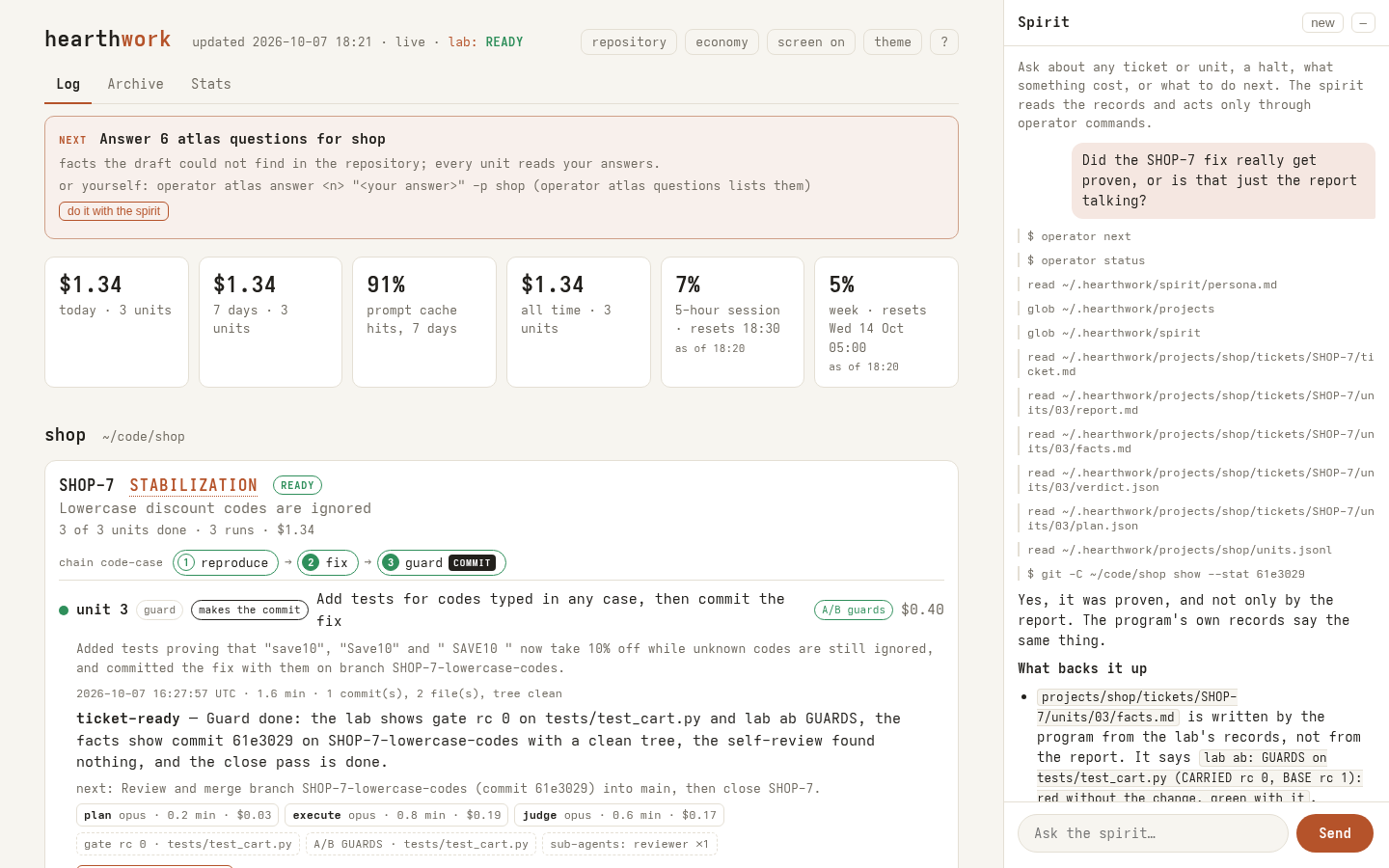
You give it a ticket. An operator plans the work in small units and writes a prompt
for each. An executor does the unit in your checkout, behind a fence. The operator
judges the report against what git actually shows, updates the plan, and writes down what
it learned. A ticket moves unit by unit until the operator judges it ready, or stops to
ask you a question.
            ┌───────────── operator (plans, judges, remembers) ──────────────┐
ticket ──►  │ PLAN: one bounded prompt   JUDGE: report + git facts → verdict │ ──► ready
            └──────────────┬──────────────────────────▲──────────────────────┘
                           ▼                          │
                executor in your checkout ──► report ─┘   (fenced, cold, 45 min)
It is extracted from a system that has carried hundreds of units of real ticket work
unattended. What made that work was not prompting. It was structure:
- The judge never sees the code. The operator reasons from the executor's report and from
facts the program reads from git; when the two disagree, the facts win. - Every answer has a contract, checked by code. A broken answer goes back to the same
session with the deviation named; three in a row halt the loop and ask you. - Investigation before execution. No change is written on a hypothesis. Work that ends in
one commit is a chain: what it needs to learn, the changes, and one committing unit. - A fix is proven, not claimed. The lab runs a guard test on your uncommitted work and on
HEAD: it must fail without the change and pass with it. Probes are disposable and never
reach a commit; a reader, a prober and a reviewer run on a cheaper model beside the executor. - Nothing is lost when something stops. A usage limit, a crash, a closed laptop: the next
run resumes, or surveys the tree and judges what is there. - You see everything. A live page with every unit's prompt, report, git facts, verdict and
cost; your 5-hour session and week; and a chat with a spirit that reads the records.
Install
Python 3.10+, git, and the Claude Code CLI (claude), logged in.
python3 -m venv ~/.hearthwork-venv
~/.hearthwork-venv/bin/pip install git+https://github.com/alexandr352/hearthwork
echo 'export PATH="$HOME/.hearthwork-venv/bin:$PATH"' >> ~/.zshrc   # ~/.bashrc on bash
source ~/.zshrc
operator doctor
To update: ~/.hearthwork-venv/bin/pip install --upgrade git+https://github.com/alexandr352/hearthwork,
then operator upgrade. What changed: CHANGELOG.md.
Start
Two ways, and they meet in the middle.
Talk to the spirit. operator ui opens the work log with a chat beside it, and a banner
that always names the next step. Say hi: the spirit lists your repositories, registers the one
you pick, drafts its map, works through the questions only you can answer, creates a ticket
from text you paste, and runs each unit when you say go. It shows every command it runs.
Or run the commands yourself:
operator init
operator project add shop --repo ~/code/shop
operator atlas                 # one read-only session drafts the project's map
operator atlas questions       # what only you know; answer with: operator atlas answer 1 "..."
operator lab config --from-atlas   # how it runs your tests; check: operator lab gate <a test file>
operator lab config up "npm run dev"   # only if the tests need the app running: the lab finds its address
operator ticket new T-12 --title "Totals include tax" --file ticket.md
operator run                   # one unit; read what it did
operator run -n 0 --max-cost 5 # keep going until ready, a question, or $5
When the operator needs you, it halts with a question; answer withoperator rule "your decision", which binds every later unit. Not sure what to do:operator next.
A ticket ends as a local commit on its own branch, with your git identity. Nothing is pushed:
review it and push it yourself.
From your own Claude Code session: claude mcp add hearthwork -- operator mcp, then
"work the next unit with hearthwork"; you approve each edit. See docs/mcp.md.
Unattended: operator run takes one unit and exits, so a schedule is just cron:*/20 8-18 * * 1-5 operator run -p shop --max-cost 5.
Documentation
- docs/commands.md: every command.
- docs/how-it-works.md: units, chains and their shapes, the lab and
its proof, sub-agents, contracts, recovery, memory, the records. - docs/safety.md: the fence, repository hooks, commits, token economy, your
limits, sleep, the page. - docs/mcp.md: working from your own Claude Code session.
- examples/atlas-hearthwork.md: the unedited atlas
operator atlasdrafted of this repository.
Development
python3 -m venv .venv && .venv/bin/pip install -e .
.venv/bin/python -m unittest discover -s tests        # the whole suite, about a minute
.venv/bin/python -m unittest tests/test_lab.py        # one file
The tests use a stand-in for the Claude CLI (tests/fake_claude.py): they spend nothing.
Status
0.3: the loop and its recovery, the lab and its A/B, sub-agents and skills, the fence by step,
the work log with archive and stats, the spirit, MCP mode, the atlas, token economy, your limits. Planned: ticket sources beyond text (GitHub
Issues, Jira).
Security: see SECURITY.md. License: MIT.
Yorumlar (0)
Yorum birakmak icin giris yap.
Yorum birakSonuc bulunamadi