baguettedb
Health Uyari
- License — License: NOASSERTION
- Description — Repository has a description
- Active repo — Last push 0 days ago
- Low visibility — Only 7 GitHub stars
Code Gecti
- Code scan — Scanned 12 files during light audit, no dangerous patterns found
Permissions Gecti
- Permissions — No dangerous permissions requested
Bu listing icin henuz AI raporu yok.
The data layer for your AI agents: one structured database per topic, each shared with exactly the people you choose.
🥖 BaguetteDB
The data layer for your AI agents: one structured database per topic, each shared with exactly the people you
choose.


Website · Documentation ·
Releases
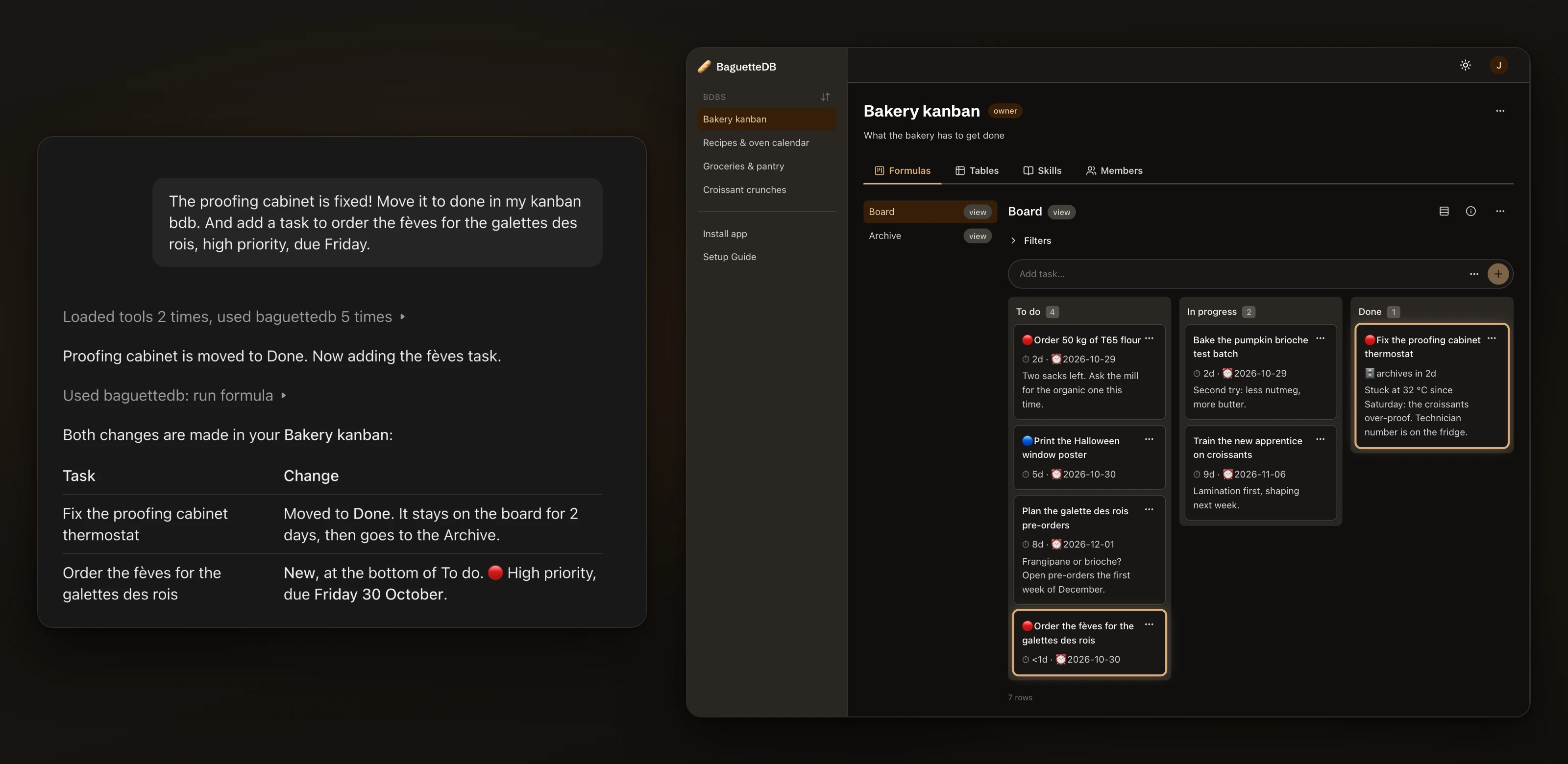
A bdb (short for baguettedb) is a small SQLite database about one thing: your groceries, your workouts, a kanban
board, the memory of an assistant. Your AI agents work in it over MCP or the command line, with real SQL and
guardrails: each bdb's schema and rules are described to them, and every change they make is logged and can be undone.
Features
- Your AI agents alongside you: they connect over MCP (stdio or Streamable HTTP) or run the
bdbcommand line, to
explore, query, change and restructure the bdbs you belong to, with built-in documentation they can read. - Formulas: named SQL with parameters, saved in the bdb. An agent calls one by name instead of rewriting the
query, and gets the same result every time; the web app shows it as a view or an action: a filtered list, a summary,
an "add" form, a one-click action. - Skills: instructions stored in the bdb that teach agents how it is meant to be used.
- Every change logged and undoable: undo and redo, revert one change or a whole batch, a change log per bdb.
- One database per topic, created blank or from one of ten starters, such as kanban, groceries or workouts.
- Your data on your machine: with
bdb, every bdb is a file in one folder you own (~/.baguettedb). - Encrypted at rest: each bdb has a key of its own (SQLCipher), wrapped by one key that stays with you.
- Sharing by invitation, with owner, editor and viewer roles per bdb.
- A web app, served by the same binary as the MCP server. A public REST API is planned.
Run it on your machine
bdb runs BaguetteDB on your own machine for your own agents: one binary, with no sign-up, no separate server to run
and no Docker. Your bdbs live in ~/.baguettedb.
Install
BaguetteDB runs on Linux and macOS; Windows is not supported yet. With Homebrew:
brew install alexandremgo/tap/baguettedb
bdb init          # your email, name and password
Or download the archive for your platform from the releases:bdb_<version>_darwin_arm64.tar.gz for a Mac with Apple Silicon, darwin_amd64 for an Intel Mac, linux_amd64 orlinux_arm64 for Linux (any distribution). The release's checksums.txt lists their SHA-256. Then:
tar -xzf bdb_*.tar.gz
sudo mv bdb_*/bdb /usr/local/bin/
bdb init          # your email, name and password
Other platforms build it from source with go install github.com/alexandremgo/baguettedb/cmd/bdb@latest, which needs a
C toolchain, plus pkg-config and the OpenSSL 3 headers on Linux, and leaves out the web app.
[!NOTE]
The binaries are not signed for now: if macOS refuses to open one downloaded with a browser, clear the quarantine
flag withxattr -d com.apple.quarantine /usr/local/bin/bdb(a download withcurldoesn't set it).
Connect your agent
An agent that runs commands on your machine, such as Claude Code or Codex, can use bdb as it is: nothing to
register, and bdb docs tells it where to start. To give an agent MCP tools instead, bdb mcp config prints what to
register in your MCP client, so the client starts bdb itself. --client claude covers Claude Desktop and Claude
Code:
bdb mcp config --client claude # also: codex, vibe
From the terminal
# Creates a bdb from the kanban starter, named Kanban
bdb bdbs create --starter kanban

# Prints its tables, its skills in full and its formulas: what an agent reads first
bdb bdbs describe Kanban

# Runs one of its formulas, adding a task
bdb formulas run Kanban add-task --param name="Buy bread"

# Adds a formula of your own, written as JSON in a file
bdb formulas create Kanban --file open-tasks.json

# Queries it in SQL
bdb q Kanban "SELECT name FROM tasks"

# Lists its changes, newest first, then undoes the last one
bdb changes Kanban
bdb changes undo Kanban

# Prints the guide for agents, then every command
bdb docs
bdb --help
The web app and other machines
bdb serve serves the web app and the MCP endpoint on http://127.0.0.1:3035. People sign in to the web app with
their email and password. MCP clients and scripts send a personal access token instead: create one in the web app's
Settings or with bdb tokens create <token-name>, and bdb mcp config --client claude --http prints the client's setup
with it. --listen 0.0.0.0:3035 makes the server reachable from other machines.
[!WARNING]
bdb servespeaks plain HTTP: passwords, session cookies and tokens cross the network unencrypted. Before reaching
it from other machines, put a TLS proxy in front.
Several people on one machine
bdb users create <email> adds an account, and --as <email> acts as it:bdb --as [email protected] mcp config --client claude registers Alice's own entry. This is a convenience, not a
boundary: whoever can run bdb on the data directory can read all of it. For people who must not see each other's
bdbs, run bdb serve and give each a token of their own.
Your data
Everything is in ~/.baguettedb (--data-dir or BAGUETTEDB_DATA_DIR choose another directory): one encrypted
SQLite file per bdb, the instance store with the accounts and memberships, and the kek file that unlocks every bdb.
[!NOTE]
Back up the bdb files, the instance store and thekekfile together: none is useful without the others.
bdb bdbs export writes a bdb to an encrypted file, and bdb bdbs import turns such a file into a bdb, on this
machine or another.
bdb info shows which data directory a command uses and why, what it holds, and the bdb serve running on it.
MCP tools
An agent acts with the permissions of one account, on the bdbs that account is a member of: the owner, or the
account --as names, over stdio; the account its token belongs to over HTTP.
| Area | Tools |
|---|---|
| Bdbs | list_bdbs, list_starters, create_bdb (blank or from a starter), describe_bdb, update_bdb |
| Schema and data | describe_table, execute_query (read), execute_data (insert, update, delete), execute_schema (create, alter, drop) |
| History | list_changes, undo_last_change, redo_last_change, revert_change (one change or a whole batch); owners also get undo_last_change_anyone and redo_last_change_anyone |
| Formulas | list_formulas, get_formula, create_formula, update_formula, delete_formula, run_formula |
| Skills | get_skill, create_skill, update_skill |
| Reference | get_docs, the built-in manuals on two topics: sql (the engine's rules, the change log included) and formulas |
Each tool has a bdb command that does the same, so an agent can work through either: describe_bdb isbdb bdbs describe, execute_data is bdb sql data, create_formula is bdb formulas create, get_docs isbdb docs. Each tool's parameters and behavior are in docs/reference/mcp-tools.md,
generated from the code.
Development
Building from source, the development stack, tests and how the web app is embedded in the binary are covered in
DEVELOPMENT.md.
License
BaguetteDB is fair source under the Functional Source License (FSL-1.1-ALv2): use, modify and
redistribute it for anything but a competing commercial product or service. Each release becomes Apache 2.0 two years
later. The name is not licensed with the code: see TRADEMARK.md.
Yorumlar (0)
Yorum birakmak icin giris yap.
Yorum birakSonuc bulunamadi