repo-steward
Health Gecti
- License — License: MIT
- Description — Repository has a description
- Active repo — Last push 0 days ago
- Community trust — 11 GitHub stars
Code Uyari
- network request — Outbound network request in steward-controls.js
Permissions Gecti
- Permissions — No dangerous permissions requested
Bu listing icin henuz AI raporu yok.
An autonomous agent for open-source repository management — triages issues, reviews PRs across iterations, watches your sites, and escalates only the decisions that are yours

Repo Steward
An autonomous agent for open-source repository management.


Repo Steward is an agent that runs the operational side of maintaining
open-source repositories — triaging issues, reviewing pull requests across
multiple iterations, joining repository discussions, authoring bug-fix PRs, and
watching your project websites
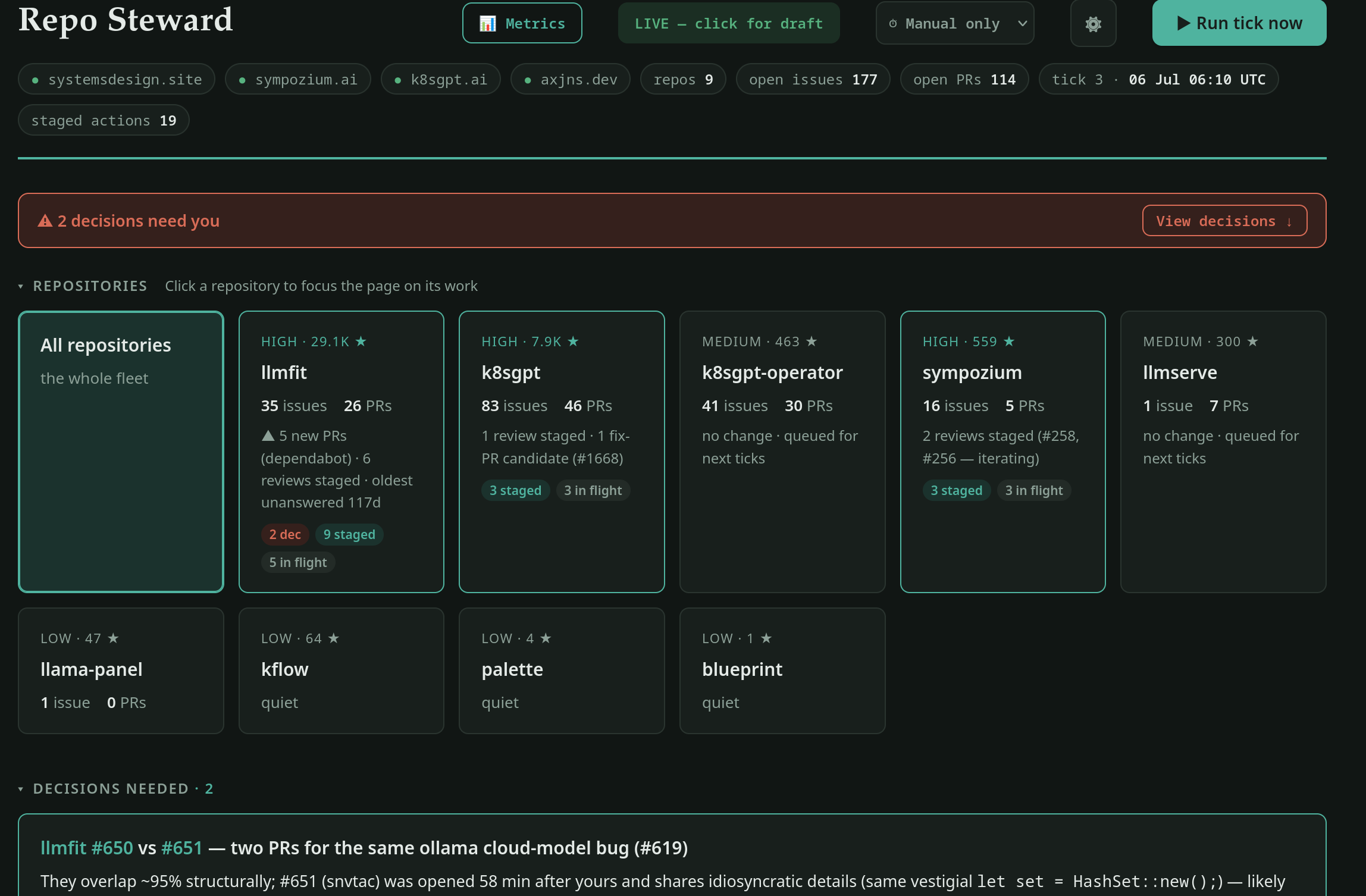
— on a schedule or a button press, keeping a live dashboard of what's happening
and escalating only tie-breaks and design decisions to you.
Built for the maintainer whose day disappears into pasting PR diffs into a
chat window: the steward does that loop autonomously, across every repository
you give it, and shows its work.
- Draft mode by default — every review and reply is staged for your
approval until you flip the live toggle; nothing speaks for you until it has
earned it. - One-click control — run a tick, approve a staged action, or go live from
the dashboard; approvals post under your GitHub auth because you clicked. - Hard guardrails — never merges, never closes, never force-pushes.
- Shows its work — per-repo queues, staged action texts, token/cost
metrics, trend lines, and uptime cards, all served from one local process.
How it works
systemd timer (hourly)
        │
        ▼
claude -p "execute one steward tick"     ← headless Claude Code session
        │
        ├─ sync: gh polls each repo since last cursor
        ├─ triage new issues → classify, label, draft substantive replies
        ├─ join discussions → draft replies to unanswered threads (GraphQL)
        ├─ review PRs → verdicts: approve-recommend / iterate / escalate
        ├─ delta re-review PRs whose authors pushed since last review
        ├─ author fix PRs for confirmed bugs (own clones, tests included)
        ├─ escalate tie-breaks to escalations.md — never blocks on them
        └─ write ledgers + metrics, regenerate dashboard.html
                                              │
                                              ▼
                            server.py (systemd, port 8377)
                            dashboard + Run-tick / Approve buttons
There is no daemon and no database: continuity comes from plain JSON ledgers
in state/, so every tick is a fresh, stateless session that picks up exactly
where the last one stopped. Everything is inspectable and editable with a text
editor.
Guardrails
- Never merges, closes, or force-pushes. Terminal states belong to you.
These are denied at the Claude Code permission layer
(.claude/settings.json), not just in the prompt. - Draft mode first. Out of the box, nothing is posted to GitHub — every
would-be review/reply is staged on the dashboard so you can calibrate the
steward's judgment before it speaks on your repos. Go live with the mode
toggle on the dashboard (or editmode:inconfig.yaml— same thing). - Untrusted-content aware. Issue, PR, and discussion bodies are treated as data; the
playbook instructs the steward to ignore embedded instructions and flag
manipulation attempts. Contributor code is never executed on your shell. - Signed output. In live mode every posted comment carries a signature
from your config, so bot output is always auditable. - Bounded ticks. Work per tick is capped (
limitsin config); a large
backlog drains over days instead of producing one enormous, unreviewable burst.
AI backends
The tick is an agentic session — it runs gh, edits ledgers, writes files —
so backends are headless coding-agent CLIs, selected at install time:
./install.sh                                            # Claude Code (default)
STEWARD_ENGINE=codex ./install.sh                       # OpenAI Codex CLI
STEWARD_ENGINE=gemini ./install.sh                      # Gemini CLI
STEWARD_ENGINE=opencode STEWARD_MODEL=ollama/qwen3 ./install.sh   # local models
STEWARD_ENGINE=custom STEWARD_ENGINE_CMD='my-agent --prompt "$PROMPT"' ./install.sh
- Local / OpenAI-compatible providers come in two flavors: run
opencode against Ollama/LM Studio/any provider it
supports, or keep the Claude Code engine and point it at a proxy
(ANTHROPIC_BASE_URL+ LiteLLM routes
to OpenAI, Bedrock, Vertex, or local models without any steward changes). - Caveats for non-Claude engines: the merge/close/force-push permission
deny layer ships as.claude/settings.json, which only Claude Code
enforces — on other engines the playbook's guardrails still instruct, but
nothing mechanically blocks; configure your engine's own sandbox/approval
settings accordingly. Token/cost capture inusage.jsonlis currently
Claude-only (other engines don't emit a usage envelope headlessly); the
metrics page degrades gracefully. Engines other than Claude Code are
lightly tested — reports and PRs welcome.
Why not a general-purpose agent harness?
A reasonable question: agent harnesses and orchestration frameworks (Hermes,
OpenClaw, Pi, and the growing rest) already give you scheduling, tool use,
memory, and multi-agent coordination. Why hand-roll systemd + gh + JSON
files instead of building on one?
Because for this job the harness is the part you'd spend your time fighting,
and the properties that matter here come from deliberately not having one:
The state is plain files, not a runtime. Every tick is a stateless,
resumableclaude -pinvocation; continuity lives entirely instate/<repo>.json,metrics.jsonl, andescalations.md— versioned,
greppable, and editable with a text editor. There's no daemon holding
in-memory state, no database to migrate, no orchestration server to keep
alive. A harness adds a stateful layer you now have to run, observe, and
trust; here, if the machine reboots mid-tick, the next tick just re-reads the
cursor and continues.The trust surface is small enough to read in an afternoon. The whole
system is a handful of readable files: one playbook, one ~500-line stdlib
Python server, one bash wrapper, one uptime probe. For software that acts on
your repos under your GitHub identity, "you can audit all of it" is a
feature, not a limitation.Guardrails sit at the OS boundary, not inside a framework's config.
"Never merge, close, or force-push" is aghpermission deny-list enforced
by Claude Code's sandbox — not a prompt instruction or a policy plugin a
harness update could quietly change. Fewer moving parts between the intent
and the enforcement.The product is the human in the loop, not autonomy. Draft mode,
approve-to-post, escalate-don't-decide — the design optimizes for doing
less on its own until you say otherwise. Most harnesses optimize the
opposite direction; you'd be turning features off.No lock-in to one harness's abstractions. The tick engine is already
swappable (claude/codex/gemini/opencode/custom). If you
want a harness, pointSTEWARD_ENGINE=customat it and the steward's
file-based contract still holds. This isn't anti-harness — it's
harness-agnostic, with the orchestration kept boring on purpose.
The honest tradeoff: a real harness gives you sophisticated multi-agent
planning, shared memory, and a tool ecosystem this doesn't have. Repo Steward
is a steward, not a general agent — a narrow job with strong guarantees. When
the job needs a fleet of coordinating agents, reach for the harness. When it
needs to reliably keep your PRs moving without becoming another system to
operate, reach for this.
Requirements
- A headless agent CLI (see backends above; default
Claude Code), authenticated - gh CLI, authenticated with push access to your repos
- Linux with a systemd user session,
python3,jq
Install
git clone https://github.com/<you>/repo-steward && cd repo-steward
cp config.example.yaml config.yaml   # edit: your repos, signature, limits
./install.sh                         # or --no-timer to only tick manually
Then either wait for the first scheduled tick or start one now:
systemctl --user start repo-steward.service
tail -f logs/tick.log
Open http://localhost:8377/ — the dashboard shows decisions needing you,
staged actions with full text, per-repo queues, and (after a few ticks)
trend lines. It auto-refreshes; from other devices on your network usehttp://<host-ip>:8377/ (open the port in your firewall if needed).
Pin a model or change cadence via env at install time:
# every half hour on a strong model
STEWARD_MODEL=claude-opus-4-8 STEWARD_CADENCE="*-*-* *:07,37:00" ./install.sh
# or one bigger tick each morning (raise `limits` in config.yaml to match)
STEWARD_CADENCE="*-*-* 07:00:00" ./install.sh
Metrics
http://localhost:8377/metrics.html tracks the steward itself:
- Tokens & cost per tick — every tick runs through
tick.sh, which
captures the Claude Code usage envelope (input/output/cache tokens, cost,
duration) intousage.jsonl. - Attention by repo — cumulative steward actions per repo, the proxy for
where the steward's effort goes (token usage is measured per tick, not per
repo — one session works all repos). - Per-repo trends — open issues/PRs over time from
metrics.jsonl
snapshots, plus a Δ-since-baseline table, so you can see which repos are
heating up and whether the backlog is actually shrinking.
Site uptime
Add a sites: block to config.yaml (see the example) and the installer
enables a token-free probe (uptime_check.py, every 5 minutes). Sites get
live status chips on the dashboard and 24h-uptime/latency cards on the
metrics page. A site is declared down after two consecutive failed probes;
the transition is logged to incidents.jsonl and escalated, and the next
steward tick investigates the linked repo (recent commits, failed deploy
workflows) — probes cost nothing, tokens are only spent when something
actually breaks.
The dashboard controls
- Run tick now — starts a tick on demand (refused while one is running).
A progress bar and toasts show elapsed time, an ETA, and which repo is being
worked; the board auto-refreshes when the tick completes. - Mode toggle — flip draft ⇄ live (rewrites
config.yaml). - Schedule —
Manual only / Hourly / Every 6h / Daily / Weekly;
live-configures the systemd timer. Ticks stay button-triggerable at any
cadence. - ⚙ Tick size — the per-run work caps (substantive + light items). Raise
for a bigger daily sweep, lower for cheaper, more frequent ticks. Applies to
the next tick, so it's safe to change while one is running. - Approve & post — appears on each staged action. Executes it via
gh
under your auth — clicking is you acting, which is why it works even in
draft mode. Executed actions are stamped and can never double-post; the
audit trail isapprovals.jsonl.
Buttons appear only when the page is served by server.py; static copies of
the dashboard are read-only.
Files
| path | what | in git? |
|---|---|---|
STEWARD.md |
the tick playbook the agent follows — edit to change behavior | yes |
server.py |
dashboard server + approve/tick API | yes |
install.sh |
generates the systemd user units | yes |
config.yaml |
your repos, mode, limits, signature | no (yours) |
state/<repo>.json |
per-repo ledger: every item's status, verdict, staged actions | no |
escalations.md |
decisions parked for you | no |
metrics.jsonl |
one snapshot per repo per tick → trends | no |
logs/tick.log |
full output of every tick | no |
Operating it
systemctl --user stop repo-steward.timer      # pause future ticks
systemctl --user start repo-steward.timer     # resume
systemctl --user start repo-steward.service   # one tick, now
journalctl --user -u repo-steward.service     # tick history
Uninstall: systemctl --user disable --now repo-steward.timer repo-steward-dash.service repo-steward-uptime.timer
and delete the repo-steward* unit files from ~/.config/systemd/user/.
Costs & cadence
Each tick is a headless Claude Code session doing real review work — budget
accordingly. The defaults (hourly, 4 substantive + 12 light items) suit an
actively maintained portfolio; quiet repos cost almost nothing since a
no-change tick exits after the sync. Lengthen the cadence or shrink limits
for a lighter footprint.
License
MIT
Yorumlar (0)
Yorum birakmak icin giris yap.
Yorum birakSonuc bulunamadi