Agent-Hub
Health Gecti
- License — License: MIT
- Description — Repository has a description
- Active repo — Last push 0 days ago
- Community trust — 23 GitHub stars
Code Gecti
- Code scan — Scanned 12 files during light audit, no dangerous patterns found
Permissions Gecti
- Permissions — No dangerous permissions requested
Bu listing icin henuz AI raporu yok.
Local runtime for Claude Code and Codex — provider management, isolated sessions, routing and protocol translation.

Agent-Hub
Your agents. Your providers. One local hub.
A local runtime for Claude Code and Codex.
Manage providers in one place, route Claude Code across Anthropic and
OpenAI-compatible APIs, and launch isolated Codex sessions without rewriting
your normal configuration.






Agent-Hub is a local runtime that owns the layer around your coding agent:
providers, sessions, routing, protocol translation and observability.
Providers live in Hub's own database. Nothing else needs to be running or
installed for normal use.
Provider management and session launching currently have separate terminal
entrypoints. See current boundaries before choosing an
interface.
Why Agent-Hub
Coding agents already own reasoning, tools, permissions and execution. Agent-Hub
focuses on the operational layer around them, so changing providers or routing
does not require replacing the agent loop or rewriting global configuration.
- Keep agents native. Claude Code and Codex remain their normal upstream
runtimes; Agent-Hub sits beside them rather than forking their execution model. - Manage providers once. Provider state lives in one local store and can be
reused across isolated sessions. - Translate only where needed. Claude Code can route through Anthropic-native
or OpenAI-compatible upstreams; Codex keeps its native runtime and isolatedCODEX_HOMEpath. - Stay local-first. The control plane is local, credentials are redacted from
normal responses, and complete message payloads are not persisted in gateway
logs.
Where Agent-Hub fits
The runtime boundary is intentionally asymmetric: Claude Code can use the local
gateway and protocol bridge, while Codex stays close to its native configuration
model.
| Claude Code | Codex | |
|---|---|---|
| Provider management | Shared Agent-Hub store | Shared Agent-Hub store |
| Session isolation | Yes | Yes |
| Model switching | Native /model routes |
Codex-native model selection |
| Local gateway | Yes | No |
| Protocol translation | Anthropic / OpenAI | No |
| Pools and fallback | Yes | No |
The two paths are intentionally different: Claude Code can use the Agent-Hub
gateway, while Codex keeps its native runtime and receives only an isolated
session configuration.
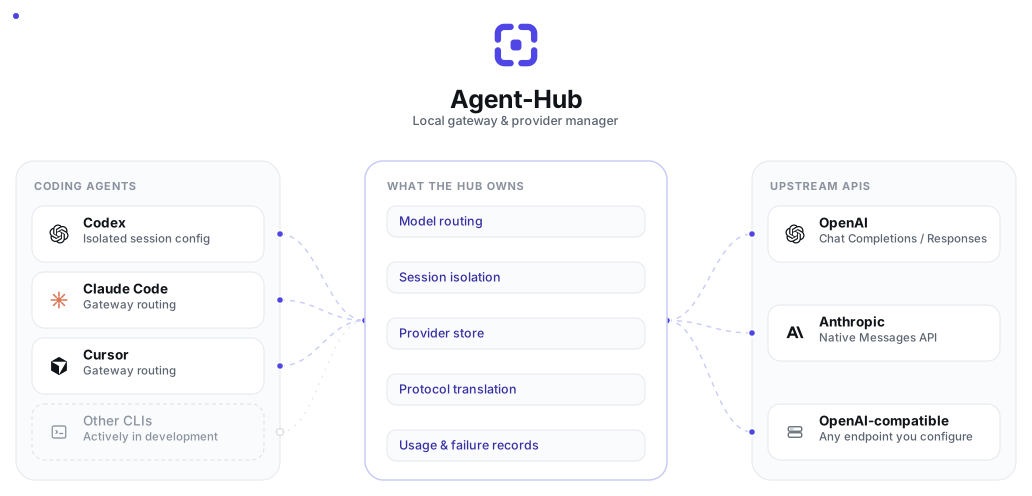
Architecture
Agent-Hub sits beside the coding agent, not inside its agent loop.
Your coding agents continue to own reasoning and execution. Agent-Hub owns
provider selection, session isolation, routing and protocol handling.
The Claude Code request path
sequenceDiagram
    autonumber
    participant CC as Claude Code CLI
    participant GW as Local gateway
    participant UP as Upstream provider

    CC->>GW: POST /v1/messages (slot resolved from /model)
    Note over GW: bound to 127.0.0.1, local auth required
    GW->>GW: resolve slot to provider, account pool, fallback chain
    alt Anthropic-native upstream
        GW->>UP: forward Messages API request
    else OpenAI-compatible upstream
        GW->>UP: translate to Chat Completions or Responses
    end
    UP-->>GW: status, headers, SSE events
    Note over GW: degrade instead of reject on unknown shapes
    GW-->>CC: upstream status and body returned as-is
    Note over GW: record usage and redacted errors,<br/>do not persist payloads
The Codex session lifecycle
flowchart TD
    Start["codex1 provider"] --> Values["Validate provider profile"]
    Values -->|invalid| Fail["Fail immediately,<br/>no silent default fallback"]
    Values -->|valid| Temp["Create temporary CODEX_HOME"]
    Temp --> Inherit["Inherit existing Codex state"]
    Inherit --> Overlay["Overlay selected provider and profile"]
    Overlay --> Run["Launch Codex session"]
    Run --> Clean["Remove temporary environment on exit"]
    Clean --> Untouched["~/.codex/config.toml and auth.json unchanged"]
The root Python modules own the request path and protocol semantics. Rust
provides the management plane; the desktop interfaces are separate macOS and
Windows builds. The Go gateway is an independent experiment.
Read the request-flow guide for actual entrypoints, data
flow and retry boundaries. The Python package console scripts undersrc/claude_hub/ are help/version placeholders; use the installation above for
working session launchers.
Capabilities
Route models in Claude Code
Bind Fable, Opus, Sonnet and Haiku slots to different providers and models.
Switch between them with Claude Code's native /model command.
Bridge provider APIs
Use Anthropic-native upstreams directly, or translate Claude Code traffic to
OpenAI Chat Completions and Responses, including streaming and tool calls.
Define fallback paths
Configure fallback routes and compatible account pools with explicit retry and
replay boundaries.
Inspect runtime behavior
Review token usage, cache behavior, provider attribution and redacted gateway
failures without storing complete request or response bodies.
Launch isolated Codex sessions
Select a provider for one Codex session through a temporary CODEX_HOME. Your
normal Codex configuration and credentials remain untouched.
Manage providers once
Add providers directly to Agent-Hub or import compatible records from JSON.
Get started
macOS preview package
The first Apple Silicon desktop preview is 0.2.2. Download the .pkg
installer from GitHub Releases,
verify its SHA-256 against SHA256SUMS.txt, quit Agent Hub and double-click the
installer. It installs the desktop app in Applications and the management CLI
and Python runtime for the signed-in user.
Python 3.11+, Claude Code and uv remain external prerequisites. Install the
Codex CLI separately for Codex sessions.
Build from source
Targets macOS and Linux. You need Python 3.11+, zsh, Rust/Cargo and Claude
Code available as claude. Install the Codex CLI separately for Codex sessions.
The gateway and protocol conversion also require uv.
git clone https://github.com/Aley3567/Agent-Hub.git
cd Agent-Hub
cargo install --path crates/agent-hub --locked
./install.sh
source ~/.zshrc
Ensure Cargo's binary directory (normally ~/.cargo/bin) is on your PATH. The
installer backs up replaced files, installs the Python runtime under ~/.claude
and ~/.codex/scripts, and adds managed shell integration to ~/.zshrc. It
creates Hub's provider database.
Add a provider
agent-hub
Press a to add or update a provider, f to import JSON, or r to reload
Hub's local configuration. API key input is hidden.
The same operations are available from the CLI:
agent-hub provider add
agent-hub provider list
Preview an import before applying it:
agent-hub provider import --file /path/to/providers.json --preview
agent-hub provider import --file /path/to/providers.json
Imports preserve existing entries by default. Use --replace only to update
matching provider IDs. See provider management
for the JSON format and storage overrides.
Launch a session
claude1    # Claude Code: choose a provider, then press Enter
codex1     # Codex: choose a provider for this session
claude1 and codex1 are the launcher command names within Agent-Hub. Theagent-hub TUI currently manages providers; it does not launch sessions on
Enter.
For Claude Code gateway routing, open claude1 and press a or n to create a
named Hub, then configure its channels and model slots. Once configured,claude1 hub starts the default Hub; use /model inside Claude Code to switch
models. Each named Hub has its own configuration, port and usage records.
Everyday commands
| Command | Purpose |
|---|---|
agent-hub |
Open provider management |
agent-hub provider list --json |
List providers without exposing credentials |
agent-hub provider import --file /path/to/providers.json --preview |
Preview a file import |
claude1 <name> |
Launch Claude Code with a named provider |
claude1 id:<provider-id> |
Select a provider by stable ID |
claude1 direct |
Launch native Claude Code directly |
claude1 hub --slot sonnet |
Start the default Hub with a chosen slot |
claude1 usage --week |
Inspect the last seven days of usage |
claude1 doctor |
Check local configuration without contacting providers |
~/.claude/scripts/claude-hub.py errors |
Read recent redacted gateway errors |
codex1 --list |
List Codex providers |
codex1 <name> -- <codex args> |
Select a provider and forward CLI arguments |
Use claude1 --help and agent-hub --help for more commands. Gateway and
account pool configurations are in examples/.
Codex
Agent-Hub keeps Codex close to its native configuration model.
For each launch, codex1 creates a temporary CODEX_HOME, inherits the user's
existing Codex state, overlays the selected provider, and removes the temporary
environment when the session exits.
The real ~/.codex/config.toml and ~/.codex/auth.json are not modified.
Generated profiles are validated before launch. Invalid or incomplete
configuration fails immediately instead of silently falling back to the default
provider.
Codex sessions currently do not use the Agent-Hub gateway, protocol bridge,
account pools or fallback routing.
Local and security model
Agent-Hub keeps its control plane local.
- Provider state is stored on the local machine.
- The gateway binds to
127.0.0.1. - Credentials are excluded from normal CLI and desktop responses.
- Error records are credential-redacted.
- Runtime metrics contain operational metadata, not full message content.
- Complete request and response payloads are not persisted in gateway logs.
Testing
Agent-Hub tests the boundaries where routing errors are most expensive:
protocol conversion, streaming, session isolation and configuration handling.
- 1,010 Python tests across macOS and Ubuntu with Python 3.11 and 3.12
- Rust workspace tests for the management plane
- macOS backend tests, type checks and production builds in CI
- shell integration and installer tests
- repository secret scanning before the test suite runs
- Ruff undefined-name and duplicate-definition checks before the test suite runs
See the CI workflow,
protocol status and
changelog for the current validation surface.
Current boundaries
The current desktop release targets Apple Silicon macOS and is ad-hoc signed,
not Apple-notarized.
Claude Code supports gateway routing, protocol translation, pools and fallback.
Codex currently uses isolated provider launches without the gateway.
Scheduled desktop actions run while Agent-Hub is open.
Windows source is maintained separately; no Windows installer is currently
published.
Configuration and security
- Provider storage:
~/.agent-hub/providers.db, with0600permissions.
Credentials are stored locally and excluded from provider list output and
desktop IPC responses. - Explicit imports: Imported records belong to Hub and do not refresh
automatically from the source. - Session isolation: Claude Code receives session-specific environment values
and temporary settings. Codex uses a temporary shadowCODEX_HOMEand profile
overrides. Normal launching leaves the original CLI configuration unchanged. - Local gateway: binds to
127.0.0.1, requires local authentication, and
validates private file permissions. - Failure reporting: errors preserve upstream evidence with credential
redaction. Logs do not store complete request or response payloads; interrupted
streams are not turned into successful completions.
Existing Hub routing configuration and logs are preserved in place, so
upgrading keeps local state. Explicit legacy database overrides can still point
the runtime at an external database; see
storage and compatibility.
Contributing
Issues and pull requests are welcome.
- Run the Python suite before opening a pull request:
python3 -m unittest discover -s tests -p 'test_*.py' - Run
ruff check .if you have Ruff installed; CI runs it with the pinned
version and the rule set declared inpyproject.toml. - Protocol changes must come with tests. The repository's protocol invariants
are documented in CLAUDE.md. - Do not include credentials, real provider endpoints or private account data in
issues, pull requests or test fixtures.
The maintainer reviews pull requests and triages issues in
GitHub Issues. Releases are
tagged with a changelog entry; see CHANGELOG.md.
Development
python3 -m pip install 'aiohttp>=3.9' 'certifi>=2024.2.2'
python3 -m unittest discover -s tests -p 'test_*.py'
cargo test -p agent-hub --locked
./tests/test_shell_integration.zsh
./tests/test_install.zsh
| Guide | Contents |
|---|---|
| Provider management | Local storage, imports and provider format |
| Request flow | Runtime entrypoints, protocol boundaries and retry behavior |
| Protocol support | Compatibility and known limitations |
| Desktop builds | macOS and Windows development |
| Project rules | Protocol invariants and documentation index |
Most detailed engineering documents are currently in Chinese.
License
Yorumlar (0)
Yorum birakmak icin giris yap.
Yorum birakSonuc bulunamadi