Flare
Health Gecti
- License — License: MIT
- Description — Repository has a description
- Active repo — Last push 0 days ago
- Community trust — 91 GitHub stars
Code Basarisiz
- exec() — Shell command execution in e2e/app.spec.ts
- fs.rmSync — Destructive file system operation in e2e/app.spec.ts
- process.env — Environment variable access in e2e/app.spec.ts
- network request — Outbound network request in e2e/app.spec.ts
- exec() — Shell command execution in e2e/web.spec.ts
- fs.rmSync — Destructive file system operation in e2e/web.spec.ts
- process.env — Environment variable access in e2e/web.spec.ts
- os.homedir — User home directory access in electron/core.ts
- process.env — Environment variable access in electron/core.ts
- process.env — Environment variable access in electron/main.ts
- process.env — Environment variable access in electron/services/exec.ts
- exec() — Shell command execution in electron/services/mcp.ts
- network request — Outbound network request in electron/services/mcp.ts
- fs.rmSync — Destructive file system operation in electron/services/mcpRegistry.ts
- process.env — Environment variable access in electron/services/mcpRegistry.ts
Permissions Gecti
- Permissions — No dangerous permissions requested
Bu listing icin henuz AI raporu yok.
The graph based agentic IDE

Flare
A graph-first IDE for agentic coding — desktop app, or served to a browser
from the machine the agent runs on.
The main surface is a live graph of your codebase — every file is a node,
imports are edges — with a full terminal underneath where you run claude,codex or opencode. As the agent edits files, the graph updates in real
time; every change burst is snapshotted into a local shadow history you can
diff against and revert to, per file or as a whole tree.
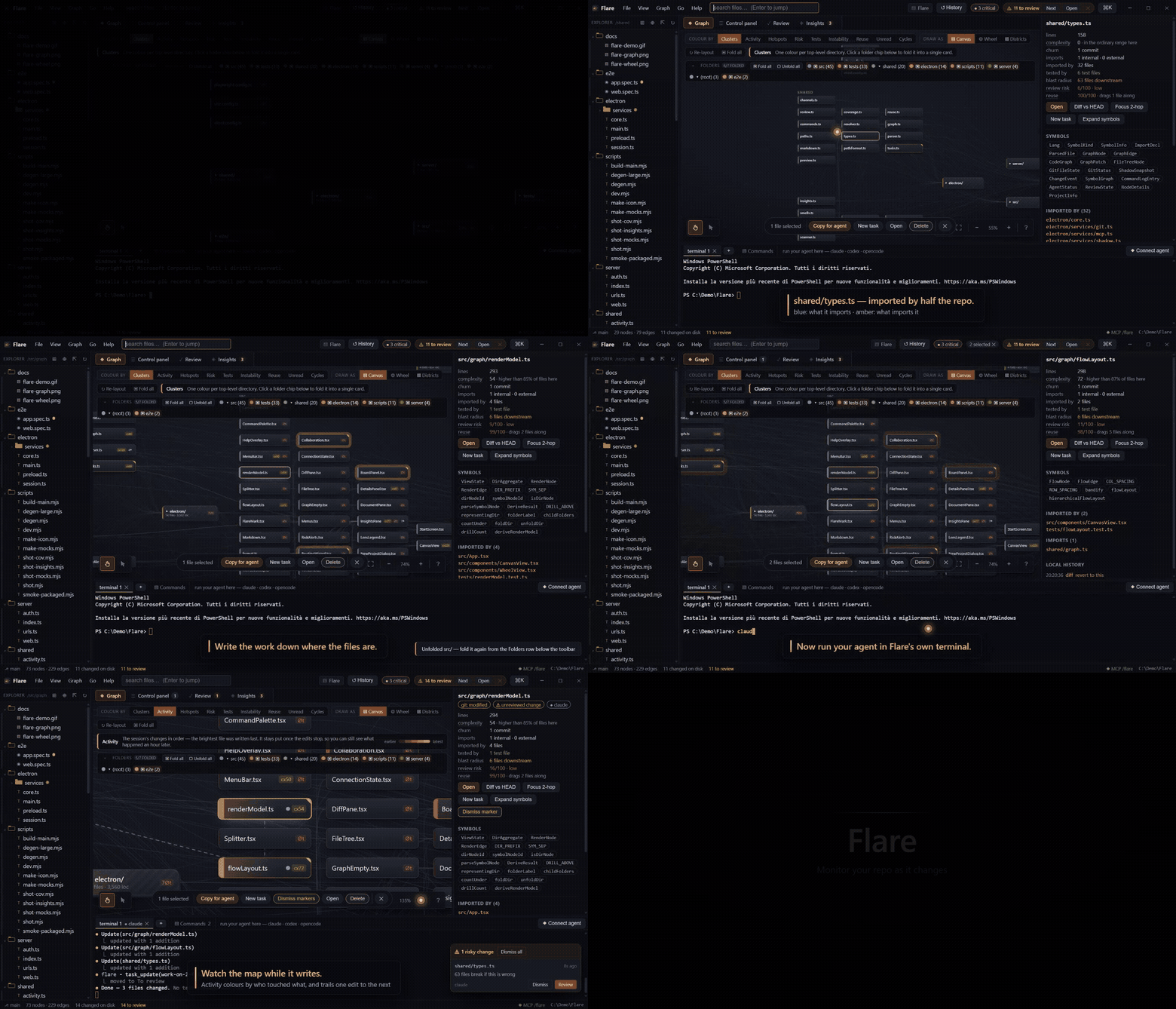
You run the agent in Flare's terminal, and Flare watches: it maps the repo
from the source, attributes every write to whoever made it, and pulls you in
when something important changes. The agent takes work from the board and
asks its questions there, so the two of you are looking at the same project
rather than at a chat log.
What you get
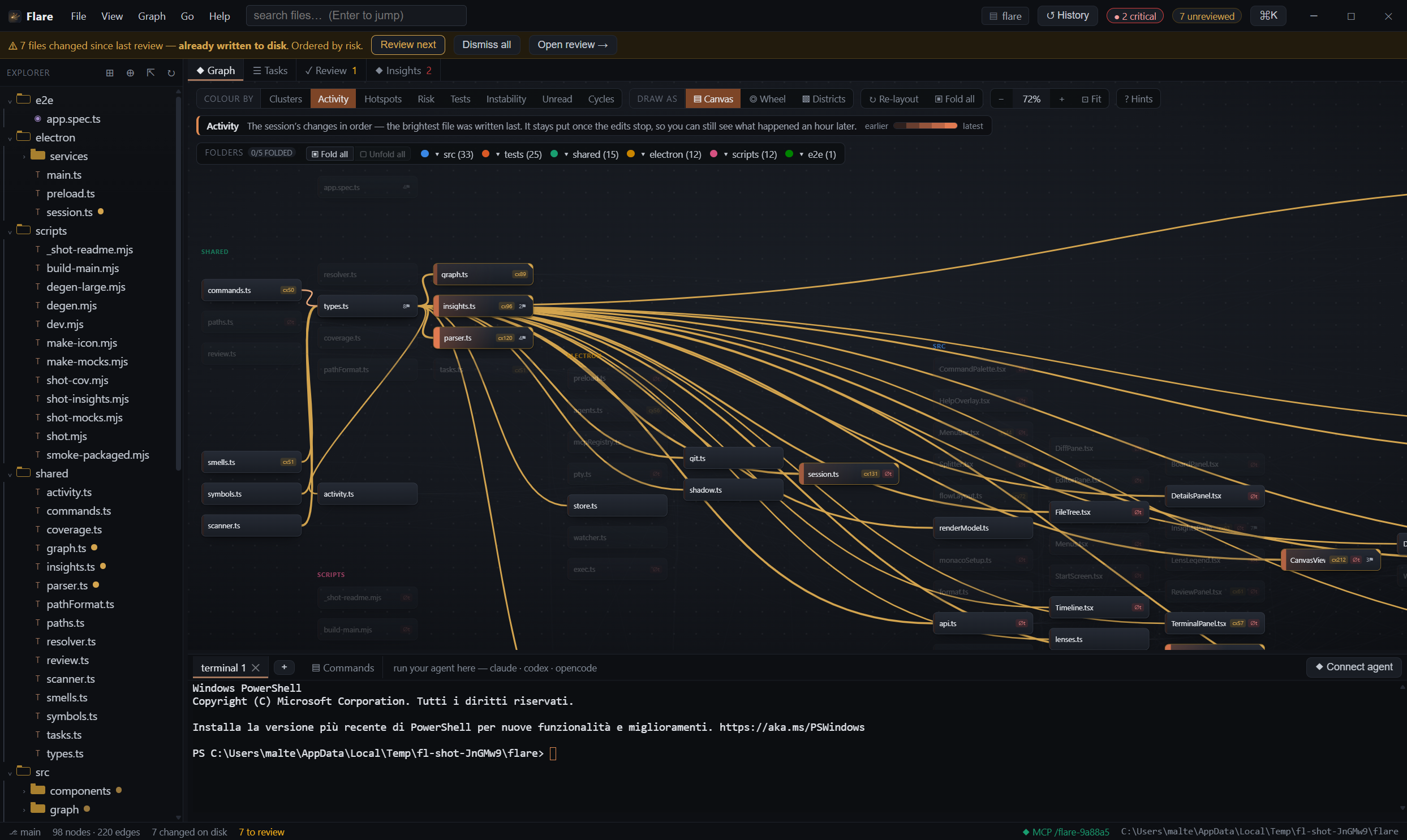
Flare open on its own source. The Activity lens highlights the seven files an
agent just edited, and hovering shared/types.ts highlights every file that
imports it — the blast radius of one file, without reconstructing it from a
grep.
Three views of the same graph
Switchable from the toolbar or the command palette. Each honours the active
lens, the selection, collapsed directories and the search filter.
- Canvas (default) — dependency cards on a pannable board, ordered
left-to-right by dependency depth (SCC-condensed, crossing-reduced, wrapped
into bands so a long chain never becomes an unreadable strip): foundations
left, entry points right. Cards carry the filename, a lens-coloured rail and
badges (complexity, coverage %, untested, TODOs, cycles). Hovering traces
imports in blue and importers in amber; shift+click traces the path between
two files; cards can be dragged and their positions persist. Zooming out
swaps the cards to a plate skin (semantic zoom) so the shape of the repo
still reads. - Wheel — every node sits on one ring ordered by directory, dependencies
cross the middle as bundled chords, and cluster bands are labelled around the
outside. Drag to spin, alt+wheel to rotate, scroll to zoom, shift+drag to
pan, ctrl+drag to box-select. Click a node to pin its dependency
directions; hover a cluster band to isolate that directory; click a band to
collapse or expand it. - Districts — a squarified treemap where area is lines of code and shade
is the active lens. The fastest read on "how big is this repo and where
does the mass sit"; selecting a file outlines everything it touches.
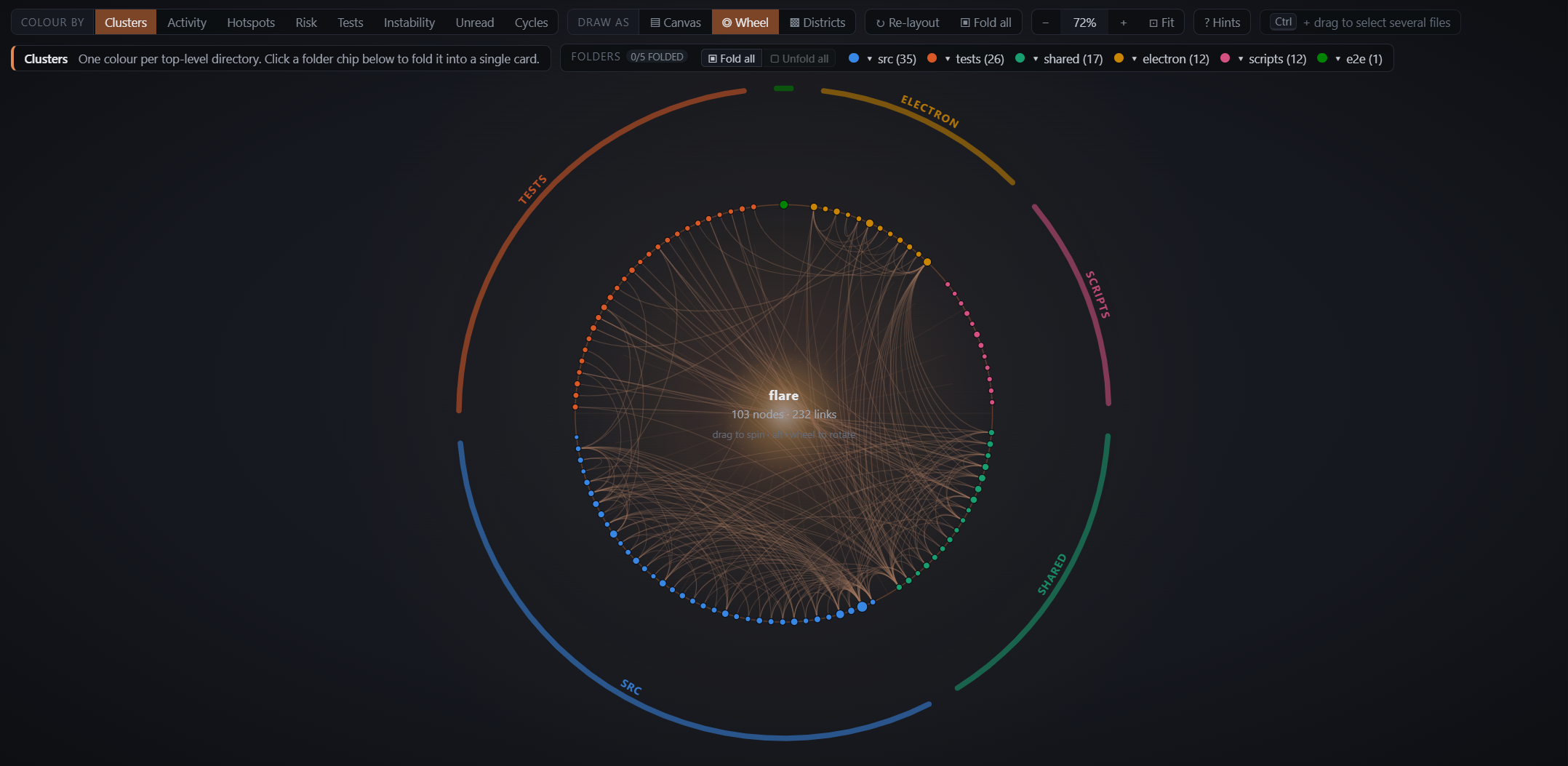
The Wheel answers the one question the canvas cannot: what talks to what
across the whole repo at once. A file whose chords fan across the entire disc
is load-bearing whether or not anyone documented it that way. Node dots take
the active lens, cluster bands are coloured by directory.
Features
Folders that open one level at a time — a folder card holding more files
than fits on a screen unfolds into its sub-folders, not into four hundred
cards. Asrc/that is 90% of the repo therefore has a middle state: it opens
intosrc/app,src/features,src/libs… with the dependencies between them
drawn, and each of those opens again. Folding it back remembers how far you
had drilled.Lenses — recolour the same layout by Clusters, Activity, Hotspots
(churn × complexity), Risk, Tests, Coverage, Instability, Reuse, Unread or
Cycles. Whichever is active, a strip under the toolbar explains how to read
the colours and shows the matching scale.Everything is discoverable — a VS Code-style File / View / Graph / Go /
Help menu bar, a?cheat sheet listing every click, drag and shortcut for
the current view, and a tooltip on every control saying what it does rather
than what it is called. What acts on the view — pointer mode bottom-left;
centre, fit, zoom and the cheat sheet bottom-right — sits on the canvas
corners rather than in a toolbar strip above it.Control panel — the collaboration, in three sections. Tasks is a
kanban of work written to be handed to an agent: a card's primary action is
Copy for agent, which emits the brief plus the files it names plus what
the graph knows about them ("29 files downstream, 0% covered, in an import
cycle"), so the agent starts from the map instead of spending half its
context rediscovering it. File a card straight from a graph selection with
right-click → New task with these files. Lanes are yours — add, rename,
reorder or remove them; removing one rehomes its tasks rather than dropping
them.Design decisions is for the architectural calls an agent makes without
being asked — a module boundary, a dependency taken on, a data shape that
will spread, a refactor across several files. It records them withdecision_recordbefore the code that assumes them and they land as
proposed, for you to agree or decline with a reason; an agent cannot
agree with its own proposal. Whether it then keeps building on one or leaves
the work that rests on it is your call, set in the routine.Questions is what it needs from you, parked rather than blocking. Each
question names the tasks it holds up, so the rest of the board stays
workable; the agent picks up something else and halts only when everything
left is waiting on an answer. Answer it in the panel and the agent reads it
back over MCP.All three are queryable over MCP, so an agent can run its own loop:
tasks_list(optionally by lane) to pick up work,task_getfor the exact
brief a human would have pasted,task_updateto log progress and move the
card to review,task_createto file follow-up work it finds but shouldn't
do now,decision_record,question_ask, andworking_agreementwhen it is
unsure whether to keep going. Everything shows up in the panel live.A routine, so it doesn't stop at the first question — the ⚙︎ Routine
wizard sets what the assistant does when it runs out of work: check the board
again rather than stopping, record design decisions you have not agreed to —
and either keep building on them or park the work that rests on them — and
park questions instead of halting on them, plus any house rules you type. It
renders the working agreement the agent actually reads — generated from the
switches, so turning one off removes its rule, and editable, because the
switches cover what every project wants and nothing of what yours wants said
in its own words. It stores it with the project, whereworking_agreement
returns it along with the state of the board: how many cards are waiting to
be picked up, how many are already in progress, how many are blocked, what is
waiting on you, and which card to take next.That last part is written for more than one agent at a time. A card is only
offered if it is still sitting in the first lane — moving it to in-progress
is how an agent claims it, and no agent is ever pointed at a card another one
has started.The last switch is the one that doesn't depend on the agent remembering any
of the others: check the board when it tries to stop. Flare answers your
assistant's stop hook with the state of the board, so a session that tries to
end while a card is still workable is handed that card instead, by name. It
adds aStophook to.claude/settings.local.json— local to your machine,
not committed — and takes it out again when you switch it off. Only ever
once per stop, so a session can always end, and never a card someone else has
already started.Several agents on one board is the case all of this is built for: the panel
and every agent write through one place, and a write made against a board
that has moved on since is rebased rather than believed — so a click in the
panel cannot delete the card an agent filed a second earlier.Review cockpit — the tab that answers the questions a file-by-file diff
can't. Changes are grouped into bursts (one batch of writes by one author),
and each burst shows:- what actually checked it. The IDE sees both the file writes and the
commands run in its terminals, so it can say "the tests ran, then two more
files were edited and nothing re-ran" — the states are verified / failed /
checked, then edited again / never checked, always quoting the output
line the verdict came from. - what it was trying to do. Agents call the
record_intentMCP tool
before editing; otherwise the burst says so plainly, because reviewing an
agent's diff makes you the first human to see that code with nothing
explaining why it exists. - which files deserve attention. Every file is tiered read carefully /
read / skim from blast radius, coverage, cycles and complexity, with the
reason spelled out ("9 files break if this is wrong", "no test covers it"),
so a 30-file change doesn't get 30 equal glances. - agent smells. Rules for the shortcuts agent changes take and human ones
don't: a test edited in the same burst as the code it covers, assertions
deleted,.skip/.onlyadded, lint or type suppressions introduced,
coverage thresholds lowered, complexity spikes, files left with no
importers, abstractions extracted for a single caller. - one-click undo. Every burst has a snapshot: revert a file, revert the
burst, or jump back to the last state whose checks passed. - walkthrough — step the graph through a burst's files worst-risk first,
approving as you go.
- what actually checked it. The IDE sees both the file writes and the
Risky changes come and find you — the review tab is a tab, so a load-
bearing file rewritten while you were reading the graph goes unnoticed until
you go and look. Those changes queue as alerts in the corner instead, one
card per file, newest first, staying put until answered: Review opens the
change on its row in the review panel, Dismiss stops that card, Dismiss
all clears the queue. Dismissing an alert is not approving the change — the
file stays flagged, unread and exactly as the agent left it. The bar is the
careful tier plus something absolute (real dependents, a cycle, real
complexity, no test at all), so a repo where nothing is load-bearing stays
quiet rather than popping a card for its least boring file.Comprehension debt, measured — the Unread lens paints every file that
changed this session and no human has opened since; approving does not clear
it, opening the file does. Insights shows the repo-level percentage.Every command classified — the command log labels each observed command
read / writes / verify / network / destructive, filterable, with the
pass/fail verdict next to verification runs. Destructive commands
(rm -rf,git reset --hard,push --force,npm publish, …) raise an
alert and trigger a snapshot.Coverage ingestion — drop an
lcov.info(vitest/jest--coverage, nyc,
pytest-cov…) incoverage/or the project root and it's picked up live: a
Coverage lens appears, per-file percentages land in the details panel and
hover cards, and real coverage replaces the test-linkage heuristic inside
the review-risk score.Drill-downs — collapse any directory into an aggregate meta-node (click
its legend chip or double-click the node); expand any file into its
functions/classes with symbol-level edges. Shift-click two nodes to highlight
the import path between them.Cross-agent tracking — the process tree of every terminal is watched for
claude / codex / opencode / aider / …; changes made while an agent runs are
attributed to it (coloured node rings, trails on the graph, "changed by" in
details), and every shell command run in the terminals lands in the
Commands log (▤ button in the terminal bar, persisted per project).Command palette — Ctrl+K: fuzzy-jump to any file,
>for commands,
recent projects. Ctrl+B sidebar, Ctrl+W close tab, Ctrl+0 fit graph,
Ctrl+=/− zoom, Esc collapses focus/drill-down. Full list under> keyboard shortcuts.Insights — a unified metrics + issues view: per-file risk/hotspot/
refactor composites, blast radius, churn (git + session), coverage, TODOs,
co-change coupling; severity-ranked rules (regression-risk, god-file,
agent-thrash, coverage-gap, cycles, dead code…) with a critical-alert badge
and toasts.Reuse — how cleanly each file would come out if you lifted it into a
package, 0–100, plus one number for the whole repo. It counts the four
things that actually stop you: talking to the host (fs, sockets, a
database), being bound to a framework, dragging a large share of the repo
along, and sitting in an import cycle. Being widely imported is not a
penalty — a util forty files depend on is the most reusable thing you have,
which is the opposite of how risk reads the same number. Unlike the other
composites it is an absolute scale rather than a ranking within the repo: if
everything importsfs, the least-bad file has not become reusable. Themixed-concernsrule points at the files where logic is trapped behind the
plumbing and worth separating.MCP server for your agents — one shared, localhost-only endpoint for
the whole machine, however many Flare windows are open. Each instance
runs a private ephemeral server and registers in a per-pid file registry;
whichever instance holds the well-known port (default 7345,FLARE_MCP_PORT) acts as the gateway and routes…/mcp/<slug>— the same
stable per-project slug the browser server uses — to the owning instance,
proxying when needed and taking over the port when the holder exits. Bare/mcpworks with a single session; with several it points the agent atlist_projects. Click the ⚡ MCP status-bar item to copy the project-scoped
setup command:claude mcp add --transport http flare http://127.0.0.1:7345/mcp/<slug>Tools:
graph_overview,file_info,dependents,dependencies,find_path,issues,top_files,search,impact_of(what breaks +
which tests to run before changing files),recent_activity,verification_status(did my changes actually get checked?),record_intent(state the goal before editing, so the human reviewing the
diff isn't reconstructing it), the board tools —tasks_list,task_get,task_update,task_create— and the collaboration tools:decision_record,decisions_list,question_ask,questions_list, andworking_agreementfor what to do next. The agent asks the IDE about the
codebase instead of re-deriving it.Workspace restore — tabs, lens, active view, panel sizes, collapse
state, node positions and window bounds all persist per project.Live change tracking — a debounced watcher re-parses changed files and
patches the graph in place. Changed-but-unreviewed nodes are marked in
warning-orange with a heat decay, so an agent's progress is visible as it
works.Review queue — every file changed since your last checkpoint is flagged.
Nothing is gated: an agent writes straight to disk, so reviewing is deciding
what to keep. Dismiss clears the marker and changes nothing; revert puts the
files back. Review next walks them worst-risk first, and each node shows its
blast radius (transitive dependents), import counts and symbols.Shadow history ("git of local changes") — a hidden git repo (separate
GIT_DIR, your worktree) auto-commits every change burst. Timeline panel lists
snapshots; diff any file against any snapshot, revert one file or restore the
whole tree. Your real repo is never touched.Git integration — branch + per-file status in the tree and graph, diff vs
HEAD in a Monaco diff editor.IDE basics — file tree, Monaco editor (VS Code's editor) with Ctrl+S save
and external-change reload, multiple terminals (xterm.js + node-pty) running
real shells.Light and dark — View ▸ Theme, following your desktop unless you pin
one. A theme is a single block of tokens in src/styles.css: the neutral
ramp runs surface→ink rather than dark→light, so the ~460 places the
stylesheet names a step do not change when a theme is added. The three
things that draw outside CSS — the graph, the editor and the terminal —
read those same tokens rather than carrying palettes of their own, and
tests/palette.test.ts holds the line: colours only inside a palette, none
in the roles, and every theme declaring the same tokens so a half-written
one fails loudly instead of rendering with holes in it.
Testing
npm test          # 421 vitest unit tests (parser, resolver, graph, scanner, git, shadow, store, reuse)
npm run e2e       # 77 Playwright tests: 53 driving the real Electron app, 24 driving a browser
npm run verify    # build + unit + e2e
Architecture
One implementation, two transports. electron/core.ts is all of Flare's
behaviour with no window and no Electron: a map of channels to handlers, and anonEvent callback. The desktop main process and the browser server are
adapters that only translate — neither names a channel, so a feature added to
the core reaches both without a second edit. tests/singleSource.test.ts
enforces that, and it is why serving Flare to a browser did not fork the
codebase.
shared/— pure engine: import parser (comment/string-safe lexer + regex),
module resolver, incremental graph builder with patch diffing, project scanner.
No Electron dependencies; fully unit-tested.electron/core.ts— the backend: project session (scan → graph → watcher →
events), git service, shadow-history service, PTY service, agent monitor, MCP
server, persisted per-project store (node positions, review state). Plain
Node. The desktop-only bits — folder picker, OS clipboard, window buttons —
are injected as an optionalCoreHost.electron/main.ts+preload.ts— the desktop adapter: a window, its
remembered bounds, the macOS menu, and a genericcontextBridgebridge.server/— the browser adapter: serves the builtdist/and carries the
same calls and events over one websocket, riding on the ports the MCP server
already owns so one instance needs exactly one port. A supervisor holds the
port and serves the start screen; each project it is asked for becomes a
session process of its own at/<slug>/. Everything it serves, websocket
included, is behind the token inserver/auth.ts.src/api.ts— the typed client both transports share; the only line that
differs between desktop and browser is which transport it is handed.src/— React renderer: the three graph views (CanvasView,WheelView,DistrictsView) over a shared render model and lens palette, Monaco
editor/diff, xterm terminals, file tree, details panel, timeline, review
banner.
Node ↔ renderer flow: chokidar batch → re-parse → graph diff → evt:graphPatch
→ graph patch + heat, plus debounced git status refresh and shadow snapshot.
Run it
Requires Node 20 or newer.
npm install
npm run build     # bundle main process (esbuild) + renderer (vite)
npm start         # launch the desktop app
Install it (Windows / macOS / Linux)
Built releases are on the releases page:
| Platform | Download | Notes |
|---|---|---|
| Windows | Flare-<version>-Windows-x64.exe |
NSIS installer, per-user, choose your own directory. A .zip is there too if you would rather not install anything. |
| macOS, Apple silicon | Flare-<version>-macOS-arm64-beta.dmg |
Beta — see below. |
| macOS, Intel | Flare-<version>-macOS-x64-beta.dmg |
Beta — see below. |
| Linux | Flare-<version>-Linux-x86_64.AppImage |
chmod +x and run. A .deb and a .tar.gz are published too. |
The macOS packages say beta in their filename for two reasons, and both
are worth knowing before you download one. They have never run on a Mac —
there is no Apple hardware behind this project, so CI builds them and nobody
has opened one; Windows and Linux are both built and exercised, suite and
packaged app, before a release goes out. And they are unsigned and
un-notarised, so Gatekeeper will refuse the first launch. Open it once with
right-click → Open, or clear the quarantine flag:
xattr -dr com.apple.quarantine /Applications/Flare.app
To build one yourself:
npm run dist      # installer for the platform you are on, into release/
npm run dist:dir  # unpacked, for a quick look
Run it on the platform you are building for. Flare's terminal is a native
module that ships as a prebuilt binary per platform and architecture, and npm
installs only the one for the machine doing the installing — so a Linux package
built on Windows contains the Windows binary and opens no terminal at all. That
is what the release workflow's one-runner-per-platform matrix is for
(.github/workflows/release.yml); tag a version and it builds all four:
npm version 0.2.0 && git push --follow-tags
It uploads to a draft release, so nothing is public until the artifacts are
all there and someone has looked at them. The title bar is platform-aware:
custom controls on Windows/Linux, native inset traffic lights on macOS.
On Windows, WSL2 is enough to test the Linux build properly: WSLg supplies a
display, so the desktop suite runs against real Electron and the AppImage
actually boots. Work inside the WSL filesystem rather than /mnt/c — npm ci
against the Windows tree from Linux replaces node_modules with Linux
binaries and breaks the Windows checkout.
cp -r /mnt/c/path/to/Flare ~/flare && cd ~/flare && npm ci
npx playwright install chromium
npm test && npx playwright test            # 421 unit + 77 e2e, on Linux
npx electron-builder --linux --publish never
Development mode (hot reload for the renderer):
npm run dev
Flare opens to a start screen listing your recent projects — arrow keys and
Enter, or Ctrl+O to pick a new folder. The last project you had open is the
first row, so restoring it is one keystroke rather than an assumption.FLARE_PROJECT=<path> skips the start screen and opens that project directly.
Run it in a browser (any remote machine)
Flare's review cockpit works by watching the process tree under its own
terminals, so the backend has to run on the machine the agent runs on. When
that is not your laptop — a VM, a dev container, a build box, a cloud
workstation, anything you reach over SSH or a forwarded port — serve it
instead of installing it:
npm install
npm run serve                          # or `npm run serve -- /path/to/project`
Flare — http://127.0.0.1:7345/?token=oq_F45fBJGdMTK4NJdm6y53n7-lHezBd
  the token is asked for once per browser — ~/.flare/web-token
  open it to pick a project — each one gets its own url
The port is the start screen. Open it and you get Flare's own start
screen — the same one the desktop app opens to: the projects you have opened
before, and a folder browser that walks the filesystem on that machine. Pick
one and it starts a session for it and takes you to its URL:
http://127.0.0.1:7345/api/
From there it is the same IDE: the graph, the editor, the review cockpit, and a
real terminal on the remote machine.
One port, many projects. The url is the folder name — /api/, not/api-3f21b8/. It is assigned once and remembered, so it stays the same across
restarts and reboots; two projects sharing a folder name get qualified by their
parent (/side-api/) rather than by a hash. Each project runs as its own
process with its own terminals and its own agents, so several can stay open in
several tabs without touching each other. Whichever process holds the port
routes to the others; when it exits another takes over and every URL keeps
working. Agents connect over that same port at /mcp/<slug>, so a restricted
machine only ever has to expose one.
Getting to the port. Flare listens on 127.0.0.1 by default and tells you
so — a loopback URL is useless from the laptop you are actually sitting at, so
it prints the machine's real addresses too and says what to do about them:
Flare — http://127.0.0.1:7345/?token=oq_F45fBJGdMTK4NJdm6y53n7-lHezBd
  reachable from this machine only. From your laptop, either
    ssh -L 7345:127.0.0.1:7345 you@workbench
    or restart with --host 0.0.0.0 for http://10.128.0.7:7345/?token=…
A tunnel or your cloud IDE's port forwarding exposes nothing and works
anywhere. Flare's asset and websocket URLs are page-relative, so it also runs
unmodified behind a path prefix — jupyter-server-proxy's /proxy/7345/, a
VS Code tunnel, an nginx location block — with no configuration.
The token. Behind this port are your files, your history and a live shell,
so the browser side asks for a token — the one in the URL above. It is
generated on first run and kept in ~/.flare/web-token, so the printed URL
keeps working across restarts; --token <value> or $FLARE_TOKEN sets your
own. Opening a URL that carries it stores a cookie, so it is asked for once per
browser and never appears in an address bar again; a URL without one gets a box
to paste it into. Scripts can send it as Authorization: Bearer orX-Flare-Token. --no-token (or $FLARE_NO_TOKEN=1) turns the whole thing
off, for a tunnel you trust or a proxy that already authenticates.
Agents are outside it: /mcp/<slug> stays open, because a token there would
break every claude mcp add line already written into a config file. It is
loopback-only unless you widen the host.
--host 0.0.0.0 (or $FLARE_HOST) listens on every interface and prints
the URLs that will answer, hostname first. Do this only on a network you trust:
the token is the only thing in front of a filesystem and a shell, and the MCP
endpoint moves with it. The per-instance private ports stay on loopback either
way; only the shared one moves.
The URL of the machine, whatever shape it takes. Every hosted environment
addresses a forwarded port differently, and none of those addresses appear in
the VM's own interfaces — so Flare derives the shape from the environment
rather than assuming one:
| where it runs | the URL it prints |
|---|---|
| your PC, a bare VM | its hostname and real addresses |
| GitHub Codespaces | https://<codespace>-7345.app.github.dev/ |
| Gitpod | https://7345-<workspace>.gitpod.io/ |
JupyterHub, jupyter-server-proxy |
https://<hub>/user/<you>/proxy/7345/ |
Project slugs are appended to whichever it found, so the printed URL is the
one you can actually paste:
Flare — https://hub.example.com/user/malte/proxy/7345/
  api → https://hub.example.com/user/malte/proxy/7345/api/
Anything else behind a proxy Flare cannot see takes --public-url (or$FLARE_PUBLIC_URL, which sessions inherit). A bare host gets the port
appended; a value that already carries a port, a path prefix, or https is
used exactly as given.
State lives in ~/.flare ($FLARE_USERDATA to move it), the token included;--port or $FLARE_PORT changes the shared port.
The terminal's PTY module is the only native dependency; everything else is
pure JS, so on an unfamiliar machine that is the one thing worth checking:
node -e "require('@lydell/node-pty')" # silence means the terminal will work
This is not a second app: it is the same dist/ bundle and the same backend as
the desktop build, reached over a websocket instead of Electron IPC — see
Architecture.
License
MIT — see LICENSE.
Yorumlar (0)
Yorum birakmak icin giris yap.
Yorum birakSonuc bulunamadi