DeepCellar
Health Uyari
- License — License: MIT
- Description — Repository has a description
- Active repo — Last push 0 days ago
- Low visibility — Only 5 GitHub stars
Code Uyari
- network request — Outbound network request in static/app.js
- network request — Outbound network request in static/auth.js
- network request — Outbound network request in static/script.js
Permissions Gecti
- Permissions — No dangerous permissions requested
Bu listing icin henuz AI raporu yok.
Minimalist, self-hosted AI hub for companies — RAG chatbot, MCP agents and everyday AI tools on your own Ollama instance. One command, one SQLite file, fully offline.
A minimalist, self-hosted AI hub for companies, built on your own
Ollama instance — local and cloud models, thinking
support, and real authentication, all wrapped in a dark purple UI.
DeepCellar is becoming a RAG chatbot over company documents, tool-equipped
agents, and everyday AI utilities: one command, one SQLite file, fully
offline.
Features
Chat
- Streams replies from Ollama's native
/api/chatendpoint through a
FastAPI proxy (NDJSON) - Persistent chat sessions in a sidebar: auto-created on the first
message, full history on click, delete — the server tees the stream
and stores each turn in SQLite, and a reload brings you back to your
last chat - Conversational memory: the full message history is resent each turn
(Ollama's chat API is stateless by design) - Thinking models (detected natively via
capabilities) getthink: true
automatically, with their reasoning shown in a collapsible block - Assistant replies rendered as markdown (bold, lists, code blocks, tables)
via vendoredmarked+DOMPurify— works fully offline - Unified composer: message box, custom model dropdown, and send button in
one smooth container
Models
- Model picker groups Cloud vs Local models and only lists chat-capable
ones (native"completion"capability — embedding-only models are
excluded) - Models dashboard with per-model details: parameters, quantization,
family, context length, size, host - Thinking models are highlighted; non-chatable models get a distinct
"not chatable" badge - Detects when Ollama isn't running and tells you how to start it
Accounts & security
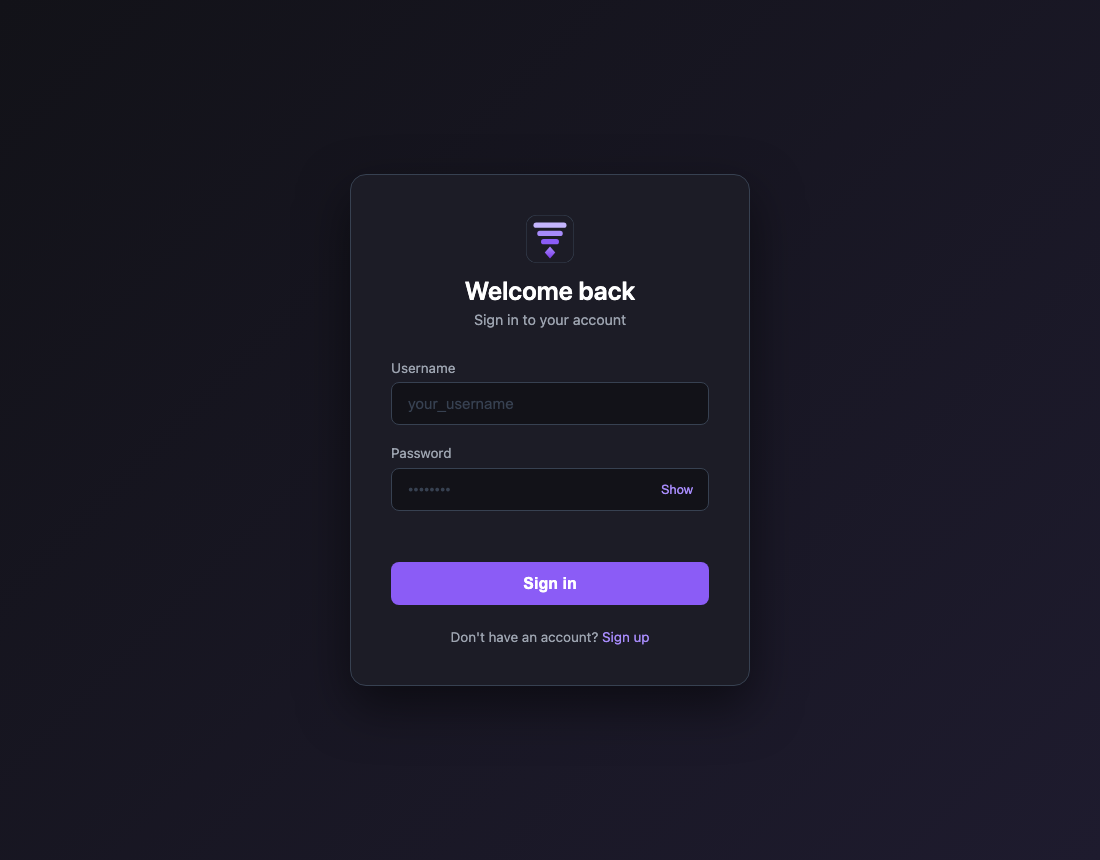
- Real local accounts: username + password signup/login, argon2 password
hashing, SQLite storage - JWT sessions in an HttpOnly, SameSite=Lax cookie
- Per-install secret key generated on first run — nothing sensitive is
ever committed to the repo - Only
static/is served publicly; source code, the database, and the
secret key are never exposed over HTTP
Requirements
- Python 3.11+
- Ollama installed and running (
ollama serve,
or the desktop app)
Quick start
git clone https://github.com/alouiadel/DeepCellar.git
cd DeepCellar

python3 -m venv .venv
.venv/bin/pip install -r requirements.txt

# make sure Ollama is running, then:
.venv/bin/python run_app.py
Open http://127.0.0.1:8000, create an account, and start chatting.
Configuration
| Variable | Default | Description |
|---|---|---|
OLLAMA_HOST |
http://localhost:11434 |
Ollama server address |
Project structure
DeepCellar/
├── run_app.py          Entry point (uvicorn launcher)
├── app/
│   ├── main.py         FastAPI app: auth API, model list, streaming chat proxy
│   ├── auth.py         argon2 hashing, JWT sessions, per-install secret key
│   ├── db.py           SQLite tables (users, chats, messages)
│   └── ollama_client.py Ollama API client (model listing, chat streaming)
├── tests/              pytest API suite (isolated SQLite per test)
├── .github/workflows/  CI: ruff + prettier + pytest on push and PRs
├── pages/
│   ├── index.html      Login / signup page
│   ├── app.html        Chat window with session sidebar (protected)
│   └── models.html     Models dashboard (protected)
├── requirements.txt
├── requirements-dev.txt Dev-only tools (pytest, httpx2)
├── next.md             Roadmap: milestone map (chat → RAG → company → agents)
├── static/
│   ├── style.css       Theme (purple / dark / gray)
│   ├── script.js       Login + signup logic
│   ├── app.js          Chat logic (streaming, memory, markdown)
│   ├── models.js       Dashboard logic
│   ├── vendor/         Pinned marked + DOMPurify (offline-friendly)
│   └── favicon.*       DeepCellar brand icon
└── docs/               Screenshots
Files created at runtime (gitignored): deepcellar.db, .secret_key.
How it works
- Auth — passwords are hashed with argon2 (
pwdlib) and stored in a
local SQLite database. Logging in issues a signed JWT stored in an
HttpOnly cookie; protected pages and API routes verify it. - Model detection — everything comes from Ollama's
/api/tags: cloud
models carry aremote_host, thinking and chat capability come from the
nativecapabilitiesarray (with a/api/showfallback for older
Ollama versions). - Chat memory — Ollama's
/api/chatis stateless, so the browser
keeps the conversation and resends it with every message. Every chat
persists from its first message: the streaming proxy tees each turn
into SQLite. Switching models starts a fresh chat.
Roadmap
See next.md for the milestone map.
- Persistent chat sessions (done — sidebar, stream persistence, tests)
- RAG: document ingestion, embeddings, cited answers (next)
- Company layer: admin roles, shared knowledge bases, branding
- Agents (MCP) and a toolbox of everyday AI utilities
Contributing
See CONTRIBUTING.md for design principles, the roadmap,
and how to submit changes.
Development
.venv/bin/pip install -r requirements-dev.txt
.venv/bin/python -m pytest tests/ -q  # API tests
ruff check --fix . && ruff format .   # Python lint + format
prettier --write .                    # HTML / CSS / JS
CI runs ruff, prettier and pytest on every push and pull request.
License
MIT — see LICENSE.
Yorumlar (0)
Yorum birakmak icin giris yap.
Yorum birakSonuc bulunamadi