pi-smart-compact
Health Warn
- License — License: MIT
- Description — Repository has a description
- Active repo — Last push 0 days ago
- Low visibility — Only 6 GitHub stars
Code Fail
- rm -rf — Recursive force deletion command in package.json
Permissions Pass
- Permissions — No dangerous permissions requested
No AI report is available for this listing yet.
Verification-oriented smart compaction extension for the Pi Coding Agent.
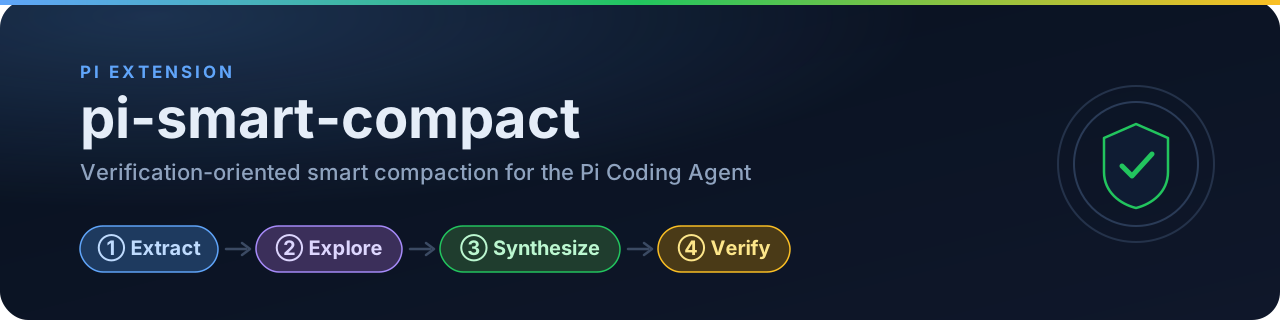


Default compaction trims your conversation blind. pi-smart-compact keeps what
the agent actually needs to continue — the goal, changed files, unresolved
errors, decisions, constraints, and open loops — through a verified
Extract → Explore → Synthesize → Verify pipeline.
Facts first, synthesis second, verification last.
Why
Default compaction produces a vague recap and quietly drops the operational
context that matters most during coding. The result is the classic
"didn't we already fix this?" loop.
| Default compaction | pi-smart-compact |
|---|---|
| Trims by token count | Extracts facts deterministically (zero LLM) |
| Generic prose recap | Structured working-state summary |
| Loses files / errors / decisions | Preserves them, then verifies they survived |
| No regression signal | Damage detection + metrics dashboard |
Install
pi install npm:pi-smart-compact
From GitHub:
pi install git:github.com/alpertarhan/pi-smart-compact
Quick start
/smart-compact                              # interactive — pick model + profile
/smart-compact anthropic/claude-sonnet-4 balanced
/smart-compact "focus on auth + unresolved follow-ups"
/smart-compact metrics                      # profile / provider comparison
/smart-compact dashboard                    # interactive TUI dashboard
Or let the agent call it as a tool on long sessions:
{
  "name": "smart_compact",
  "parameters": { "profile": "balanced", "dashboard": false }
}
Auto-compaction also runs before Pi's native compact once context pressure
crosses your threshold (default 60% actual context usage).
How it works
flowchart LR
    A["Extract<br/>deterministic facts<br/><i>0 LLM calls</i>"] --> B["Explore<br/>optional deep<br/>analysis"]
    B --> C["Synthesize<br/>single-pass or<br/>chunked summary"]
    C --> D["Verify<br/>score gaps,<br/>repair"]
    D --> E["Return verified<br/>summary to Pi"]
| Stage | What it does |
|---|---|
| Extract | Deterministically pulls files, errors, decisions, constraints, topics, and open loops — no LLM, the ground truth. |
| Explore | Optionally inspects the conversation more deeply when the session is complex. |
| Synthesize | Single-pass for short sessions, Kamradt-style chunked + assembled for long ones. |
| Verify | Scores the result against extracted facts and patches missing critical details. |
What it preserves: user goal · constraints & preferences · modified / read /
deleted files · unresolved & resolved errors · key decisions · open follow-up
work · critical next-turn context · the delta since the previous compaction.
Integration surfaces
| Surface | When | Detail |
|---|---|---|
/smart-compact |
Manual | Interactive picker or direct args; bypasses the adaptive gate. |
session_before_compact |
Auto | Runs before Pi's native compaction when context pressure is high. |
smart_compact tool |
Agent | Prepares a pending summary; Pi applies it on the next natural compact. |
A short-lived pending summary is staged in memory (5-minute TTL) and handed to
Pi when compaction is applied.
Example output
A generated summary follows a stable, structured contract:
## Goal
Add retry/backoff to the LLM client so transient 429/5xx don't abort compaction.

## Constraints & Preferences
- [requirement] never compact mid-turn from the tool path

## Progress
### Done
- [x] Added `withRetry` wrapper in src/infra/llm-retry.ts
### In Progress
- [ ] Wire retry client into the services container
### Blocked
- None

## Key Decisions
- **Honor Retry-After verbatim**: providers that set it know their limits best.

## Files Modified
- src/infra/llm-retry.ts
- src/infra/llm-client.ts

## Files Read
- src/app/run-smart-compact.ts

## Open Loops
- [high] Retried but unresolved: AbortSignal ignored by some providers

## Changes Since Last Compaction
- New files touched: src/infra/llm-retry.ts
- New loops: AbortSignal ignored by some providers

## Next Steps
1. Add an outer hard-timeout as a second line of defense

## Critical Context
- 408/425/429/5xx are retriable; 4xx (other) fails fast

## Topics Covered
- LLM retry wrapper (high)
A machine-readable CompactionState is built alongside it for reuse across
later compactions (delta tracking, damage detection).
Configuration
Add to ~/.pi/agent/settings.json:
{
  "smartCompact": {
    "profile": "balanced",
    "summaryModel": "anthropic/claude-sonnet-4",
    "autoTrigger": true,
    "minContextPercent": 60,
    "backupEnabled": true
  }
}
| Key | Type | Default |
|---|---|---|
profile |
light | balanced | aggressive |
balanced |
summaryModel |
string | null |
null (uses session model) |
segmentationModel |
string | null |
null |
autoTrigger |
boolean |
true |
autoTriggerTimeoutMs |
number |
120000 |
minContextPercent |
number |
60 |
backupEnabled |
boolean |
true |
backupDir |
string |
~/.pi/agent/compact-backups |
profiles |
per-profile overrides | built-ins |
Profiles
| Profile | Summary budget | Keep recent | Use when |
|---|---|---|---|
light |
10000 | 30000 | preserve more detail |
balanced |
6000 | 20000 | default, general use |
aggressive |
3000 | 10000 | tighter summaries |
The legacy config key semanticCompact is still accepted.
Safeguards
Correctness
- Deterministic extraction before any synthesis
- Verification scoring with deterministic patching before LLM patching
- Hallucinated file-reference detection (SemVer-aware)
- Open-loop injection + cross-compaction delta tracking
Safety
- Conversation backups before compaction (retention-pruned)
toolCall/toolResultpair integrity at the compaction boundary- Cross-session leak guard on the pending summary
- Session-log recovery that bypasses truncation of older tool results
Observability
- Metrics logging with profile / provider comparison
- Post-compaction damage (regression) detection
- Interactive TUI + HTML dashboards
Usage notes
- Auto / tool compaction is skipped while context is small (below 60% actual usage).
- Manual
/smart-compactbypasses that gate — you asked for it. pi-toolkit'stool=XX%means tool-output ratio, not context fullness;
smart-compact uses actualcontext=XX%.- The tool path does not compact mid-turn (it stages a pending summary).
- Exploration is adaptive and may be skipped for simple sessions.
Companions & compatibility
pi-smart-compact is designed to coexist with — and recommended alongside —pi-toolkit. pi-toolkit handles
everyday context hygiene (anchors, pivots, status lines, old tool-output
trimming); smart-compact handles high-pressure verified compaction. The
integration protects recent pi-toolkit anchors and recovers original tool
outputs from the session log.
Because smart-compact sits close to Pi's compaction path, take extra care with
extensions that also rewrite compaction hooks, branch history, entry IDs, tool
output, or the compaction boundary. If you run another automatic compaction /
context-rewriting extension, prefer a single session_before_compact owner
unless hook order is explicitly coordinated.
Runtime artifacts
The extension writes under ~/.pi/agent/:
| Path | Purpose |
|---|---|
settings.json |
configuration (read) |
compact-backups/ |
conversation backups (retention-pruned) |
.cache/compact-extraction-<session>.json |
incremental extraction cache |
.cache/compact-metrics.jsonl |
metrics log |
.cache/smart-compact-report.html |
HTML dashboard |
.cache/smart-compact/projects/<projectId>.json |
project fingerprint |
.cache/smart-compact/states/<projectId>.json |
reusable compaction state |
.cache/smart-compact/damage-reports.jsonl |
regression signals |
Development
bun install
bun run typecheck   # tsc --noEmit
bun test            # full test suite
bun run build       # dist/ output for publishing
Pull requests run the same verification in GitHub Actions before merge.
Documentation
ARCHITECTURE.md— system design, execution model, layer responsibilitiesCHANGELOG.md— release historyCONTRIBUTING.md— contributor workflow and expectationsSECURITY.md— vulnerability reporting and data-handling notesSUPPORT.md— where to ask for helpdocs/RELEASE.md— release checklist
License
MIT © Alper Tarhan
Reviews (0)
Sign in to leave a review.
Leave a reviewNo results found