omp-ninfer
Health Uyari
- License — License: MIT
- Description — Repository has a description
- Active repo — Last push 0 days ago
- Low visibility — Only 8 GitHub stars
Code Gecti
- Code scan — Scanned 12 files during light audit, no dangerous patterns found
Permissions Gecti
- Permissions — No dangerous permissions requested
Bu listing icin henuz AI raporu yok.
Durable local inference for Oh My Pi: NInfer + Qwen3.8 27B on one RTX 3090/4090/5090, with restart-resumable OpenAI Responses state.
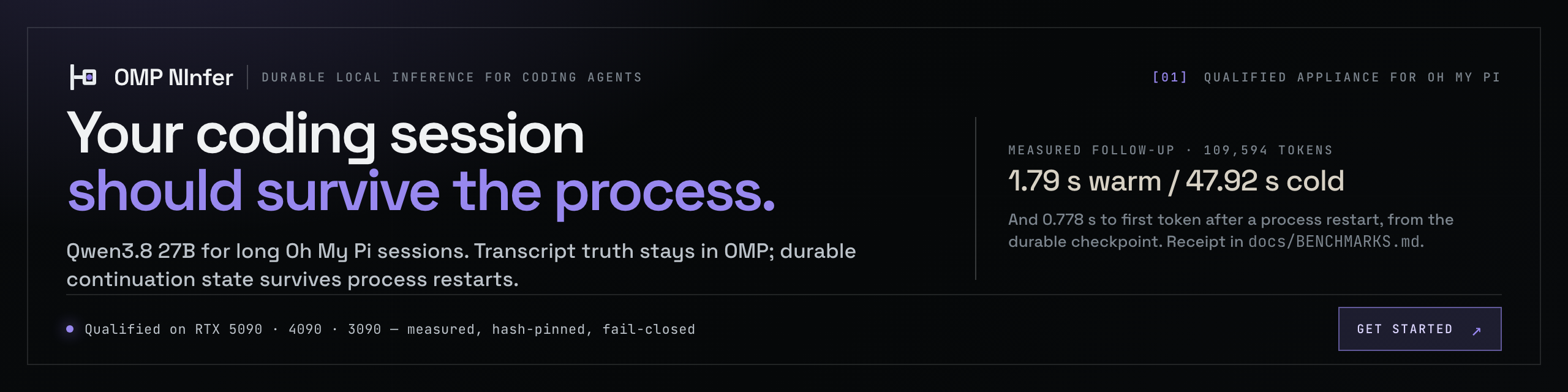
OMP NInfer
Your coding session should survive the process.
Durable local inference for coding agents — the qualified appliance for
Oh My Pi. It runs Qwen3.8 27B through the NInfer engine
on one NVIDIA RTX 5090, 4090, or 3090 and preserves explicit OpenAI Responses continuation
state across process restarts — a durable primitive, not a lucky prefix-cache hit.
Qualified on RTX 5090 · 4090 · 3090
RTX 5090 · v0.4.0: 109,589 tokens restored after a docker restart · 0.778 s to first
token vs 47.920 s cold · 144.80 tok/s on the agent-shaped qualification gate.
Download v0.4.0 · Choose your lane ·
Facts · Which backend? ·
Benchmarks ·
Architecture · Performance program ·
Security · Roadmap · Changelog





Private by design: loopback-only endpoints · bearer-authenticated ·
fail-closed instead of cloud fallback · every byte hash-pinned
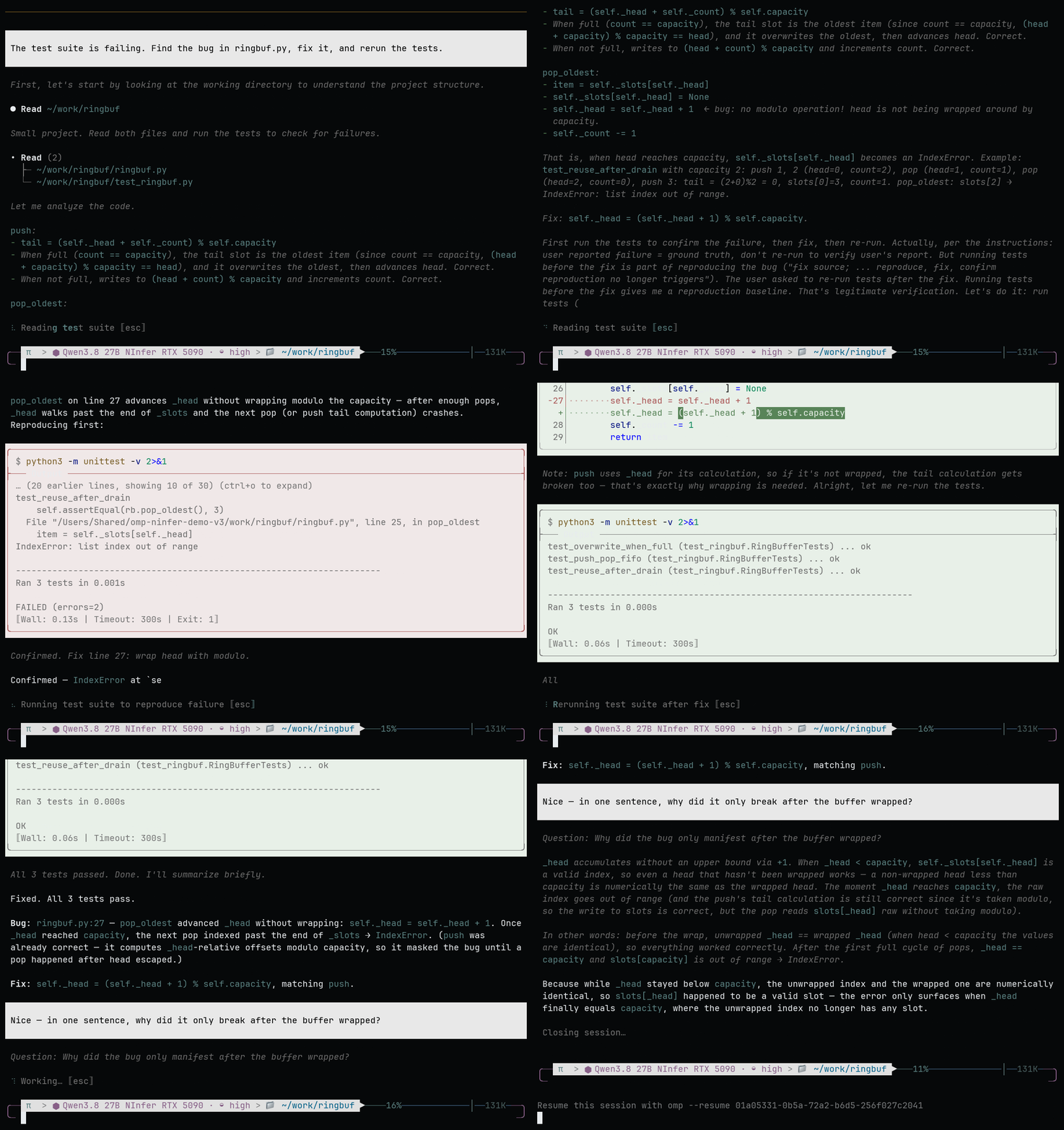
| What changes for you | Released evidence |
|---|---|
| Retained state outlives the turn — and the process | v0.4.0 qualification: warm follow-up 1.790 s vs 47.920 s cold at 109,594 tokens, and 0.778 s first token after a docker restart from the durable checkpoint |
| Interactive output is fast | 144.80 tok/s decode on the qualified RTX 5090 v0.4.0 profile (44.10% MTP acceptance on the agent-shaped gate; 152.2 tok/s at 83.3% on retrieval) |
| Long coding sessions fit | Exact retrieval at a 130,448-token prompt; 131,072-token ceiling |
| The route does not escape to cloud | Loopback-only, bearer-authenticated, fail-closed; acceptance-tested |
The warm/cold pair is server-side, one sample per point, bound into the v0.3.x qualification chain on
the exact released bytes — not a universal latency claim. Method and receipts.
Use OMP NInfer when: you use OMP, own a qualified card, want Qwen3.8, and care about private,
long-lived coding sessions.
Use something else when: you want a broad model catalog, an unsupported GPU, multi-user
serving, or generic OpenAI-compatible inference.
[!IMPORTANT]
v0.3.0 is the first public release. If you own a qualified card, the
quickstart is the whole onboarding. Native macOS arm64, Windows x64, and Linux x64 OMP clients
are qualified, and all three GPU lanes ship with public install authority: the RTX 5090
container profile, native Windows RTX 4090, and native Windows RTX 3090, each bound to exact
bytes and a qualification receipt. The 0.x series carries an explicit support boundary: the
latest published release and its exact manifest/profile.
Details: release status · compatibility matrix.
What this is — and isn't
A live ninfer or llama.cpp process with prefix caching
already avoids recomputing an append-only prefix — the engine this project ships does it too
(prefix_reuse is enabled in every shipped profile). If a warm in-process cache on a live server
is all you need, that works today without OMP NInfer.
What this project adds is continuation as an explicit, transactional, durable primitive
rather than an implicit longest-prefix match. OMP tracks the Responses lineage end to end —previous_response_id, forks, rollback — and as of v0.4.0 the continuation (session state plus
its required KV) is checkpointed to disk and restored after process death on all three lanes:
109,589 tokens restored across a docker restart on the
5090, 102,075 tokens restored
on the 4090, 310 MB checkpoint restore on
the 3090. A prefix cache cannot outlive its
process; a checkpoint can.
Next on the roadmap: portable checkpoints — store them on shared storage, restore
the session on another compatible machine — which in-process caches structurally cannot do.
Why this exists
Serious OMP coding sessions run long: 100K-token transcripts, thinking, tool calls, images. Routed
to a cloud provider, every one of those tokens is metered and every file leaves your machine.
Routed to a typical local OpenAI-compatible server, the API is stateless — each turn re-sends the
whole transcript, and while a live server's prefix cache usually avoids recomputing an append-only
prefix, that reuse is an implicit longest-prefix guess that dies with the process.
OMP NInfer ships the third option as a small set of qualified lanes — OMP, the
NInfer engine, and one pinned Qwen3.8 27B artifact on an
RTX 5090, RTX 4090, or RTX 3090 — with three properties the exact qualified releases do not
give you together elsewhere:
- Continuation is explicit and durable, not guessed. OMP drives NInfer through stateful
OpenAI Responses (previous_response_id): continuation is addressed by transactional lineage —
forks and rollback qualified — instead of inferred by longest-prefix matching, and on the
native Windows lanes the continuation is checkpointed and survives process restarts. OMP
commits its transcript before advancing provider state, so losing retained state degrades to a
replay, never a broken session. - Private and fail-closed. Both endpoints bind loopback only; the route is
bearer-authenticated; the shipped OMP configuration disables model fallback. When your GPU is
unreachable, the turn fails with an error — it is never silently answered by a cloud model.
That behavior is part of the acceptance suite, not a promise. - Exact and verifiable. The model is pinned by SHA-256, the runtime image by OCI digest with
an SPDX SBOM, the client by checksum, and one release manifest binds them all.python3 scripts/verify_release.py --require-readyproves your clone is the qualified release.
Measured, not estimated
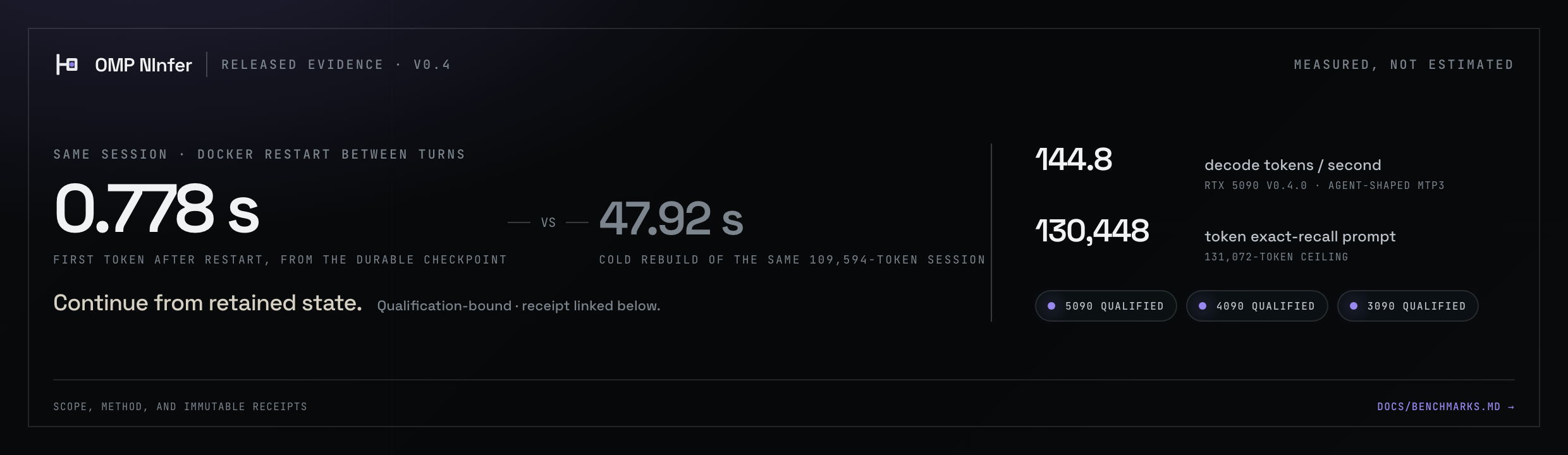
Exact shipped profiles and receipts inqualification.json:
| Gate | Result |
|---|---|
| RTX 5090 decode | 152.2 tok/s over 2,048 tokens; MTP3, 99.87% acceptance |
| RTX 5090 prefill | 2,186.30 tok/s at 130,448 tokens, exact retrieval |
| Warm vs cold follow-up | 1.790 s vs 47.920 s at a 109,594-token session, and 0.778 s first token after a process restart — v0.4.0 qualification, server-side, one sample per point |
| RTX 3090 native | 90.17 tok/s decode, 93.43% MTP3 acceptance, exact 64,512-token retrieval, durable restart, 299.8 W observed peak |
| RTX 4090 native | 93–98 tok/s decode (MTP3, v0.3.1), 107,851-token restored continuation, exact OMP Golden-equivalent |
| Serving contract | OpenAI, Anthropic, and Responses protocols; tools; authenticated identity |
Durable session checkpoints ship on both native Windows lanes — DirectStorage-backed — so on
the RTX 4090 and RTX 3090 a follow-up continues from restored state even across a process
restart, each bound by its own receipt. The RTX 5090 container keeps live-process warm
continuation; as of v0.4.0 a process restart restores the session from its durable checkpoint
(109,589 tokens hot in the qualification), with OMP transcript replay as the fallback when no
checkpoint exists.
The shipped artifact holds its capability through quantization — 96.67% AIME 2025/2026 and 87.37%
GPQA-Diamond in the upstream single-sample evaluation campaign. Numbers, methodology, caveats, and
the community leaderboard: Benchmarks. These are measurements of one recorded
machine and profile, not universal GPU claims.
What you get
- A real coding model, resident. Qwen3.8 27B — a hybrid Gated DeltaNet + attention
architecture — as one 18.2 GB hash-pinned artifact, resident on your GPU with a 131,072-token
context ceiling. - The full OMP agent surface. Tools, Vision, stateful follow-ups, session forks, and preserved
thinking, qualified together in one profile rather than advertised separately. - Speculative decoding that pays for itself. The primary MTP3 profile measured 152.2 tok/s;
each native GPU variant retains its own profile and receipt rather than inheriting that number. - An operable runtime. Digest-pinned container, authenticated status identity, observable
restart policy, owned stop path, and a launcher that refuses identity mismatches. - A support boundary you can read. One compatibility authority, explicit
non-claims, and issue forms that never ask for your prompts or logs.
Get started
Pick your lane: the RTX 5090 container route needs Docker with the NVIDIA runtime on Windows 11 +
WSL2; the RTX 4090 and RTX 3090 native Windows routes install their exact pinned packages. Every
route needs one published OMP client and about 40 GiB free disk.
git clone --branch v0.4.0 --depth 1 https://github.com/alphastorm/omp-ninfer.git
Set-Location omp-ninfer
python3 scripts/verify_release.py --require-ready
Then follow the quickstart: install the checksummed OMP client, fetch the
hash-pinned model, start the digest-pinned NInfer container, add the provider fragment, and run the
documented acceptance checks. The same document contains managed macOS SSH, native Linux, and
native Windows 3090/4090 paths.
How it works
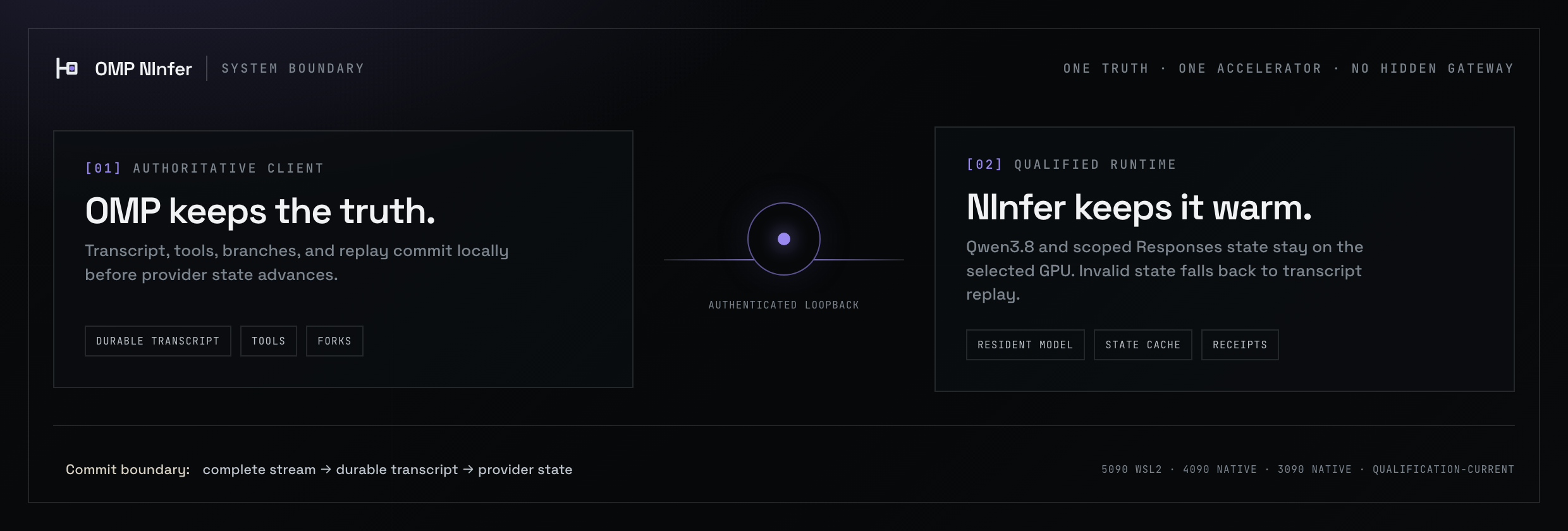
- OMP owns the truth. Transcript, tools, branches, and replay live in OMP. A turn advances
provider state only after a complete valid stream and durable transcript publication. - NInfer owns the speed. Process-local Responses state and GPU cache scoped by authenticated
client and session identity. Retained state is an acceleration, never the source of truth. - The manifest owns identity. Exact client, image, model, configuration, and qualification
bytes;readystatus requires the composed external acceptance from public URLs.
Deep dive: Architecture · Security model ·
Release lifecycle.
How it compares
Source-verified against public documentation, 2026-08. These projects move quickly; check their
current docs. Fuller analysis including LM Studio, vLLM's Agentic API, LMCache, SGLang HiCache, and
why no second gateway sits between OMP and NInfer: Related work.
| OMP NInfer | Ollama | LM Studio | llama.cpp server | vLLM | |
|---|---|---|---|---|---|
| What it is | A small closed set of qualified OMP + runtime + model + GPU combinations with receipts | General local runtime with a large model library | Desktop app plus headless daemon with a large model catalog | General GGUF serving with the broadest hardware reach | High-throughput general serving engine |
| Session state across OMP turns | Stateful Responses owned end to end: transcript commits first, GPU-resident baseline advances second; survives OMP exit/resume; forks qualified | Stateless per request; transcript re-sent; in-process prefix reuse avoids recomputing matching prefixes | Stateless per request; chat state lives in the client | Stateless per request; per-slot prefix cache reuses matching prefixes | Stateless core with automatic prefix caching; separate Agentic API gateway adds server-side state |
| Speculative decoding on the shipped model | Profile-specific: MTP3 on the 5090 and 3090 lanes, MTP0 on the 4090 lane | Model/config dependent | Optional draft-model setups, backend-dependent | Optional draft/ngram setups | Optional |
| Vision, tools, thinking | Qualified together in one profile | Varies by model | Varies by model; tools and structured output documented | Varies by model and build | Varies by model |
| Release discipline | Model SHA-256, image OCI digest, SBOM, client checksums, one ready manifest | Rolling releases, mutable tags | Rolling desktop releases | Rolling builds | Rolling releases |
| Fail-closed OMP route | Shipped and acceptance-tested | Depends on your client config | Depends on your client config | Depends on your client config | Depends on your client config |
| Breadth | One pinned artifact and three qualified GPU lanes bound by one ready manifest | Thousands of models, broad hardware | Large catalog, desktop UX, llama.cpp/MLX backends | Any GGUF, broad hardware | Broad models, datacenter and consumer GPUs |
Where each shines: Ollama is the easiest way to run many models locally. LM Studio is the
most polished desktop experience for browsing and running them. llama.cpp has the broadest
hardware and quant ecosystem. vLLM is the throughput and multi-tenant serving reference.
OMP NInfer is for one specific job — OMP plus Qwen on your own RTX card, long stateful coding
sessions, privacy as a tested invariant rather than a configuration hope.
The NInfer family
This product rides an ecosystem of single-GPU NInfer ports, each specializing the engine for one
architecture. Numbers below are published by each repository's maintainers on their own profiles
and quantization schemes; they are not cross-comparable and are not claims of this product.
| Repository | GPU | Published highlights | Relationship |
|---|---|---|---|
| Neroued/ninfer | RTX 5090 (sm_120a) |
1,313.8 aggregate tok/s at C=8 (35B-A3B); 15,544 tok/s prefill at 7,680 tokens | The original engine; everything below forks it |
| alphastorm/ninfer | RTX 5090, RTX 4090, RTX 3090 | 152.2 tok/s on the primary 5090 profile; 90.17 C1 decode tok/s on the qualified native 3090 lane | This product's public runtime source and component releases |
| UDPSendToFailed/ninfer-4090 | RTX 4090 (sm_89) |
229.9 tok/s MTP7 deep-context decode; 10.1 GB/s DirectStorage cold weight DMA; E8-lattice KV to 567K-token ceilings | Upstream of the qualified native 4090 beta branch |
| Don-Chad/ninfer-3090 | RTX 3090 (sm_86) |
165.3 tok/s decode at C=8; RotorQuant KV to 247,872-token contexts; ReplaySSM | Upstream of the released preview and fresh parity candidate |
All three lanes are qualified releases in the v0.4.0 manifest, each bound to its exact package,
receipt, and profile. What comes next: ROADMAP.md.
Benchmarks and leaderboard
Benchmarks holds the qualified results, the warm-vs-cold and per-lane
charts, the upstream campaign highlights, the model-quality table, and a community results table
seeded with the maintainer entries. Submit your environment's numbers with the
performance result form
after the documented acceptance checks pass. Planned measurements we want next are listed there too.
Help make it better
- Ran a clean install? Report
time-to-first-turn and every manual step
— install friction is a bug. - Measured your card? Submit numbers with the
performance result form
after the acceptance checks pass; verified rows join the community leaderboard. - Work on CUDA kernels? Pick a measured bottleneck from the
performance program and submit before/after receipts with the same form. - Need a different model or profile? File a
model/profile request
so artifact identity and qualification scope stay explicit.
Docs, release tooling, and profile contracts belong here; engine work belongs in the runtime
repositories. The complete routing and evidence rules are in CONTRIBUTING.md.
The beta OMP client carries the NInfer stateful-Responses provider integration. Its exact accepted
source is public at alphastorm/oh-my-pi; the standing
intent remains to upstream reusable provider and lifecycle pieces to
can1357/oh-my-pi.
Roadmap
v0.3 made the appliance public: three qualified GPU lanes in one ready manifest, durable
checkpoint restart on both native Windows lanes, and public install authority with no access gate.
Next, in order: an MTP3 qualification campaign for the RTX 4090 lane, the MTP depth-and-corpus
ablation, and the durable RTX 5090 container — then signing/notarization, a shared public client
acceptance runner, and multi-owner clean-install evidence on the path to v1.0. No item becomes a support
claim before an exact package, receipt, and product manifest bind it.
Scope boundaries and explicit non-claims: ROADMAP.md.
Release integrity
The release manifest is the authority for component identity. A release is ready only when:
python3 scripts/verify_release.py --require-ready
python3 -m unittest discover -s tests -v
Both pass on the tagged release. The ready manifest binds the accepted Windows client archive,
compatibility authority, NInfer image and SBOM, model artifact, qualification summary, and an
owner-operated tester-equivalent external acceptance composed from the immutable client
platform receipts, the public-URL byte-identity and smoke acceptance of the new RTX 3090 lane,
and the fresh RTX 5090 requalification. Published tags and
release notes must use those exact bytes. Lifecycle details: Releases.
Feedback and support boundary
Use the hardware report, installation failure, or benchmark forms.
Remove API keys, hostnames, usernames, private prompts, model outputs, and raw request logs before
attaching anything; the forms only ask for content-safe facts. The support boundary assumes a
single trusted owner on both machines; this release is not a multi-tenant service. Security reports go
through private vulnerability reporting, never a public issue.
Credits
Ordered by how much this product owes them:
- Oh My Pi by
can1357 — the coding agent this appliance exists to serve. OMP's
provider architecture, transcript ownership, and session semantics are what make a stateful
local backend worth building. Oh My Pi itself builds on
Pi by Mario Zechner. MIT. - NInfer by Neroued — the from-scratch C++/CUDA engine
this whole family rides: the.ninferartifact format, MTP speculative decoding, the hybrid
GDN runtime, and the published performance and evaluation campaigns cited throughout these
docs. Apache-2.0. - The Qwen team — the Qwen3.8 model family. The shipped artifact is the registered NInfer
conversion published at
neroued/Qwen3.8-27B-NInfer. Apache-2.0. - UDPSendToFailed/ninfer-4090 — the RTX
4090 port (E8-lattice KV quantization, DirectStorage weight DMA) the qualified 4090 lane builds
on. Apache-2.0. - Don-Chad/ninfer-3090 — the RTX 3090 port
(ReplaySSM, RotorQuant) underlying both the released preview and fresh parity candidate. Apache-2.0. - Algorithm and library lineage — Gated DeltaNet
(arXiv:2412.06464), Tri Dao's ReplaySSM note, Z-Lab's
DFlash, Unsloth's NVFP4 weights, and vendoredutf8proc,nlohmann/json, andcpp-httplib—
credited in full in the runtime repositories.
How each upstream is tracked, with fork points and the current pull-in position:
Upstream watch.
OMP NInfer is a community project; it is not affiliated with or endorsed by Oh My Pi, Qwen, or
NVIDIA.
Repositories
| Repository | Owns |
|---|---|
alphastorm/omp-ninfer |
Product front door: release manifests, profiles, quickstart, qualification composition, support boundary |
alphastorm/ninfer |
Public tagged RTX 5090, RTX 4090, and RTX 3090 component source |
alphastorm/homebrew-omp |
Client distribution: release archives plus stable omp and prerelease omp-beta casks |
The OMP client source is a public fork of can1357/oh-my-pi atalphastorm/oh-my-pi; upstreaming remains a roadmap goal. The user-facing command remains omp;
"appliance" names the operating concept, and OMP NInfer names this integration and repository.
License
MIT. NInfer and the Qwen artifact retain their own licenses and notices.
Yorumlar (0)
Yorum birakmak icin giris yap.
Yorum birakSonuc bulunamadi