tokengraph
Health Uyari
- License — License: MIT
- Description — Repository has a description
- Active repo — Last push 0 days ago
- Low visibility — Only 6 GitHub stars
Code Uyari
- process.env — Environment variable access in packages/cli/package.json
Permissions Gecti
- Permissions — No dangerous permissions requested
Bu listing icin henuz AI raporu yok.
Your AI coding agents' token usage as a GitHub-style graph: Claude Code, Codex CLI, Cursor, Gemini CLI and 7 more. Local-first CLI, no server.

Your AI coding, as a GitHub-style graph.
Claude Code, Codex CLI, Cursor, Gemini CLI, Cline, OpenCode, Kilo CLI, Copilot CLI, pi, Qwen Code and Goose: one graph, in your README.
Your usage never leaves your machine unless you publish it, and then only to your own gist.


English · Türkçe

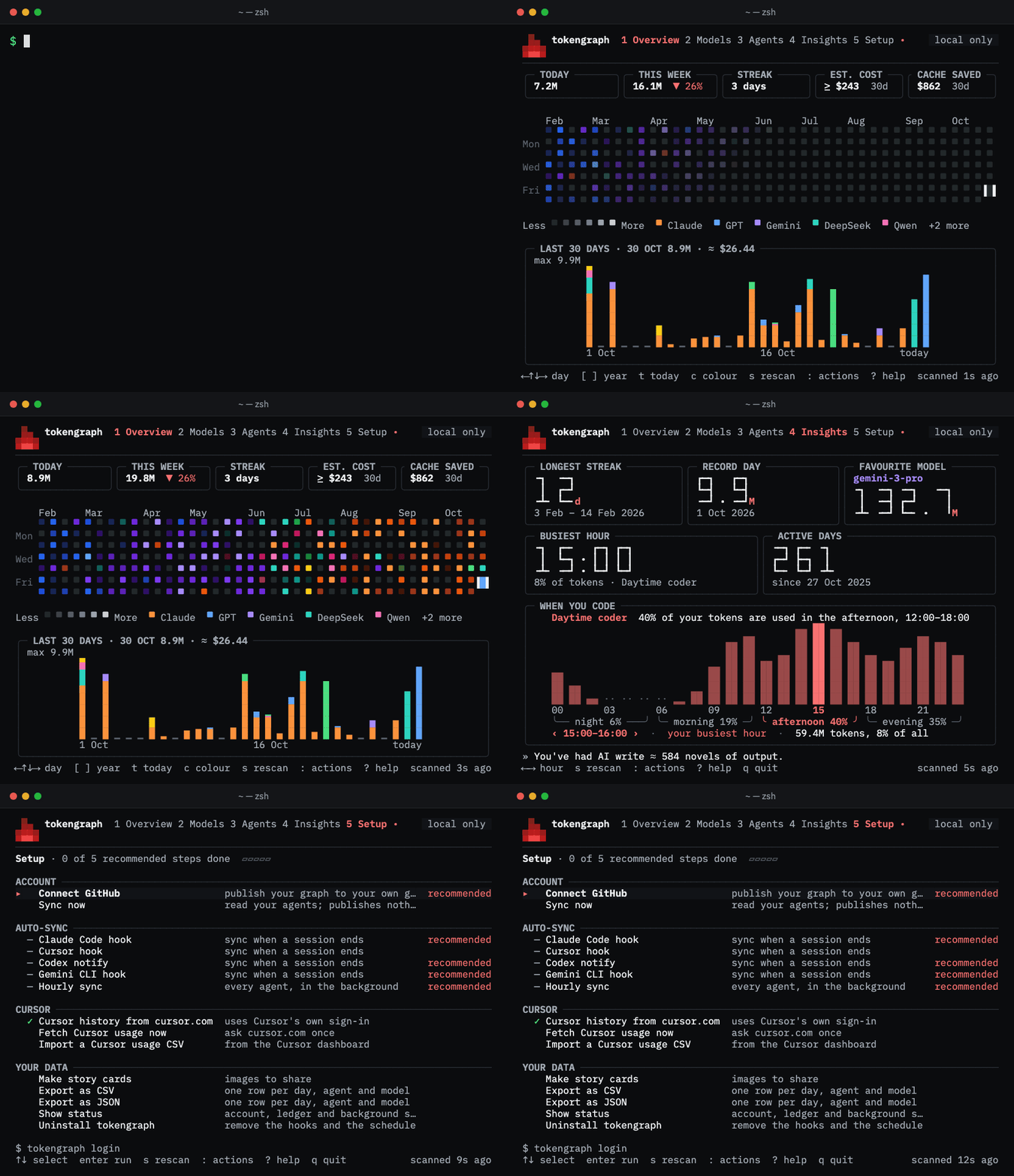
Quick start
npx tokengraph            # your graph, right in the terminal
npx tokengraph login      # publish it to your GitHub gist and get the README snippet
npx tokengraph story      # turn your usage into story cards and send them to your phone
Needs Node.js 22 or newer. To keep the README graph fresh without thinking about it, install it once and
turn on the hourly sync: npm install -g tokengraph && tokengraph schedule. After an npx tokengraph login,
login offers to do both for you.
Put it in your README
tokengraph login publishes your graph to a public gist on your GitHub account and copies this
snippet to your clipboard. Run tokengraph readme to print it again. Paste it into your profile
README (the YOUR_LOGIN/YOUR_LOGIN repository):
<a href="https://github.com/altindalorcun/tokengraph">
  <picture>
    <source media="(prefers-color-scheme: dark)" srcset="https://gist.githubusercontent.com/YOUR_LOGIN/GIST_ID/raw/tokengraph-dark.svg">
    <img alt="My AI coding token usage, made with tokengraph" src="https://gist.githubusercontent.com/YOUR_LOGIN/GIST_ID/raw/tokengraph-light.svg">
  </picture>
</a>
The graph switches between light and dark with the reader's GitHub theme. Every sync updates the
same gist, so the snippet never changes. Use tokengraph readme --compact for a smaller graph
without labels, and tokengraph readme --colors single for one colour instead of one per model
family (--colors model switches back). The families are Claude, GPT, Gemini, DeepSeek, Qwen,
GLM, Kimi, Grok, Composer (Cursor's own models), Mistral, Llama and MiniMax; every other model
counts as "Other models".
Share your day
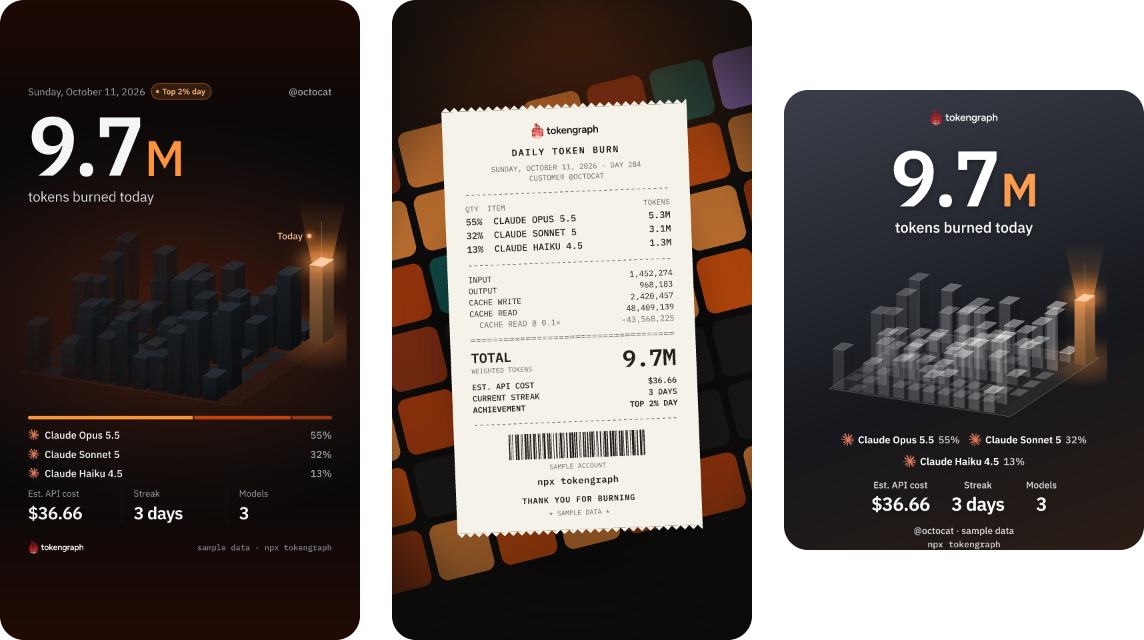
tokengraph story draws three cards (a skyline, a receipt and a sticker) sized for Instagram and
TikTok stories and shows a QR code. Scan it with your phone on the same Wi-Fi and save each card: on
an iPhone, touch and hold it and tap Save to Photos (Save shows you how); on Android, Save puts it in
your gallery. Nothing is uploaded anywhere, and nothing is written to your computer unless you press
S while the code is up (or pass --save, --out <dir> or --no-qr). Your computer serves the cards
to your phone until you press Ctrl+C, or after 10 idle minutes. It asks which period to cover (today, 7 days, 30 days or 12 months); skip the question with --range today|7d|30d|1y, and leave
the estimated cost off with --no-cost.
How it works
agent logs on your machine ──► tokengraph ──► ~/.tokengraph ledger ──► your gists
(Claude Code, Codex, …)        dedups,         (totals only grow)       public: the SVG graph
                               weights                                  secret: daily counts per machine
tokengraph reads the usage counters the agents already write to disk. It never reads your prompts
or answers. Each day's number is a weighted token count:
weighted tokens = input + output + cache writes + 0.1 × cache reads
Cache reads cost a fraction of fresh input, so they count a tenth. Without that, one long session
re-reading a big cached context would drown a day of real work. It measures work, not a bill.
- No double counting. Agents write the same message to disk several times while streaming,
and resumed or forked sessions copy earlier records. tokengraph dedups by each agent's own
message or response id, and never counts usage that another adapter already counts. - Totals only grow. Agents delete old transcripts. The ledger keeps the largest count it has
ever seen for each day, so history survives, and a fresh smaller scan never lowers it.
Privacy
| What leaves your machine | To a public gist on your account: the SVG graphs (daily token totals and the names of the model families they are coloured by) and a README with the embed snippet and a link. To a secret gist on your account: one file per machine with its daily token counts per agent, model and pricing tier, a random machine id, a label such as darwin-3f2a1c, a hashed machine fingerprint, the CLI version and the time of the last update; if you use the Cursor fetch, also your Cursor account's daily counts per model under a hashed account key; and a short README. Both only after tokengraph login, and only when tokengraph publishes (sync, a hook, the schedule, login, or readme --colors). sync --local, story, status, export and import never do, and view does only when you pick Sync (or login, or graph colours) in it. |
| What stays on this machine | Which project you used each agent on: tokengraph notes the folder each session ran in, keeps it in state.json to total usage per project (and in cursor-events.jsonl for Cursor turns, and in config.json for a project you named), and never puts a project name or a path in a machine file, a gist, the graph or a story card. export --projects writes project names only when you ask for that file. Which hour of the day you used each agent. tokengraph keeps weighted tokens per local hour in state.json for the busiest-hour card, the "When you code" chart and export --hours; they are never put in a machine file, the data gist, the graph or a story card. Hours exist only for days your agents' logs still hold. |
| What tokengraph fetches | Only for Cursor, and only while it is on (the default once Cursor is signed in; tokengraph cursor off stops it): sync reads Cursor's own sign-in token from Cursor's local database (read-only, that one row) and asks cursor.com for your own usage export, the file the Cursor dashboard's export button gives you. The token goes to cursor.com only, is held in memory for the request and is never stored, printed or logged. What is kept is the usage rows (timestamps, model names, token counts). sync --local never does. Separately, the terminal view asks the npm registry (registry.npmjs.org) for the latest tokengraph version, at most once a day, so it can tell you when an update is out. That request carries no usage data; like any download it shows npm your IP address and the tokengraph version you run. tokengraph update off stops it. |
| What never does | Prompts, answers, code, file names, paths. Nothing is sent to any tokengraph server: there is none. |
| How to remove it | tokengraph logout forgets the login on this machine. Delete the two gists on gist.github.com to remove what was published. |
A secret gist is unlisted, not private: anyone who has its URL can read it. It holds the fields
listed above and never a hostname, a user name or an e-mail address. Until you run tokengraph login,
nothing is published; the only network calls before that are the view's daily version check to the
npm registry (tokengraph update off turns it off) and the Cursor fetch to cursor.com, and that one
only when Cursor is signed in on the machine and you run sync (tokengraph cursor off turns it off).
Supported agents
| Agent | Where it reads | Notes |
|---|---|---|
| Claude Code | ~/.claude/projects/**/*.jsonl and transcripts (also $CLAUDE_CONFIG_DIR), and the Code and Cowork sessions of the Claude desktop app (~/Library/Application Support/Claude, %APPDATA%\Claude, ~/.config/Claude) |
Claude Code deletes old transcripts, so sync at least every few weeks. tokengraph install-hook --agent claude-code syncs when a session ends. |
| Codex CLI | ~/.codex/sessions and archived_sessions (also $CODEX_HOME) |
tokengraph install-hook --agent codex syncs after a turn, at most every 10 minutes. It never overwrites a notify setting that is not its own. |
| Cursor | Your own usage history from cursor.com, fetched with Cursor's sign-in on this machine (cursor-account-*.jsonl); ~/.tokengraph/cursor-events.jsonl, written by Cursor's stop hook, for real time |
Cursor keeps no usable token counts on disk. When Cursor is signed in, tokengraph sync fetches your whole usage history from cursor.com by itself, at most once an hour (every machine, IDE, CLI and cloud agents; turn it off with tokengraph cursor off). The hook (tokengraph install-hook --agent cursor, then restart Cursor) fills in the hours before cursor.com has them; a usage CSV (tokengraph import cursor <csv>) works for people who keep fetching off. Reading Cursor's sign-in needs Node 22.13 or newer. |
| Gemini CLI | ~/.gemini/tmp/*/chats, and ~/.cache/.gemini/tmp from the macOS sandbox (also under $GEMINI_CLI_HOME) |
tokengraph install-hook --agent gemini-cli syncs when a session ends (Gemini CLI settings, also under $GEMINI_CLI_HOME); tokengraph schedule still covers it. Gemini CLI deletes sessions after 30 days by default, so sync at least monthly. It never records some side calls, so totals are a lower bound. |
| Cline | saoudrizwan.claude-dev/tasks in VS Code-family editors (VS Code, Cursor, VSCodium, Windsurf, Positron, Trae, Kiro, Antigravity and others; $XDG_CONFIG_HOME on Linux, %APPDATA% on Windows; remote ~/.vscode-server and friends), and ~/.cline/data (also $CLINE_DIR, $CLINE_DATA_DIR, $CLINE_SESSION_DATA_DIR) |
Requests Cline sends through the Claude Code provider are skipped, because the Claude Code adapter already counts them. |
| OpenCode | ~/.local/share/opencode/opencode*.db and the older storage/ folder (also under $XDG_DATA_HOME; $OPENCODE_DB adds one database) |
Reading the database needs Node 22.13 or newer. Records from before OpenCode 1.3.16 that cannot be read with certainty are skipped and reported. |
| Kilo CLI | ~/.local/share/kilo/kilo*.db (also under $XDG_DATA_HOME; $KILO_DB adds one database) |
Kilo Code 7.x in VS Code writes the same database, so it is counted here too. Reading the database needs Node 22.13 or newer. Records from before Kilo 7.2.6 that cannot be read with certainty are skipped and reported. |
| Copilot CLI | ~/.copilot/session-store.db (also $COPILOT_HOME) |
Needs Copilot CLI 1.0.70 or newer and Node 22.13 or newer. Only the CLI's own database is read, not the Copilot Chat extension in VS Code. A database with an unrecognised layout is skipped and reported. |
| pi | ~/.pi/agent/sessions (also $PI_CODING_AGENT_DIR, and $PI_CODING_AGENT_SESSION_DIR if set) |
Written the same way by @mariozechner/pi-coding-agent and its successor @earendil-works/pi-coding-agent. Forked sessions share earlier requests, which are counted once. Compaction and branch-summary calls name no model and are skipped and reported. |
| Qwen Code | ~/.qwen/projects ($QWEN_HOME, $QWEN_RUNTIME_DIR), chats and background subagents, and Qwen Code's own usage ledger in ~/.qwen/usage |
Chats forked with /branch copy earlier requests, which are counted once. Qwen Code does not record cache writes separately, so they count as ordinary input. It deletes background subagent transcripts after 30 days by default, so sync at least monthly. Its usage ledger, the only local record of the memory extractor's requests, is written only while privacy.usageStatisticsEnabled is true (the default); with it off, those requests are in no local file and only the chat requests are counted. |
| Goose | ~/.local/share/goose/sessions/sessions.db (also under $XDG_DATA_HOME or $GOOSE_PATH_ROOT/data; %APPDATA%\Block\goose\data on Windows; every database found is read) |
Reads the per-request usage ledger, so it needs a Goose version that has one, and Node 22.13 or newer. Usage from before the ledger existed has no known day or model and is skipped and reported. Sessions that drive Claude Code, Codex, Gemini CLI, Cursor, Copilot CLI or pi through Goose are left out, because those agents' own logs already count them (for Cursor only if its hook fires for Goose's runs, which is unchecked). |
Each agent's counts are checked against real runs of Claude Code 2.1.304, Codex CLI 0.163.0, Gemini CLI 0.64.0, Cline 3.0.73, OpenCode 1.19.3, Kilo 7.8.15, Copilot CLI 1.0.100, pi 0.73.1, Qwen Code 0.25.3 and Goose 1.55.0 on every protocol they support, with scripts/e2e. Cursor cannot be driven offline; its CSV parser was checked against real exports, its fetch against a local fake server and its hook format follows Cursor's documentation. Cline stores output tokens without the reasoning tokens some providers report inside them, so those are not counted.
Every agent is read from its default folder plus any folder its environment variable names, and tokengraph remembers such a folder
(in config.json) the first time sync, view, status, schedule or install-hook runs with it set, so the hourly sync and the hooks, which do not get your shell's environment,
still read it. tokengraph status lists the folders it scans and whether they exist.
Cline, OpenCode, Kilo CLI, Copilot CLI, pi, Qwen Code and Goose have no hook (and Gemini CLI's is optional): tokengraph schedule syncs them every hour. Aider is
not supported, because its local history rounds token counts.
Commands
Every command takes --help. An unknown option is an error. The full guide is at tokengraph.app/docs.
| Command | What it does |
|---|---|
tokengraph [view] |
Opens the live terminal view: year heatmap, models, agents, streaks, a "When you code" chart of the hours you work in (← → picks an hour), and a Setup tab to manage hooks, the hourly schedule, sync, Cursor, export and story without leaving the view. The Projects tab shows tokens and estimated cost per project, with its models and agents. : or Ctrl-K opens a command palette; each action shows its CLI equivalent. --print prints a static snapshot, --no-motion skips animations, --no-live stops rescanning while open, --theme auto|dark|light. The default command in a terminal. |
tokengraph login |
Connects GitHub, publishes your graph to your own gist, prints the README snippet. Uses your GitHub CLI login if you have one (--gh), or a one-time code you approve in the browser (--device, --no-open). Asks for gist access only. Then offers the hourly sync; run through npx, it first offers to install tokengraph globally with npm, since the schedule needs a lasting install. |
tokengraph logout |
Forgets the GitHub login on this machine. Local data and your gists stay. |
tokengraph sync |
Reads every agent's logs into the ledger and, when logged in, publishes. With Cursor signed in it first fetches your Cursor usage from cursor.com (at most once an hour). --since <days> sets how far back to read (default 90), --local never touches the network. |
tokengraph projects |
Shows tokens, share and estimated cost per project on this machine; --range 7d|30d|90d|1y|all, --json. projects show <name> adds its models, agents and folders. A project is a git repository, or the folder a session ran in when there is none. projects name <name-or-folder> <new-name> renames one, and folders with the same name count as one project, so that is also how you merge them; --reset removes a name. |
tokengraph readme |
Prints the README snippet and copies it. --compact, --colors model|single. |
tokengraph story |
Draws story cards and shows a QR code that sends them to your phone; nothing is written to this computer unless you press S there or pass --save (your Downloads folder) or --out <dir>. --no-qr only saves the files, as does any run without a terminal. --template skyline|receipt|sticker|all, --range today|7d|30d|1y, --no-cost, --save, --qr / --no-qr, --no-preview, --handle <name> (default: your GitHub login, or your computer's user name when you are not logged in). |
tokengraph status [--json] |
Shows the GitHub account, the ledger, your machines, which background syncs are installed and healthy, the folders each agent is read from (and which exist), and how long Claude Code, Gemini CLI and Qwen Code keep their logs, with a warning when a short retention puts history at risk. --json prints it as one JSON object for scripts and AI agents; it includes the secret gist's address and local paths, so don't paste it in public. |
tokengraph install-hook --agent <claude-code|cursor|codex|gemini-cli> |
Makes that agent start a background sync when it finishes. --remove uninstalls it, --dry-run shows what would change. For Claude Code, --event SessionEnd|Stop|SubagentStop picks the hook event (default SessionEnd). |
tokengraph schedule |
Installs an hourly background sync: launchd on macOS, cron on Linux, Task Scheduler on Windows. schedule --remove turns it off, --dry-run shows what would be installed. |
tokengraph export |
Writes your daily usage as CSV or JSON, one row per day, agent, model and pricing tier, with weighted tokens and estimated cost. --format csv|json, --out <file>, --since <date>, --all-machines. --hours writes one row per day, local hour and agent instead (date, hour, source, weighted tokens; this machine only). --projects adds a project column with one row per day, project, agent, model and tier; it holds the name, never the path, and covers this machine only. Reads the ledger only. |
tokengraph cursor fetch|on|off |
Fetches your Cursor usage from cursor.com now (ignoring the hourly pause), or turns the automatic fetch on or off. tokengraph import cursor --fetch does the same as cursor fetch. status shows its state. If Cursor's sign-in has expired, open Cursor once. |
tokengraph import cursor <file.csv> |
Adds Cursor history by hand, for when fetching is off: download the usage CSV from the Cursor dashboard (Usage, export CSV) and pass it here. Importing the same or an overlapping file twice adds nothing twice. Import on one machine only: machines are added together, so the same file on two machines counts twice. Never publishes. |
tokengraph update |
Installs the latest version with npm, after showing the command and asking (--yes skips the question). The terminal view checks once a day in the background and, when a new version is out, says so in its status bar and updates on u, then reopens. Offline it stays silent. A copy run through npx, or installed some other way, is left alone and you get the command to run. update off stops the daily check, as do TOKENGRAPH_NO_UPDATE_CHECK=1 and NO_UPDATE_NOTIFIER=1; it never runs in CI. |
tokengraph uninstall |
Removes the Claude Code, Cursor, Codex and Gemini CLI hooks and the hourly schedule. --purge also deletes tokengraph's own files in ~/.tokengraph (ledger, login, logs, the Cursor event, import and fetched-account files) and keeps anything else there, --yes skips the question, --dry-run changes nothing. Your gists are never touched. |
Hooks and the schedule store the path of the installed program, so install tokengraph globally
(npm install -g tokengraph) before using them; both refuse to run from an npx cache.
Several machines
Each machine writes its own file, machine-<id>.json, to the secret data gist. When you sync, the
graph is built from this machine plus every other machine's file, summed per day and model, so a
laptop and a desktop show up as one graph. The same files are a backup: after a reinstall or a
wiped ~/.tokengraph, tokengraph login recognises your machine, restores its history and counts
nothing twice.
FAQ
How is this different from ccusage or tokscale? Both are good tools. ccusage
is the one for detailed daily, weekly, monthly and session reports in your terminal.
tokscale has a public leaderboard and profiles, which you join by logging in and
submitting your usage. tokengraph is for showing your year on your GitHub profile: the graph lives in your own gist,
several machines merge through your own secret gist, and there is no tokengraph server or account.
Why gists? They are free, they belong to you, GitHub serves and caches the images, and there
is no server for anyone to run, trust or shut down. If tokengraph disappears tomorrow, your graph
keeps working.
Is the cost real? It is an estimate at public API list prices, from a dated price table. It is
not what you were billed, which depends on your plan. A model with no known price is left out of
the total and marked unpriced, never counted as $0, so the total can only be a lower bound.
Prices are the vendor's published list price for Claude (Anthropic), GPT and o-series (OpenAI), Gemini
(Google), Grok (xAI) and Cursor's Composer 2.5. Open-weight models (DeepSeek, Qwen, Llama, Mistral,
MiniMax and the like) are deliberately left unpriced, since they have no single list price, and so is any
model whose vendor does not publish one (retired models, previews without a price, Cursor's Auto).
Why weighted tokens? Raw totals are mostly cache reads, which are cheap and large. Counting
them at a tenth keeps the graph about work done. The formula is under How it works.
Can I see how much one project cost? Yes: the Projects tab or tokengraph projects. Numbers start from the logs still on your disk when you first run this version, and Claude Code deletes its logs after 30 days by default. Usage with no known project, such as cursor.com's account history, is shown as Not assigned, so the total still matches. The cost is an estimate at public list prices, not what a subscription plan charges.
Can a team use it? There is no team view and no server, but tokengraph export --projects gives each person a file with project names and no paths, and you can combine those files however you like.
Does it work offline? Yes. view, story, status, export, import <file> and sync --local work without the network. view publishes only if you pick Sync (or login / colours) in it, and skips its update check silently when there is no connection.
Only publishing needs GitHub, and the Cursor fetch (sync, cursor fetch) needs cursor.com.
How do I stop? tokengraph uninstall removes the Claude Code, Cursor, Codex and Gemini CLI hooks and the hourly
schedule; add --purge to also delete tokengraph's own files in ~/.tokengraph (the ledger, the login, logs, and the Cursor event, import and fetched-account files). Anything else in that folder stays.
Then npm uninstall -g tokengraph. Your gists stay on GitHub until you delete them.
Windows? Paths, hooks and the hourly Task Scheduler job are written for Windows, but tokengraph
is developed on macOS and Linux, so expect rough edges and please open an issue.
Contributing
Bug reports and pull requests are welcome; see CONTRIBUTING.md. New agents
arrive as adapter PRs. What tokengraph is for, and what it will not do, is in the
product notes.
If tokengraph made your profile better, a ⭐ helps other people find it.
License
MIT, see LICENSE. Bundled third-party components: see
THIRD-PARTY-NOTICES.md.
tokengraph is a goldenbranch.dev project.
Yorumlar (0)
Yorum birakmak icin giris yap.
Yorum birakSonuc bulunamadi