Mobile-ReverseSkill
Health Warn
- License — License: MIT
- Description — Repository has a description
- Active repo — Last push 0 days ago
- Low visibility — Only 5 GitHub stars
Code Pass
- Code scan — Scanned 12 files during light audit, no dangerous patterns found
Permissions Pass
- Permissions — No dangerous permissions requested
No AI report is available for this listing yet.
Reusable Agent Skills for mobile reverse engineering & Android native fuzzing (AFL++ on-device, stub-JNIEnv harness) — installable via skillfish
Reusable Agent Skills for mobile reverse engineering & native fuzzing —
native support for Claude Code, opencode, Codex, Gemini CLI, Cursor, Copilot,
Windsurf, Amp, Crush & ZCode: works straight after git clone.







Skills
| Skill | What it does |
|---|---|
afl-fuzzing |
Greybox-fuzz Android native .so libraries on-device with AFL++ — cross-compile the fuzzer for Android arm64, harness a JNI parser with a stub JNIEnv, detect bugs with ASan/libdislocator, and validate the harness actually reaches the target (poison-pointer control). Includes a complete worked harness + scripts. |
reverse-engineer |
Static analysis of Android APKs, iOS IPAs, and web bundles — extract endpoints, secrets, permissions, code flow, and separate real endpoints from planted honeypots; report as JSON + Markdown. |
mobile-vuln-hunt |
Vulnerability-class detection over decompiled trees — ripgrep signature scan (zero deps) + optional semgrep taint rules for the dataflow classes, then triage (exported check, attacker-APK discipline) and per-class dynamic PoCs, driven by the Android & iOS vuln-class references. |
Workflow
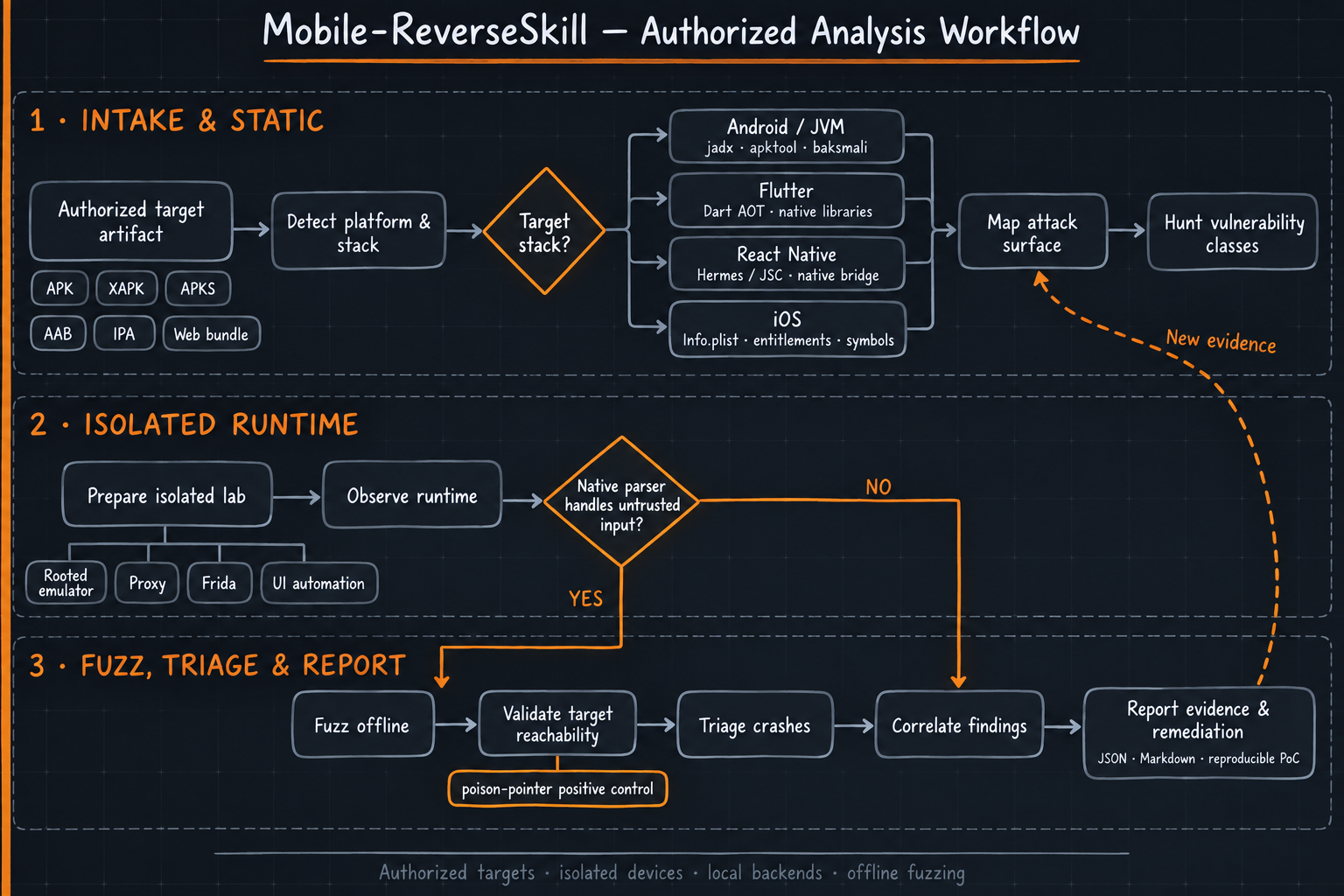
All dynamic testing stays on an isolated device or emulator, traffic is limited to an
authorized/local backend, and fuzzing targets local libraries rather than production services.
Component connections
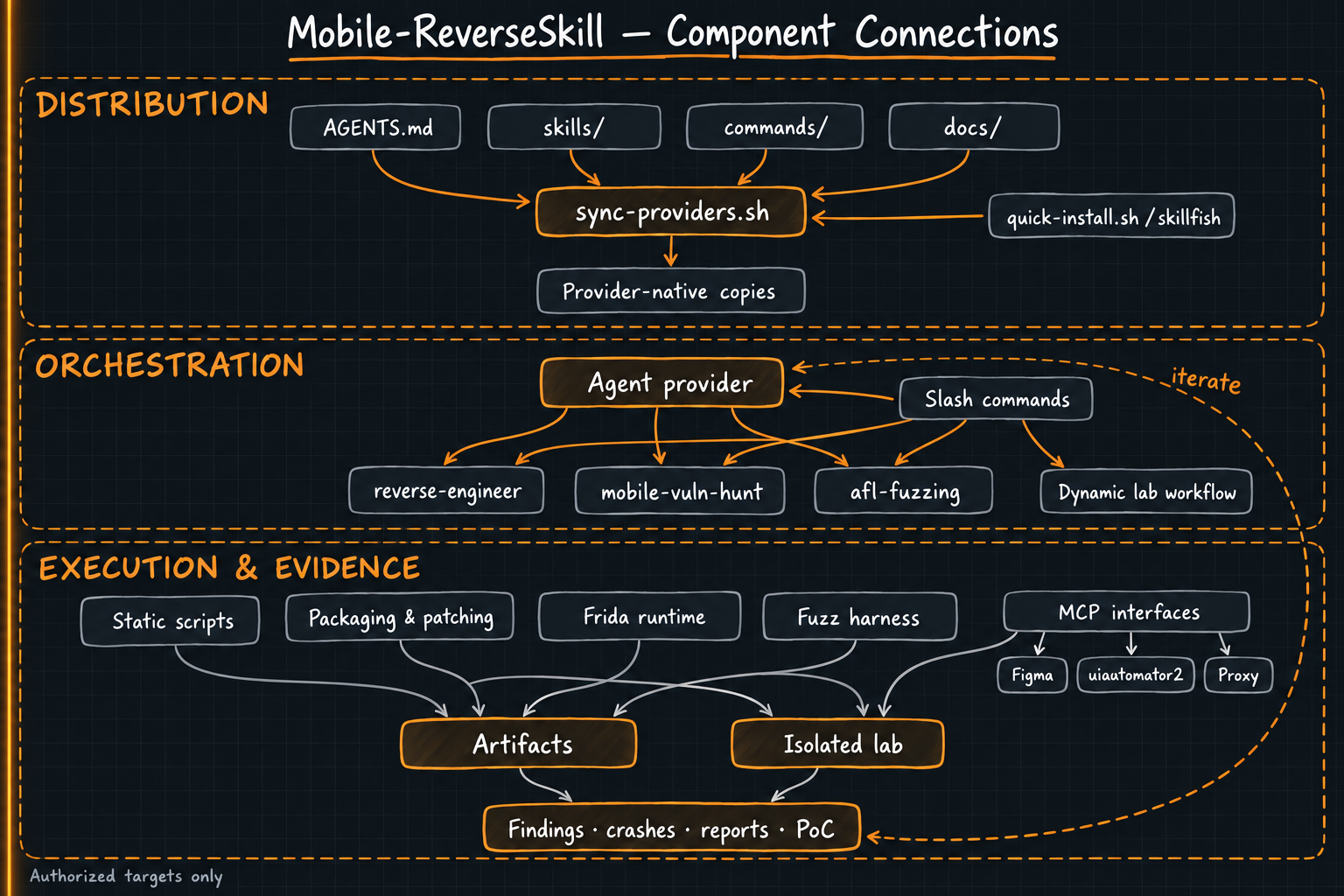
The canonical files define behavior once; provider copies only adapt that behavior to each
agent's native format. At runtime, the agent combines skills and commands with local scripts,
Frida helpers, and optional MCP interfaces, then feeds evidence back into the next analysis pass.
Provider support
Skills, slash commands, and the agent guide ship in each tool's native format —
generated from the canonical sources (skills/, commands/, AGENTS.md) byscripts/sync-providers.sh and committed, so a plaingit clone needs zero setup:
| Agent | Skills | Slash commands | Guide |
|---|---|---|---|
| Claude Code | .claude/skills/ |
.claude/commands/ |
CLAUDE.md → @AGENTS.md |
| opencode | .agents/skills/ |
.opencode/commands/ |
AGENTS.md |
| ZCode | .agents/skills/ |
.agents/commands/ |
AGENTS.md |
| Codex CLI | .codex/skills/ (also scans .agents/skills/) |
— custom slash prompts removed upstream; skills are model-invoked — type the command text (e.g. /re-static app.apk) and the skill fires |
AGENTS.md |
| Gemini CLI | .agents/skills/ |
.gemini/commands/ (TOML) |
GEMINI.md → @AGENTS.md |
| Cursor | .agents/skills/ |
.cursor/commands/ |
AGENTS.md |
| Copilot (VS Code) | .agents/skills/ |
.github/prompts/ |
AGENTS.md |
| Windsurf | .agents/skills/ |
.windsurf/workflows/ |
AGENTS.md |
| Amp · Crush | .agents/skills/ |
— (skills only) | AGENTS.md |
.agents/ is the cross-tool convention most agents already scan; Claude Code (and its.claude/ mirror) and Gemini's TOML commands are the exceptions handled by the sync.
Install
Quick install — skills + slash commands into every agent (one command, usable in
any project afterwards):
curl -fsSL https://raw.githubusercontent.com/alvinhayy/Mobile-ReverseSkill/main/scripts/quick-install.sh | bash
Or target specific providers only — pass names after -s -- (valid: all claude codex opencode zcode cursor gemini copilot windsurf):
# Codex only
curl -fsSL https://raw.githubusercontent.com/alvinhayy/Mobile-ReverseSkill/main/scripts/quick-install.sh | bash -s -- codex

# Codex + Claude Code
curl -fsSL https://raw.githubusercontent.com/alvinhayy/Mobile-ReverseSkill/main/scripts/quick-install.sh | bash -s -- codex claude
Equivalent without curl-piping (clone + install; the temp clone is removed
whether the install succeeds or fails — note the ; before rm):
git clone --depth 1 https://github.com/alvinhayy/Mobile-ReverseSkill /tmp/Mobile-ReverseSkill \
  && /tmp/Mobile-ReverseSkill/scripts/quick-install.sh; rm -rf /tmp/Mobile-ReverseSkill
Or keep the clone and install from it (reusable, nothing to clean up):
git clone https://github.com/alvinhayy/Mobile-ReverseSkill \
  && ./Mobile-ReverseSkill/scripts/quick-install.sh
What it installs user-globally:
| Type | Destinations |
|---|---|
| Skills | ~/.claude/skills/ · ~/.codex/skills/ · ~/.agents/skills/ |
| Slash commands | ~/.claude/commands/ · ~/.config/opencode/commands/ · ~/.agents/commands/ · ~/.gemini/commands/ (Codex has none — skills only) |
In-repo (every agent): clone and open the repo — skills, commands, and the guide
are already in each tool's native directories.
git clone https://github.com/alvinhayy/Mobile-ReverseSkill
User-global (same as the quick install, from an existing clone — optional provider names):
scripts/sync-providers.sh --user           # every provider
scripts/sync-providers.sh --user codex     # Codex only (skills + prompts)
Per-skill via skillfish (skills only):
npx skillfish add alvinhayy/Mobile-ReverseSkill afl-fuzzing
npx skillfish add alvinhayy/Mobile-ReverseSkill reverse-engineer
# or from a clone (reads skillfish.json): npx skillfish install
skills/+commands/are the sources of truth. Everything else is generated —
edit canonical files, runscripts/sync-providers.sh, and commit.--check
reports drift (CI-friendly).
Slash commands
Canonical source: commands/*.md (frontmatter description + argument-hint,$ARGUMENTS placeholder), synced into every provider's command dir — see the
matrix above. To use them outside this repo, install user-globally withscripts/sync-providers.sh --user.
| Command | Does |
|---|---|
/re-static <apk|ipa|bundle> |
Static analysis via the reverse-engineer skill (endpoints, secrets, deception) |
/vuln-hunt <apk|ipa|jadx_out> |
Vulnerability-class hunt via the mobile-vuln-hunt skill — rg signatures + optional semgrep taint, triage, per-class PoC |
/pull-apps <package|bundle-id> [output.ipa] |
Pull Android base APK + splits, or resolve an app on a USB iOS device and download its FairPlay-encrypted IPA with ios-ipa-extractor + ipatool |
/fuzz-build [lib.so] |
Build AFL++ for Android + harness, push to the emulator |
/fuzz-validate [lib.so] |
Prove the harness reaches the target (poison-pointer / under-alloc controls) |
/fuzz-run [seconds] |
Run the on-device campaign and triage crashes |
/fuzz-source <url|path> <entry-fn> |
Coverage-guided fuzz an open-source C/C++ lib on the host (AFL++/libFuzzer, source-instrumented) |
/frida-run <package> [script.js ...] |
Spawn the app with runtime/ bypass scripts attached |
/observe-runtime <package> [re-out] |
Autonomous runtime observation — reads static protections+flow, attaches the right bypasses, drives the app via uiautomator2-mcp, correlates behavior |
/scope-flow <package> |
Scope-constrained runtime analysis of ONE feature flow, driven by its Figma design (open-figma-mcp) |
| `/merge-apks <dir | xapk |
/patch-apk <apk> |
Static patch/rebuild/re-sign (decompile→smali→apktool b→apksigner), or depin via apk-mitm |
/root-avd [api] |
Rooted AVD (KernelSU on Apple Silicon, Magisk on x86_64) |
/spawn [avd-name] |
Boot a rooted KernelSU AVD — auto-picks the only one, else /spawn <name> |
/setup [burp|httptoolkit|all] |
Prep dynamic analysis — proxy CA in the trust store + frida-server + uiautomator2-mcp |
Interactive / long-running steps open in a new tab
Commands that need a live CLI (frida REPL, emulator boot, frida-server, a fuzz campaign)
launch it in a new terminal tab via scripts/run-in-tab.sh <label> "<command>" so you can
watch and interact — while the whole session is mirrored to ~/.mre-runs/<label>-<ts>.log, which
the agent tails to keep monitoring. Uses script -q (TTY preserved, so the frida REPL still
works). If macOS Automation isn't granted (first use prompts: System Settings → Privacy &
Security → Automation → allow your terminal to control iTerm), it falls back to a logged
background run — the process still runs and stays monitorable. Standalone:
scripts/run-in-tab.sh frida "frida -U -f com.example.targetapp -l runtime/flutter-tls.js"
tail -f ~/.mre-runs/frida-*.log
Tooling & multi-stack (staged)
Static-analysis + decompiler toolchain covering Android · Flutter · React Native · iOS
(+ cross disassemblers). Detect the framework, then run its pipeline — each tool writes to its
own <tool>_out/ folder (git-ignored: holds decompiled target code).
scripts/install-tools.sh --stack <android|flutter|rn|ios|cross> --check   # audit availability
scripts/detect-stack.sh   app.apk        # flutter|react-native|unity|xamarin|cordova|native

scripts/analyze-android.sh app.apk  out/app   # jadx, apktool, baksmali, dex2jar, dexdump, strings
scripts/analyze-flutter.sh app.xapk out/app   # r2flutter metadata + blutter pseudo-source
scripts/analyze-rn.sh      app.apk  out/app   # Hermes (hermes-dec/hbctool) or JSC (rn-decompiler)
scripts/analyze-ios.sh     app.ipa  out/app   # Info.plist, entitlements, otool/nm, class-dump, swift-demangle
Full matrix + per-stack notes: docs/TOOLING.md.
Repository layout
commands/               canonical slash commands (13) — source of truth
skills/
  afl-fuzzing/         SKILL.md + harness/ + scripts/ + README.md (full method writeup)
  mobile-vuln-hunt/    SKILL.md + semgrep/android-taint.yaml (rg + taint vuln-class scan)
  reverse-engineer/    SKILL.md + references/r2flutter.md
.claude/ · .opencode/ · .agents/ · .cursor/ · .github/ · .gemini/ · .windsurf/
                        per-provider skills/commands/prompt dirs — GENERATED by
                        scripts/sync-providers.sh (committed so a clone works everywhere)
AGENTS.md               canonical agent guide (imported by CLAUDE.md / GEMINI.md wrappers)
opencode.json           opencode integration (loaded docs + MCP)
scripts/                 detect-stack, analyze-{android,flutter,rn,ios}, attack-surface,
                         merge-apks, patch-apk, install-tools, run-in-tab, fuzz-source,
                         rebuild, sync-providers
runtime/               Frida templates — SSL/pinning (ssl-pinning-universal, flutter-tls*,
                       ios-bypass), root/JB/anti-debug (android-root-bypass, flutter-jb-root-bypass,
                       android-antidebug, emu-bypass), recon (rn-frida-hook, crypto-dump,
                       registernatives-dump) — set your own target package
docs/
  ROADMAP.md           backlog / gap-analysis status
  WORKFLOW.md          end-to-end workflow + OWASP MASTG checklist
  vuln-classes-android.md · vuln-classes-ios.md   58 vuln classes: root cause /
                       grep signature / PoC / fix (adapted from Niraj Kharel's series)
  research/mobile-pentesting/   full-text verbatim archive of the 65-post source series
                       (included with the author's permission for open-source use)
  TOOLING.md           per-stack toolchain matrix (+ iOS lab tooling)
  MCP-SETUP.md         device-automation MCP (uiautomator2) + Burp CA routes
  bypass-reference.md · frida-objection.md   root/JB/anti-debug/SSL + Frida/Objection/RMS
  react-native.md · flutter.md               RN & Flutter static + dynamic + TLS
  ios-reversing.md · ios-nojailbreak.md       iOS RE + non-jailbreak pipeline
  attack-surface.md · commercial-protectors.md   IPC/loot + Appdome-style bypass
Frida runtime helpers (runtime/)
Generic Frida templates for dynamic analysis. The target package is a placeholdercom.example.targetapp — replace it with the app you are authorized to test:
frida -U -f com.example.targetapp -l runtime/flutter-tls.js
Highlights: flutter-tls*.js (Flutter/BoringSSL TLS unpinning), emu-bypass.js
(emulator-detection bypass), approov-*.js (attestation/pinning probes),rasp-*.js (RASP neutralisation patterns), *-spoof.js (device identity spoofing).
Runtime device automation (MCP)
Dynamic analysis drives the app on a device — launch it, dump the UI tree, tap through flows,
and reach the screen that triggers the code under test (open the QR scanner, walk an auth flow
while a Frida script is attached). This uses uiautomator2-mcp
by @fdciabdul:
git clone https://github.com/fdciabdul/uiautomator2-mcp.git
cd uiautomator2-mcp && python3 -m venv .venv && source .venv/bin/activate && pip install -r requirements.txt
claude mcp add --transport stdio uiautomator2 -- $PWD/.venv/bin/python $PWD/server.py
Full setup + config for other MCP clients: docs/MCP-SETUP.md.
Rooting a test AVD
- macOS / Apple Silicon (arm64) → KernelSU via
alvinhayy/Mobile-Pentest-Setup:./create-avd.sh --name lab1 --api 36 --full - x86_64 → Magisk via
newbit/rootAVD:./rootAVD.sh system-images/android-<API>/<tag>/x86_64/ramdisk.img
See docs/WORKFLOW.md for the full toolchain and step-by-step flow.
⚠ Authorized use only
These skills are for authorized security research: apps you own, or engagements you are
contracted/permitted to run, or CTF/education. Keep the target's identity, real domains, and
raw findings in your private report — never commit them here. All fuzzing runs offline on a
local emulator/device; nothing targets third-party production infrastructure.
Credits & license
afl-fuzzingbuilds on AFL++ (AGPL-3.0) and the
Trail of Bitsaflppskill.reverse-engineer— original full-methodology skill maintained in this repo
(skills/reverse-engineer/).
Original content in this repository (harnesses, scripts, skill docs) is MIT — seeLICENSE. Bundled/referenced upstream tools keep their own licenses.
Reviews (0)
Sign in to leave a review.
Leave a reviewNo results found